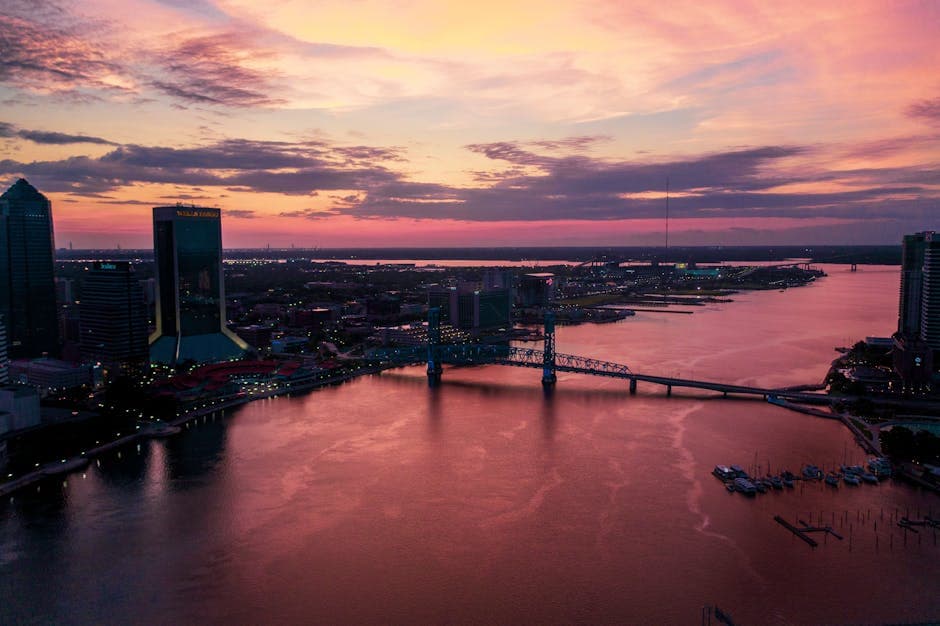
Jacksonville, FL / The St. Johns River City

Eight hundred seventy-five square miles
of city, ringed by a river.

Jacksonville is the largest US city by land area, roughly 875 square miles, bisected by the St. Johns River and bordered on the east by the Atlantic. The food economy here is not one market. It is a Riverside Avondale chef culture, a Beaches resort halo, a Mayport and NAS Jax military catering rhythm, a Mandarin and Southside residential base, and a single fall weekend (the Florida-Georgia game) that runs at four times normal volume. DirectOrders is built for that whole map, not for any one slice of it.

~875 sq mi
Largest US city by land area
US Census Bureau, geographic boundary file
~75K
Active duty plus civilian Navy footprint
Naval Station Mayport and NAS Jacksonville, Navy public affairs
~85K
Florida-Georgia game attendance
EverBank Stadium, neutral-site SEC rivalry, NCAA
~50K
Filipino American population, Jacksonville metro
US Census ACS, Asian alone or in combination

01 / Jacksonville section

Opening scene

Riverside Avondale, a Friday in late October

The chef on King Street wipes the pass at 5:42 on a Friday in late October. The bar already has two tops sitting, both with cocktails the bartender has been refining since August. The Avondale magnolia leaves on the sidewalk outside still have their summer green, but the light has shifted: the river light, in late October, is the gold that Jacksonville locals know means football season has begun and the city is about to fill.

The phone has rung four times this hour. Two of the calls were caterers from Mayport, asking about a Saturday wardroom dinner for forty-eight officers and their guests. One was an officer's spouse with a request for a vegetarian set menu inside a corporate retreat at the Ponte Vedra Lodge. One was an absent-minded regular who wanted to know if the corn pudding was still on the menu (it is, the chef tells her through the voice AI's transcription that prints on his pass like an old kitchen ticket). None of the four calls pulled the chef off the line.

A black SUV pulls into the small lot. Three women step out, all carrying small clutch purses, all walking with the practiced ease of people who flew in from the Northeast that afternoon for the Florida-Georgia weekend. The driver already has the order pulled up on his phone: she ordered ahead through the restaurant's own ordering page, a direct link from a friend in Atlanta who messaged her the recommendation two weeks ago, before they booked the trip. The total was a hundred forty-two dollars. The kitchen ticket printed at 5:31. The food is plated and warm at the pickup window at 5:43.

At a 25 to 30 percent marketplace commission, the same order on DoorDash or Uber Eats would have cost the chef roughly thirty-six to forty-three dollars in fees. The fish on the menu came from a Mayport boat that off-loaded at the dock that morning, and the dayboat snapper had a cost basis high enough that another forty dollars of marketplace commission would have flattened the margin to zero. On the direct ticket, the platform fee is nothing. The processing fee, around two and a half percent on cards, applies either way. The difference is the chef's entire night.

On the other end of King Street, three blocks south, another chef is loading insulated catering boxes into the back of a Sprinter. The order is for the Mayport CPOA Friday social: eighty plates of low-country shrimp and grits, three dozen Minorcan chowder cups, a tray of datil pepper hot sauce in eight-ounce squeeze bottles for the wardroom to take home. The Sprinter will be inside the base gate by 6:30. The chef placed the catering quote through the same admin he uses for retail ordering. The military buyer paid by purchase card. The W-9 was already on file from the wardroom's order three weeks ago.

That, in one Friday evening, is what an independent Jacksonville operator's direct ordering surface does. It catches the chef-driven Friday dinner from the out-of-town visitor. It catches the Mayport catering order from the wardroom CPOA. It catches the corporate retreat menu at Ponte Vedra. It catches the regular who just wants corn pudding. One menu, one admin, one customer file, four channels, zero marketplace commission. The rest of this page is about how that map fits together across 875 square miles of city.

02 / Jacksonville section

The Jacksonville geographic atlas

The largest US city by land area, bisected by the St. Johns, ringed by the Atlantic

ATLANTICIntracoastalI-95I-295 beltwaySt. Johns RiverConsolidated city, ~875 sq miDowntownRiverwalk + stadiumRiverside AvondaleChef-drivenMurray HillIndie blocksSpringfieldRevitalizationSan MarcoSouth BankMandarinRiverfront residentialSouthsideTown CenterWestsideNAS Jax adjacentAtlantic BeachNeptune BeachJacksonville BeachPonte Vedra BeachTPC SawgrassNS MAYPORTRiver mouthNAS JAXSouthwest bankNChef-driven indie blocksResidential dining corridorsNaval installations

Figure 1. Schematic atlas of Jacksonville and the First Coast. The St. Johns River bisects the consolidated city north to south, with downtown on the north bank. Locations are schematic, not surveyed. Sources: US Census Bureau geographic boundary files, Visit Jacksonville neighborhood guides, City of Jacksonville planning maps.

Jacksonville is the largest US city by land area: about 875 square miles, the consolidated city-county footprint that resulted from the 1968 city-county consolidation with Duval. New York City is roughly 302 square miles for comparison. The implication for an operator is blunt: there is no single neighborhood that is Jacksonville. There are at least eight, and they do not share a labor pool, a customer base, or a delivery zone.

Downtown sits on the north bank of the St. Johns River, with the Riverwalk, EverBank Stadium, and the Northbank office towers. Riverside Avondale, the chef-driven heart of the city, sits two miles west along the river, centered on King Street and Park Street. San Marco is the corresponding South Bank neighborhood, brick streets and lion statues and a tight cluster of indie kitchens.

South of downtown along Philips Highway, the Southside corridor runs through corporate office parks, the St. Johns Town Center retail anchor, and the Tinseltown entertainment district. Mandarin, further south along the river, is residential with a quietly strong independent dining scene. North and west, Murray Hill and Five Points anchor the historic post-1900 indie blocks; Springfield to the north sits at the edge of a long revitalization arc.

Eighteen miles east of downtown, the Beaches are their own city: Atlantic Beach, Neptune Beach, and Jacksonville Beach, each with a distinct character and a shared resort halo that runs heaviest from May through September. Ponte Vedra Beach sits to the south of Jacksonville Beach across the county line in St. Johns County, anchored by the PGA Tour headquarters and TPC Sawgrass.

Naval Station Mayport sits at the mouth of the St. Johns where it meets the Atlantic; Naval Air Station Jacksonville sits on the southwest bank of the river near the Buckman Bridge. Between them, the military catering economy. Wrapped around all of it, the river, the Intracoastal Waterway, and the Atlantic.

An operator who runs Jacksonville well runs at least three of these maps at once. Direct ordering, with delivery zones that respect the river and the Intracoastal, is the only stack that can do that.

03 / Jacksonville section

The Mayport and NAS Jax catering economy

Two major naval installations, roughly seventy-five thousand active duty plus civilian

On-base wardroom and CPOAGate-to-Sprinter deliveryAtlantic Beach + Mayport pickupRiverside, San Marco, Southside cateringNS MAYPORTand NAS JAX clusterWardroom dinner~$2,400, monthlyChange of command~$3,800, quarterlyRetirement ceremony~$1,200, monthlySquadron family event~$1,800, monthlyMWR Friday social~$650, weeklySpouse club brunch~$800, monthlyBY THE NUMBERS~75K active duty + civilianTwo installations, one halo

Figure 2. Schematic of the military catering envelope that ranges out from Naval Station Mayport and Naval Air Station Jacksonville. Order types are illustrative composites. Sources: Navy Region Southeast public affairs, Defense Commissary Agency, City of Jacksonville economic impact summaries.

Naval Station Mayport at the mouth of the St. Johns River, and Naval Air Station Jacksonville on the southwest bank, together carry roughly seventy-five thousand active duty plus civilian Navy personnel according to Navy Region Southeast public affairs, with dependents and contractors layered on top. Mayport is home to a carrier-capable basin and a fleet of destroyers and amphibious ships. NAS Jax flies P-8A Poseidons. Both bases keep a calendar of wardroom dinners, change-of-command receptions, retirement ceremonies, CPOA socials, and squadron events.

The base catering economy that runs alongside that calendar is large, repeating, and largely invisible to marketplaces. A Mayport CPOA Friday social does not get ordered on DoorDash; it gets ordered with a phone call to a chef in Atlantic Beach who has done the order twelve times before, who knows the gate procedure, and who has the wardroom's W-9 already on file. The invoice goes to a purchase card. The chef delivers in a Sprinter, drops at the back kitchen of the building, and is out before quarters.

This is the highest-margin lane in Jacksonville independent operations. Ticket sizes run four hundred to four thousand dollars. Repeat rates are quarterly or better. Cancellation rates are low because military events do not move. The chef who systematizes this lane with a real quoter, a real corporate account, a real W-9 management feature, and a real delivery scheduling block captures it forever.

We build the military catering motion as a first-class flow in the Jacksonville admin. PDF quote export with itemization and tax broken out. Net-30 terms toggle for approved accounts. Gate procedure notes attached to the delivery card so the courier knows which gate to use. Repeat-order one-tap from the customer side so the wardroom MWR coordinator does not rebuild the order every quarter. And a voice AI that speaks to the half-formal, half-casual Navy phone style without rejecting Filipino-accented or Puerto Rican-accented English, which would lose a real fraction of the inbound calls.

The base catering line is the most overlooked, most durable channel in the Jacksonville indie economy. We treat it like the load-bearing wall it is.

04 / Jacksonville section

The Riverside Avondale renaissance

Post-2015 chef-driven, the King Street and Park Street corridor

Riverside and Avondale, the twin historic neighborhoods on the western bank of the St. Johns River just south of downtown, carry the longest continuous chef-driven block in Jacksonville. The Florida Times-Union and Eater Miami regional coverage have profiled the post-2015 renaissance repeatedly: Black Sheep on King Street, Orsay on Park Street, The Bearded Pig BBQ on Hendricks, Hawkers Asian Street Food at Five Points, and a chef community that treats Riverside as the city's testing ground.

The economic shape of this corridor is different from the tourist food economy of the Beaches or the catering economy of Mayport. Riverside operators serve a primarily local, repeat customer base: doctors from Baptist Health, attorneys from the Northbank office towers, professors from JU and UNF, the residential neighborhood itself. A typical King Street operator does sixty to seventy percent of their revenue from dine-in, twenty to twenty- five percent from direct takeout and delivery, and the balance from catering and private events.

The digital problem in Riverside is signal, not scale. A chef who is fully booked Thursday through Saturday at dinner does not need a marketplace pushing volume; the kitchen cannot absorb it. What the chef needs is a tasting-menu booking page that captures a deposit, a wine-club SMS list that fills the slow Tuesday night, a loyalty program that rewards the Wednesday regular, and a private-event quoter for the Saturday rehearsal dinner that lands the room for a flat eighty-five hundred dollar deposit. None of that is a marketplace job.

The other operational subtlety in Riverside is small-batch menu changes. A chef who buys whole fish from the Mayport dock at the morning landing wants to put redfish on the menu at lunch service and snapper at dinner. A POS that requires twenty-four hours to update the menu is a POS that suppresses the chef's creative latitude. Our direct menu admin is built for mid-service edits, which is what Riverside actually needs to operate at its own pace.

Riverside Avondale is the dining neighborhood of Jacksonville the way Mills 50 is the dining neighborhood of Orlando. The direct ordering surface should fit the chef culture, not push against it.

05 / Jacksonville section

The St. Johns River seafood economy

Mayport shrimp, Minorcan chowder, datil pepper, the Northeast Florida pantry

The Mayport shrimp fishery has supplied Jacksonville kitchens since long before the Navy built the basin at the river mouth. The Florida Fish and Wildlife Conservation Commission and NOAA Fisheries publish landings data for the Northeast Florida shrimp fleet showing a continuous commercial harvest, mostly white shrimp in summer and pink shrimp in cooler months, off-loaded at Mayport docks and sold to wholesalers who supply Riverside chefs, Beaches operators, and the chef-driven San Marco kitchens.

Down the coast, St. Augustine's Minorcan community (descended from late-1700s settlers from the Balearic Islands) gave Florida the datil pepper, a small fruity chile that runs sixty thousand on the Scoville scale and that anchors hot-sauce culture from St. Johns County north through Jacksonville. The same Minorcan community gave the region Minorcan chowder, a tomato-based seafood stew spiked with datil heat that lives on Jacksonville menus from old-line seafood houses to new-wave Riverside spots that put it on the bar menu in cups.

The implication for direct ordering is two-fold. First, the menu cycles seasonally with the fishery: white shrimp spring through fall, scallops in winter, sheepshead in cooler months, redfish year-round, snapper and grouper on dayboat runs. A direct menu admin that can be updated mid-shift is the right tool for that rhythm. Second, the upsell economy is regional: a customer ordering shrimp and grits should be offered datil pepper hot sauce at checkout, the same way a Texas barbecue site offers jalapeno cheese sausage at the upsell prompt. Regional upsells convert.

We design the Jacksonville menu admin to support a dayboat-fish toggle (a tag that surfaces on the menu and in SMS the moment the chef enables it for the day) and a datil pepper upsell template (a pre-built modifier and upsell block tuned for the regional pantry). The chef does not have to rebuild these primitives. They ship configured for Northeast Florida and the chef adjusts the prices.

Real cuisine, real fishery, real margins. The Jacksonville seafood economy is the most underbuilt direct ordering surface in the city. The operators who set up a regional pantry admin win the season.

06 / Jacksonville section

The Florida-Georgia game playbook

A single late October or early November weekend, the largest hospitality surge of the Jacksonville year

NHC Atlantic hurricane season Jun 1 to Nov 30The PlayersFL vs GA0255075100JanFebMarAprMayJunJulAugSepOctNovDecIndex of monthly Jacksonville chef-driven traffic, Jan = 64

Figure 3. Schematic 12-month traffic shape for a Jacksonville chef-driven independent. The Florida-Georgia game weekend (late October or early November) sits at index 100 on a base of about 64 in January. The Players Championship week (mid-March) shows as the spring spike. Hurricane trough sits in September. Pattern is illustrative. Sources: EverBank Stadium attendance, NCAA neutral-site bowl data, PGA Tour attendance summaries, NOAA NHC.

The annual Florida-Georgia neutral-site game at EverBank Stadium (formerly TIAA Bank Field, formerly Jacksonville Municipal Stadium, formerly the Gator Bowl) is the single largest hospitality weekend in Jacksonville. The game runs in late October or early November, draws roughly eighty-five thousand attendees to the stadium per SEC published attendance data, and brings two full alumni economies (Florida and Georgia) into the city for three to four days.

The economic impact reports run by the City of Jacksonville and the Jacksonville Sports Council estimate direct visitor spending in the high tens of millions for the game weekend. Hotels run sold out from the Beaches to the Westside. Bars, restaurants, and catering operators run at three to four times normal volume. The corporate hospitality economy (tailgate packages, sponsor receptions, alumni dinners) lands squarely on the chef-driven blocks of Riverside and San Marco.

Operationally, this is a four-day surge with three failure modes. First, staffing: a kitchen that runs at 3x volume without staffing up flips into a brand problem in twenty-four hours. Second, supply: shrimp, pork, dayboat fish all need to be ordered eight days ahead. Third, channel mix: marketplaces flood the inbound order channel with high-fee tickets that hurt margin at the worst possible week. Direct ordering, a pre-built event menu, and SMS to the existing customer list are the three levers that win the weekend.

Our Florida-Georgia playbook ships three primitives. An event-mode menu toggle that opens a parallel hospitality menu with set prices, party trays, and delivery-window blocks. An SMS broadcast template pre-tuned for the weekend (Friday morning, Saturday morning, Sunday morning). And a corporate tailgate-package quoter that lets a sponsor book a three-hundred-person spread with a deposit and a delivery time without a phone call.

The chef who runs Florida-Georgia weekend well runs the whole fall well. The substrate is the same.

07 / Jacksonville section

The Players Championship at TPC Sawgrass

PGA Tour, second weekend of March, the Ponte Vedra corporate week

The Players Championship is the PGA Tour's flagship non-major, held annually at TPC Sawgrass in Ponte Vedra Beach, just south of Jacksonville Beach across the St. Johns County line. The Tour's own headquarters sit on the same campus. The tournament typically runs the second full week of March and draws a corporate hospitality economy that, in published PGA Tour and First Coast Tourism reports, ranks among the largest single-week economic events in the region.

The hospitality halo around Ponte Vedra extends north into Jacksonville Beach, Atlantic Beach, and Riverside Avondale, and south into St. Augustine. Corporate buyers booking client dinners, sponsor receptions, player-team welcome meals, and tournament-week catering hit the same Riverside and Beaches chef-driven blocks that run the Florida-Georgia hospitality economy four months earlier.

The operational shape is corporate, not consumer. The buyer is an executive assistant or hospitality coordinator for a Fortune 500 brand sponsoring a hole or hosting clients in a chalet. The order is a sit-down dinner for twenty-four, or a passed-canape reception for one hundred, or a breakfast spread delivered to the Sawgrass clubhouse at 7 a.m. The lead time is two to six weeks. The W-9 is required. The invoice has to break out tax and gratuity clearly because corporate finance teams audit it.

The same corporate catering primitives that win Mayport wardroom dinners and Florida-Georgia sponsor packages win The Players. The chef-driven operator who systematized military catering in November is the chef-driven operator ready to take Players orders in March. One admin, one quoter, one customer file, three different sponsor sets, one durable revenue line that runs eight months out of twelve.

08 / Jacksonville section

Hurricane operational continuity

Matthew 2016, Irma 2017, Ian 2022, Nicole 2022. The Atlantic season is the calendar.

Atlantic storms, recent record

2016
Hurricane Matthew
Brushed Northeast Florida coast, major surge at the Beaches
2017
Hurricane Irma
Statewide impact, multi-day power outages metro-wide
2022
Hurricane Ian
Cross-state, cascade outages and reopening lag
2022
Hurricane Nicole
Late-season Atlantic landfall, secondary disruption

Storm-week timeline

  1. T-72 to T-24h

    Stock up. Charge generators. Set storm mode draft.

  2. T-24 to T-0

    Pre-storm pickup surge. Limited-menu toggle. SMS to file.

  3. Landfall

    Closed. Voice AI announces in 3 languages. Public ordering off.

  4. T+24h

    Reopen draft live. Emergency catering page published.

  5. T+48 to T+96h

    Utility and insurance catering. Reopen SMS. Same-day payouts.

  6. T+5 days

    Out-of-town orders resume. Storm mode off. Normal cadence.

Jacksonville sits on the Atlantic coast of Florida, which means it gets the full Atlantic basin hurricane season per NOAA's National Hurricane Center, from June 1 through November 30, with the statistical peak around September 10. Unlike Tampa or Orlando, the east coast risk profile is direct ocean strike. Matthew brushed the coast in October 2016 with major surge. Irma crossed the state in September 2017 with multi-day metro outages. Ian and Nicole, both in 2022, hit the broader Florida coast with cascade effects.

The operational implications for a Jacksonville restaurant are direct. A typical Beaches operator will see a four to seven day window of disruption per major event: one pre-storm spike (the bread-and-water rush from neighbors), one or two storm-closure days for evacuation zones, and two to four reopening days with reduced staff. Inland Riverside and Mandarin operators see less direct surge risk but the same outage exposure. Inventory loss on perishables can run thousands of dollars per location if backup power is unavailable.

We build the storm playbook directly into the admin. The operator can toggle storm mode, which switches the public ordering surface into one of three states: limited menu, pickup only, or temporarily closed. The site shows a banner with the operator's own words, not a generic Closed message. The voice AI on the phone line repeats the banner in English, Spanish, and Tagalog. The customer database gets a one-tap SMS broadcast for reopening. Same-day payout keeps cash moving on the day the bank branch is shut.

We also build the reopening rhythm. Utility crews, insurance adjusters, and reconstruction teams flood the First Coast after a storm. They eat three meals a day and they pay corporate. The restaurant that has an emergency catering page live within forty-eight hours of landfall captures a meaningful share of that business. We seed that page as a draft the moment a tropical cyclone enters the seven-day cone.

Storm operations is not a feature we add on. In Jacksonville, it is the substrate.

09 / Jacksonville section

Why Spanish and Tagalog Voice AI matters in Jacksonville

A Navy-shaped Filipino community and a growing Puerto Rican base

The Filipino American community in the Jacksonville metro is among the largest in the Southeast, estimated at around fifty thousand residents per US Census American Community Survey tabulations of Asian alone or in combination ancestry. The community grew out of decades of Filipino enlistment and service in the US Navy, with families settling permanently in Jacksonville after retirement from Mayport, NAS Jax, and earlier stations. Generations later, the community runs Filipino bakeries, sari-sari stores, restaurants serving lumpia and adobo and pancit, and a Sunday church culture that anchors family ordering for after-service meals.

The Puerto Rican community in Jacksonville is smaller than the Orlando concentration but growing. Pew Research and the Center for Puerto Rican Studies have tracked a Northeast Florida settlement pattern that accelerated after Hurricane Maria in 2017, with secondary migration south from New York and New Jersey continuing through the early 2020s. The Westside, parts of the Southside, and pockets of Mandarin hold the densest cells.

For an independent operator, the implications are concrete. The phone calls that come in for catering on Friday afternoons toggle between English, Spanish, and Tagalog in the same conversation. The Filipino family ordering a Sunday lechon spread for thirty after morning mass calls in Tagalog-accented English; the Puerto Rican family ordering a Saturday party tray calls in Spanish-accented English. An English-only voice AI that rejects either accent loses the order. A multilingual voice AI that handles both captures it.

We design the Jacksonville voice AI motion with Tagalog as a first-class language alongside English and Spanish. Customer-facing menus support a one-tap Spanish toggle that runs the full menu, modifiers, upsell prompts, and post-purchase email flows in Spanish. The kitchen ticket prints in English because that is the line's shared language. The customer chooses their language. The operator sees both. Nothing is lost in translation; every order is captured.

10 / The thesis

How DirectOrders fits Jacksonville, river to base to beach

Argument 01

The Jacksonville operator's problem is not foot traffic. It is map size.

Eight hundred seventy-five square miles of consolidated city, with the St. Johns River bisecting the whole thing and the Intracoastal cutting off the Beaches. An operator in Riverside Avondale has a different customer base from a Mayport-adjacent operator in Atlantic Beach, who has a different customer base again from a Mandarin operator on the southern river bank. No single marketing channel reaches all three at once.

The direct ordering surface, with delivery zones drawn for the river and the Intracoastal, with SMS lists segmented by neighborhood, with Google Business profiles that win the relevant search inside each ring, is the only stack that respects the geography. Marketplaces collapse all of Jacksonville into one node. Direct ordering treats each neighborhood as its own market and wins them one at a time.

Argument 02

The Mayport and NAS Jax catering line is the load-bearing wall.

Seventy-five thousand active duty and civilian. A continuous calendar of wardroom dinners, change-of-command receptions, CPOA socials, retirement ceremonies, and squadron family events. Repeat rates that run quarterly or better. Ticket sizes that run four hundred to four thousand dollars. Cancellation rates near zero. No marketplace touches this lane.

The chef-driven operator who builds a real catering quoter, a real corporate account with W-9 on file, a real net-30 toggle, and a real voice AI that does not reject Filipino-accented or Puerto Rican-accented English captures the lane and keeps it. It is the most durable revenue line in the Jacksonville indie economy.

Argument 03

The Jacksonville product ships multilingual or it does not ship.

Around fifty thousand Filipino Americans in the metro, anchored by Navy service. A growing Puerto Rican community settled across the Westside and Southside. A Riverside chef-driven scene that already toggles between English, Spanish, and Tagalog on a normal Friday phone shift. Multilingual menus and multilingual voice AI are not nice-to-have. They are the floor.

Our Spanish toggle is built into the customer-facing menu; the Tagalog voice AI is built into the phone line. The kitchen ticket prints in English. The customer chooses their language. The receipts, the SMS confirmations, and the post-purchase email flows match the customer's choice. One product. No translation outsourcing.

Argument 04

The surge weekend playbook is the substrate, not a feature.

Florida-Georgia in late October. The Players Championship in mid-March. A Mayport ship homecoming three or four times a year. A NAS Jax squadron reunion. The Jacksonville Jaguars home schedule. The Beaches summer resort tide. The substrate that supports one surge supports all of them: event-mode menu toggle, SMS broadcast templates, corporate hospitality quoter, delivery-window blocks, same-day payout.

We design for the biggest weekend of the year and let the rest of the calendar inherit the structure. The same event-mode toggle that runs Florida-Georgia in November runs The Players in March, the Jaguars schedule from September through January, and a wardroom retirement ceremony in February. The substrate works in every weather.

Closing

You do not need to be on every corner. You need to be the right answer at the river crossing.

That is the entire Jacksonville playbook for an independent. Be the right Google result when the Florida-Georgia visitor searches Riverside chef-driven dinner. Be the right voice AI when the Mayport CPOA coordinator calls on Friday afternoon for an eighty-plate Friday social. Be the right multilingual menu when the Filipino family orders a Sunday lechon spread. Be the right emergency catering page when the utility crew rolls in after the storm. We built the stack to make those four moments easy.

References

Sources and citations

Every figure in the page above is sourced. Volumes are reported as ranges in published sources and we use the published ranges here. No invented statistics.

Last reviewed by the DirectOrders editorial team for the Jacksonville and First Coast market. The geographic atlas, the military catering halo, and the twelve-month traffic shape are schematic illustrations. Neighborhood and base positions are visualized for cluster pattern only and should not be taken as a surveyed map.

Keep exploring

More Florida cities and nearby markets

All Florida cities →