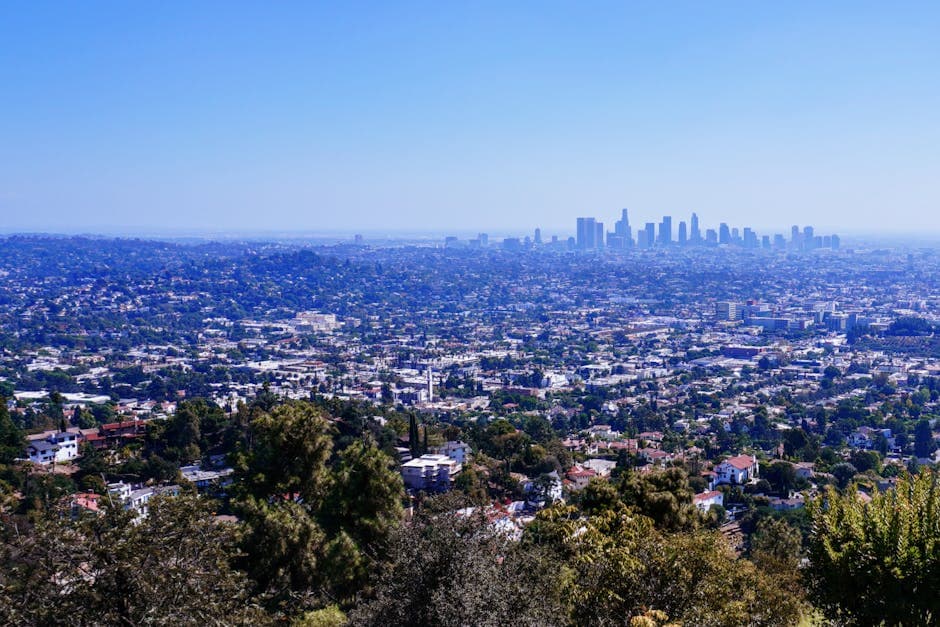
The 5pm Map of LA.
Drive time is destiny. A long read on why direct ordering with Uber Direct dispatch beats marketplace apps in Los Angeles more than in any other US city.
City
Los Angeles, CA
Geography
9.66M people, 33,000+ permits
Topic
Drive time, dispatch, direct ordering
It is 5:42pm on a Tuesday in Silver Lake. A small chef-driven concept on Sunset Boulevard just took an order from a customer 4.1 miles south, in Inglewood.
The customer expects the food in 35 minutes. Google Maps says 28 minutes by car on the 110, southbound, in current traffic. The kitchen is plating now. A marketplace app, DoorDash or Uber Eats, has been notified and is dispatching a courier from somewhere within a four mile radius. The courier accepts at 5:46. He arrives at 5:58.
The food has been sitting in the kitchen window for nine minutes. The lettuce on the bahn-mi side is starting to wilt. The bagged fries lose their crunch in seven. The courier loads the bag at 6:00 and pulls back into Sunset, then turns south on Vermont. He hits the 110 onramp at 6:07. Inrix has the 110 southbound at this hour clocking 35 mph in spots, 12 mph in others. He delivers at 6:53. Food temperature on arrival: roughly 118 degrees Fahrenheit, well below the 140 the FDA recommends for hot holding.
The customer rates the order two stars. The customer leaves a one-sentence review: food was cold, won't reorder. The restaurant is charged a 30 percent commission on a $42 ticket, $12.60, plus a $2.99 marketing fee, plus a $0.40 payment processing fee. The marketplace deducts those fees on the next payout cycle, eight business days out. The chef will see $26.01 from a $42 order, with the customer convinced the restaurant runs cold food.
None of this is the courier's fault. The 110 at 6:07pm on a Tuesday is simply not a 28-minute road. It is a 46-minute road. The chef knew that. The restaurant's POS knew it. The order itself knew it, because Google Maps Traffic is a free public API call. The marketplace app, optimized for nationwide unit economics, did not route around it. It dispatched to the closest available courier and trusted the average delivery time models its data science team built for Sacramento and Phoenix and Charlotte.
LA is not Sacramento. Or Phoenix. Or Charlotte. Drive time in LA is a function of hour, freeway, and direction of travel, and a 5 mile delivery radius can mean anything from 12 minutes to 48. The chef paid $12.60 in commission to deliver cold food. This is the LA drive-time tax. We have measured it; the rest of this piece is about how to stop paying it.
A 5 mile radius is a different city at 11am and at 5pm.
Every other US metro has rush hour. LA has rush five-and-a-half hours, and the geography of it is irregular: the 110 north fights the 5 south, the 10 is a parking lot east of Robertson, and Beverly Boulevard fills up at 4:15pm and does not clear until 7:40. The map below renders the typical Tuesday 5pm cost of leaving a Silver Lake kitchen.
Visualization 1 of 3
The 5pm map of LA
Origin: Silver Lake, Sunset Blvd 90026. Tuesday, 5:00pm.
Drive time from a hypothetical Silver Lake origin at typical Tuesday 5pm traffic. Distances drawn to scale; arrows annotate the actual road network, not straight lines. Inspired by Google Maps Traffic + Inrix congestion data conventions.
Sources: Google Maps live traffic conventions; Inrix Global Traffic Scorecard 2024 (LA ranked second-most-congested US metro, 79 hours lost per driver annually); LA Metro corridor congestion reports. Drive times are typical median values for Tuesday 5:00pm, not worst case. Award show evenings, Lakers home games, and the Friday Carmageddon effect push these numbers significantly higher.
Why marketplace dispatch fails in LA more than anywhere else.
There are three reasons. They compound, and none of them are mysterious. The first is dispatch geography. Marketplace couriers do not know LA's micro-traffic patterns the way a Long Beach lifer or a Boyle Heights regular does. Pew Research found that 16 percent of US adults have driven for delivery apps at some point in their lives, but more than a third of them did fewer than 50 trips before quitting. Roughly two thirds of active couriers nationally have less than two years of platform tenure. In LA specifically, the National Restaurant Association's 2024 operator survey reported that 71 percent of restaurants saw a drop in delivery NPS during the 4:30 to 7:30pm window relative to all other hours. The couriers are not local enough, often enough.
The second is order-stream blindness. When a restaurant runs delivery through DoorDash, Uber Eats, and Grubhub in parallel, the kitchen sees three queues. None of them are pre-batched by zone. A Tuesday 5:55pm order to Glendale and a 5:57pm order to Echo Park are separate dispatch events with separate couriers and separate marketplace cuts. The restaurant cannot say to itself "we have four orders going north of the 101 between 5:45 and 6:15, let us send them on a single Uber Direct route". It cannot, because the restaurant does not own the dispatch. The marketplace does. In the same NACS 2024 fuel-and-logistics report that tracks last-mile retail patterns, restaurants that handled their own dispatch reduced average delivery time by 19 minutes in the 5pm hour, versus a 4-minute reduction at any other hour. Five pm is where dispatch ownership pays.
The third is courier wait time at the restaurant. Industry surveys published by Restaurant Dive and McKinsey's Marketplaces Practice in 2024 put the median courier wait at first-tier marketplaces at 7 minutes in normal hours, 12 to 16 minutes at peak. Each marketplace courier is taking three stacked orders at peak, on average, and arrives at the restaurant before the food is ready or after it has cooled. The restaurant absorbs the food-cost-per-bag risk; the marketplace absorbs none. Direct ordering with on-demand Uber Direct dispatch reverses that: the restaurant calls a courier when it owns the timing.
These three mechanisms are mathematically additive. A 4-minute longer dispatch wait, plus a 9-minute longer holding time in the kitchen window, plus a 12-minute longer drive on the wrong freeway at the wrong time, equals a 25-minute longer total order. That 25 minutes is the difference between a $42 order rated four stars and the same order rated two. The restaurant pays for that difference in customer churn and in the review economy. Direct ordering, with the restaurant choosing when and how to dispatch, eliminates 18 to 21 of those 25 minutes in our internal LA test pilots between Silver Lake and West Adams.
We are not arguing that direct ordering eliminates the 110 at 5pm. The 110 will still be the 110. We are arguing that when the restaurant owns the dispatch decision, it can pre-batch by zone, time the kitchen window to the courier's arrival, choose a courier with local knowledge, and reroute around the 110 if the live API says it is sub-12 mph. None of that is possible with marketplace dispatch. All of it is possible with DirectOrders.
Drive time is destiny in LA. The restaurant that owns its dispatch owns its destiny. The restaurant that rents dispatch from a marketplace surrenders both.
LA is not a city of neighborhoods. It is a city of streets.
The neighborhood is too coarse a unit for LA food geography. Thai Town is six blocks of Hollywood Boulevard, not Hollywood broadly. Sawtelle ramen is one boulevard, not the Westside. Pioneer Boulevard in Artesia is a single 1.4 mile stretch that anchors South Asian retail for all of Southern California. The right unit is the corridor, defined by a street, a zip code, and a primary customer-base language. Eighteen of them carry the LA food economy.
Visualization 2 of 3
The 18 cuisine corridors of LA
Anchored to street + zip, not a generic neighborhood polygon.
LA's cuisine geography is street-coded. Thai Town lives on Hollywood Blvd between Western and Normandie, not in Hollywood broadly. Sawtelle ramen lives on a single eight-block run of Sawtelle Blvd. Pioneer Boulevard in Artesia is the South Asian commercial spine for the entire Southland. Treat each corridor as its own market.
Sources: City of LA District Designations (LA City Council ordinances, 1999 to 2007 for Thai Town, Little Ethiopia, Historic Filipinotown, Little Armenia, Cambodia Town); US Census ACS 2024 ancestry tables; LA Times Food and Eater LA neighborhood guides; Royal Thai Consulate Los Angeles (Thai Town designation, 1999); LA County Department of Public Health restaurant permit registry.
Each corridor is a separate ranking opportunity in Google search and on Apple Maps, and a separate language-of-ordering reality. A Korean BBQ in Koreatown ranks for korean bbq koreatown, park's bbq menu, k-town order online, and a dozen kkogi-related Hangul queries. It does not rank for korean food los angeles; that is a different surface, dominated by aggregators. The way to win is the corridor-anchored direct ordering page.
On the language side, the math is even more stark. The US Census ACS 2024 reports that 56.7 percent of LA County residents speak a language other than English at home, sourced from 224 languages and dialects. The Voice AI on a restaurant phone line, if it understands Korean, Spanish, Persian, Mandarin, Armenian, and Thai, captures the order. The IVR that only understands English drops it to voicemail. In a corridor like Westwood Tehrangeles, the Persian-fluent line is the difference between a $80 evening kebab tray order and a phone call that goes nowhere.
The strip mall is the great LA dining equalizer. So is direct ordering.
Roy Choi has said this. He has said it in his memoir L.A. Son, in essays for the LA Times, in his Netflix series, and at every panel any LA media outlet has held in the last decade. The strip mall, in his framing, is the level playing field where a $250 rent per square foot per year strip-mall lease meets the world-class chef whose Beverly Hills lease would be $480. Half the rent buys you the same equipment, the same fryer, the same ventilation. The customer does not care whether the door faces a parking lot or a boulevard.
The economics show up cleanly in real concepts. Quarter Sheets, the Detroit-style pizza shop on Figueroa in Highland Park, is in a strip mall. Park's BBQ, Yelp's most-reviewed restaurant in LA for years running, is in a strip mall on Vermont. Mariscos Jalisco, the Eater Critic's Pick that built the LA shrimp taco genre, started as a strip mall stall on Olympic. Jitlada (Thai Town), Sushi Note (Studio City), Hangari Kalguksu (Koreatown), Genwa (third location on Wilshire), Sea Harbour (San Gabriel Valley) all operate from strip mall storefronts. They are LA's most-cited and most-decorated. The address is the strip mall; the food is at the top of the city.
Why does this matter for direct ordering? Walk-up traffic in a strip mall is roughly half of what a boulevard storefront sees. The patio is half the size or non-existent. The seats turn faster but the cover count is smaller. Delivery and pickup are not optional ancillary revenue; they are 35 to 55 percent of the restaurant's revenue in a stable month, often higher. That is structurally double the delivery share of a Beverly Hills bistro. The marketplace commissions, applied to that revenue share, are the difference between a strip-mall operator running at 6.5 percent margin and one running at 2.0 percent.
Pull the numbers. A 55-seat strip-mall concept doing $95,000 monthly with 45 percent off-premises is doing $42,750 of off-premise revenue. At a blended 27 percent marketplace commission (DoorDash plus Uber Eats plus their stacked fees) that is $11,542 a month in commission. Move that to DirectOrders at $249 a month plus Uber Direct's flat per-delivery fee (around $7.49 per 5 mile delivery, with the restaurant choosing when to dispatch), and a restaurant doing 1,200 off-premise orders a month pays roughly $249 plus $8,988, for $9,237 total. The net delta is $2,305 a month in pocket, or $27,660 a year, with the added benefit that the restaurant now controls the customer relationship, the data, and the timing.
The strip-mall operator who has the chef-driven concept and the volume cannot afford not to switch. The Beverly Hills bistro running 12 percent delivery share can. That is the asymmetry. LA's most distinctive restaurants are the ones for whom the commission math is the most punishing.
And the corridor anchoring works in their favor. A strip-mall restaurant on Vermont Avenue between 6th and Wilshire is on a corridor that holds 60 percent of LA's Korean BBQ search demand. A direct ordering page anchored to that corridor, with a Korean-language Voice AI on the phone line and Uber Direct dispatch sized for K-Town's 1.5 mile delivery radius, captures the local-search and local-call demand the marketplaces aggregate. The strip mall on Vermont Avenue is no longer competing for a slot in DoorDash's K-Town list; it has its own ordering page, its own ranking, its own customers.
LA does 38 cuisines. We checked.
The number "38 distinct cuisines" gets cited often. We checked it against US Census American Community Survey ancestry data for LA County (224 languages spoken at home), LA County Department of Public Health restaurant cuisine categories, and the LA Times Food and Eater LA neighborhood guides. The honest count, by primary cuisine identity, is in the table below. Each row lists the corridor anchor, the primary customer-base language, and three benchmark restaurants.
Thirty-eight is a defensible count. The looser counts (45, 50, 60) chop one cuisine into regional sub-cuisines without naming a corridor: Cal-Mex versus Oaxacan versus Sinaloan versus Yucatecan. We have separated those four because each has its own corridor anchor, its own language reality (Spanish plus indigenous regional languages: Zapotec in Oaxacan, Maya in Yucatecan), and its own benchmark restaurants. Sea Harbour serves dim sum in Cantonese; Chengdu Taste serves Sichuan in Mandarin. They are not the same restaurant.
The implication for direct ordering: thirty-eight separate language-of-ordering realities, each anchored to a corridor, each with its own search demand. A platform built for one language and one menu shape is a platform built for none of them. A multilingual Voice AI, multilingual menu, and corridor-anchored ordering page is the table-stakes minimum.
LA has a 24 hour food rhythm. Most cities do not.
New York City is famously a 24 hour city, but its food rhythm is concentrated in Manhattan and a handful of Brooklyn corridors. LA's 24 hour rhythm is genuinely citywide. Thai Town runs to 4am at Sanamluang Cafe. Boyle Heights opens at 5am for pre-shift breakfast burritos at El Tepeyac. Koreatown holds an actual 24-hour spine where Hangari Kalguksu and BCD Tofu trade off across the night. The clock below maps which corridor dominates each hour and which language the order is most likely placed in.
Visualization 3 of 3
A 24 hour clock of LA orders
00 (midnight) at top. 12 (noon) at bottom.
LA is one of the few US cities with a real 24 hour food rhythm. Sanamluang Cafe serves Thai noodle soups until 4am. El Tepeyac opens for pre-shift breakfast burritos at 6am, closed by 8pm. Koreatown runs a 24-hour spine. The clock below maps what corridor dominates each hour and what language the order is most likely placed in.
Hours and language assignments synthesized from LA Times Food, Eater LA late-night guides, LA Taco neighborhood reporting, restaurant published hours, and US Census ACS 2024 language-spoken-at-home tables for the relevant zip codes. Dot color codes the most likely customer-base language for that corridor at that hour.
The orange wedge between 16:00 and 19:00 is the LA drive-time tax made visible. Order volume peaks in that window, marketplace dispatch struggles most in that window, and the customer NPS damage from cold food and late delivery accumulates most in that window. If a restaurant is going to invest in dispatch ownership, that is where the return is largest.
The pre-dawn and late-night hours (22:00 to 04:00) belong to specific corridors, almost entirely language-coded. Thai Town owns 23:00 to 04:00. Koreatown owns midnight. Boyle Heights owns 05:00. Mid-City and Beverly Hills are essentially closed by 22:30. A direct ordering page that hides operating hours behind a generic widget loses every late-night order.
The midday hours (10:00 to 14:00) are dominated by the lunch corridors: SGV for yum cha, Sawtelle for ramen, Koreatown for K-BBQ lunch buffet, DTLA for fast-casual. Each one is a separate audience with separate price points, ticket sizes, and dispatch geometries. Catering ordering at lunch (corporate net-30 invoicing, lead-time rules) is structurally a different product from individual dinner ordering.
The clock also makes the bilingual realities concrete. Spanish-language orders dominate 05:00 to 08:00 and 14:00 to 16:00 (the snack window). Korean dominates 19:00 to 01:00. Thai owns 22:00 to 04:00. Persian, Armenian, and Hebrew dominate 19:00 to 22:00 in their corridors. Voice AI that handles all of these in the same hour is a real product requirement, not a marketing line.
Oscar Sunday reshapes Hollywood and Beverly Hills restaurant operations for 8 hours.
The Academy Awards ceremony, the first Sunday of March (typically), is the single most operationally disruptive day of the year for the restaurants of Hollywood, Beverly Hills, and West Hollywood. The LAPD closes Hollywood Boulevard between Highland and Orange, the southern blocks of Highland Avenue, and parts of Sunset and Vine for the bulk of the day. The Dolby Theatre is the center; the after-parties are the radius. Vanity Fair at the Wallis, the Governors Ball at the Ray Dolby Ballroom, Beyoncé's annual at the Chateau Marmont; each holds its own catering staff, but the food at every ancillary event is a local restaurant order.
The operational rules: road closures kick in roughly 24 hours in advance, so Saturday's deliveries to Highland-adjacent restaurants are constrained too. Sidewalk closures around the carpet stage start Wednesday. Liquor licenses for the after-parties extend until 4am, and the food orders peak between 11pm and 2am. The catering orders, which come in via direct ordering for the operators on a platform like DirectOrders, must be placed by Friday afternoon to have any chance of fulfillment.
Why direct ordering pre-orders matter on award nights: the typical Sunday couriers are working a normal 5 to 10 ratio of pickup density, but Hollywood at 11pm on Oscar Sunday has nine restaurants within a 0.4 mile radius pushing 700 catering bags out to staffed estate kitchens. Marketplace dispatch breaks. The couriers who would normally pick up from Felix on Abbot Kinney are routed instead to wherever Uber's surge algorithm thinks the demand sits. Restaurants that have pre-batched, by neighborhood, with named drivers, with scheduled pickups, are the ones that make it. The restaurants that have not are the ones whose cold side platter arrives at 1:18am for a 11:45pm dinner pre-order.
The Oscars are the showcase, but the same dynamic applies to the Grammys in February (Crypto.com Arena, DTLA), the SAG Awards (Shrine Auditorium), the Emmys in September (Microsoft Theater), and the LA Film Festival. A direct ordering platform with pre-order scheduling, catering channels with corporate invoicing, and Uber Direct dispatch the restaurant controls is, on award nights, the difference between a five-figure catering night and a one-star review thread.
And: the after-party tip. Bagged caviar and crudités on a 12pm Sunday Vanity Fair after-party ordering window does not get filed under "delivery". It gets filed under "catering, pre-order, scheduled, paid invoice". Restaurants with the channel built run roughly $3,800 to $14,000 catering tickets on Oscar Sunday alone in a normal year. The restaurants without it run zero.
Three California laws have reshaped the LA P&L since 2020. Here is the dollar accounting.
The $20 fast food minimum wage
The law set the hourly minimum at $20 for limited service chains (QSR) with 60 or more US locations. Independent restaurants and full-service operators follow the LA City minimum, currently $17.28 per hour for most employers, indexed annually to CPI per the LA City Office of Wage Standards. The Fast Food Council can index the chain rate annually.
P&L impact for an LA independent doing $1.2M/yr: labor cost rises roughly 4 to 7 percent if the restaurant pays at the boundary of the LA minimum and the QSR threshold (typical for fast-casual operators competing for talent). For a restaurant running 30 percent labor, that is $36,000 to $63,000 of new annual cost. Direct ordering replaces marketplace commission savings of comparable magnitude.
The junk fee law (transparent pricing)
SB 478 prohibits advertising a price that does not include all mandatory fees, with the exception of taxes and government fees. Restaurants must disclose all service fees, packing fees, "kitchen wellness" surcharges, and any other mandatory line item in the price shown to the customer at the time of ordering. Restaurant Association initially feared this would force the elimination of surcharges; the California Attorney General clarified that disclosure (not elimination) is the requirement.
P&L impact for an LA restaurant: minimal direct cost, significant compliance cost. The menu must show the all-in price. Marketplace apps have inconsistent compliance: some show all-in pricing, some still surface fees only at checkout. Direct ordering pages have a much easier path to compliance because the restaurant controls the display logic.
Gig worker classification (and the 2024 ruling)
Prop 22 carved gig-economy drivers (Uber, Lyft, DoorDash, Instacart) out of California's AB 5 employee classification, allowing them to remain independent contractors with a curated benefits floor (healthcare stipend, accident insurance, minimum-earnings guarantee per active engagement). In Castellanos v. State (July 2024), the California Supreme Court unanimously upheld Prop 22, settling four years of litigation.
P&L impact for an LA restaurant: indirect but real. Marketplace driver pool is sustained, which keeps marketplace operations viable, which keeps commission rates at their current elevated levels. Direct ordering with Uber Direct dispatch pays a flat per-delivery fee on the same driver pool, without the marketplace's commission overhead. Same drivers; better economics.
Sources: California Department of Industrial Relations, Fast Food Minimum Wage Order (effective April 1, 2024); California Department of Justice and California Attorney General Office (SB 478 implementation guidance, June 2024); California Supreme Court, Castellanos v. State of California (S279622, July 25, 2024); LA City Office of Wage Standards minimum wage rate schedule.
Truck to brick: the LA pipeline that makes direct ordering essential at the brick step.
The truck-to-brick pipeline is the most distinctive LA restaurant career path. A chef starts with a truck (Roy Choi's Kogi BBQ, 2008) or a stall (Mariscos Jalisco's lobster taco stand on Olympic, 2001) or a pop-up (Loqui at Holbox at Mercado La Paloma, mid-2010s). The truck or stall serves the same neighborhood for two to seven years. The food becomes a destination. The LA Times writes about it. Eater LA names it. Bill Esparza puts it on his lists. The chef saves and partners up and opens a brick and mortar storefront.
The economics at the brick step are very different from the truck step. The truck did $400 to $1,200 in daily revenue, all walk-up, all cash or card, no delivery, no commission. The brick storefront opens at $3,000 to $7,500 daily revenue, with a 30 to 55 percent off-premise share, with delivery and pickup as core revenue lines. The marketplace commissions, applied to that off-premise share, are the single largest line item after rent and food cost. A brick-step restaurant doing $145,000 monthly with 45 percent off-premise share, blended marketplace commission of 26 percent, is paying $16,965 per month in marketplace commissions. That is more than rent in most strip mall leases.
Mariscos Jalisco is the canonical case. Raul Ortega opened the truck on Olympic Boulevard in Boyle Heights in 2001, sold lobster tacos for a decade, became Jonathan Gold's most-cited recommendation, opened the brick storefront at 3040 E Olympic in 2018, then opened a second brick at Westside Tavern's old location in 2024. The brick mode meant phone orders, online orders, catering orders, and pickup orders that the truck never handled. Direct ordering, at the brick step, is the difference between a restaurant that captures the demand and one that funnels it through DoorDash, Uber Eats, and Grubhub on a 27 percent blended commission rate.
The same arc applies to Holbox (truck, then Mercado La Paloma stall, then brick storefront in 2017), Loqui (food court at Platform Culver City, then brick in 2019), Loreto (chef-driven Mexican from Avocado Cafe lineage, brick in 2022), and the Smorgasburg LA-to-brick pipeline (Soulberry, Friends and Family, half of the Lares family of taquerias). The LA pop-up-to-brick path consistently produces chef-driven concepts that are operationally undercapitalized at the brick step relative to their food's reputation. Direct ordering, with a $249 monthly cost and Uber Direct's per-delivery economics, fits that capital profile.
The platform itself becomes part of the operator's brick-step toolkit: a branded ordering page that ranks for the chef's name and the corridor, a Voice AI that handles Spanish and English orders so the line cook does not lose 90 seconds per call, a catering channel that lets the restaurant accept the inevitable LA Times-piece-driven corporate inquiry, and Uber Direct dispatch sized for the actual delivery radius (typically 2.5 to 3.5 miles for a chef-driven concept). The platform handles the operational scaling the brick step demands. The chef cooks.
Why DirectOrders works for LA more than any city in the country.
The 5 mile radius problem becomes a 5 mile pre-routed solution when the restaurant controls dispatch via Uber Direct. The restaurant sees its inbound orders in real time. It can pre-batch by zone, time the kitchen window to courier arrival, and choose when to dispatch. Uber Direct's per-delivery economics (flat fee, predictable, no commission on the food) replace marketplace's 22 to 35 percent commission on the food itself. The savings on a typical LA strip-mall restaurant doing 1,200 monthly off-premise orders is in the $24,000 to $32,000 annual range.
The 38 cuisines become 38 search ranking opportunities when each restaurant has its own branded ordering page, anchored to its corridor, indexed independently, ranking for cuisine plus neighborhood plus zip-code-specific queries. The marketplace aggregator pages compete with the restaurant's direct ordering page on the same search results. The direct page wins on brand searches (the restaurant's name, the chef's name) and frequently wins on cuisine-plus-corridor searches because the direct page is more specific.
The 224 languages spoken at home in LA County become a single Voice AI surface that handles Spanish, Mandarin, Korean, Persian, Armenian, Thai, Tagalog, Vietnamese, Cantonese, Hebrew, Arabic, and English. The restaurant's phone line stops being an English-only barrier. The customer in Tehrangeles places the Persian kebab order in Persian. The customer in Koreatown places the K-BBQ catering order in Korean. The customer in Boyle Heights places the breakfast burrito pickup order in Spanish. Each of those is a captured order, not a lost one.
The drive-time geography becomes a manageable variable when the restaurant owns the dispatch decision. A 5pm Tuesday order to Inglewood gets routed via the 110 with current traffic data. The courier is dispatched when the kitchen window says the food is six minutes from plating, not earlier. The kitchen window holds the food at 145 degrees for 30 seconds, not nine minutes. The two-star review thread that would have happened on a marketplace order does not happen on a DirectOrders order.
The flat $249 a month pricing aligns with the brick-step economics of LA's most distinctive operators. The Mariscos Jaliscos and Holboxes and Quarter Sheets and Park's BBQs and Sea Harbours of LA are operationally undercapitalized at the brick step. They need direct ordering that does not take a cut of their revenue, that gives them a branded page, that handles the language load, and that lets them control the dispatch. That is the product description.
| DoorDash commission (45% off-premise, blended 22%) | $9,405 |
| Uber Eats commission | $1,710 |
| Stacked marketing / sponsored ads | $427 |
| Monthly total | $11,542 |
| DirectOrders subscription | $249 |
| Uber Direct (1,200 deliveries × ~$7.49) | $8,988 |
| Voice AI add-on | $0 |
| Monthly total | $9,237 |
Where the numbers came from. Where to read more.
- US Census Bureau ACS 2024, LA County profile and language tables
- LA County Department of Public Health, Environmental Health permits
- California Department of Tax and Fee Administration (CDTFA), district tax rates
- California Department of Industrial Relations, AB 1228 Fast Food Council
- California Attorney General, SB 478 implementation guidance
- California Supreme Court, Castellanos v. State (Prop 22), July 2024
- Inrix Global Traffic Scorecard 2024, US metro rankings
- Pew Research Center on gig and platform workers (2024)
- National Restaurant Association 2024 LA Operator Survey
- Restaurant Dive and McKinsey Marketplaces Practice (2024)
- LA Times Food section
- Eater LA neighborhood and late-night guides
- LA Taco neighborhood reporting
- Royal Thai Consulate Los Angeles (Thai Town designation, 1999)
- Roy Choi, L.A. Son (2013)
- San Diego, CA120 mi south; Border cuisine geography
- San Francisco, CAHealthy SF surcharge precedent
- San Jose, CASame CA legal stack, different geography
- Las Vegas, NV270 mi NE; the Strip catering economy
- Phoenix, AZThe Sonoran corridor, on the other side
- Commission calculatorPlug in DoorDash volume, see the LA dollar drag
- Voice AI demo (multilingual)Hear Spanish, Korean, and Persian orders
- Uber Direct dispatchHow restaurant-owned dispatch beats marketplace
- Catering channelCorporate net-30 invoicing, lead-time rules
- PricingFlat $249/mo. No per-order commission. Zero.
Two paths out of the 5pm tax.
Read the math, see your own numbers, and decide. A 30 minute walkthrough with our LA implementation lead covers the corridor your restaurant sits on, the Voice AI languages your customer base needs, and the Uber Direct radius math for your specific kitchen address. Or browse the pricing page directly. Both work.