Social Media Marketing for Restaurants: A No-BS Guide
A practical guide to social media marketing for restaurants. Which platforms matter, what content works, and how to convert followers into direct orders.
Updated Jul 11, 2026
4.8% engage
3.2% engage
TikTok
6.1% engage
0
Total Monthly Engagement
+127% vs. last quarter
TLDR
Instagram is the most important social platform for restaurants, with 70% of diners saying they have discovered a new restaurant there. TikTok is the top discovery engine for Gen Z, offering organic reach no other platform can match. The key shift is treating social media as a sales channel, not a bulletin board, by linking every post to your direct ordering page and tracking cost per order instead of just impressions.
Stop Posting and Start Selling
Most restaurant social media accounts are a graveyard of food photos that nobody interacts with. The owner or a manager posts a picture of today's special, gets 15 likes, and wonders why social media "does not work" for them.
Social media works. The problem is most restaurants treat it as a bulletin board instead of a sales channel. This guide covers what actually matters: which platforms deserve your time, what content drives orders, and how to turn followers into paying customers who order directly from you.
Which Platforms Actually Matter
You do not need to be everywhere. You need to be effective somewhere. Here is how the major platforms stack up for restaurants in 2026.
Instagram: Your Primary Platform
Instagram is the single most important social platform for restaurants. Period. Food is inherently visual, and Instagram is where people go to discover new places to eat.
Why it matters: 70% of diners say they have discovered a new restaurant on Instagram. The platform's Reels, Stories, and Shopping features give you multiple ways to reach people and drive orders. Instagram also integrates with ordering platforms, letting you add an "Order Food" button directly on your profile.
What works: High-quality food photos, 15-30 second Reels showing food preparation, Stories with polls and questions, customer reposts, and behind-the-scenes content.
Time investment: 30-45 minutes per day for content creation and engagement.
TikTok: Your Discovery Engine
TikTok's algorithm is the great equalizer. A restaurant with 200 followers can get 500,000 views on a single video if the content is good. No other platform offers that kind of organic reach.
Why it matters: TikTok is the top search engine for Gen Z when discovering restaurants and food. "Best restaurants in [city]" and "food I need to try" are massive content categories. The platform drives discovery at a scale Instagram cannot match.
What works: Quick behind-the-scenes clips, satisfying food preparation videos, "day in the life" content, responding to comments with video, and trending audio overlaid on your food content.
Time investment: 20-30 minutes per day. TikTok content can be raw -it does not need the polish of Instagram.
Facebook: Your Community Hub
Facebook is not dead for restaurants. It is where your local community lives, especially if your customers are 35+. Facebook Groups, Events, and Marketplace are underutilized tools for local restaurants.
Why it matters: Facebook still has the largest user base for adults 30-65. Local Facebook groups ("Best Restaurants in [City]," "[Neighborhood] Foodies") drive real foot traffic and orders. Facebook Events are still the best tool for promoting in-restaurant happenings.
What works: Event promotion, community engagement, customer reviews, local group participation, and targeted local ads.
Time investment: 15-20 minutes per day.
Twitter/X: Low Priority
Unless you have a strong brand voice that lends itself to short-form commentary, Twitter is not worth the time investment for most restaurants. The platform does not drive food discovery the way Instagram and TikTok do.
Skip it unless: You are in a major metro area, your brand voice is witty or provocative, and you can commit to daily engagement. Even then, it is your fourth priority.
Content Types That Drive Orders
Not all content is equal. Some posts get likes. Some posts get orders. Here is what falls into each category and why you should prioritize the latter.
Food Photography That Sells
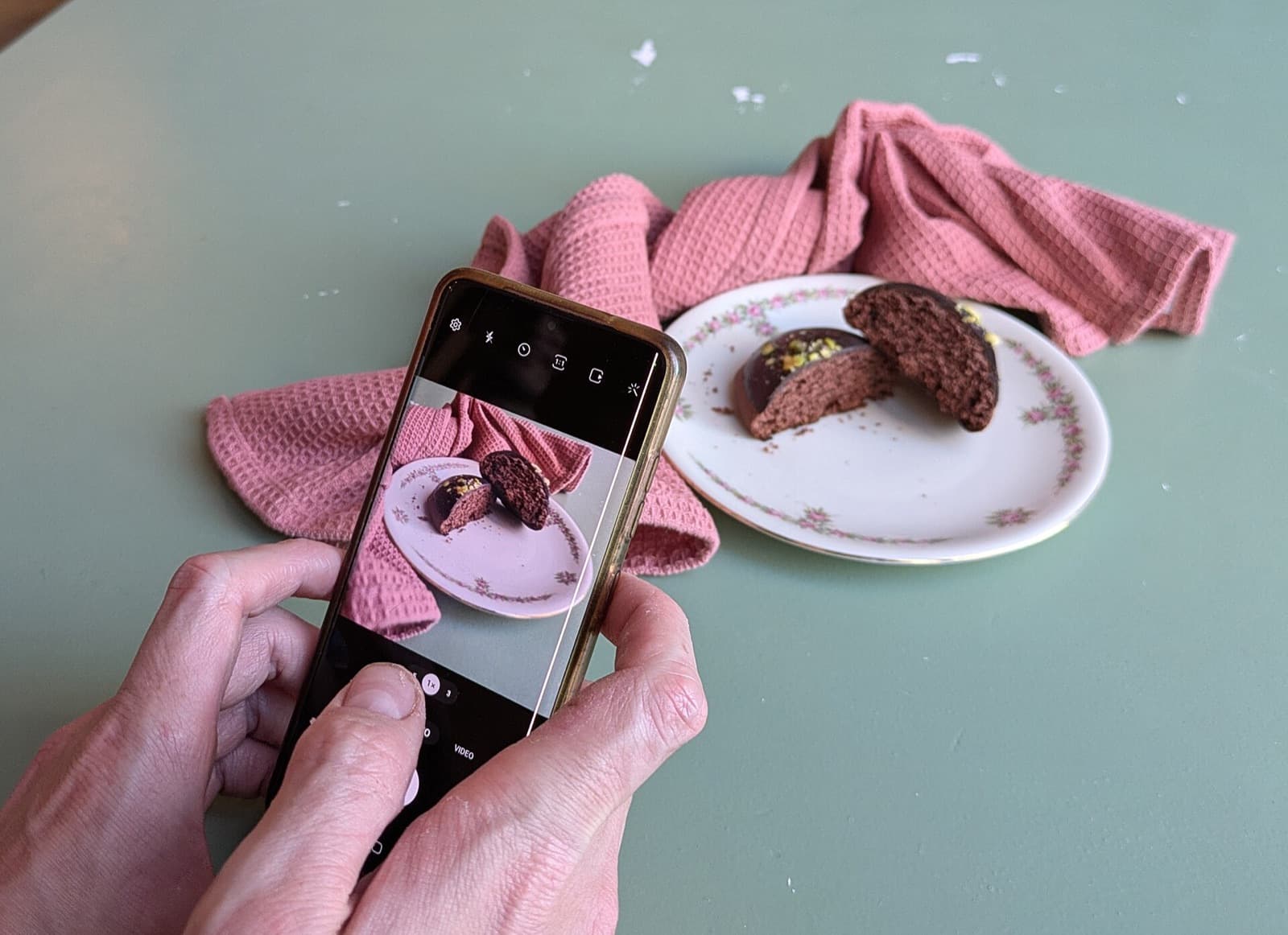
Good food photography is table stakes. You need it. But "good" does not mean "professional studio shoot." It means well-lit, appetizing, and shot from the right angle.
The rules: Natural light (near a window, never overhead fluorescent). Shoot at a 45-degree angle for plated dishes, directly overhead for flat items like pizza. Clean background -no clutter, no dirty napkins in frame. Edit lightly for brightness and contrast.
The template that works: Close-up of the dish, one sentence about what makes it special, a direct call to action with your ordering link. "Our hand-pulled mozzarella burrata with heirloom tomatoes and basil oil. Available for delivery tonight. Link in bio."
That last sentence is the difference between a post that gets likes and a post that gets orders.
Behind-the-Scenes Content
People want to see where their food comes from. Kitchen prep, dough being stretched, sauces being made from scratch, morning market runs, the team plating dishes during a rush.
This content humanizes your restaurant. It builds trust. A customer who has watched your chef hand-roll pasta is emotionally invested in ordering from you over the chain restaurant next door.
Frequency: 2-3 behind-the-scenes posts per week. These can be quick -a 15-second Story or Reel of your line cook torching creme brulee is enough.
Customer Stories and UGC
User-generated content (UGC) is the most trusted form of marketing. When a customer posts about your restaurant and you reshare it, you get social proof without any production cost.
How to encourage it: Ask. Literally. "Enjoying your meal? Share a photo and tag us -we might feature you." Put this on your receipt, your takeout bags, and your table tents. When someone tags you, repost it within 24 hours with a thank-you message.
Why it works: A customer's post about your restaurant reaches their entire friend network. That is word-of-mouth at scale.
Specials and Limited-Time Offers
Weekly specials create urgency and give people a reason to follow you. If your social media only posts evergreen content, there is no reason to check back regularly.
"This Friday only: Lobster Mac and Cheese, $18. Available for pickup and delivery. Order by 6 PM." Time-limited, specific, with a clear action. Post these as Reels and Stories, not just feed posts -Stories create urgency because they disappear in 24 hours.
Posting Frequency: The Honest Answer
Here is a realistic posting schedule for a restaurant that does not have a full-time social media manager.
Instagram: 4-5 posts per week. Two feed posts (food photos or specials), two Reels (behind-the-scenes or short-form video), and daily Stories (quick updates, polls, reposts).
TikTok: 2-3 videos per week. Focus on trending formats and raw kitchen content.
Facebook: 3-4 posts per week. Share your Instagram content plus event promotions and community engagement.
Total time: 60-90 minutes per day if you batch content. Spend Sunday evening planning and shooting content for the week. Daily posting and engagement takes 15-20 minutes.
Consistency beats volume. If you can only manage 3 posts per week on Instagram, do 3 great posts every single week. That beats 7 posts one week and nothing the next.
Converting Followers to Direct Orders
This is where most restaurants fail. They have followers but no strategy to turn those followers into customers who order directly.
Your Bio Is Your Storefront
Your Instagram and TikTok bios are the most valuable real estate you have on social media. Every word should drive toward an order.
Bad bio: "Family-owned Italian restaurant. Est. 2015. Fresh pasta daily."
Good bio: "Fresh pasta made daily in [City]. Order pickup and delivery. Zero delivery app fees." Then your link goes directly to your ordering page -not your homepage, not Linktree, your ordering page.
If you are using multi-channel ordering, make sure your social profiles link directly to your menu where customers can place an order in two taps.
Every Post Needs a CTA
Call to action. Every single post. Not "link in bio" buried as an afterthought. A clear, specific instruction.
"Order tonight: [link]." "This special is available through Saturday -order at [link]." "Tag someone who needs this in their life, then order it for them."
You are running a business, not a photography gallery. Ask for the sale.
Use Stories for Real-Time Selling
Instagram Stories are the most underutilized selling tool for restaurants. Stories create urgency (they disappear in 24 hours), they appear at the top of the app, and they support direct links.
Post a Story at 4 PM on a Friday: "Tonight's special: Prime Rib for Two, $65. Swipe up to order for delivery." That catches people during the "what should we eat tonight" decision window. Include the link sticker that goes directly to your ordering page.
For more strategies on driving direct orders through all your marketing channels, read our guide on how to increase restaurant sales.
Paid vs. Organic: Where to Spend Your Money
Organic reach on Instagram and Facebook has declined steadily. The average organic post reaches 5-10% of your followers. That means if you have 2,000 followers, only 100-200 people see each post.
Paid promotion changes that math. Here is how to think about paid social for restaurants.
Start With Boosted Posts
Do not run complex ad campaigns. Start by boosting your best-performing organic posts. If a Reel got 3x your normal engagement, put $20-50 behind it and target a 5-mile radius around your restaurant.
Budget: $300-500/month is enough to make a meaningful difference for a single-location restaurant.
Targeting: Location-based (3-10 mile radius), age-filtered to your core demographic, interest-based (food, dining out, cooking).
The One Ad Every Restaurant Should Run
A retargeting ad that shows to people who have visited your website but did not place an order. This catches people who were interested but got distracted. The creative is simple: your best food photo, a compelling offer ("Free delivery on your first order"), and a direct link to your ordering page.
Retargeting ads typically convert at 3-5x the rate of cold ads because the audience already knows who you are.
Measuring ROI
Do not measure social media success by likes and followers. Measure it by orders.
Set up UTM parameters on every link you share. This lets your analytics tool (Google Analytics or your ordering platform's dashboard) tell you exactly how many orders came from social media.
Track cost per acquisition. If you spent $500 on ads and got 40 new customers who ordered, your acquisition cost is $12.50. Compare that to what delivery apps charge you per new customer -it is almost always cheaper.
Track return customer rate from social. Are people who discover you through social media coming back for a second order? If not, the content is attracting the wrong audience.
For more on measuring your overall marketing effectiveness, read restaurant marketing trends for 2026.
Platform-Specific Tactics
Instagram Reels Strategy
Reels are Instagram's highest-reach content type. The algorithm pushes Reels to non-followers, making them your best tool for discovery.
What performs: Food preparation in fast motion (15 seconds), plating close-ups with satisfying reveals, "before and after" of raw ingredients to finished dish, and trending audio overlaid on food content.
Hook in the first second. The first frame determines whether someone stops scrolling. Start with the most visually appealing moment -the cheese pull, the sauce pour, the sizzle on the grill. Not the cutting board.
TikTok Trends Worth Following
TikTok moves fast. Do not chase every trend. Focus on these evergreen content categories that consistently perform for restaurants:
"What I do as a restaurant owner" day-in-the-life content. "How we make our [signature dish]" process videos. "Rating my own menu items" honest reviews. "Restaurant secrets" insider knowledge. "Responding to a customer review" reaction content.
Facebook Community Strategy
Join every local food group in your area. Do not spam with promotions. Add genuine value -answer questions, share tips, recommend other local businesses. When you do post about your restaurant, it comes from a place of credibility.
Create a Facebook Event for every special occasion: holiday menus, live music nights, tasting events, charity fundraisers. Events show up in local searches and get shared by attendees.
Common Mistakes That Kill Your Social Media
Posting Without a Strategy
Random posting is not marketing. Before you post anything, answer: "What do I want the person who sees this to do?" If the answer is "nothing," do not post it.
Ignoring Comments and DMs
Social media is a conversation, not a broadcast. Reply to every comment and DM within 2 hours during business hours. A customer who asks "Do you deliver to [neighborhood]?" and gets no response is a lost order.
Only Posting Food Photos
Food photos are necessary but not sufficient. If every post is a menu item against a white background, your feed is a catalog, not a story. Mix in people, process, personality, and promotions.
Buying Followers
Fake followers do not order food. They destroy your engagement rate, which makes the algorithm show your posts to fewer real people. A restaurant with 800 real local followers outperforms one with 10,000 bought followers every single day.
Not Linking to Direct Ordering
If your social media drives traffic to DoorDash or Uber Eats instead of your own ordering page, you are paying 25-30% commission on every order your marketing generates. That is funding someone else's business with your content. Make sure every link points to your direct ordering channel. Learn more about building your restaurant online ordering strategy.
The 30-Day Social Media Reset
If your current social media is not working, here is a 30-day reset plan.
Week 1: Audit and clean up. Update bios on all platforms with ordering links. Delete or archive posts that do not represent your brand. Set up UTM links for tracking.
Week 2: Content bank. Spend 2 hours taking photos and videos. Aim for 20 photos and 10 short videos. This gives you a content bank to pull from for the next month.
Week 3: Consistent posting. Post daily on Instagram (alternating feed posts, Reels, and Stories). Post 3 times on TikTok. Post 3 times on Facebook. Every post includes a CTA.
Week 4: Paid boost. Take your 3 best-performing posts from week 3 and boost them with $50-100 each, targeted to a 5-mile radius. Measure orders from each.
At the end of 30 days: Review your analytics. Which posts drove the most profile visits? Which drove the most link clicks? Which drove actual orders? Double down on what works, cut what does not.
Social media for restaurants is not about going viral. It is about consistently showing up in front of your local audience with content that makes them hungry and an easy way to order. Do that every day for 90 days and the results take care of themselves.
Connect your social channels to your direct ordering marketing tools to track exactly which posts and platforms drive the most revenue.
Frequently Asked Questions
Instagram is the best overall platform for restaurants in 2026. It is the most visual, has the highest engagement rates for food content, and offers direct ordering integrations. TikTok is second for discovery and reaching new audiences. Facebook is useful for local community engagement and events.
Related resources
Related Articles
Repeat orders
100% kept
Restaurant Marketing Automation: 5 Flows That Pay
Five trigger-based flows set once that drive repeat direct orders on autopilot: welcome, winback, birthday, abandoned cart, and review requests.
Pankaj Avhad
How to Take Online Orders for Your Restaurant (2026 Guide)
The complete guide to restaurant online ordering: 5 methods compared, real costs, step-by-step setup, and how to keep 100% of your revenue instead of paying 15-30% to delivery apps.
Pankaj Avhad
15% OFF
How to Get More Direct Orders and Stop Losing Money to Third-Party Apps
A step-by-step playbook for restaurant owners to migrate customers from DoorDash, Uber Eats, and Grubhub to their own branded ordering site and keep them coming back.
Pankaj Avhad