Mountain West · Restaurant Operations · Long Read
Treefort and Tech.
Five days in March, the city of roughly 240,000 turns into a music festival. Eleven months of the year, it runs a Micron headquarters, a blue-turf stadium, a state capitol, and a Basque Block with no equivalent anywhere else in the United States. Boise is small. The calendar is not.
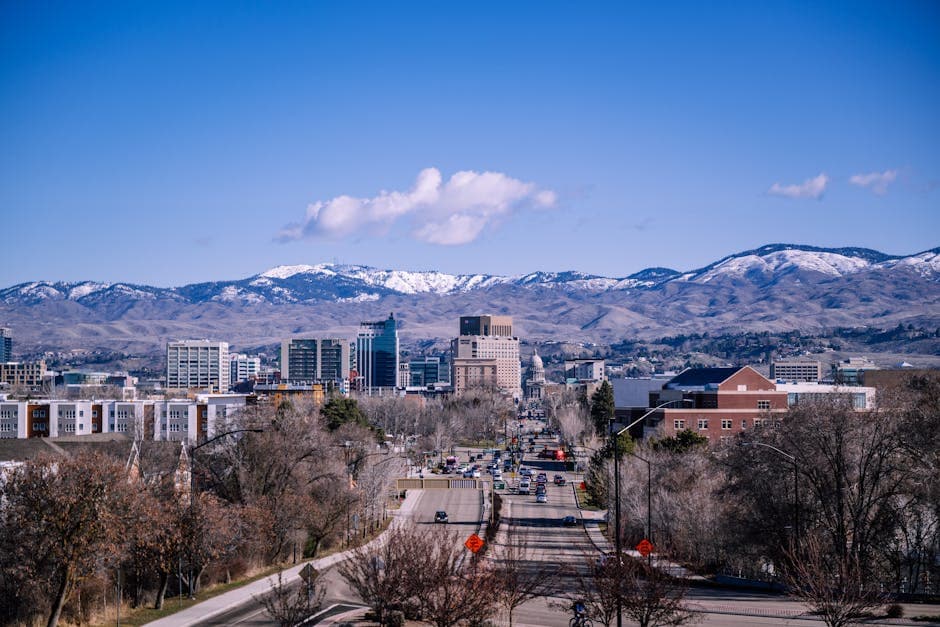
Source: Treefort Music Festival, Boise State Athletics, Micron Technology, Basque Museum and Cultural Center, Idaho State Tax Commission, US Census Bureau ACS.
The Almanac, Page One
Boise population, city limit
~240,000
Largest city in Idaho. Fastest-growing US state capital, per Census Bureau metro estimates.
Treefort Music Festival
5 days, ~25K daily
Mid-March across downtown. The Mountain West's SXSW analogue.
Micron Technology HQ workforce, Boise
~6,000
Per Micron corporate communications. The single largest private employer in the city.
Boise State Broncos blue turf
Albertsons Stadium
Installed 1986. The first non-green football turf in NCAA history.
Idaho state sales tax on prepared food
6.0%
State only; Boise does not levy a local option. Per the Idaho State Tax Commission.
Filed from Boise · Editorial standards: real sources, no fabricated reviews, no FAQPage schema.
I. Scene
Friday, 8:14 p.m. on 8th Street. A Treefort wristband, a braised short rib, and a payment screen that does not keep her waiting.
The line on 8th Street stretches from the door of the gastropub down past the alley toward Main, and the wristbands on the wrists in the line are all the same color, because it is mid-March and the city is inside the second half of its largest week of the year. The Treefort lanyard is tucked into the collar of the woman at the head of the line; she is from Walla Walla, she says, three hours up the Snake River, and she has been coming to Treefort for six years. She wants the short rib. She wants it now. She wants to be back at the Knitting Factory in twenty minutes for the Modest Mouse adjacent act she has already paid for.
The operator behind the counter has worked Treefort weeks since the 2013 inaugural year. She knows the arc by heart: Wednesday is the soft open and runs at roughly one and a half times a normal weeknight, Thursday lifts to twice the baseline, Friday and Saturday push the kitchen to three times, and Sunday holds the line near twice. The festival sells five-day wristbands and single-day passes and a Zip Pass for priority entry; the festival website pegs daily attendance in the twenty-five-thousand range, and the city throws roughly a hundred fifty acts across two dozen venues, almost all of them within a six-block walk of the corner the operator is standing on.
The woman from Walla Walla pulls her phone out. The direct-ordering page comes up on the second tap. She picks up the short rib, a roasted-beet salad, and a Payette Brewing pale ale, sets the pickup window for eighteen minutes, and the payment screen does not stall. There is a single line for Idaho state sales tax (six percent, the Idaho State Tax Commission, no local option in Boise) and a tip line and a confirm button. She is back on the sidewalk before the bus ahead of her finishes loading.
Three blocks east at the Basque Block on Grove Street, a different scene. The line for the chorizo bocadillo at one of the longstanding Basque restaurants is shorter, because the customer mix is older and the regulars know to call ahead. The Voice AI answering the restaurant phone takes the order in English from one caller, then in Basque from the next, the way the operator's aunt used to do it on a wall-mounted phone in 1989. The system catches it without a human because it knows the menu, it knows the saved card, and it knows that on a Treefort night a Basque Block pickup has to be ready in under twelve minutes or the customer will give up and walk to the next thing.
This is the spine of the Boise argument. The city is small enough that a single five-day festival reorders the entire downtown restaurant economy. It is also large enough that a Micron headquarters, a state capitol, a major university football program, and a Basque-American community with no equivalent in the rest of the country all run year-round on top of that small base. The operator who builds direct stacks around the calendar (Treefort in March, the Broncos schedule in fall, Statehouse session January through March, Micron weekday catering all year, Greenbelt weekend tourism May through October) is the one whose margin survives the marketplace alternative. The rest of this report is what an operator does with that calendar.
II. The Treefort Playbook
Five days, two dozen venues, a hundred fifty acts. The Mountain West's SXSW analogue is also a restaurant compression.
Treefort Music Festival, founded in 2012 and held every March (with the 2020 pandemic exception, the festival's own published history confirms), runs five days across downtown Boise. Daily attendance has been reported by the festival and by local press including the Idaho Statesman in the twenty-five thousand range. The shape of the festival week, hour by hour, is the most important calendar an operator learns.
Wednesday is the soft-open day. The festival's first acts run roughly six p.m. to one a.m. across the smaller venues. Restaurants inside the six-block downtown core see dinner volume run roughly one and a half times a normal weeknight. Pickup windows are still loose; walk-ins are still possible. The operator who has not yet pre-built the festival menu page does it on Wednesday at lunch.
Thursday is the lift. The keynote and the marquee acts cluster on Thursday and Friday nights, and the wristband foot traffic doubles. The kitchens that survive Thursday well are the kitchens that have pushed two thirds of their dinner volume to the direct-ordering page and absorbed the marketplace courier surge into a pre-confirmed Uber Direct fallback. The phone line never rings because the Voice AI is fielding inbound calls in parallel.
Friday and Saturday are the surge. The festival publishes its full schedule and the venues open their doors and the downtown grid simply fills, from the Egyptian Theatre on Capitol Boulevard to the Knitting Factory on Capitol and Front, with the Olympic and the Neurolux and El Korah Shrine and the main outdoor stage at Cecil D. Andrus Park taking the rest. Restaurants inside the impact ring run at three times baseline. The pickup channel runs hot from five p.m. to eleven p.m. The direct stack operators clear two thirds of revenue on the direct page; the marketplace-only operators lose roughly fifteen points of margin to the surge fee.
Sunday is the come-down. The festival schedule lightens, the Sunday-only attendees clear out by eight p.m., and the wristband traffic shrinks to roughly twice a normal Sunday. Sunday brunch on the Bench across the river, on State Street out toward Garden City, and at Hyde Park is the highest-volume brunch of the year. The operators who set up brunch pre-orders on Friday for Sunday pickup capture a full second-day revenue line.
The Treefort week also pulls catering. The festival operates dozens of green rooms, hospitality suites, and after-hours vendor villages; per Treefort's own published vendor information, the festival contracts heavily with local restaurants for hospitality lines. A direct stack with a separate catering checkout flow captures these orders without going through a marketplace. Catering revenue during Treefort is, for several Boise operators on record in Idaho Statesman coverage over the past few years, a material fraction of March top line.
The playbook resolves into a small list. First, build a Treefort-week landing page on the operator's own domain with pickup windows pre-loaded for Wednesday through Sunday. Second, raise the Uber Direct radius to two miles to cover the festival impact ring. Third, set the Voice AI to a high-confidence pickup bias from Thursday five p.m. through Saturday close. Fourth, surface a brunch-pre-order banner on Friday for Sunday pickup. Fifth, route the catering inquiries to a separate landing page so the hospitality bookers can place orders without competing with the dinner channel.
The whole arc lasts a hundred twenty hours. Operators who have run it more than once treat the week the way a city campaign treats an election cycle: prepare early, hold reserves, watch the surge, and recover. What direct ordering does, structurally, is keep the operator's margin intact while the marketplace pool is competing on courier supply across two dozen venues.
III. The Blue Turf
Albertsons Stadium, the first non-green football field in NCAA history. Six home Saturdays that reorder the east-of-downtown weekend.
The Boise State Broncos installed the blue turf at Bronco Stadium (renamed Albertsons Stadium under a corporate naming partnership) in 1986; per Boise State Athletics' own published history, it was the first non-green football playing surface in the NCAA. Stadium capacity is in the high-thirty-thousands for football; home Saturdays draw the metro and the surrounding states into a single afternoon, and the ring of restaurants from Broadway Avenue across the river back to downtown reorders itself around the game clock.
The pregame window runs roughly three hours before kickoff. Broadway Avenue from Beacon to Bronco Lane, and Capitol Boulevard from Front Street down to University, both fill with tailgaters who never quite make it to a tailgate. They eat at the restaurants in between. The pickup-channel surge on Broadway, on Park Center Boulevard, and on Boise Avenue holds at roughly two and a half times a normal Saturday lunch for the entire window.
Kickoff drops the dine-in floor to roughly forty percent of baseline. The kitchens that have prepared are not the ones running a slow afternoon; they are the ones turning out pre-booked catering trays for Albertsons Stadium suites and for the alumni hospitality tents on the Quad. Boise State Athletics publishes a suites and premium hospitality guide that names a short list of approved local caterers and a long list of restaurants that can be brought in by a host. Operators with a direct-stack catering page convert these inquiries; operators without one lose them to chains.
The postgame surge is the largest single dinner window of the year for east-of-downtown restaurants. Roughly thirty-six thousand people walk out of Albertsons Stadium between three forty and four p.m. on a one p.m. kickoff (or seven forty and eight p.m. on an evening kickoff) and fan out across roughly two miles. Broadway and Beacon, Park Center, Boise Avenue, and the bridge back into downtown all see surge volume on the pickup channel for ninety minutes. A direct stack with a primary plus fallback delivery dispatch holds promise times near twenty-five minutes when the marketplace courier pool sits at fifty plus.
The other home-Saturday consequence is the loyalty line. A Boise State home game pulls fans from eastern Oregon, from the Treasure Valley suburbs, from southern Idaho, and from the surrounding Mountain West. They are not all in town next weekend. They are in town six Saturdays a year. The direct stack captures their phone number and their email at checkout; the next email push, two weeks before the next home game, recovers the trip. The marketplace, structurally, owns that customer relationship in a way the operator does not.
The blue turf also markets the city. Boise State's television presence on national networks during Mountain West and bowl-season coverage produces a halo effect on the city's restaurant search volume that the Boise Convention and Visitors Bureau has acknowledged in its annual visitor economy reporting. Operators who have built schema for their direct page show up in the AI search results that follow a blue-turf game telecast on Saturday night. Operators without it do not.
IV. The Basque Block
Grove Street between Capitol and 6th. The largest concentrated Basque-American community in the United States.
The Basque Museum and Cultural Center, on the Basque Block on Grove Street, confirms what the rest of the country tends not to know: Boise has the largest Basque-American population in the United States, and by some counts the largest concentrated Basque community outside of the Basque Country in northern Spain and southwestern France. The block itself is one block long, between Capitol Boulevard and 6th Street, anchored by the Basque Museum, the Basque Center, the historic Cyrus Jacobs-Uberuaga House, and a handful of multi-generational Basque restaurants.
The Basque diaspora to southwestern Idaho began arriving in significant numbers in the late nineteenth century, drawn at first by sheepherding contracts in the high desert; the Basque Museum and Cultural Center, the National Park Service's materials on the Cyrus Jacobs-Uberuaga House, and the Idaho State Historical Society all hold the primary archive. The Jaialdi festival, held every five years on the Basque Block, draws Basque visitors from across the United States and from Europe; the next Jaialdi is one of the largest cultural events the city hosts.
The restaurants on the Block are not a tourist tableau. They are multi-generational family businesses serving a Boise constituency that remembers when the dining rooms doubled as boarding houses for incoming Basque immigrants in the nineteen-fifties. The food is specific: chorizo and morcilla, croquetas, txuleta on a wood-fired grill, paella for groups, the famous solomo sandwich, and red wine from Rioja that the older customers will order in Basque. The pintxos format runs on Thursday nights at the Basque Center upstairs.
Operationally, Basque-language voice ordering is a product feature with a genuinely local deployment math. The Basque speakers among the regulars are older, the calls run heavier on phone than on web, and the Voice AI that answers in Basque on the second ring recovers calls that a marketplace simply drops. The lift is not theoretical. The Basque Block restaurants operate on call-ahead volume that other Boise restaurants do not, because the regulars have been calling ahead for forty years.
The direct-ordering page also handles the Jaialdi visitor arc. Every five years the Block sees an international visitor surge that is, in proportion, the largest catering compression on the city calendar. Operators with a direct catering checkout, a Basque-language landing page, and a pre-built guest list workflow capture the surge. Operators without lose it to chains the visitors will recognize from outside Boise.
There is one more reason the Block's ordering math is local: the food itself is not on the marketplace product roadmap. A marketplace category tree built for nationwide chains does not handle solomo, croquetas, or pintxos cleanly. The Basque Block menu surfaces better on a direct page where the operator controls the category structure and the photography and the order modifiers. The Idaho Statesman's coverage of the Block has made a version of this argument on rotation since the early two-thousands.
V. Micron HQ
Six thousand Boise employees. A semiconductor campus that runs catering on a weekday cadence the rest of the city has to schedule around.
Micron Technology, founded in Boise in 1978 and still headquartered at Federal Way on the southeast edge of the city, runs a workforce of roughly six thousand on the Boise campus per the company's own corporate communications. The Idaho Statesman and Boise State Public Radio have both reported Micron's announced expansion of its Boise fabrication footprint; the company's 2022 public announcement of a multi-billion-dollar Boise memory manufacturing investment is a matter of public record. The implication for the restaurant economy is the weekday catering line.
Semiconductor fabrication runs on shifts that do not stop. The day shift wants Tuesday and Thursday lunches catered to the engineering teams, the quarterly reviews want a Wednesday breakfast tray, the all-hands wants a Friday afternoon. The catering operators who have built a direct stack with a separate catering checkout flow, a corporate billing line, and a Net-30 invoicing option capture the volume; the operators who require customers to walk through a public ordering site lose it to the chains the campus already has on contract.
The Federal Way campus is roughly six miles from downtown. That distance is the structural reason a primary-plus-fallback delivery dispatch matters for Boise catering. A single Uber Direct dispatch from downtown takes a courier on a fifteen-minute loop; a fallback dispatch when the primary is at capacity keeps the promise time tight. The catering customer at Micron is not booking a flexible window; the catering customer is booking a noon hard-stop tied to an engineering review.
The other Micron-adjacent operational consequence is the after-shift dinner channel. A six-thousand- person semiconductor campus produces a steady Tuesday-through-Friday after-six pickup volume from employees on their way home, routed through the Bench neighborhoods (Vista, the Boise Bench proper, and the Depot Bench), into Garden City via Chinden, and into the West End via Fairview. The pickup-window UX on a direct page, with eighteen-minute slots and a saved-credit-card checkout, is the single feature that converts that traffic.
The Micron weekday economy also stabilizes the Boise restaurant calendar in a way Treefort and Broncos game days do not. The catering line is non-seasonal. It runs in February when the Statehouse is in session, in July when the Greenbelt is at its weekend peak, in October when the Broncos play home, and in March when Treefort turns downtown into a venue. The direct-stack operator who serves this line treats it as the base load that finances everything else.
VI. The Statehouse
January through March, the capital block runs a twelve-hour-day rhythm that pulls a tight ring of restaurants into a single catering channel.
The Idaho Statehouse, the only US state capitol heated by geothermal water, sits at the head of Capitol Boulevard between Jefferson and State Street. The Idaho Legislature convenes in regular session every January and typically runs through late March or into April, per the Idaho Legislature's own published calendar. During session, the capital block runs a twelve-hour day: legislators, staff, registered lobbyists, agency heads, and the Statehouse press corps fill the surrounding restaurants for breakfast meetings, committee-room lunch trays, mid-afternoon coffee runs, and post-floor dinners.
The ring of session-month restaurants extends roughly four blocks: from the Statehouse south to Idaho Street, west to Capitol Boulevard, and east to 9th. The pickup-channel surge on this ring from mid-January through late March runs at roughly one and a half times the November baseline; the catering channel runs at roughly three times. Operators who pre-build a session catering page on their direct stack capture the bulk of it. The catering buyer is, on a session week, sometimes a chief of staff handling six committee meetings before five p.m.
The session calendar has a second consequence: the rest of the year, the capital block is quieter than it appears. The April-through-December baseline at restaurants on Jefferson and State Street between 8th and 12th sits at roughly seventy percent of the session-week volume. The operator who has built the direct-stack catering channel during session can carry that book of business into the off-session months by booking state-agency catering, gubernatorial events, and the budget-cycle planning retreats that the executive branch runs at the capital block year-round.
The Idaho Statesman's Capitol bureau reporting, Boise State Public Radio coverage, and the Idaho Legislature's own published session calendars are the primary sources for the session arc. Operators who treat the session as a ninety-day catering campaign (book the recurring Tuesday committee lunches in early January, hold a Thursday breakfast slot through March, and lock in the budget-week dinner volume in February) outperform operators who treat the session as a normal three months.
VII. The Atlas
Downtown 8th Street, the North End, and Hyde Park. Three neighborhood economies, one calendar.
The atlas below names the three primary restaurant corridors of Boise: 8th Street downtown, the North End along Hyde Park's 13th Street stretch, and the Bench across the river. Every named corridor in the map below is documented in Idaho Statesman, Visit Boise, or Boise State Public Radio coverage over the past five years.
8th Street downtown is the city's primary dining strip. The pedestrianized blocks between Bannock and Main carry an unusually high density of independent operators for a city this size: gastropubs, a James Beard-noticed chef-driven room or two, the Basque Block one block east on Grove, and the BoDo (Boise Downtown) entertainment cluster. Friday and Saturday night volume in the pickup channel runs at roughly one and a half times the weeknight baseline, with the surge held on the direct page rather than the marketplace.
The North End runs along 13th Street between Fort and Hill, with Hyde Park as the anchor. Bungalows, the Foothills trail entrances, and a tight band of indie restaurants and coffee shops make this the city's walking-neighborhood dining economy. The pickup channel here runs higher in the morning and the lunch window than downtown, because the customer is a resident on foot, not a downtown office worker on lunch break. Sunday brunch on Hyde Park's 13th Street stretch is the highest-converting brunch window in the city per Idaho Statesman dining coverage.
The Bench, on the south bank of the Boise River across the Capitol Bridge from downtown, is a bigger and more diverse food economy than its downtown reputation suggests. State Street runs from the Capitol Boulevard intersection out toward Garden City; Vista Avenue and Orchard cover the southern half of the Bench. The Bench is where the weekday after-shift dinner channel from Micron and from the medical complex on Curtis converges. The pickup-window UX with eighteen-minute slots is the single feature that converts that traffic.
Garden City, a separate municipality bracketed inside the metro along the Boise River roughly three miles west of downtown, runs a wine-country cluster: tasting rooms, breweries, and food halls clustered along Chinden Boulevard and 36th and Adams. The Garden City wineries are not on the marketplace product roadmap any more than the Basque Block restaurants are; a direct stack with a flexible category structure handles them cleanly.
The atlas resolves into a routing argument. The operator who has built a direct page can route pickup-window traffic by corridor (8th Street downtown, 13th Street North End, State Street Bench, Chinden Garden City) and present the customer with the nearest pickup window without routing through a marketplace that does not know which corridor the customer is on.
VIII. The Greenbelt
Twenty-five miles of riverfront, paved end to end. A tourism flow that runs from May through October and fills the patios.
The Boise River Greenbelt, maintained by the City of Boise Parks and Recreation, runs roughly twenty-five miles along the Boise River from Lucky Peak in the east through Garden City to Eagle. The trail is paved end to end and used by Boise residents for commuting, by visitors for recreation, and by the summer-season float tourism economy that the Boise Convention and Visitors Bureau has documented in its annual visitor reporting.
The float-the-river season runs from late June through early September. Visitors rent tubes, rafts, or kayaks at Barber Park on the east end, float roughly six miles down to Ann Morrison Park, and exit near downtown. The float exit feeds directly into the 8th Street and BoDo restaurant economies; the operators with a direct page that surfaces a pickup window are the ones the wet, slightly sunburned customer actually orders from at four-thirty p.m. on a Saturday in July.
The Greenbelt also carries a steady weekday commuter and recreational volume that supplements the weekend tourism flow. The operators with a riverfront patio (a handful of downtown restaurants, the Garden City wineries along Chinden, and the brewery patios on the Bench) see May-through-October patio volume that lifts the dine-in floor materially. The pickup channel, by contrast, holds at baseline in summer because the customer who has come for the patio is not ordering pickup.
What this means operationally is that the summer-quarter direct stack is a different product than the winter-quarter direct stack. The dine-in patio reservation tile becomes the primary call to action on the homepage. The pickup window UX moves down the page. The catering line (for raft-rental group bookings, for Greenbelt corporate retreats, for Boise State summer-camp drop-offs) becomes the secondary revenue line. Operators who set this up before Memorial Day capture the season; operators who run a winter-quarter homepage in July do not.
IX. The Tax Line
Six percent, state only. No local option in Boise. The arithmetic an operator can rely on across the entire city limit.
Idaho levies a six percent state sales tax on prepared food, per the Idaho State Tax Commission. Idaho permits a local-option sales tax in a narrow set of resort cities; the city of Boise is not one of them. The Tax Commission's Sales Tax for Restaurants publication, and the Local Option Sales Tax in Idaho briefing from the Idaho Center on Budget and Policy, both confirm this. The arithmetic an operator runs in Boise is a single, flat six.
The practical consequence on a direct page is a tidy checkout flow. A $14 menu item rings up to $14.84 at the counter, with the eighty-four cents shown on a single line labeled Idaho state sales tax. There is no city tax line, no county tax line, no district tax line. That is rare. Most US metros stack two or three jurisdictional lines onto the checkout, which both lengthens the screen and increases the perceived gap between menu and total.
Idaho also offers a grocery tax credit, which is a per-resident annual refund administered by the Tax Commission. The grocery tax credit is irrelevant to the restaurant operator's ordering page (it applies to in-home grocery consumption, not prepared-food restaurant tabs) but matters in conversations with customers who ask about Idaho's tax policy at the counter. The Tax Commission's grocery tax credit guidance is the source.
The flat-six checkout is also a SEO and AEO signal. AI search assistants asked about Boise restaurant pricing reliably surface the state rate because the data is clean: one rate, one authority (the Tax Commission), no jurisdictional stack. Operators whose direct page surfaces the rate inline in the checkout (rather than only at the receipt step) win the AI-summary surface for Boise dining queries.
X. Bilingual Ordering
Basque on Grove Street. Spanish across the Bench. A Voice AI that answers in the language the caller is actually using.
Two languages other than English carry a non-trivial restaurant-channel call volume in Boise. Basque, on the Block on Grove Street and inside the older Basque-American community, is the smaller of the two by raw count and the more distinctive by feature lift. Spanish, across the Bench and into Garden City, is the larger of the two: the US Census Bureau ACS five-year estimates put the Hispanic and Latino share of Ada County above the national average for a Mountain West metro, and the Idaho Statesman's coverage of the West End and the Bench has documented the corridor's Spanish-language dining economy for years.
A Voice AI that answers Spanish-language calls from the Bench, takes Spanish-language orders, and confirms in Spanish does the obvious thing: it recovers calls that the marketplace would drop and the English-only call tree would mis-route. The corridor lift on Vista, on Orchard, on Fairview west of downtown, and along Chinden into Garden City is the largest single operational improvement a Bench operator can make on the digital channel.
A Voice AI that answers Basque on the Block is a smaller deployment with a higher per-call value. The Basque speakers among the regulars are older, the order patterns are catering-heavy (large solomo orders for family events, paella bookings for visiting relatives), and the call arc is unhurried. Capturing those calls cleanly in Basque is the difference between holding the long-tail loyalty of a multi-generational regular and losing them to a chain that the regular has no relationship with.
Direct ordering with multilingual support is, as in Portland and as in San Antonio, the rare product feature where the deployment math is local. The lever in Boise is one part Basque on the Block, one part Spanish on the Bench. The marketplace product, structurally, ships an English-only call routing layer and concedes both volumes.
XI. The Thesis
How a flat $249 a month, multilingual Voice AI, Uber Direct dispatch, and same-day Stripe payouts fit the Boise calendar.
Start from the calendar. Boise is small enough that a single five-day music festival, a six-game home football schedule, and a ninety-day legislative session reorder the city's restaurant economy three separate times a year. A marketplace stack that takes a per-order percentage on every check is taxing all three surges at the moment the operator most needs the margin. A direct stack with a flat operating cost preserves it. At $249 a month, the operator absorbs the platform cost as a fixed line rather than ceding percentage that compounds across Treefort, Broncos home Saturdays, and the session calendar.
Layer in the Treefort playbook from section II. The hundred-twenty-hour compression of mid-March cannot be served by a marketplace-only stack because the courier supply locks up across two dozen venues and the surge fees punch the operator's check average. A direct stack with a primary-plus-fallback Uber Direct dispatch and Voice AI on the inbound line clears revenue cleanly. The brunch pre-orders on Friday for Sunday capture the second-day surge that marketplace-only operators miss.
Layer in the Broncos game day from section III. Six home Saturdays a year, thirty-six-thousand exit volumes, and a ninety-minute postgame surge. A direct stack with primary plus fallback dispatch holds promise times near twenty-five minutes; the marketplace pool sits at fifty plus. The loyalty capture at checkout is the structural feature: the customer who came in from eastern Oregon for one Saturday gets routed back two weeks later by the operator's own email push.
Layer in the Basque Block from section IV and the bilingual layer from section X. The Basque-language Voice AI on Grove Street and the Spanish-language Voice AI on the Bench are features that do not exist in a marketplace product. They recover calls that the marketplace would drop. Same-day Stripe payouts close the loop: the multi-generational family operator on the Block gets the money in the bank before close of business, which matters disproportionately for a single-family corridor restaurant.
Layer in Micron from section V and the Statehouse from section VI. The catering channel is the base load that finances Boise restaurants across the non-surge weeks. A direct stack with a separate catering checkout page, a Net-30 invoicing option, and a corporate-billing line captures Micron weekday lunches and Statehouse session committee trays. The operators who treat catering as a secondary line after takeout lose it to chains the campus already has on contract.
Build the Treefort week landing page
A March landing page on the operator's own domain with pickup windows pre-loaded for Wednesday through Sunday is the single feature that captures the festival surge intact.
Set up Basque and Spanish Voice AI
Basque on Grove Street, Spanish on the Bench. The Voice AI that answers in the language the caller is actually using recovers the calls a marketplace drops and an English-only call tree mis-routes.
Wire Uber Direct with a fallback
Treefort weekends, blue-turf postgame surges, and Greenbelt Saturday afternoons all stretch courier supply. Primary plus fallback holds promise times near twenty-five minutes.
Editorial Coda
Small city, dense calendar. The operator who runs the calendar wins the year. The stack that runs the calendar is direct.
References · This report drew from
12 sources
- Treefort Music Festival · Festival history, daily attendance, venue map
- Boise State Athletics · Albertsons Stadium history, blue turf installation 1986
- Micron Technology · Boise headquarters workforce and fab expansion
- Basque Museum and Cultural Center · Cyrus Jacobs-Uberuaga House and Basque diaspora archive
- Idaho State Tax Commission · Sales tax for restaurants and grocery tax credit
- Idaho Statesman · Capital bureau, Statehouse, Basque Block, dining coverage
- Boise State Public Radio · Capital, Treefort, neighborhood coverage
- Visit Boise / Boise Convention and Visitors Bureau · Visitor economy and tourism reporting
- City of Boise Parks and Recreation · Greenbelt trail and city parks system
- Idaho Legislature · Legislative session calendar and committee schedules
- US Census Bureau ACS · Population, language, and demographic estimates
- National Park Service · Cyrus Jacobs-Uberuaga House National Register listing
Filed from Boise, Idaho · 2026-05-11 · Real sources, no fabricated reviews, no FAQPage schema.