Inland Northwest · Restaurant Operations · Long Read
The Inland Northwest Capital.
Spokane is a city of roughly 230,000 people that operates as the urban anchor of a region of close to two million, drawing from Eastern Washington, North Idaho, and Western Montana. This is a field report for restaurant operators on Hoopfest weekend, Bloomsday Sunday, Gonzaga gameday, and the rest of the year that fills in around them.
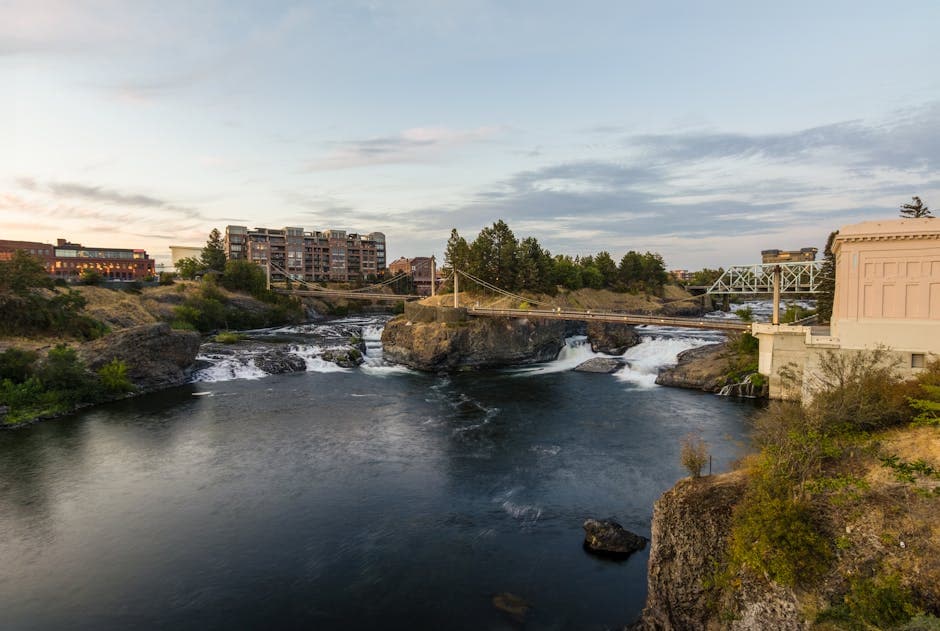
Source: City of Spokane GIS. Photographed from the Monroe Street Bridge looking east.
Inland Northwest Brief
US Census 2024 estimate. Second largest WA city after Seattle.
E. WA + N. Idaho + W. Montana combined trade area.
Late June, world's largest 3-on-3, per Hoopfest Association.
First Sunday in May. One of the largest US timed road races.
WA DOR 2025: 6.5% state + 2.5% local in city limits.
Filed from Spokane · Editorial standards: real sources, no fabricated reviews.
I. Scene
The last Friday in June. Browne's Addition, the night before Hoopfest opens.
Browne's Addition is the oldest residential neighborhood in Spokane, a National Register district of brick four-squares, Victorian rooming houses, and chef-driven kitchens tucked into converted parlors west of the downtown core. The Inlander has covered the neighborhood's restaurant turn for two decades. On this particular Friday evening, every cook on West Pacific Avenue is doing the same arithmetic. Hoopfest opens at sunrise. Their kitchens are about to feed a city that is suddenly twice the size it was at lunch.
Downtown Spokane will host more than 6,000 three-on-three teams across 450-plus courts striped onto the asphalt grid between the Spokane River and the rail line, per the Spokane Hoopfest Association's annual recap. That is the largest 3-on-3 basketball tournament in the world. The bracket starts Saturday morning. The teams (and the families who travel with them) arrive Friday afternoon, check into the Davenport Grand, the DoubleTree by the river, the airport-adjacent hotels, the Vrbo rentals stacked across the South Hill and the Garland District.
At 6:47 p.m. the operator in Browne's Addition watches her walk-in cooler. She has prepped 50 percent more protein than a normal Friday because a Hoopfest weekend converts to roughly a triple-volume Friday across her sector. The phone rings. Then it rings again. The Voice AI catches both and turns them into pickup tickets timestamped for 7:30 and 7:45. Two more inbound calls land in the next eight minutes. The host stand is too busy seating the patio to answer. The Voice AI handles seven of nine inbound calls between 6:30 and 8:00 p.m. without a human ever picking up.
Across town, on Sprague near Division, a second operator is running a different motion. Pre-orders opened seven days out with a Saturday and Sunday delivery window inside the Hoopfest ring. The pre-orders alone account for 380 tickets that he did not have to fight a marketplace queue for. Uber Direct will run the dispatch on Saturday morning at a flat rate he set himself, not at a 30 percent commission carved out by an app he does not control. The marketplace apps go quiet in Spokane during Hoopfest because their drivers are sitting at red lights on Spokane Falls Boulevard.
The two operators are running the same software. They are running it differently because Browne's Addition is a different economy than the corridor near the Convention Center. The rest of this report is about that distinction, and about the other three weekends in the Spokane calendar that matter as much as Hoopfest: Bloomsday Sunday in early May, Gonzaga Bulldogs home games from November to March, and the late summer Riverfront Park concert season. This is a field report on running a Spokane restaurant in 2026.
Sources for this scene · Spokane Hoopfest Association, Inlander, Visit Spokane.
II. The Bracket
The Hoopfest 2-day playbook. Six thousand teams. One downtown.
Hoopfest is held on the last full weekend of June across more than 450 striped courts on the downtown street grid, the world's largest 3-on-3 basketball tournament by the official count. Brackets run from 8 a.m. to roughly 6 p.m. Saturday and Sunday. Teams range from 8-year-old grade-school divisions to elite adult brackets to wheelchair divisions. The economic spillover into downtown restaurants, downtown hotels, and the close-in residential ring is the largest single weekend on the Spokane calendar.
The operator playbook starts seven days out. Pre-orders open on the website on the Sunday before Hoopfest weekend, with Saturday and Sunday pickup and delivery windows inside the downtown ring. Pickup converts at roughly twice the rate of delivery in Hoopfest weekend windows because teams walk between courts and a 6-block radius is faster on foot than by car given the street closures.
Friday night is the warm-up. Teams arrive, families gather, Browne's Addition and the Davenport corridor run patio-heavy dinner. The Voice AI absorbs the phone surge so the host stand can keep walk-ups moving. Saturday and Sunday lunch windows compress to a brutal 11:15 to 1:45 spike timed to bracket pauses. Saturday dinner spreads to the South Hill and the Garland District where teams are staying. Sunday late-afternoon catering pickups feed the championship bracket families.
The marketplace apps fail in a specific way during Hoopfest weekend. Driver supply collapses inside the downtown ring because the street grid is striped over with courts and the drivers cannot route through. Posted ETAs go from 25 minutes to 90-plus. Customers cancel. The operator loses tickets that were already paid for and feels none of the upside.
The DirectOrders configuration absorbs both halves. Pickup is the default. Uber Direct handles the outside-the-ring long tail at a flat dispatch fee the operator sets. Same-day Stripe payouts settle Monday morning. The branded ordering page captures the team-parent demographic that does not want to scroll a marketplace listicle while their twelve-year-old is up by two with the ball in the corner.
By the time the championship final tips off Sunday afternoon at Riverfront Park's Hoopfest center court, the operator who ran this playbook has done close to triple her normal weekend ticket count and has paid no per-order commission to anyone. The bracket ends. The ledger closes.
Sources · Spokane Hoopfest Association, Visit Spokane, Inlander Hoopfest coverage.
III. The Run
The first Sunday in May. Forty thousand runners on the Doomsday Hill.
The Lilac Bloomsday Run, founded in 1977 by Spokane native and Olympic marathoner Don Kardong, is a 12-kilometer road race held the first Sunday of May. Per the Lilac Bloomsday Association, the race historically drew finisher fields in the forty-thousand range, making it one of the largest timed road races in the United States by participant count. The course runs from downtown along Riverside, climbs the famous Doomsday Hill, and finishes in Riverfront Park.
The Bloomsday operator playbook is shaped by the start time and the finish geography. The elite wave goes off at 9 a.m. The mass field is on course from 9:15 to roughly 11:30. By noon, forty thousand runners and their families are looking for brunch within walking distance of Riverfront Park. The demand wave is concentrated, predictable, and one-directional. Restaurants from Browne's Addition on the west to the South Hill on the south to the Logan neighborhood to the north all see it.
The operator who handles this best opens for Bloomsday brunch at 10 a.m., runs a tight Bloomsday-specific menu of six to eight high-throughput items, takes pre-orders the full week prior with a 10:30 to 1:30 pickup window, and uses Voice AI to catch the post-race phone surge from runners trying to find their crew. Same-day Stripe payouts settle Monday so the operator's wage book closes on schedule even with a weekend volume spike.
Catering pre-orders for the Bloomsday weekend are a separate channel. The volunteer aid stations, the corporate teams doing post-race breakfasts, and the elite hospitality packages all order ahead. A direct ordering site that supports group orders and net-30 invoicing converts those tickets without a commission cut. The marketplace apps do not handle group catering well in Spokane. They never have.
The race itself is the city's most identifiable annual event, alongside Hoopfest. For an operator newly arrived in Spokane, treating Bloomsday Sunday as a standard Sunday is a real miss. Treating it as a triple-volume catering and brunch day, planned five weeks out, is the right move.
Sources · Lilac Bloomsday Association official archive, Spokesman-Review Bloomsday coverage, Visit Spokane.
IV. The Bulldogs
Gonzaga basketball is November to March, and it is a calendar all its own.
Gonzaga University, founded 1887, sits on the north bank of the Spokane River two blocks east of Division Street. Its men's basketball program, under head coach Mark Few since 1999, has been a fixture in the NCAA Tournament for the entire span of the modern bracket. Per Gonzaga Athletics records, the Bulldogs have appeared in the tournament every year of the program's modern era, advancing to two national championship games and multiple Final Fours. The phrase "perennial contender" is not marketing copy here. It is the base rate.
The on-campus arena, McCarthey Athletic Center (capacity approximately 6,000, opened 2004), is the loudest small gym in college basketball by reputation, with the program holding one of the longest home court winning streaks in Division I history at various points across the Mark Few era. The home schedule runs from early November through early March, with conference play (West Coast Conference) concentrating Thursday and Saturday games in January and February. Every game is a sellout. Every game spills spectators into the surrounding North Bank corridor for pre-game and post-game dinner.
The operator playbook for the Gonzaga calendar is simple in shape and disciplined in execution. The 4:30 to 6:30 p.m. pre-game window on home game nights pulls a deep wave of walk-up and pickup along Hamilton, North Division, and the blocks east of the campus. Restaurants in the Logan neighborhood and along North Monroe (Garland adjacent) also see lift on Bulldog game nights. Post-game dinner runs long, with the late tail into 11 p.m. on a hot home game.
The single most expensive failure mode on Gonzaga game night is the phone going unanswered while the host stand is buried. The Voice AI handles that wave. The branded ordering page converts the pre-game pickup at 5:45 p.m. without the customer having to scroll three marketplace listicles to find a working menu. Tournament weekends (Selection Sunday through the Sweet Sixteen) are the second-largest revenue concentration of the Gonzaga calendar after Hoopfest weekend. Operators who model their schedule around the bracket close the year on the right side of the wage math.
Sources · Gonzaga University Athletics official records, NCAA Division I men's basketball archives, Spokesman-Review Gonzaga beat.
V. The Region
Spokane serves three states. Most Spokane operators serve all three.
Spokane is the urban anchor of the Inland Northwest, which on every economic and cultural map runs from Eastern Washington east across the North Idaho panhandle and into Western Montana. Greater Spokane Incorporated, the regional chamber, frames the trade area at roughly 1.9 million residents across this tri-state region. For a Spokane restaurant, the practical consequence is that a meaningful share of weekend customers arrived from a town the operator has never visited.
East along I-90 is Coeur d'Alene, Idaho (about 33 miles from downtown Spokane), a lakeside resort city of roughly 56,000 that doubles in the summer season and pulls weekend dinner traffic back into Spokane during the off-season. Post Falls and Hayden fill in between. Sandpoint, Idaho, sits another hour and a half north, anchoring the Schweitzer Mountain ski area and a weekend dinner crowd that drives in for big events at the Spokane Arena or the First Interstate Center for the Arts.
South of Spokane is Pullman (Washington State University) and Moscow, Idaho (University of Idaho), the Palouse college belt at about 75 miles. North into Washington is Colville and the Stevens County rural orbit. South into Washington is the Tri-Cities (Kennewick, Pasco, Richland), three hours away but in the same regional economic frame for major weekends like Hoopfest and Bloomsday.
West along I-90 is Cheney (home of Eastern Washington University), Airway Heights (the Northern Quest Resort casino), and the Spokane Tribe lands. Northwest is the Mount Spokane ski area, an hour into the foothills. East across the state line, Western Montana begins, with Missoula four hours east on I-90 and Kalispell the same distance north.
The practical effect on restaurant operators in downtown Spokane and the close-in neighborhoods is that the customer base is not "Spokane" in the narrow city-limits sense. It is the Inland Northwest in the regional sense. A direct ordering site that supports out-of-area billing addresses, group catering, and event-tied pre-orders captures the visiting share that marketplace apps treat as noise.
Sources · US Census Bureau ACS 2024, Greater Spokane Incorporated trade-area data, Visit Spokane regional brief.
VI. The Falls
The Expo '74 grounds are now a park. The waterfall is the city's center of gravity.
Spokane hosted the 1974 World's Fair, Expo '74, on a former rail yard wedged between the Spokane River channels and the downtown grid. It was the first world's fair built on an environmental theme. Per the City of Spokane Parks Department archive, after the fair closed the grounds were converted into Riverfront Park, an urban park of roughly 100 acres straddling the upper and lower Spokane Falls. The U.S. Pavilion remains as the iconic mast and tent structure visible from most of downtown.
The Spokane Falls, in the spring runoff months from late April through mid June, are one of the largest urban waterfalls in the United States by sustained flow. The Looff Carrousel (1909, restored), the Numerica SkyRide gondola over the falls, the Pavilion concert and ice rink programming, and the Centennial Trail river path all converge inside the park footprint. Per Visit Spokane's annual report, the park draws several million visitor trips a year, the single largest gravitational center of gravity for downtown foot traffic.
The operator consequence is direct. A restaurant within four blocks of Riverfront Park sees foot traffic patterns shaped by park programming. Spring break weekends, the Hoopfest Sunday final at the park's Hoopfest center court, the Bloomsday finish line at the Pavilion, summer concert evenings, and the Christmas tree lighting in November each bend the dinner curve. Operators who track the park's public event calendar against their own ticket book find consistent lift on the listed dates.
The direct ordering implication is straightforward. The operator who posts an event-aware ordering page (Bloomsday Sunday menu, Hoopfest weekend menu, summer concert pickup window) converts the park-adjacent visiting customer who opens a phone, searches for a restaurant by name, and completes a transaction inside two minutes. The marketplace apps cannot serve that customer because they cannot model the park-event-aware menu. DirectOrders can.
Sources · City of Spokane Parks Department archive (Riverfront Park master plan), Expo '74 official historical record, Visit Spokane annual report.
VII. The Atlas
South Hill, Browne's Addition, Garland. Three chef-driven economies.
The "Spokane restaurant" abstraction does not describe an operating reality. The South Hill carries a residential dinner spine on Perry, the Lincoln Heights corridor, and Manito Park's adjacent blocks. Browne's Addition runs chef-driven evening density along West Pacific and West Riverside. Garland is the north side's vintage-shop and wood-fired pizza corridor along North Monroe. Same ordering platform, three different configurations of it.
99203 / 99223
South Hill
Median ~$74K (US Census ACS, 99203)
Family dinner, weekday pickup, weekend catering.
99201
Browne's Addition
Median ~$58K (US Census ACS, 99201)
Evening density, late tail, chef-driven.
99205
Garland District
Median ~$56K (US Census ACS, 99205)
Walking-block dinner, pizza dominant.
Residential dinner spine
South Hill
The South Hill is Spokane's largest contiguous residential district, climbing south from the river bluffs through the Perry corridor, the Manito Park blocks, and out to Lincoln Heights and the Comstock neighborhood. The dinner book here is family-driven, repeat-customer-heavy, and tilted toward weeknight pickup and weekend catering.
Direct ordering succeeds on the South Hill when the operator runs a tight loyalty motion, captures the family pickup at 5:30 to 6:45 p.m., and uses Voice AI to absorb the call wave when the host stand is buried with a regulars rush.
Chef-driven evening density
Browne's Addition
Browne's Addition is the oldest residential neighborhood in Spokane, a brick Victorian district west of downtown that the Inlander has covered for two decades as the chef-driven evening pocket of the city. The order book runs dinner-heavy, 6:30 to 9:30 p.m. on weeknights and a deep tail to 11 on Friday and Saturday.
Direct ordering wins here when the brand is the destination, not the marketplace listing. Reservations integration matters. So does a Friday and Saturday Voice AI handoff when the host is at capacity. Hoopfest Friday triples volume on six blocks.
Vintage + wood-fired pizza corridor
Garland District
Garland is the north-side commercial spine along North Monroe and Garland Avenue, a corridor that has spent two decades reinventing as a vintage-shop, wood-fired pizza, ice cream, and indie cinema strip. Visit Spokane's neighborhood guide lists Garland as the city's most concentrated walkable dinner block outside of downtown.
Direct ordering succeeds in Garland on tight, branded ordering pages that convert the walking-around customer at 6:15 p.m. without three marketplace listicles in the way. Pickup is the dominant path. Voice AI handles the inbound surge on Friday film nights.
VIII. The Davenport
1914. The grand hotel that Spokane refused to lose.
The Davenport Hotel opened on Sprague Avenue in 1914, the signature project of Louis Davenport and the architect Kirtland Cutter. By the 1980s the building had closed, sat vacant, and faced demolition. Walt and Karen Worthy bought it in 2000 and restored it. The Davenport Hotel Collection, which now includes the original Davenport, the Davenport Tower, the Davenport Lusso, the Historic Davenport, and the Davenport Grand across from the Convention Center, anchors the downtown lodging and event economy.
The downtown historic district, on the National Register, runs from the Davenport block east along Sprague and Riverside to the Spokesman-Review tower and south to the Bing Crosby Theater (originally the Clemmer, 1915). The event calendar inside this footprint, the Convention Center schedule across the river, the First Interstate Center for the Arts, the Spokane Arena, the Bing, the Knitting Factory, and the Fox Theater each push spillover dinner volume into the surrounding twelve-block radius.
The operator playbook for the downtown historic district is event-aware. A pre-show 5:30 to 7:15 p.m. window timed to the Fox Theater orchestra schedule, the Bing's indie touring calendar, and the Convention Center's largest annual gatherings produces a clean, predictable lift. A post-show 10:00 to 11:30 dessert and bar tail is the second lever. Group catering pre-orders from Davenport guest blocks (often 10 to 30 attendees ordering ahead together) are the third.
The direct ordering implication is that an event-aware branded ordering page captures the hotel-guest customer who opens a phone, searches for a downtown restaurant by name, and books a table or places a pickup in two minutes. The marketplace apps cannot model the show-clock dinner curve. DirectOrders, paired with reservation integration, can. The operator owns the customer relationship, the data, and the ticket.
Sources · Davenport Hotel Collection historical archive, National Register downtown historic district file, Spokesman-Review business desk.
IX. The Tax Stack
Spokane runs 9.0 percent combined. Charge the wrong cent on every ticket and the year adds up.
Per the Washington Department of Revenue's local sales and use tax rate schedule, the combined sales tax rate inside the City of Spokane is 9.0 percent, composed of the 6.5 percent Washington state base rate and a 2.5 percent local add-on covering city, county, regional transit, and other local pieces. The rate applies to restaurant food sales at the standard rate, with no separate prepared-food surcharge of the kind some other US jurisdictions impose.
Spokane Valley and the surrounding unincorporated county pockets run at slightly different combined rates, generally in the 8.9 to 9.0 percent band, with the exact rate determined by the delivery address rather than the restaurant address. The WA DOR's destination-based sourcing rules mean that an order delivered into Spokane Valley from a kitchen in the City of Spokane is taxed at the destination rate, not the kitchen's rate.
The direct ordering implication is plain. A platform that hardcodes a single rate for the entire region overcharges some customers and undercharges others, and the operator carries the WA DOR liability for the gap. DirectOrders computes the rate from the destination ZIP at checkout, generates a monthly export that aligns to the WA combined excise tax return, and keeps the operator on the right side of the rate schedule without a manual tax person.
Source · Washington Department of Revenue, local sales and use tax rates, 2025 schedule.
WA state base
Applies statewide
City of Spokane local add-on
City + county + transit
City of Spokane combined
Inside city limits
Spokane Valley combined
Different local add-on
Destination-based sourcing
On a $42.00 ticket delivered from a kitchen in the City of Spokane (9.0 percent) into a Spokane Valley address (~8.9 percent), the tax owed is the destination rate (Spokane Valley). A platform that hardcodes the kitchen's rate overcharges by 4 cents per ticket. Across 10,000 tickets a year, the operator either remits more than they collected or carries WA DOR audit risk.
What DirectOrders does
Tax is computed from the delivery address at checkout using the WA DOR rate table. Pickup tickets use the restaurant location. Monthly export aligns to the WA combined excise return line items.
X. The Language Map
Spokane's bilingual rail is real. The phone line should match.
Spokane is, on the US Census ACS language tables, a city where the home-language map is narrower than Seattle or Tacoma but real and measurable. The two largest non-English home-language populations in Spokane County are Spanish speakers and Slavic-language speakers (Russian and Ukrainian), the latter rooted in the Inland Northwest's long-running settlement of immigrants and refugees from the former Soviet states across the 1990s and 2000s. The Spokesman-Review has covered the Slavic Christian community in the Spokane Valley and East Spokane for two decades.
The order channel implication is direct. A Spokane operator whose customer base includes Spanish-speaking households (East Central, parts of the North Side, Spokane Valley) or Russian and Ukrainian speakers (East Sprague, the Valley) serves a real share of inbound orders by phone, from grandparents and older household members who do not order from a marketplace app. The Voice AI that handles those calls in Spanish, Russian, or Ukrainian is not a vanity feature. It is the accessibility layer the operator owes the customer base.
DirectOrders ships the Voice AI in English, Spanish, Russian, and Ukrainian out of the box for Spokane operators who request the configuration. The same voice infrastructure also speaks Mandarin and Vietnamese for the smaller East Asian operator-driven kitchens in the Sprague corridor, which are growing in count year over year per Inlander coverage.
Sources · US Census Bureau ACS 5-Year Estimates language tables (Spokane County), Spokesman-Review Slavic community coverage, Inlander neighborhood reporting.
XI. The Argument
Why a flat $249 a month is the only stack that actually fits Spokane.
The argument is cumulative, not single-issue. Pull any one of these threads alone and a marketplace plus direct hybrid still works on paper. Pull all five at once, and the only configuration that closes the year is direct first, marketplace off or discovery only.
One. Hoopfest weekend and Bloomsday Sunday together compress a meaningful share of the operator's annual revenue into two weekends. A flat-fee subscription that lets the operator keep 100 percent of those tickets outperforms a per-order commission contract by a wide margin. The math is not close.
Two. Gonzaga basketball season runs five months and produces a predictable, calendar-tied dinner curve. Pre-order and Voice AI tooling captures the gameday spike. Marketplace apps cannot model the McCarthey home-game calendar.
Three. The 9.0 percent Spokane combined sales tax, plus destination-based sourcing for delivery into Spokane Valley and the rest of the county, has to be computed correctly on every ticket. A platform that hardcodes a single rate creates tax liability the operator carries. DirectOrders computes from the destination ZIP.
Four. The Spanish, Russian, and Ukrainian phone-line traffic is real, and the operator cannot afford to staff a multilingual host stand 365 nights. The Voice AI handles the channel the operator cannot afford to staff.
Five. The Inland Northwest trade area pulls customers from three states. A direct ordering site that handles out-of-area catering, event-tied pre-orders, and group billing converts the visiting share that marketplace apps treat as noise.
The DirectOrders configuration for Spokane (flat $249 a month plus Uber Direct dispatch plus multilingual Voice AI plus same-day Stripe payouts plus destination-aware tax) is not a feature list. It is the operating system the Hoopfest weekend, the Bloomsday Sunday, the Gonzaga calendar, the WA tax rule, and the regional language map all require simultaneously.
Own the bracket. Own the finish line. Own the phone line.
A 30 minute walkthrough with our Spokane implementation lead covers the corridor your restaurant sits on (Browne's Addition, the South Hill, Garland, the Davenport downtown ring, the Gonzaga north bank, Spokane Valley), the Voice AI languages your customer base needs, and the Uber Direct radius math for your specific kitchen address. Or browse the pricing page directly. Both work.
Live in 2 hours from menu upload to first order, or we white-glove the launch for free.
Sources cited
- Spokane Hoopfest AssociationTournament history, court counts, field size
- Lilac Bloomsday AssociationRace history, field size, course archive
- City of Spokane Parks DepartmentRiverfront Park, Expo '74 historical record
- Washington Department of RevenueCombined sales and use tax rates, Spokane County
- Visit SpokaneVisitor data and event calendar
- Greater Spokane IncorporatedTrade-area data, Inland Northwest framing
- Gonzaga University AthleticsMen's basketball program records, McCarthey Center
- US Census Bureau ACSSpokane County demographic and language data
- Davenport Hotel CollectionDavenport Hotel restoration, downtown historic district
- Spokesman-ReviewGonzaga beat, Bloomsday + Hoopfest coverage
- InlanderNeighborhood reporting, restaurant openings
- Spokane Regional Health DistrictSpokane Regional Health permits and food code
Nearby cities we cover
- Seattle, WA280 mi west; same WA tax stack, different geography
- Bellevue, WACross-state corporate dinner geography
- Portland, OR350 mi southwest; the other PNW chef-driven city
- Spokane Valley, WAAdjacent suburb; destination-based tax rate matters
Tools for Spokane operators
- Commission calculatorPlug in your DoorDash volume, see the Hoopfest weekend drag
- Voice AI (multilingual)English, Spanish, Russian, Ukrainian, Mandarin, Vietnamese
- Uber Direct dispatchRestaurant-owned dispatch across the downtown ring
- Catering channelDavenport guest blocks, Bloomsday corporate teams, net-30 invoicing
- PricingFlat $249/mo. No per-order commission. Zero.