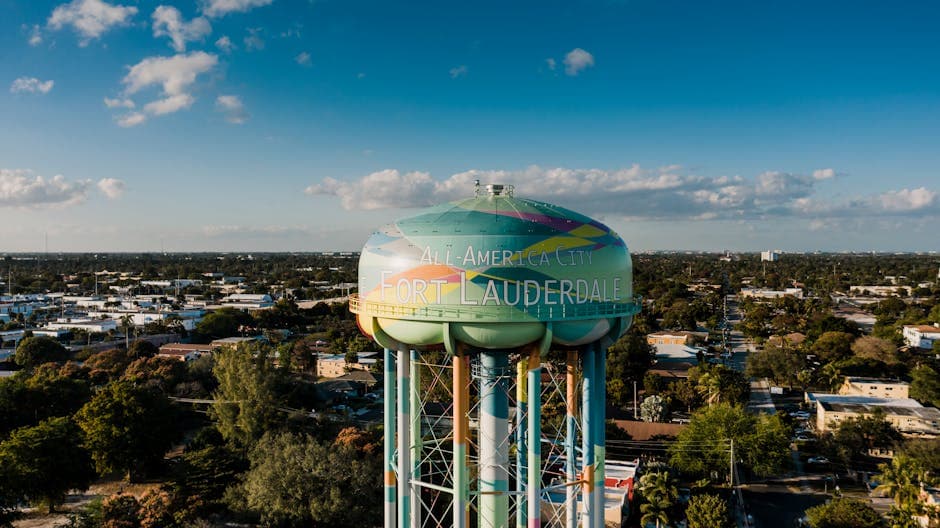
Fort Lauderdale, FL / Yacht Capital + Las Olas

One hundred sixty-five miles of waterway,
and a boulevard that runs through all of it.

Fort Lauderdale is the only US city that calls itself the Yacht Capital of the World and gets to back it up with roughly 165 miles of navigable inland waterways, more than one hundred marinas, and a registered yacht stock north of fifty thousand. Every October the Fort Lauderdale International Boat Show, the largest boat show on the planet, lands six exhibit sites along the Intracoastal and draws a hundred thousand attendees. Las Olas Boulevard is the spine that connects the boats, the dining rooms, the weddings, and the cruise terminal. DirectOrders is built for restaurants on that spine.

~165 mi
Navigable inland waterway
City of Fort Lauderdale, official figure
~50K
Registered yachts, Broward
FL FWC vessel registry, Broward County
~100K
FLIBS October attendees
Informa Markets, the world's largest boat show
7.0%
Combined FL + Broward sales tax
6.0 percent state plus 1.0 percent local

01 / Fort Lauderdale section

Opening scene

Las Olas Boulevard, Thursday of Boat Show week, 7:14 p.m.

The host stand at the bistro on the 800 block of East Las Olas runs on a paper book and an iPad. The book is for the owner. The iPad is for the platform. The owner trusts the book. The book says the 7:30 four-top is a yacht broker from Newport Beach who has been here three Octobers in a row, his guests are buyers from Genoa and Sydney, and the reservation is followed by a closing dinner two days later for fourteen at the same table.

The phone rings. It is the marina manager at Bahia Mar calling for an off-vessel catering order at noon Friday for twenty-eight. The order has to be packed for a sportfish with limited galley storage and a midday departure window. The host writes the marina slip number on the book, then writes it again on a yellow sticky note, then thumbs across the iPad to enter the order into the catering form. The catering form does not let her save the slip number. She sticks the note to the screen.

The bell over the front door rings. A couple from a cruise ship at Port Everglades wants a table for two. Their ship boards back at eleven. They have a guide to South Florida they downloaded onto a phone that has no service because T-Mobile dropped them coming up the New River. The host hands them a paper menu and points at the wine list with a pen. Three languages happen in ninety seconds: English, Spanish, and the kind of polite international English a couple from Hamburg uses to read a Florida wine list.

Outside, two valet stands are running. The first is the restaurant's own. The second is the yacht show's overflow valet, set up Wednesday morning and tearing down Sunday night. Three blocks east, the New River runs south of Las Olas, busy with tenders and water taxis. Five blocks west, Federal Highway runs north toward Wilton Manors. Twenty-six blocks south, Port Everglades is moving a cruise ship out of the channel and into a Bahamas turn. All of those economies are seated, or trying to be seated, inside this one dining room tonight.

The bistro will do roughly two hundred and forty covers by eleven. Eighty more will be catering pickup tomorrow at eleven thirty for the Bahia Mar marina order. Sixty more will be a Saturday brunch wedding party off Las Olas Isles. None of those three channels run cleanly through the same software, and the owner is paying twenty-five to thirty percent commission on a chunk of the catering because the platform that takes the order is the only one the marina knows. The rest of this page is about why none of that has to be true.

02 / Fort Lauderdale section

The FLIBS playbook

Five days in late October, six exhibit sites, the largest boat show in the world

AtlanticA1A barrier islandIntracoastalWaterwayNew RiverLas Olas BlvdLas Olas CausewayUS 1 / Federal HwyHall of Fame Marinain-water sailLas Olas Marinain-water sail + powerHilton Marinabroker showroomPier Sixty-Sixin-water large yachtBahia Maranchor site, superyachtsConvention Centeron-land exhibitor hallsNFLIBS exhibit site (six total)Las Olas Boulevard (dining spine)Intracoastal Waterway and New River

Figure 1. Stylized site map of the Fort Lauderdale International Boat Show. Six exhibit sites span the Intracoastal from Bahia Mar to Pier Sixty-Six to the Hall of Fame Marina to the Las Olas Marina to the Convention Center and Hilton Marina. The Show runs five days, late October, with a Wednesday preview day and a Thursday through Sunday public run. Source: Informa Markets official site map.

The Fort Lauderdale International Boat Show, known inside the industry as FLIBS, is the largest in-water boat show in the world by both attendance and brokerage volume. Informa Markets, the global trade show operator, runs the event. It runs five days every October, with a Wednesday preview day for buyers and a Thursday through Sunday public run. Attendance lands near one hundred thousand. Sailboats, sportfish, motoryachts, megayachts, and superyachts are exhibited in the water across six sites.

For a Las Olas or downtown restaurant, FLIBS is the single most important calendar week of the year. Hotel occupancy along East Las Olas, the Beach corridor, and the I-Drive-equivalent stretch on Seventeenth Street runs at or above ninety-five percent for the full run, with hotel rates often two to three times shoulder season. The buyers are international, the brokers are American, and the catering envelope is enormous: closing dinners, broker hospitality, vendor receptions, and on-vessel galley overflow orders that go straight to the slip.

The operational problem is volume and routing. A Las Olas operator might run two hundred and fifty covers a night during the Show, plus ten to twenty catering drops to marinas, plus a wedding rehearsal or two on the weekend nights, plus the regular Saturday brunch trade from local residents who refuse to give up their Saturday because the Show is in town. The phone rings more in five days than in the previous five weeks. The online ordering page sees a spike of out-of-market traffic from buyers searching the city for the first time.

Marketplace apps handle none of this well. They route by street address, which fails for a slip number at Bahia Mar. They cap delivery fees on $10 lunch orders and have no way to model a $1,200 closing dinner with a captain pickup window. They do not have the bilingual phone capacity for an Italian broker calling for a Saturday lunch reservation at noon. They take twenty-five to thirty cents on every dollar that does flow through them. Direct ordering, with marina-aware catering quoting and bilingual voice AI on the phone line, returns the week to the operator.

The Show also has a half-life. Buyers who fly in for the week often come back for a closing dinner six weeks later when the deal funds. Brokers visit the city ten times a year. Boatbuilders and yacht designers run their fall and winter client cycles through Fort Lauderdale dining rooms. The operator who captures the customer file in October owns a steady rebooking stream for the next three quarters. The marketplace, by contrast, hands you the order and keeps the customer.

This is the single best argument in Fort Lauderdale for owning your own digital surface. If your busiest five days of the year are routed through a third party, the customer who came for a yacht and stayed for a closing dinner does not belong to you in November. With direct ordering, that customer is in your file by Friday night, gets the Saturday brunch SMS, and shows up again in March for an off-season visit.

The same playbook works for the Palm Beach International Boat Show in March and the Miami International Boat Show in February. Three boat shows, one customer file. Direct ordering is the surface that compounds across all three.

03 / Fort Lauderdale section

The Yacht Capital, sized

One hundred sixty-five miles of navigable inland waterway, one hundred-plus marinas, fifty thousand registered yachts

AtlanticIntracoastal WaterwayNew RiverLas Olas IslesRio VistaCoral RidgeTarpon RiverSunrise HbrBahia MarPier 66Lauderdale Marine CtrCity MarinaNew River yardsLas Olas BlvdDowntownNInland waterway (~165 navigable miles)Marina or yacht yard (Broward ~100+)Las Olas Boulevard (dining spine)

Figure 2. Stylized waterway atlas of Broward County and the City of Fort Lauderdale. The city's own figure of roughly one hundred sixty-five miles of navigable interior waterway is concentrated along the New River, the Middle and Stranahan branches, Las Olas Isles, Rio Vista, Bay Colony, Coral Ridge, and the Intracoastal. Marina counts come from the Marine Industries Association of South Florida.

The city's own published figure is roughly one hundred sixty-five miles of navigable inland waterway inside the city limits. That is more navigable interior waterway than any other US city, including comparable marine cities like Annapolis and Newport. The Marine Industries Association of South Florida estimates Broward County hosts over one hundred marinas and yacht facilities, anchored at Bahia Mar, Pier Sixty-Six, Hall of Fame, Las Olas, Sunrise Harbor, Lauderdale Marine Center, and several dozen smaller yards along the New River.

The Florida Fish and Wildlife Conservation Commission publishes vessel registrations by county. Broward County consistently registers north of fifty thousand vessels, making it one of the top-three boating counties in the United States. The economic footprint of the marine industry in South Florida, according to MIASF, is the largest single-cluster marine economy in the country, roughly twenty billion dollars in annual economic output across boatbuilding, brokerage, refit, crew, services, and charter.

For a restaurant, this geography produces a customer base that is intermittent, high-spend, and routed by water as often as by street. A megayacht crew of twelve places a Wednesday provisioning order to a Las Olas grocery and a Thursday catering order to a Las Olas restaurant, with delivery to a slip at Pier Sixty-Six. The crew's home port might be Antigua, or Palma, or Newport. The captain pays in cash. The chef texts the next order in Spanish from a phone with an Italian SIM. None of this fits the marketplace pickup flow.

Direct ordering with marina-aware catering quoting, multi-language phone handling, and pickup vs slip delivery options is the only configuration that handles the water-routed customer cleanly. Every marina has a different drop protocol. Every captain has a different timing window. The operator's own customer file is the only place that institutional knowledge lives. A third party platform is built to ship the order, not to remember the slip number.

The other half of the geography is the residential waterfront. Las Olas Isles, Rio Vista, Coral Ridge, Bay Colony, Idlewyld, Seven Isles, Nurmi Isles, the Tarpon River neighborhoods. These are dense single-family blocks with private docks at the back of the lot, ordering Friday night takeout to come in by car to the front of the house. Same kitchen, same menu, two different doorways. The operator who remembers which house wants the order at the dock and which house wants it at the door has solved a Fort Lauderdale problem the marketplace cannot solve.

04 / Fort Lauderdale section

Port Everglades and the cruise turn

One of the busiest cruise ports in the world, the deepest US East Coast port south of Norfolk

PORT EVERGLADES, RELATIVE PASSENGER FLOW BY DAY0255075100Relative passenger flow (index)Mon18Tue24Wed32Thu58Fri70Sat92Sun96Oasis-classSaturday and Sunday concentrate the weekly turn. Pre-cruise dinner Fri-Sat. Post-cruise brunch Sun.Weekday turnPeak weekend turn

Figure 3. Schematic of Port Everglades cruise activity by week. Port Everglades is one of the world's three busiest cruise ports by passenger volume (alongside Miami and Canaveral), and per Broward County the deepest port on the US East Coast south of Norfolk, Virginia, with channel depths supporting the world's largest cruise ships. Saturday and Sunday are the heaviest turn days. Source: Port Everglades Department, Broward County.

Port Everglades sits at the south end of the city, bordering Dania Beach and Hollywood, and is the third-busiest cruise port in the world by passenger count, after PortMiami and Port Canaveral in some years, swapping positions year to year. Per Broward County, Port Everglades is the deepest port on the US East Coast south of Norfolk, Virginia, with channel depths that accept the world's largest cruise ships, including the Oasis class and Icon class Royal Caribbean vessels that exceed 250,000 gross tons.

Cruise turns happen most heavily on Saturday and Sunday, with secondary turn days on Thursday and Friday. A typical large turn moves five to seven thousand passengers off and back on the same ship inside ten hours. The arriving passengers fly in to FLL on Friday night or Saturday morning, stay near the airport, eat dinner on Las Olas or in Hollywood, then transfer to the ship in the morning. Departing passengers reverse the pattern. The Fort Lauderdale restaurant calendar is shaped by cruise weekends as much as by the boat show calendar.

For a downtown or Las Olas operator, the cruise weekend creates two distinct order streams. The pre-cruise dinner stream runs Friday and Saturday evening, typically four-tops and six-tops of multi-generational families, average ticket forty to sixty dollars, paying in English and Spanish with a notable share of Brazilian Portuguese on South American summer cruise weeks. The post-cruise brunch stream runs Sunday eleven to two, disembarked passengers with bags in the car, often spending the day in Fort Lauderdale before a late flight home.

The provisioning channel is the other half. The large cruise lines provision most stock through centralized contracts at scale. The crew, however, orders meals off-ship between turns, the captain's dinner ashore is sometimes a local catering order to a ship galley, and the smaller charter and expedition ships in the secondary terminals run closer to a yacht-style provisioning model. Direct ordering with marina-aware addresses, plus a Voice AI that handles the language mix, makes that channel cleanly addressable.

The other operational fact about Port Everglades is that the port also handles enormous container traffic and is the import gateway for petroleum products for the south Florida market. That means Port Everglades stays open in conditions when other ports close, and cruise turns can be rerouted to Port Everglades during weather disruption elsewhere. An operator who builds direct relationships with port-area hotels and crew is building a recession-resistant channel.

05 / Fort Lauderdale section

From spring break to destination wedding

Reframing six decades of brand inheritance, from Where the Boys Are to the LGBTQ+ wedding capital of Florida

The 1960 film Where the Boys Are, shot on Fort Lauderdale Beach and on Las Olas, did more to set the city's mid- century brand than any tourism campaign. It produced roughly two decades of college spring break that crested in the early 1980s with an estimated three hundred and fifty thousand students arriving each March, eight blocks of A1A clogged from the Bahia Mar to the Las Olas Causeway, and a city economy that depended on the influx for a third of its annual restaurant trade.

The city dismantled that economy on purpose in the late 1980s. The Mayor and the City Commission, alongside the Greater Fort Lauderdale Convention and Visitors Bureau, spent a decade reframing the destination toward families, yacht charter, business travel, and destination weddings. The 2012 film Spring Breakers, which used Fort Lauderdale as a stand-in, was a backward-looking artifact, not a brand restart. The actual restart was the 2000s investment in the Beach Place, the Riverwalk, the Las Olas redevelopment, and the Convention Center expansion.

The reframed Fort Lauderdale today markets itself as the destination wedding capital of Florida and the LGBTQ+ wedding capital of Florida, with Wilton Manors as the second-densest LGBTQ+ population concentration of any US city per US Census American Community Survey data. The Greater Fort Lauderdale CVB invests heavily in LGBTQ+ destination marketing. The wedding venue economy along the Intracoastal, the Riverside Hotel, the Bonnet House, and the dozens of beachfront resorts has displaced the spring-break dependency entirely.

For an independent restaurant, the practical implication is that the March calendar is now anchored by destination weddings, the Palm Beach International Boat Show spillover, and the Tortuga Music Festival on the beach, not by college spring break. The customer who flies in for a Saturday wedding rehearsal at the Riverside Hotel books a Friday welcome dinner for forty at a Las Olas restaurant, a Saturday post-ceremony brunch for sixty at a Flagler Village restaurant, and a Sunday farewell breakfast at the Beach. None of those three orders runs cleanly through a marketplace.

The reframing also widened the calendar. Where spring break compressed business into March, destination weddings spread it across nine months, October through June, with March still the busiest single month. Yacht charter weeks layer onto the same calendar. Cruise weekends layer onto the same calendar. The result is a dining room that runs near full from November through May and a kitchen that has to plan for catering layers every week. Direct ordering with catering quoting, wedding-party flow handling, and customer file persistence is the only configuration that respects that calendar.

06 / Fort Lauderdale section

The Las Olas, Wilton Manors, and downtown atlas

Three commercial spines, three customer bases, one customer file

US 1 / Federal HwyAndrews AveBroward BlvdSunrise BlvdNew RiverLas Olas BoulevardRiverside Hotel800 blk bistrosGalleria districtLas Olas MarinaA1A endWilton DriveWilton Manors (LGBTQ+ corridor)Flagler VillageDowntown / Brightline stopHimmarshee HistoricFLIBSBahia MarPort EvergladesFLL AirportNLas Olas Boulevard (dining spine)Wilton Drive (LGBTQ+ corridor)Downtown / Flagler VillagePort Everglades + FLL

Figure 4. Stylized atlas of the three core commercial dining spines: Las Olas Boulevard from Andrews to A1A, Wilton Drive in Wilton Manors, and the Flagler Village and Himmarshee districts of downtown. The three spines serve three different anchor demographics with material overlap during boat show, wedding, and cruise weeks.

Las Olas Boulevard is the canonical Fort Lauderdale dining spine, running about two miles east from Andrews Avenue downtown to the beach at A1A. The Boulevard mixes destination dining rooms, boutique retail, gallery space, and the Riverside Hotel anchor. The customer base is a mix of yacht customers, hotel guests, wedding parties, the Las Olas Isles residential base, and cruise pre-departure dinners.

Wilton Drive in Wilton Manors is the second commercial spine and the densest LGBTQ+ dining corridor in South Florida. The neighborhood emerged as a center of the LGBTQ+ community in the 1990s and 2000s. Per the US Census American Community Survey, Wilton Manors has one of the highest concentrations of same-sex partnered households of any US city. The Stonewall National Museum and Archives, the Pride Center, and the bars and restaurants along the Drive anchor a weekend economy that runs hard Thursday through Sunday.

Downtown Fort Lauderdale, particularly Flagler Village north of Broward Boulevard and the Himmarshee Historic District west of Andrews, has been the fastest-growing residential and restaurant frontier for the past decade. Brightline service from West Palm Beach and Miami terminates at the Fort Lauderdale station downtown, which has accelerated weekend visitor traffic. The new mid-rise residential development along Federal Highway and US 1 has doubled the downtown resident base.

These three spines share customers and overlap during the big weeks. The yacht broker on Las Olas Wednesday is at a wedding on Saturday and at a Wilton Manors brunch on Sunday. The operator who maintains the customer file across all three visits is the operator who gets the November rebooking and the March return trip. Marketplace apps fragment that file across three accounts and three commission slabs.

Direct ordering with one customer file across the operator's locations, with SMS that segments by neighborhood, and with a checkout that respects local delivery zones, is the only fit for a multi-spine operator. For a single-location operator, the same customer file compounds across the three boat shows, the cruise weekends, the wedding season, and the Tortuga Festival. Six visits a year on a four-hundred- dollar average ticket is a twenty-four-hundred-dollar customer the marketplace would have rented to you at six hundred dollars of fees.

07 / Fort Lauderdale section

The LGBTQ+ wedding capital essay

Wilton Manors, the Greater Fort Lauderdale CVB campaign, and the catering economy that follows

The Greater Fort Lauderdale Convention and Visitors Bureau has, for two decades, run one of the most consistent and measurable LGBTQ+ destination marketing programs in the United States. The campaign began in the early 2000s, accelerated after the 2015 Obergefell decision legalized same-sex marriage nationally, and now positions Greater Fort Lauderdale as the wedding capital of Florida for same-sex couples, with Wilton Manors as the cultural anchor.

Wilton Manors itself is a small city of roughly twelve thousand residents inside Broward County, located just north of downtown Fort Lauderdale along Wilton Drive. Per US Census American Community Survey data, Wilton Manors has consistently ranked at or near the top of US cities by share of same-sex partnered households, often second only to Provincetown, Massachusetts. The City of Wilton Manors has elected predominantly LGBTQ+ City Commissions for two decades and hosts Stonewall Pride, one of the largest LGBTQ+ pride parades in the Southeast.

For a Fort Lauderdale restaurant, the wedding catering economy that flows from this positioning is concrete and measurable. A typical destination wedding weekend in Greater Fort Lauderdale runs three or four catered events: the Friday welcome dinner, the Saturday rehearsal lunch or pre-ceremony brunch, the Saturday reception, and the Sunday farewell brunch. Average wedding catering spend per couple in South Florida, per The Knot's annual real wedding survey, has run in the thirty to fifty thousand dollar range, with the catering line item alone typically eight to fifteen thousand.

The wedding planner is the customer interface, not the couple. A wedding planner books four to twelve weddings per year and develops vendor preferences they reuse. A restaurant that earns a wedding planner's trust earns the entire following year of that planner's bookings. The operator's customer file at the planner level is worth far more than the planner's individual ticket average, because each planner is a multiplier on the annual revenue stream.

Direct ordering with catering quoting that lets a planner save deposit holds, return for menu adjustments, and reorder the same package for the following year's cohort is the configuration that compounds. Marketplace catering tools are built for one-off orders. The wedding planner economy is built on repeat bookings. The math clearly favors direct.

08 / Fort Lauderdale section

The Hispanic and Caribbean community order

Broward County is roughly thirty-three percent Hispanic and roughly nine percent Caribbean Black

Broward County's demographic mix is materially different from Miami-Dade just south. Per the US Census Bureau's most recent American Community Survey, Broward County is roughly thirty-three percent Hispanic or Latino, with significant Colombian, Venezuelan, Cuban, Puerto Rican, Dominican, and Brazilian communities. The Caribbean Black share, with strong Jamaican and Haitian populations, is roughly nine percent of the county, concentrated in central and west Broward, including Lauderhill, Lauderdale Lakes, Miramar, and parts of Sunrise and Plantation.

For a Fort Lauderdale restaurant, the language and cuisine implications are real even if less pronounced than in Miami-Dade. The Las Olas customer base is predominantly English-first, with a meaningful Spanish-first share from the South American business traveler and yacht charter customer pool. The downtown and Flagler Village customer base is younger, more bilingual, with a growing Portuguese-first Brazilian renter population, especially during winter.

Voice AI that handles English and Spanish confidently is the floor for any Fort Lauderdale restaurant. Portuguese capability is a meaningful edge given the South American tourism corridor through FLL and the Brazilian winter renter community. Haitian Creole capability matters for any restaurant with delivery reach into central Broward.

The phone language mix on a typical Fort Lauderdale Las Olas restaurant runs roughly seventy percent English-first, twenty percent Spanish-first, six percent Portuguese-first during peak South American visitor weeks, and four percent other, including French from European visitors and occasional Italian during boat show week. The mix shifts week to week. A bilingual phone tree that picks up in the caller's language captures the order the host stand was about to miss.

Bilingual checkout on the ordering site is the next surface. A Spanish-first menu toggle at the top of the page, with prices in both languages and dietary filters that translate cleanly, increases conversion on the Spanish-first share materially. The catering quote form, in particular, benefits from a Spanish toggle, since the customer placing a wedding or reunion catering order is often the family matriarch whose first language is Spanish.

The receipts, the SMS confirmations, the post-order email flows should match the language of checkout. The kitchen ticket prints in English. The customer facing channel matches the customer. Direct ordering is what makes that asymmetry simple.

09 / Fort Lauderdale section

Hurricane operational continuity

Atlantic basin June 1 to November 30, peak September, the operator's worst weeks are the substrate

Per NOAA's National Hurricane Center, the Atlantic basin hurricane season runs June 1 through November 30, with peak activity in mid August through mid October. Fort Lauderdale is squarely inside the Atlantic basin landfall corridor. Hurricane Andrew in 1992 missed Fort Lauderdale by twenty miles to the south. Hurricane Wilma in 2005 passed directly over the city. Hurricane Irma in 2017 prompted a county-wide evacuation order. The city loses power, flooded streets, and a week of trade roughly every other year on average.

The structural operational reality for a restaurant is that the busiest single week of the year (FLIBS, late October) sits at the tail end of hurricane peak season. Operators have to plan for the possibility of a Category 1 or 2 strike landing on the Wednesday of FLIBS, displacing inventory, shutting down marina power, and forcing rebooking of catering orders that were already paid for.

Port Everglades is part of the operational geography. Cruise lines reroute ships to Port Everglades during weather disruption at other ports, but a direct strike on Fort Lauderdale closes Port Everglades for two to four days. The cruise weekend that would have generated four hundred covers across the dining room vanishes. The catering orders for the next ship turn cancel. The restaurant has to pivot to local resident pickup, neighborhood SMS, and emergency provisioning of nearby hotels.

The channel that survives the storm is the operator's own customer file with SMS consent. After Wilma in 2005 and Irma in 2017, the Las Olas and Wilton Manors operators who had built direct customer lists reopened in days. Those who relied on marketplace apps waited for the marketplace to redeploy couriers to the city, which took up to two weeks in some ZIPs. SMS to the customer file announcing reopening windows, limited menus, cash backup, and curbside pickup is the only channel the operator controls.

Direct ordering with banner toggles for storm mode, voice AI fallback messaging in storm mode, and same-day Stripe payouts that survive a 72-hour bank settlement gap is what an operator needs in September and October. The same banner toggle that announces storm mode in October is the same toggle that announces a kitchen fire repair in March or a power outage in July. The substrate works in both weathers.

The hurricane substrate is also the reason a Fort Lauderdale operator should not rely on a single delivery courier pool. Uber Direct as primary, DoorDash Drive as fallback, plus a local courier roster for storm weeks is the only configuration that survives the year. Marketplace apps that demand exclusivity to ship at all are charging the operator a hurricane tax disguised as a commission.

10 / Fort Lauderdale section

The 7 percent combined sales tax close-read

Florida state 6.0 percent plus Broward County 1.0 percent local discretionary surtax

Per the Florida Department of Revenue, the state sales tax on prepared food in Florida is 6.0 percent. Per Broward County's discretionary sales surtax filing, Broward County levies an additional 1.0 percent local surtax. The combined rate on a prepared food sale in Fort Lauderdale is 7.0 percent, identical to Miami-Dade, and 1.5 percentage points lower than Hillsborough (Tampa) at 8.5 percent during the recent surtax window.

Per Florida statute, sales tax on food prepared for immediate consumption is collected by the operator and remitted monthly to the state, which then distributes the local share to the county. The operator's checkout has to compute the right rate, display it transparently to the customer, and remit on the right schedule. A direct ordering platform that computes the wrong rate on a Las Olas Boulevard transaction creates a state liability the operator has to clean up at filing time.

Delivery fees, in Florida, are generally subject to sales tax when the delivery is part of the prepared food sale. Service charges and gratuities follow specific Florida Department of Revenue rules. Direct ordering platforms have to be configured to apply these rules cleanly. The marketplace platforms vary in how cleanly they remit the surtax portion, which sometimes leaves the operator on the hook for the local share at the end of the year.

Out-of-state buyers, especially yacht customers during boat show week and cruise customers during weekend turns, sometimes ask whether their purchase is exempt from Florida sales tax. The answer is generally no for prepared food consumed in Florida, regardless of buyer residency, with narrow exemptions for foreign diplomatic missions and certain non-profit entities. The yacht itself may be exempt under specific Florida statute for certain commercial vessels in transit, but the catering order delivered to the slip is taxable.

Charter and crew catering orders to vessels with Florida registration follow the same 7 percent rule. Out-of-state and foreign-flagged vessels follow the same rule, but operators sometimes try to argue exemption based on the flag. The Department of Revenue rejects this position. A catering quote that does not include the 7 percent tax line is a quote that will be adjusted at pickup time, which is a poor customer experience.

Direct ordering with a tax engine that knows the Fort Lauderdale ZIPs (33301, 33304, 33305, 33308, 33309, 33311, 33312, 33315, 33316, 33394) and the Wilton Manors ZIP (33305 north of Northeast 26th Street, plus 33334 south of Oakland Park), and that handles the FL exemptions cleanly, is the configuration that protects the operator at filing time. The marketplace alternative is a monthly reconciliation tax that lands in February and lasts until March.

11 / Fort Lauderdale section

How DirectOrders fits Fort Lauderdale

One stack across Las Olas, Wilton Drive, downtown, and the marina catering envelope

Argument 01

The Fort Lauderdale operator's problem is not visibility. It is calendar density and channel routing.

Las Olas operators are visible. The customer pool walks past the front door every Saturday and arrives by tender every Wednesday. The problem is that the calendar density during peak weeks (FLIBS, wedding weekends, cruise weekends, March destination wedding peak) overloads the host stand, the catering coordinator, and the phone line, and the operator pays a marketplace commission on the slice that does not have to flow through a marketplace at all.

Our job in Fort Lauderdale is to make direct ordering, direct catering quoting, and direct phone capture so good that the marketplace becomes the marginal channel, not the main one. Voice AI on the phone, marina-aware catering quoting, wedding-planner repeat handling, and same-day Stripe payouts return the calendar to the operator.

Argument 02

One stack handles the three spines. One customer file persists across all of them.

A multi-location operator on Las Olas and Wilton Drive runs two locations on one customer file. A single-location operator on the Boulevard captures the same yacht customer across FLIBS, the post-show closing dinner, the spring wedding catering, and the summer rental of the Las Olas Isle home. One file. One menu. One admin. One vendor.

We replace the typical seven-system stack (Wix, Square, DoorDash, Uber Eats, Mailchimp, Toast plugin, Google Forms catering) with a single substrate. Direct site, direct ordering, voice AI on the phone, SMS and email on the marketing channel, catering quoter for FLIBS and weddings, loyalty and gift cards on the retention channel, same-day payout on the cash channel.

Argument 03

The Fort Lauderdale product ships bilingual or it does not ship.

The English-Spanish floor is non-negotiable in Broward County. Portuguese capability is a meaningful edge for the South American business and FLL transit pool. The bilingual menu, the bilingual checkout, the bilingual voice AI are not nice-to-have for the Las Olas operator. They are the floor.

Our Spanish toggle is built into the customer-facing menu. The kitchen ticket prints in the line's language. The customer chooses their own language. The receipts, the SMS confirmations, the post-purchase email flows match. The voice AI handles the same toggle on the phone. One product.

Argument 04

Storm operations is the substrate, not a checkbox.

Andrew, Wilma, Irma, Ian. Direct hits or near-misses every two to four years. Inventory loss, multi-day outages, marketplace courier withdrawal, cruise turn cancellations, FLIBS week disruption. A Fort Lauderdale direct ordering platform that does not bake storm mode, banner toggles, voice AI in storm mode, emergency catering pages, and same-day payouts into the admin is a platform that fails the moment the operator needs it most.

We design for the worst week of the year and let the rest of the year inherit the structure. The same banner toggle that announces storm mode in October is the same one the operator runs for a kitchen repair in March. The substrate works in both weathers.

Why this fits

A flat monthly fee, trilingual voice AI, marina-aware catering, and same-day payouts. The Fort Lauderdale fit, top to bottom.

Flat monthly fee handles the calendar swing from FLIBS October peaks to summer shoulder. Trilingual voice AI in English, Spanish, and Portuguese captures the South American visitor and the South Florida resident with one phone line. Marina-aware catering quoting respects the slip-number, captain-pickup reality of the yacht customer. Same-day Stripe payouts keep the cash flow geometry of a small Las Olas kitchen workable through the seasonal swing.

Coda

Two paths from here

Path one

Read the platform the way a Las Olas operator would.

Sit with the pricing page. Read the line about the flat monthly fee. Trace how the voice AI handles a 7 p.m. Saturday call in Spanish, then in English, then in Portuguese during boat show week. Compare it to your current phone tree. Decide for yourself whether it fits the kitchen.

See the pricing

Path two

Book twenty minutes with a Fort Lauderdale specialist.

A demo here is not a slide deck. It is a working call where we set up the trilingual voice AI on a Fort Lauderdale menu, run a Bahia Mar slip-number catering scenario, and walk through a destination wedding catering quote. Bring last week's phone log. We will look at it together.

Book a Fort Lauderdale demo

The Boulevard runs east. The Drive runs north. The Intracoastal runs both ways. Port Everglades turns the ships on Saturdays. FLIBS lands in October. The wedding calendar opens in March. The phone keeps ringing in three languages. The only question is what software, and whose customer file, is in the kitchen when it does.

References

Sources and citations

Every figure on this page is sourced. Volumes are reported as ranges in published sources and we use the published ranges here. The waterway atlas, the FLIBS site map, the Port Everglades weekly flow, and the neighborhood atlas are schematic illustrations of public information, not surveyed maps.

Last reviewed by the DirectOrders editorial team for the Fort Lauderdale market. Restaurant locations on the Las Olas, Wilton Drive, and Flagler Village atlas are visualized for cluster pattern only and should not be taken as a directory of specific operators. Statistics for the Fort Lauderdale International Boat Show, Port Everglades, Broward County demographics, and Florida sales tax are drawn from the cited public sources at time of publication.

Keep exploring

More Florida cities and nearby markets

All Florida cities →