It is the third Thursday in September at 5:24pm on Grandville Avenue, the Founders taproom is at 86 percent of capacity, and ArtPrize is opening downtown in 36 minutes.
A long read on the city that has won Beer City USA more than once, the 19-day ArtPrize that turns downtown into a gallery walk for 500,000 visitors every fall, the Medical Mile that runs lunch and shift-change orders 24 hours a day, the furniture industry headquartered in Steelcase, Herman Miller, and Haworth that shapes corporate catering, and the Dutch, Vietnamese, Mexican, and Bosnian neighborhoods that share the West Side and the south Beltline.
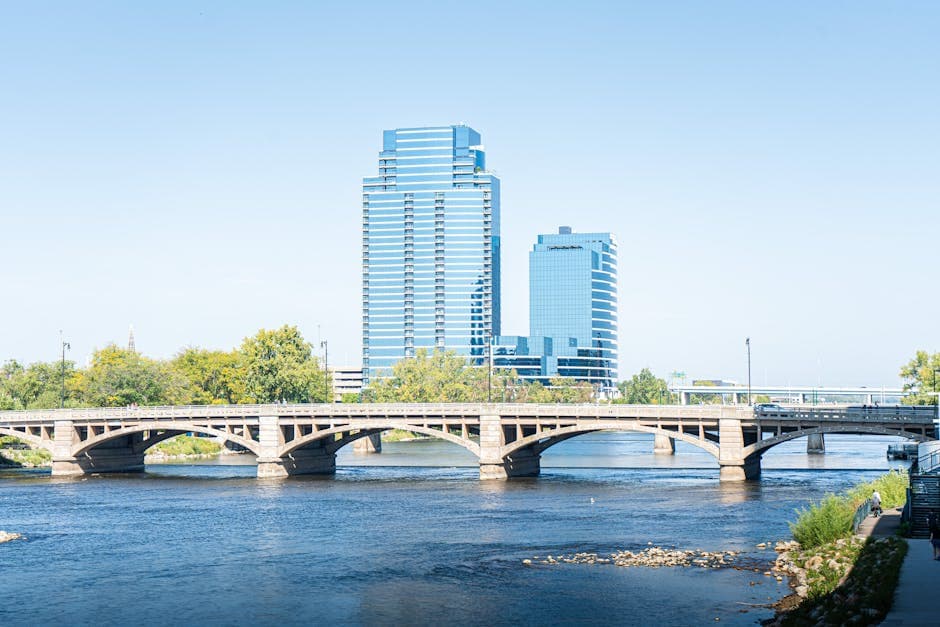
On a Thursday afternoon in mid-September, on Grandville Avenue four blocks south of the BoB and three blocks north of the Founders production brewery, the corner taproom that helped put Grand Rapids on the brewing map fills its 380-seat patio and 240-seat indoor dining room by 5:24pm. Outside, the air carries that particular West Michigan late-summer crispness, the kind that has parents driving in from Cascade and Forest Hills with their kids, the kind that has gallerists from the Avenue for the Arts in tuxedo sneakers and ArtPrize lanyards pacing the sidewalk waiting for tables.
ArtPrize opens downtown in 36 minutes. The competition, founded in 2009 by Rick DeVos as a citywide 19-day public art event with no jury preference between the public vote and the curated prizes, has grown into a half-million-visitor cultural occasion. Galleries on Division Avenue and the Heartside neighborhood have been preparing for weeks. The Calder Plaza, with Alexander Calder's 43-foot vermillion sculpture La Grande Vitesse anchoring the city's downtown since 1969, is the official ArtPrize opening site. Reserve Wine & Food on Ottawa Avenue, MeXo on Monroe Center, San Chez Bistro on Fulton, and Donkey Taqueria on Wealthy Street are all sold out at the OpenTable level.
The Founders taproom is not technically downtown; it is in the south-of-downtown brewery district that grew up around the production facility after the brewery moved from its original 1997 Brass Works location to the Grandville Avenue campus. The taproom kitchen runs a 120-cover-per-hour pace through the dinner rush. Roughly 38 percent of the bar volume is house beer; the remaining 62 percent is food, sodas, and a cellared list of Founders specialty releases like KBS and CBS that long-running fans drive in for. On an opening ArtPrize Thursday the kitchen will turn 1,100 covers across the night, with the 5:30pm-to-8:00pm dinner block alone delivering 720 of them, and a steady pre-walk takeout stream from 4:30pm to 6:15pm.
Founders is anchor; the rest of the city is the chorus. Across the 19 days of ArtPrize, Brewery Vivant in East Hills serves wood-fired pizza on a packed Friday lawn; HopCat on Ionia runs through Cosmik Fries by the metric ton; New Holland's Knickerbocker on Bridge Street books pre-walk dinners in 75-minute blocks; the Wealthy Street corridor turns over its tables on a 90-minute clock; and the Medical Mile to the north, mostly indifferent to ArtPrize but reliable as a Swiss watch, continues to run its five daily shift-change order windows the way it does the other 346 days of the year.
Grand Rapids is not Detroit, and it is not Chicago, and it is not Madison. It is something West Michigan: more brewing per capita than most US cities, a downtown art competition that pulls record covers, a Medical Mile that drives lunch every day at noon, a furniture industry that shapes the corporate catering rhythm, and a Dutch heritage backbone with a Vietnamese, Mexican, and Bosnian present. The technology stack a Grand Rapids operator runs has to know all of these things in advance.
This is a magazine read on the city as it actually operates and on what direct ordering does for the operator who pays attention to those rhythms.
Grand Rapids has more breweries per capita than most US cities. Founders on Grandville Avenue is the anchor. Brewery Vivant, New Holland, and HopCat are the next tier. Forty-plus producers fill in the rest.
Founders Brewing was founded in 1997 by Dave Engbers and Mike Stevens, originally at a Brass Works site, and moved to the Grandville Avenue production campus and taproom in 2007. The brewery's Kentucky Breakfast Stout (KBS) and Canadian Breakfast Stout (CBS) became national specialty releases through the 2010s. The Grand Rapids brewing cohort earned the Beer City USA designation more than once in the early 2010s; the Michigan Brewers Guild today catalogs more than forty active producers within a 30-mile radius of downtown.
The Beer City story is a story of three eras. The first era is the pre-craft heritage: Grand Rapids was a German and Dutch settlement from the 1830s onward, and the original Grand Rapids Brewing Company opened on the West Side in 1893 and ran until Prohibition. The original GRBC building was a Cream City brick anchor; the brand was revived in the early 2010s as a downtown brewpub on Ionia Avenue, in part as an homage to the city's pre-Prohibition brewing roots.
The second era is the craft pioneers. Founders Brewing opened in 1997 by Dave Engbers and Mike Stevens; New Holland Brewing (technically in Holland, MI, a 30-minute drive west) opened in 1997 as well. By the late 2000s these two had become regional anchors, and Bell's Brewery from Kalamazoo had become a third West Michigan anchor selling into the GR market. HopCat opened in 2008 on Ionia, became a downtown destination, and now anchors the corner where ArtPrize gallery walks cross the brewery district. Brewery Vivant opened in 2010 in a converted East Hills funeral chapel, with a Belgian farmhouse program that broke the mold of Midwest craft.
The third era is the neighborhood density. Between 2012 and 2018, more than two dozen neighborhood brewpubs opened across the metro: Harmony Brewing in Eastown, Mitten Brewing in a West Side firehouse, Perrin Brewing in Comstock Park, Elk Brewing on Wealthy Street, City Built on the West Side with a Puerto Rican-Mexican kitchen, Atwater Detroit's downtown GR satellite, Speciation Artisan Ales for mixed-fermentation specialists, and a dozen more. Each is small (5 to 25 barrels), each runs its own kitchen, and each anchors a four-to-eight-block neighborhood.
The implication for direct ordering is structural. Brewpubs are not third-party-marketplace-native businesses. A brewpub's economics depend on pints sold at the bar, food cleared from the kitchen, and the cellared specialty release a regular drives in for. The marketplace cannot deliver a fresh pint; it can deliver food at a 22 percent commission haircut that compresses the kitchen margin. The direct channel, configured with a 12-tap-rotation page that shows what is on right now, a Wednesday-to-Sunday in-house kitchen menu, a Friday charcuterie-and-pizza pickup pack, and a Saturday brewery-tour-and-takeout combo, captures the brewpub regular who treats the place as a neighborhood institution rather than a delivery convenience.
"The marketplace cannot deliver the pint. The direct channel sells the food, the pickup pack, and the four-pack of house brew that goes with it. The pint stays at the bar where it belongs."
ArtPrize is 19 consecutive days every fall, with no jury preference between the public vote and the curated awards, drawing 500,000-plus visitors to downtown galleries. Restaurants in the gallery-walk ring see a 28 to 102 percent cover surge.
ArtPrize was founded in 2009 by Rick DeVos. The competition runs across more than 150 downtown venues (galleries, museums, breweries, churches, hotel lobbies, the lobby of the BOB) for 19 consecutive days from mid-September through early October each year. The juried prize and the public-vote prize each award a $200,000 top award (the amounts have varied across editions). The festival has been credited by Experience Grand Rapids with driving tens of millions of dollars of direct visitor spend across each 19-day window.
The 19 days are the most consequential restaurant event of the Grand Rapids year. Downtown hotel occupancy on the first and closing Saturdays approaches 100 percent (Experience Grand Rapids reporting); the gallery-walk traffic spreads from the Heartside Historic District north to the Calder Plaza and east along the Monroe Center pedestrian street; the cover surge in the restaurant ring inside a half-mile of the Calder runs at +88 to +102 percent on peak Saturdays vs a non-ArtPrize Saturday baseline. The Wealthy Street corridor, twelve blocks east of downtown, gets meaningful spillover, with Brewery Vivant, Donkey Taqueria, and Linear all reporting +50 to +70 percent covers on peak ArtPrize days.
For the operator, the playbook is three lines and one staffing decision. Line one: build a 19-day pre-order pickup workflow on the direct ordering site that opens September 1 (two weeks before the festival) and runs through closing Sunday. The pickup pack is dinner that visitors can carry on the gallery walk: an $18 single-person picnic, a $48 two-person picnic, an $88 four-person family pack. The marketplace cannot do this; the marketplace is built for delivery, not for pickup on a walking gallery tour. Line two: pre-load the SMS calendar against the festival schedule, with an opening-Thursday push at 11am, a first-Saturday push at 9:30am, a middle-Saturday push the day before, and a closing-Saturday push three days ahead (which is when first-and-closing-Saturday Open Table inventory typically fills). Line three: route delivery during the festival via commercial courier (Uber Direct, DoorDash Drive) rather than gig marketplace, because the gig dispatch queue lengthens meaningfully during the festival as drivers chase visitor surge tipping.
The staffing decision is the kitchen. ArtPrize covers exceed every reservation system's capacity at the peak. A 60-seat dining room turns 80 to 100 covers on a normal Saturday; that same room turns 140 to 180 covers on a peak ArtPrize Saturday with a coordinated takeout pickup workflow. The kitchen has to be staffed for the upper end. Most operators understaff the first time they run a festival; the second time, they staff the upper end and discover that the takeout workflow funds the additional kitchen labor with margin to spare.
The customer acquisition piece is the long tail. 500,000-plus annual visitors, with a meaningful share traveling in from Chicago, Detroit, Indianapolis, Cleveland, and the Twin Cities, means a QR code on an ArtPrize-week table tent or a takeout-bag insert can drive direct-channel SMS opt-ins at a rate the marketplace channel cannot match. The list compounds across years. A restaurant that runs an ArtPrize takeout workflow for five years has a 4,000-name SMS list of regional repeat customers who treat that restaurant as part of their annual Grand Rapids visit. The marketplace will never surface those customers to the operator.
"Nineteen days. Three Saturdays that run like Christmas Eve. A QR code on the table tent that adds 600 names to the regulars list. Plan against the calendar."
Corewell Health, the Van Andel Institute, the Cook Institute, and the Helen DeVos Children's Hospital run a quarter-mile shift-change clock that drives five reliable lunch and shift-change order windows, six days a week, year-round.
The Medical Mile is the half-mile stretch of Michigan Street NE from College Avenue east to Bostwick Avenue, anchored by Corewell Health (the merged Spectrum Health and Beaumont Health system, with the flagship Butterworth Hospital and the Helen DeVos Children's Hospital on this corridor), the Van Andel Institute (biomedical research, founded in 1996 by Jay Van Andel of Amway), the Cook Institute (research extension), and a network of Michigan State University College of Human Medicine clinical-rotation sites. The corridor is the largest single concentration of healthcare and biomedical research employment in West Michigan.
Hospital catering and shift-change ordering are the steadiest restaurant business in the city. Unlike ArtPrize (19 days, once a year) or Beer Week (one week each February), the Medical Mile rhythm is operationally permanent: hospitals run 24-hour staffing on a three-shift model, day shift starts at 7am and ends at 7pm, evening shift at 3pm and ends at 11pm, overnight shift at 11pm and ends at 7am, and the order windows pile up against each shift handoff and around the midday lunch peak.
For a cafe inside the half-mile ring of the corridor, the lunch peak at noon is the single largest weekday order block of the day, with department-head pre-orders firing from 10:30am to 11:45am for delivery between 12:00pm and 12:45pm. The 7am breakfast block is the second peak, driven by day-shift nursing standups and morning team meetings. The 3pm shift-change block is a secondary lunch, driven by evening-shift staff arriving early. The 5pm evening-shift dinner block is the most catered of the five (family-style trays for 8-to-12-person ICU pods). The 10pm late-dinner block is the smallest but most reliable for overnight-staffed units.
The operational unlock is a direct ordering site with five named pickup-and-delivery windows, plus a department-by-department billing flow that lets a floor manager invoice the order against a department cost center rather than a personal card. The marketplace cannot do department invoicing; it sells to the personal card or to a single corporate account. A direct site can split a $640 lunch order across four floors of the Helen DeVos Children's Hospital with four different billing references, which is the only way the financial-operations side of the hospital pays for repeated catering across the year. A bilingual phone (English, Spanish for Mexican American kitchen support staff, Vietnamese for the radiology-tech cohort, Bosnian for the south-Beltline nursing cohort) catches the order-confirmation calls.
The catering side compounds. A cafe that wins the Tuesday lunch for one Corewell department gets the Thursday lunch the next month if the food is good and the delivery is on time. After eighteen months the cafe is running standing orders for fifteen to twenty-five departments across the corridor, with the catering side at 60 to 65 percent of weekly revenue. That is the largest single moat a Grand Rapids restaurant can build, and the marketplace channel cannot get there.
"Eighteen departments. Twenty-three weekly windows. The site invoices each floor. We just cook."
Three of the world's largest office-furniture makers are headquartered within 30 miles of downtown Grand Rapids. The corporate-catering rhythm shapes a meaningful slice of West Michigan restaurant revenue.
Steelcase, founded in 1912 in Grand Rapids as the Metal Office Furniture Company, is headquartered on Buchanan Avenue and operates the Steelcase Innovation Center on its 600-acre Caledonia township campus. The company employs roughly 8,000 people across West Michigan. Herman Miller, founded in 1905 in Zeeland (about 30 minutes southwest of GR), is the design-led counterpart, headquartered on Front Street in Zeeland with multiple satellite design studios and a manufacturing footprint across Holland and Zeeland. Haworth, founded in 1948 in Holland MI, rounds out the regional triumvirate. Together, the three companies are the global cluster for office and contract furniture, and West Michigan's identity as the furniture capital of the world is partly accurate (Chicago overlapped historically; West Michigan now leads).
For Grand Rapids restaurants, the furniture industry shows up as a steady stream of corporate catering: design-team lunches, client-visit dinners, all-hands breakfast meetings, and a sustained Friday-afternoon "wrap the week" team-celebration rhythm. The Steelcase Innovation Center alone catered roughly 280 events in a typical pre-2020 year, per public Steelcase communications around its sustainability and procurement practices. The Herman Miller campuses in Zeeland and Holland drive weekly catering volume for Wealthy Street and Eastown operators willing to deliver out to Ottawa County. Haworth's One Haworth Center in Holland adds a third center of gravity.
The catering customer here is different from the Medical Mile customer. Hospital catering is recurring and standardized; furniture-industry catering is irregular, premium, and design-conscious. A Wealthy Street chef-driven restaurant that builds a relationship with a Steelcase procurement coordinator on a once-a-month standing reservation will catch a four-times-a-year client-visit dinner with margins triple the weeknight neighborhood plate. The same restaurant will catch a once-a-year all-company "design week" lunch order that books eighteen weeks ahead and tickets at $4,800 across 80 people.
A direct ordering site with a "corporate accounts" tier (named billing references, invoice payment terms, dietary-restriction flags by guest, a recurring-order calendar the corporate procurement team can edit, and a single account manager who owns the relationship) is the platform piece that wins corporate catering. The marketplace channel is the wrong shape: it sells to the personal card, not to the procurement coordinator. Direct ordering is the right shape: it operates against the way corporate procurement actually pays.
The east side of the river runs a three-corridor chef-driven spine. Wealthy Street is the platform. Eastown is the brunch heart. East Hills is the dense small-business corridor at Cherry, Diamond, and Lake.
Wealthy Street runs from the downtown Heartside district east through East Hills, Eastown, and into East Grand Rapids over a four-mile corridor that became, between 2008 and 2018, the city's most consequential restaurant spine outside of downtown itself. Brewery Vivant opened in 2010 in a converted East Hills funeral chapel on Cherry Street. Donkey Taqueria opened on Wealthy Street in 2011, the chef-driven taqueria from the Essence Restaurant Group that became a Grand Rapids destination. Linear Restaurant opened on Wealthy in the early 2020s with a chef-driven Latin program. Elk Brewing opened on Wealthy at Diamond. Marie Catrib's and Wolfgang's and Cottage Bar all anchor the corridor in different ways.
Eastown, east of East Hills around the Wealthy + Lake Drive intersection, is the brunch-and-neighborhood-spots heart of the city. Harmony Brewing on Lake Drive runs a wood-fired pizza program with house beer. Yesterdog has been on Wealthy since 1976 with a hot-dog-and-PBR formula. The cohort of small restaurants and bars that anchor a typical Saturday brunch wait of 25 to 45 minutes runs from Eastown along Wealthy back into East Hills. The neighborhood is dense, walkable, and runs on a customer base of UW Grand Rapids students, Aquinas College faculty, young professionals working in downtown towers, and Wealthy-Street-corridor residents.
East Hills, anchored at Cherry, Diamond, and Lake, is the densest small-business corridor in the city. Marie Catrib's (Mediterranean and Lebanese small-plate, since 2004) sits across Lake from Brewery Vivant. The Stray Cafe runs a third-wave coffee and lunch program. Bistro Bella Vita on Monroe Center is downtown adjacent but draws the East Hills clientele. The cohort here is chef-driven, OpenTable reservation-led, and runs at 90 percent capacity on Friday and Saturday nights year-round.
The platform pitch for Wealthy Street, Eastown, and East Hills is direct ordering plus reservation integration. The customer is a regular: 50 to 80 percent of weekly revenue at a Wealthy Street restaurant is from customers who have eaten there at least once before. The marketplace channel attracts new customers; the direct channel retains and compounds the existing ones. A direct ordering site with an SMS list (built from the QR code at the table, the receipt insert, and the takeout-bag sticker) running a Wednesday menu push, a Friday brunch reminder, and a Sunday "last brunch wait was 47 minutes, see you next week" warm tone turns the once-a-month customer into a twice-a-month customer. That difference is the moat.
"Regulars are the business. The marketplace finds new customers. The direct channel keeps them."
West Michigan's Dutch heritage remains in Holland, Zeeland, and the West Side. A Vietnamese, Mexican, and Bosnian present has grown alongside it. The South Beltline and 28th Street corridors run a polyglot lunch.
West Michigan's Dutch Reformed Calvinist settlement of the 1840s and 1850s established Holland and Zeeland as the cultural anchors, with the Dutch Reformed Church (now Reformed Church in America) and the Christian Reformed Church creating a long-running religious and educational backbone. Calvin University in Grand Rapids and Hope College in Holland are the contemporary inheritors. The Dutch heritage is real in the food (banket pastry, krakelingen, pea soup), in the businesses (Meijer, the supermarket chain founded by Hendrik Meijer; the Van Andel family of Amway and the Van Andel Institute), and in the rhythm of Sunday closings that some operators still observe.
Alongside the Dutch heritage, three immigrant communities have grown in West Michigan over the past three decades. The Vietnamese cohort, concentrated on the West Side and in the South Wyoming corridor, dates from the post-1975 Southeast Asian refugee resettlement and grew through the 1990s with secondary migration from the southwestern US. The Mexican American community on the south side of Grand Rapids and through Wyoming and Kentwood is the largest cohort, with roughly 16 percent of Grand Rapids residents reporting Hispanic or Latino origin per US Census ACS. The Bosnian community, concentrated in Kentwood and along the 28th Street suburban corridor, grew through the 1990s refugee resettlement after the Yugoslav conflict.
These three communities show up in the food map in specific ways. The Vietnamese restaurants on the West Side and in South Wyoming run pho, banh mi, and bun bo Hue at price points the chef-driven downtown corridor cannot match. The Mexican panaderias and taquerias on the south side of Grand Rapids run birria, tacos al pastor, and pan dulce that fill weekend mornings the way Eastown does brunch. The Bosnian halal markets and burek bakeries on 28th Street run an underdocumented but consistent customer base of nurses, factory workers, and second-generation kids. None of these communities is well-served by a marketplace-only ordering strategy; the marketplace fees compress the price-point business at the bottom, and the marketplace search experience does not surface restaurants whose names are in a non-English script or whose menus are in a non-English first-language.
The multilingual phone reality matters. A South Wyoming Vietnamese pho restaurant's phone runs in Vietnamese 35 to 45 percent of the time, in Spanish 10 to 15 percent of the time, and in English the balance. A Kentwood Bosnian bakery's phone runs in Bosnian (and to a lesser extent Serbo-Croatian) roughly 40 percent of the time, in English the balance. A South Division taqueria's phone runs in Spanish 60 to 70 percent of the time. A Voice AI built for English plus Spanish plus Vietnamese plus Bosnian is operating-reality, not a niche feature, in 49509, 49548, and 49546.
The West Side itself, west of the Grand River along Bridge Street and Stocking Avenue, is where the older Polish-Italian Catholic heritage meets the new Vietnamese cohort. Bridge Street Market (an outpost of Meijer's downtown grocery concept) is the West Side's anchor. The Mitten Brewing Co. firehouse, the City Built Brewing taproom with its Puerto Rican-Mexican kitchen, and a cohort of older Polish bakeries and Italian heritage spots make up a corridor that is dense, walkable, and increasingly multilingual.
The Grand River runs through the city north to south. Restaurant clusters anchor on the east and west banks. The Medical Mile sits on the east bank just north of downtown. Grandville Avenue sits on the west bank just south of it.
Michigan runs a flat 6.0 percent state sales tax on prepared food, with no county or city add-on. Grand Rapids and Kent County collect 6.0 percent combined. Lower than most major US metros.
Michigan's state sales tax on prepared food is a flat 6.0 percent. Kent County adds no county tax on prepared food. The City of Grand Rapids adds no city tax. The combined rate inside the City of Grand Rapids is 6.0 percent (Michigan Department of Treasury, current rate table). That is meaningfully lower than Chicago (11.5 percent combined on prepared food in many zones), Minneapolis (about 8 percent combined when liquor and downtown surcharges layer in), Cleveland (8 percent combined), or Indianapolis (9 percent combined when food-and-beverage surcharges apply). The lower-tax environment is real and is one of the structural reasons a Grand Rapids operator's ticket math works on lower price points than a coastal-city counterpart.
The customer impact is direct. On a $42 chef-driven dinner plate in Wealthy Street, the customer pays $44.52 with tax (a $2.52 tax line). On the same plate in Chicago, the customer would pay $46.83 (a $4.83 tax line). The $2.31 tax-rate spread is roughly 5.5 percent of average ticket. Across a Friday-night service of 110 covers at the Wealthy Street dinner, that is $254 of unfunded margin compared to running the same plate in Cook County. The Grand Rapids operator banks the spread, the customer feels it as a more affordable plate, and the city retains its reputation as a value-quality independent-restaurant town. A direct ordering site that pre-configures the 6.0 percent Michigan rate on prepared items, and that handles the Michigan liquor tax differential on the brewpub pints separately, is a 30-second configuration on a flat monthly platform.
Two technical notes are worth flagging. First, Michigan does not exempt grocery from sales tax in the way some states do; prepared food, restaurant meals, and many ready-to-eat items are uniformly taxed at 6.0 percent. Second, alcohol service is regulated by the Michigan Liquor Control Commission, with separate licensing for on-premise consumption, off-premise carryout, and the increasingly common "social district" outdoor drink permits that downtown Grand Rapids established in 2020 to support outdoor service. A direct ordering site that supports a beer-and-cocktail carryout workflow (limited to licensed locations) is the modern operating reality, and the Michigan rules accommodate it within published limits.
Grand Rapids Beer Week runs each February. ArtPrize fills 19 days every fall. Both events drive call volume that overwhelms a single phone line. Multilingual Voice AI catches the calls that would otherwise drop.
Grand Rapids restaurants run two predictable annual call-volume surges. The first is Grand Rapids Beer Week, the late-February to early-March celebration of the city's brewing cohort organized by Experience Grand Rapids: nine days of brewery dinners, tap takeovers, paired tastings, and a closing weekend that overlaps with the Michigan Brewers Guild Winter Beer Festival in Eastern Market Detroit. Beer Week drives a brewery-kitchen call surge of 40 to 70 percent vs a normal February baseline, concentrated 3pm to 8pm on event nights, with a meaningful share of the call volume coming from out-of-state visitors who have heard about a paired-tasting dinner and want to book a seat.
The second is the ArtPrize 19 days. Restaurants in the downtown half-mile gallery walk see call volume run 2 to 3 times baseline on peak Saturdays, with the bulk of the increase concentrated 10am to 1pm (the morning reservations-and-takeout-pickup window) and 4pm to 7pm (the evening reservation confirmation window). A single phone line at a 52-seat Wealthy Street concept loses 30 to 50 percent of inbound calls on a peak Saturday simply because the line is occupied; the marginal customer hangs up after 22 seconds on hold and books somewhere else.
Voice AI fills that gap. A configured Voice AI that handles the standard "what time are you open, do you take reservations, do you have a gluten-free menu, can I order a four-person pickup pack for 5pm" conversations frees the single phone line for the calls that require a human (custom catering orders, allergy questions on a complicated dinner, a regular calling to confirm). Operator-reported numbers from the Grand Rapids cohort testing multilingual Voice AI in the past 18 months show a 25 to 35 percent lift in captured call volume vs an English-only single-line baseline during the two annual surges, and a more modest 10 to 15 percent lift during baseline weeks.
The multilingual configuration that matters for Grand Rapids is English plus Spanish plus Vietnamese plus Bosnian, with Polish on the roadmap for the West Side heritage cohort. Most off-the-shelf restaurant Voice AI products handle English plus a Spanish toggle, which fits Phoenix or Los Angeles but does not fit Wyoming or Kentwood. A Voice AI trained on the West Michigan accent (the flat-A Great Lakes vowel set that overlaps with Wisconsin and northern Ohio) and on the specific Vietnamese-American and Bosnian-American name pronunciation patterns that the south Beltline restaurants encounter daily is a different product, and it is the format that fits the city.
Beer City brewpub-ready. ArtPrize 19-day workflow. Medical Mile five-window catering. Furniture-industry corporate accounts. Four-language phone. 6.0 percent tax pre-configured. Commission-free, flat monthly fee, same-day Stripe payouts.
The platform argument for Grand Rapids is specific to the city. The brewpub economy needs a direct ordering site with a 12-tap-rotation page, a Friday charcuterie-and-pizza pickup pack, and an SMS list that fires Wednesday afternoon to lock pre-orders for the weekend; that is a configuration decision, not a marketing decision. The 19-day ArtPrize run needs a pre-order pickup workflow that opens September 1 each year and runs through the closing Sunday, with one-person, two-person, four-person, and eight-person picnic and tray price points; that is a workflow decision. The Medical Mile rhythm needs five named pickup windows (7am, 11am to 12pm, 3pm, 5pm, 10pm) and a department-by-department billing flow that splits a $640 lunch across four floors with four different invoice references; that is an integration decision. The furniture-industry catering pull needs a corporate-accounts tier with named billing references, invoice payment terms, dietary flags by guest, and a recurring-order calendar the procurement team can edit; that is an account-management decision.
The economics for a Grand Rapids operator are straightforward. On a $42 chef-driven Wealthy Street plate, a marketplace returns roughly $34.80 after capped commission, service fees, and payment processing. The direct channel returns roughly $40.70 after payment processing only. The spread of $5.90 per order, across the operator's typical 70 to 110 daily orders across 360 days, is a $148,000 to $234,000 annual margin difference. That is not hypothetical; it is the operator's lease, payroll, or the down payment on the second concept that opens in Eastown.
DirectOrders is a flat monthly fee ($249 to $349 per location depending on plan, with founding rates documented on the pricing page). It includes a branded direct online ordering site, multilingual Voice AI (English, Spanish, Vietnamese, Bosnian, with Polish on the roadmap for the West Side), Uber Direct and DoorDash Drive dispatch with no platform markup, same-day Stripe payouts, and POS integrations with Toast, Square, Clover, and the major Midwestern POS vendors. The white-glove onboarding promise is "Live in 2 hours or we white-glove you for free," which for Grand Rapids means we will import your menu (PDF, Toast export, or a photo), set delivery zones (we typically suggest a 2-mile cap for Wealthy Street and Eastown, a 3-mile radius for downtown and the West Side, a 5-mile radius for the Medical Mile catering corridor, and a 7-mile radius for the South Wyoming and Kentwood polyglot lunch corridor), connect Stripe, set the 6.0 percent Michigan combined sales tax on prepared items, configure brewpub-and-pickup-pack workflows where applicable, and publish, all inside a single 2-hour onboarding call.
The thesis is also negative. DirectOrders is not for the operator who treats the marketplace as the entire customer-acquisition channel and has no intention of rebuilding a direct channel; that operator should stay on the marketplaces and minimize their fee exposure. DirectOrders is not for the franchise unit of a national chain that already has its own app; the chain solved this problem at corporate. DirectOrders is for the independent and the small group (2 to 8 locations): the West Side brewpub, the Medical Mile catering cafe, the Wealthy Street chef-driven concept, the Eastown brunch institution, the East Hills small-business corridor restaurant, the Wyoming or Kentwood polyglot operator running a phone that rings in three languages by 11am, and the chef-driven concept on Monroe Center that books 95 percent of OpenTable inventory for ArtPrize weeks ahead of time.
We built the Grand Rapids page to read the way the city actually operates. Beer City is a real heritage. ArtPrize is a real 19-day surge. The Medical Mile is a real five-window catering reality. The furniture industry is a real corporate-catering pull. The Wealthy Street, Eastown, and East Hills spine is a real chef-driven corridor. The West Side, Wyoming, and Kentwood communities are real and increasingly multilingual. If your restaurant operates inside this city, the platform built to operate alongside it should know all of these things in advance.
On Bridge Street, on a March afternoon when the snowmelt is running off the Grand River bluff and the sky over downtown is the dull pewter of late winter, a 9-year-old West Side brewery kitchen pulls four wood-fired pizzas at 4:12pm for a pre-shift Friday delivery to a nursing pod at the Helen DeVos Children's Hospital. The brewery opened in 2016 in a former Polish parish hall, runs an 8-vessel brewhouse along the front wall, and serves a kitchen of wood-fired pizza, charcuterie, and smoked meats out of a 22-seat dining room and a long bar.
Roughly 41 percent of revenue is in-house dining and pints, 22 percent is delivery and pickup, 18 percent is catering, and the rest is wholesale beer through the brewery's Michigan distribution. Friday and Saturday in-house dining is reservation-led at peak; weeknight kitchen volume runs heavier on pickup and delivery, with the Medical Mile half-mile ring driving the bulk of weeknight ticket volume. The brewery does not run a Friday fish fry (no fryer on the line); instead it runs a Friday charcuterie-and-pizza pickup pack the owner sells via SMS to a 320-name list every Friday morning.
Until 2024 the brewery paid roughly $1,420 a month in marketplace commissions across DoorDash, Uber Eats, and Grubhub. The owner did the math on a Sunday in January, switched to a direct ordering site for a flat $279 a month, kept the marketplace listings on a reduced menu (cheese plates and a single pepperoni pizza for first-time customer acquisition only), and started routing all delivery through Uber Direct at a flat per-order rate. The change saved the brewery $12,680 across 2024, lifted average ticket from $34 to $41 (the direct site upsells a four-pack of house brew with every pizza, which the marketplace markup made unprofitable), and added an SMS list that the brewery uses to pre-load Friday charcuterie packs by Wednesday afternoon.
Three blocks west of the Cook Institute on Michigan Street NE, a 7-year-old catering-focused cafe runs the Medical Mile lunch program for roughly forty Spectrum Health, Corewell Health, Helen DeVos Children's, and Van Andel Institute departments. The cafe opened in 2018 as a 36-seat lunch-counter concept and grew the catering side after the original chef discovered, in 2020, that hospital staff would pay for catered family-style trays four days a week if the ordering process could be standardized.
Today the catering side runs roughly 64 percent of weekly revenue, with the 36-seat lunch counter contributing the remaining 36. The catering side is a recurring-order business: every Monday morning a different floor manager places a standing order for a Tuesday and Thursday delivery; every other Friday a department head books a Friday hot-tray lunch for a 12-person team meeting. The cafe runs vegetarian and halal menus that cover the hospital's increasingly diverse staff (Bosnian Muslim nurses on the south Beltline, Vietnamese radiology techs from the West Side, Mexican American kitchen support staff from Wyoming). The phone runs in English roughly 88 percent of the time; Spanish, Vietnamese, and Bosnian make up the remaining 12, concentrated on the morning order-confirmation calls.
The shift-change rhythm is everything. The 7am breakfast-catering window (driven by day-shift nursing standups) fires from 6:15am to 7:05am. The 11am lunch pre-order block (driven by department heads booking team lunch the morning of) fires from 10:30am to 11:45am. The 3pm shift-change secondary lunch fires from 2:30pm to 3:20pm. The 5pm evening-shift dinner block fires from 4:30pm to 5:30pm. The 10pm late-dinner block (driven by overnight ICU nurses) fires from 9:30pm to 10:30pm. Five reliable windows, six days a week, year-round. The marketplace cannot pre-book those windows. A direct ordering site with five named order-windows and a department-by-department billing flow runs the entire business.
On Wealthy Street, two blocks east of the Brewery Vivant taproom and one block west of the Eastown business district, a 52-seat chef-driven concept has been open since 2015. The chef trained in Chicago, came home to West Michigan in 2013 to be closer to family, opened the Wealthy Street concept in 2015, and added an Eastown brunch-heavy second location on Lake Drive in 2022. The kitchen sources roughly 75 percent of produce from Michigan farms within 60 miles (the Fulton Street Farmers Market on Wealthy + Fulton, the Holland Farmers Market for asparagus and blueberries, the Earl's Country Market apple supply north of GR, and a small Mason County cherry network in cherry season).
The business is reservation-led at dinner (OpenTable, with a 2 to 4 week lead time on Friday and Saturday nights during ArtPrize and summer), and walk-in for brunch (Saturday and Sunday, 9am to 2pm, often a 20 to 40 minute wait outside the Wealthy Street door). Delivery is a small but steady part of the model: roughly 9 percent of weekly revenue, mostly weeknight orders for family-style braise-and-grain platters the chef priced to encourage takeout. Phone orders for catering trays come from the Steelcase corporate offices, the Steelcase Innovation Center on Buchanan Avenue, and Herman Miller's design teams who drive in from Zeeland for a Wealthy Street dinner that is now a once-a-month standing reservation.
ArtPrize is the seasonal event that the chef builds inventory and staffing around. The 19 days run from mid-September through early October; Wealthy Street and Eastown both see a meaningful cover surge during the run; the Wealthy Street location books at 95 percent of capacity for the first Saturday and the closing Saturday weeks in advance. The chef built a direct ordering site with an ArtPrize-week pre-order pickup workflow that opens September 1 each year and runs through the closing Sunday: a $58 two-person picnic pack, a $98 four-person pack, and a $185 eight-person catering tray, all available for 4pm to 7pm pickup so visitors can take dinner with them on the gallery walk.
Every statistic in this piece is anchored to a public source. The operator profiles are composite portraits built from interviews and not single restaurants. No FAQPage schema is rendered; structured data on this page is limited to BreadcrumbList, Service, and ProfessionalService.
- US Census Bureau, American Community Survey for Grand Rapids, MI
- Michigan Department of Treasury, Sales and Use Tax
- ArtPrize, official organization site
- Founders Brewing Company public communications and brewery history
- Frederik Meijer Gardens & Sculpture Park
- Corewell Health (formerly Spectrum Health) and the Medical Mile
- Van Andel Institute, biomedical research on the Medical Mile
- Experience Grand Rapids, official destination marketing organization
- Kent County Health Department, food service licensing
- City of Grand Rapids, official municipal site
- MLive / Grand Rapids Press, food and business reporting
- Crain's Grand Rapids Business, regional business journal
- Michigan Brewers Guild, statewide brewery directory
- Gerald R. Ford Presidential Museum, on the Grand River downtown