Aloha Economics · Restaurant Operations · Long Read
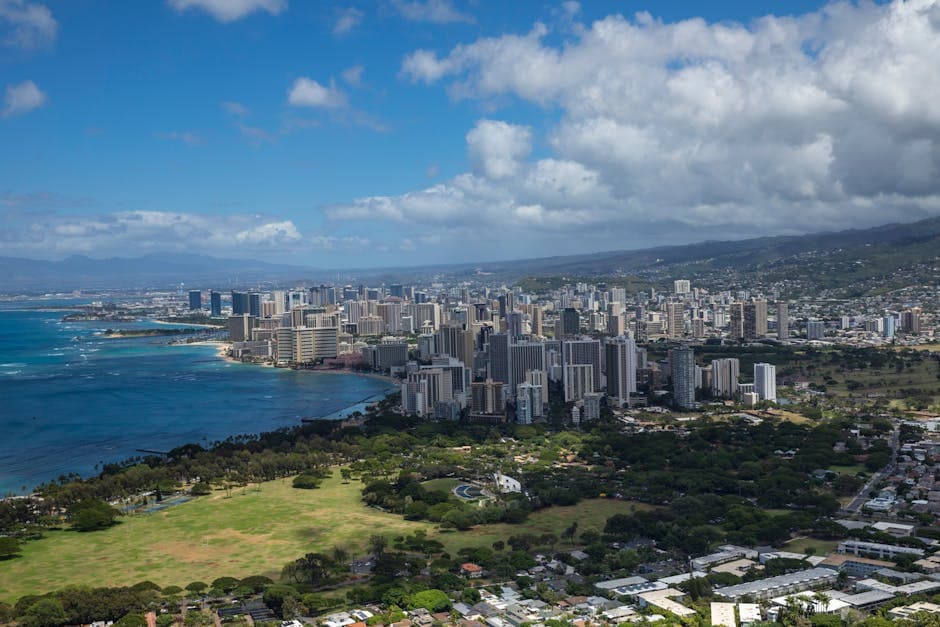
Oahu’s South Shore.
Twenty-five hundred miles from the nearest mainland port. The most isolated major city in the United States, by a long margin. Nine million annual visitors land at Daniel K. Inouye International. Three commands sit inside the Joint Base Pearl Harbor-Hickam fence. The only royal palace on US soil opens its doors three blocks from Chinatown. This is a field report for the operator who runs a restaurant inside that frame.
Source: US Census Bureau ACS, City and County of Honolulu.
Pacific Brief
All of Oahu sits inside the City and County of Honolulu. US Census ACS.
The Honolulu Census Designated Place, Waikiki through Salt Lake.
Statewide, with the majority through HNL. Hawaii Tourism Authority.
Joint Base Pearl Harbor-Hickam combined community.
Honolulu County, US Census ACS. One of the highest in the US.
Filed from Honolulu · Editorial standards: real sources, no fabricated reviews.
I. Scene
Tuesday, 7 a.m. Kalakaua Avenue. Diamond Head against a gold sky.
The operator on Kalakaua unlocks the back door at six fifty. The beach across the street is already in use. Surfers, runners, Japanese honeymooners holding phones at arm’s length, a wedding-album photographer waiting for the light to clear Diamond Head. Hawaii Tourism Authority pegs the seven-day average daily visitor census on Oahu somewhere north of one hundred and ten thousand people inside three square miles of Waikiki. The local population of Waikiki proper, by City and County of Honolulu zoning records, is closer to twenty-five thousand. The visitor-to-resident ratio is the operating fact of the neighborhood.
By seven fifteen the breakfast counter has its first guests. Two of them ordered ahead in Japanese on the operator’s branded site last night, picking a 7:30 a.m. window because their tour bus to Pearl Harbor leaves at 8:15 a.m. from the hotel lobby across the street. One of them ordered on the same site, in English, for a family of four staying at the Sheraton. The phone has been ringing for twenty minutes. Tour-bus dispatchers calling to confirm trays. A Marriott concierge calling to ask whether the operator can hold five bento boxes for an 8:00 a.m. pickup on behalf of a guest who does not speak English. The Voice AI handles seven of the eight calls before the line cook gets to the kitchen.
The afternoon is a different city. By 4:00 p.m. the tour buses are back from the North Shore and the cruise ship in Honolulu Harbor has reopened its gangway. The 5:30 p.m. to 7:00 p.m. dinner window is the highest revenue ninety minutes of the day. By 9:00 p.m. the foot traffic on Kalakaua is local again. Waikiki residents walking dogs. Service-industry workers ending shifts at the hotels. The operator who survives in this neighborhood is the operator whose menu, language stack, and ordering surface can serve three different cities inside the same twenty-four hours.
The math on tourist-facing Waikiki is unforgiving. Rent per square foot is the highest in the state. Hawaii’s General Excise Tax stacks 4.5 percent on gross receipts in Honolulu County. A marketplace commission of twenty-seven to thirty percent on top of that is the difference between a restaurant that pays the rent and a restaurant that closes by the second peak season. The operator who runs direct ordering keeps the relationship, keeps the margin, and keeps the language.
The rest of this report is the operating frame around that Tuesday: the Waikiki visitor economy, the Pearl Harbor military catering ledger, the Honolulu Marathon weekend, the Aloha Festivals, the Asian-American and Native Hawaiian food economy, Chinatown, Kakaako’s warehouse-to-art rise, the Kaimuki foodie corridor, and the Pacific supply chain that determines every menu price on the island. This is the Honolulu stack.
Sources for this scene · Hawaii Tourism Authority, City and County of Honolulu zoning records, Honolulu Star-Advertiser.
II. The Coast
Two miles of beach. One hundred and ten thousand visitors a day.
Waikiki is roughly two miles of coastline between the Ala Wai Canal and the base of Diamond Head. The strip carries the bulk of Oahu’s hotel inventory. Hawaii Tourism Authority publishes monthly visitor data by island. In a typical year, statewide arrivals run between 9 and 10 million people, and Oahu absorbs the majority of those arrivals through Daniel K. Inouye International. Waikiki itself, three square miles, hosts the largest single concentration of those visitors at any given time.
Diamond Head is the volcanic tuff cone at the eastern end of the strip. Native Hawaiian name Le’ahi. State Monument with timed-entry permits. The silhouette is the most photographed natural feature in the state. The operator on Kalakaua looking east on a clear morning sees the cone framed between hotel towers. That view is monetized by every concierge desk on the street.
The operational reality of a Waikiki restaurant is the language stack. Hawaii Tourism Authority’s monthly reports break out arrivals by origin. Japan has been the single largest international source market for decades. South Korea, mainland China, Australia, and Canada fill out the rest. A restaurant in Waikiki that does not publish a Japanese-language menu and accept Japanese inbound calls is leaving a measurable share of the available revenue on the table.
The other reality is the pickup-window discipline. Tour-bus pickups leave hotel lobbies on tight schedules between 7:30 a.m. and 9:00 a.m. A restaurant that cannot guarantee a 7:45 a.m. pickup window for a pre-ordered bento misses the bus. The branded ordering site that runs five-minute windows is the fulfillment model that actually fits the neighborhood.
Source: Hawaii Tourism Authority, Hawaii Visitors and Convention Bureau.
III. The Numbers
The Honolulu operating sheet.
Hawaii does not have a sales tax. It has a General Excise Tax (GET) applied to gross receipts. The state base rate is 4.0 percent. Honolulu County layers a 0.5 percent county surcharge on top. The total effective GET on a Honolulu restaurant receipt is 4.5 percent on the gross, not on the net. Source: Hawaii Department of Taxation.
Restaurants on Oahu
~3,500
Permitted food service establishments. Hawaii Department of Health.
Median ticket, Waikiki dinner
$72
Operator survey median, casual sit-down. Honolulu Star-Advertiser.
Hawaii GET, Honolulu Co.
4.5%
4.0% state + 0.5% county surcharge. Applied to gross receipts.
Annual visitor arrivals
~9.6M
Statewide, majority through HNL. Hawaii Tourism Authority.
JBPHH active duty + family
~50,000
Joint Base Pearl Harbor-Hickam combined population. JBPHH public affairs.
Asian-American share, county
~55%
Honolulu County, plus ~10% Native Hawaiian and Pacific Islander. US Census ACS.
Distance to mainland port
~2,500 mi
Honolulu to Los Angeles. Most isolated major US city geographically.
Iolani Palace, built
1882
Only royal palace on US soil. National Historic Landmark.
Honolulu Marathon finishers
~25,000
December event. Third-largest US marathon by finishers.
GET, explained for the operator
Mainland operators are used to a sales tax that is added on top of the menu price and collected from the customer. Hawaii’s GET is structurally different. It is a tax on the seller’s gross receipts, including any amount the seller chooses to pass through to the customer. Most Honolulu restaurants display a 4.712 percent visible surcharge on the bill, because that is the rate that, when applied to the pre-tax subtotal and then added to it, yields a final gross receipt on which the 4.5 percent GET produces the correct tax liability. The direct-ordering platform has to compute this correctly out of the box, on every receipt, in every channel. Source: Hawaii Department of Taxation tax facts.
IV. The Plate
The cuisine mix is the demographic mix.
Honolulu County is one of the most demographically diverse counties in the United States. US Census ACS data puts the Asian-American share at roughly 55 percent of the county population. Native Hawaiian and Pacific Islander residents account for another 9 to 10 percent. White residents make up about 20 percent. The remaining share is multiracial, Hispanic, Black, or other. There is no majority group.
The cuisine mix on a Honolulu restaurant block reads as a direct projection of that demography. Hawaiian regional food (poke, kalua pork, lau lau, poi, lomi salmon, haupia) sits next to Japanese (sushi, ramen, udon, donburi), Korean (Korean barbecue, kalbi, bibimbap), Filipino (lechon, adobo, pancit, kare-kare), Chinese (the Chinatown roast meat counters, dim sum, Shanghainese), Vietnamese (Maunakea pho counters), and the local-style plate lunch that fuses all of the above into one paper plate.
Plate lunch deserves its own paragraph. Two scoops of rice, one scoop of macaroni salad, a protein (teriyaki beef, kalua pork, chicken katsu, mahi mahi), and a side of gravy or shoyu sauce. It is the working lunch of the islands. Rainbow Drive-In on Kapahulu has been serving the format since 1961. Highway Inn since 1947. The format is unkillable.
For the operator, the implication is that the ordering platform has to handle long modifier lists (which rice, which sides, sauce on or off, extra meat), multilingual menu fields, and a tip flow that respects the local convention. A platform built for a three-modifier mainland burger menu cannot serve a plate lunch counter on Kapahulu.
Sources · US Census Bureau ACS, Honolulu Star-Advertiser, Hawaii Department of Business Economic Development & Tourism.
V. The Year
The Honolulu calendar runs on five overlapping waves.
The tourist high season runs November through April, driven by mainland winter and Japanese New Year travel. Aloha Festivals fall on September. The Honolulu Marathon, the third-largest US marathon by finishers, runs the second Sunday of December. Pearl Harbor Remembrance Day falls on December 7. The Honolulu Festival, a Japanese-Hawaiian cultural weekend, runs mid-March. King Kamehameha Day is June 11, a Hawaii state holiday. Big-wave winter surf on the North Shore from November through February drives a spectator visitor flow that crosses the island for the competitions.
Event note
Honolulu Marathon weekend
Second Sunday of December. Roughly 25,000 finishers, a majority of whom are international visitors, especially Japanese. The race starts at 5:00 a.m. in front of Ala Moana Center and finishes at Kapiolani Park. Pre-race carbo-load dinners on Friday and Saturday night, post-race brunch on Sunday and Monday, and a banquet circuit through the week. Source: Honolulu Marathon Association.
Event note
Aloha Festivals
September. The longest-running Hawaiian cultural festival in the United States. Floral parade, ho'olaule'a street party in Waikiki, Royal Court investiture at Iolani Palace. The September week reliably lifts Waikiki and downtown food traffic. Source: Aloha Festivals.
Event note
Pearl Harbor Day
December 7. National Pearl Harbor Remembrance Day. Memorial ceremony at the USS Arizona Memorial, hosted by the National Park Service and the US Navy. Hotels host visiting veterans and family delegations. Catering trays cross the Joint Base gate all week. Source: USS Arizona Memorial / NPS.
Event note
Honolulu Festival
Mid-March. A Japanese-Hawaiian cultural exchange weekend with a parade down Kalakaua Avenue and a Nagaoka fireworks finale over Waikiki. Heavy Japanese inbound. Restaurants with a Japanese-language ordering surface and Voice AI capture a measurable share. Source: Honolulu Festival Foundation.
Event note
King Kamehameha Day
June 11. Hawaii state holiday commemorating Kamehameha I, founder of the Kingdom of Hawai'i. Lei draping ceremony at the Kamehameha Statue across from Iolani Palace, followed by the floral parade. Downtown lunch and dinner traffic shifts to the parade route. Source: City and County of Honolulu.
Event note
North Shore winter surf
November through February. Big-wave events on the Triple Crown circuit (Haleiwa, Sunset, Pipeline) draw international spectators. The drive from Honolulu to the North Shore is about an hour. Coastal lunch counters and town restaurants both pick up traffic on competition days. Source: World Surf League.
VI. The Houses
The Honolulu restaurants the operator should know.
A field guide is incomplete without naming the houses that defined the local food culture. These are not endorsements and not affiliations. They are the operators a Honolulu chef will tell you to study if you want to understand the market. Sources for the listings and citations: James Beard Foundation, Honolulu Star-Advertiser, Hawaii Magazine.
Helena's Hawaiian Food
Since 1946Kalihi
James Beard Foundation America's Classics, 2000. Pipikaula short ribs and kalua pig. Cash and check, no cards, generations of Kalihi families through the door.
Rainbow Drive-In
Since 1961Kapahulu
The plate lunch institution. Mixed plate, loco moco, slush float. Generations of West Honolulu locals on the picnic tables out front.
Highway Inn
Since 1947Kakaako + Waipahu
Three generations of Hawaiian regional food. Kalua pig, lau lau, beef stew. A local benchmark for the Hawaiian plate.
Leonard's Bakery
Since 1952Kapahulu
Malasadas, the Portuguese-Hawaiian doughnut. A line out the door most weekend mornings. The food truck satellites cover the rest of the island.
Liliha Bakery
Since 1950Liliha + multiple
Coco Puffs, butter rolls, plate lunch counter. A 24-hour anchor of the Liliha neighborhood for decades.
Alan Wong's
Since 1995Honolulu
Hawaii regional cuisine. James Beard Best Chef Northwest, 1996. A defining house for the modern Hawaiian fine-dining vocabulary.
Roy's
Since 1988Hawaii Kai (original)
Roy Yamaguchi. James Beard Best Chef Pacific Northwest, 1993. The original Hawaii Kai location is the founding store of a chef-driven regional brand.
Senia
Since 2016Chinatown
Chris Kajioka + Anthony Rush. A modern Chinatown chef-driven house. Repeated national press for the cuisine and the room.
MW Restaurant
Since 2013Ala Moana
Wade Ueoka + Michelle Karr-Ueoka. James Beard semifinalist multiple years. Local-pantry contemporary cuisine on Kapiolani.
Town
Since 2005Kaimuki
Ed Kenney. A Kaimuki anchor of the local farm-to-table movement. Closed in 2020 but the alumni network defines the modern Kaimuki dining scene.
Side Street Inn
Since 1992Kapiolani + Kapahulu
The chef's late-night room. Pork chops, fried rice, karaoke. The kitchen the rest of the industry eats at after service.
Marukame Udon
Since 2011Waikiki
The Kalakaua udon counter with the perpetual line. A Japanese chain done at Honolulu scale. A study in fast-format Japanese ordering flow.
Ono Seafood
Since 1993Kapahulu
The poke counter. Ahi, salmon, tako, octopus, with classic shoyu and limu prep. A neighborhood institution that defined the modern poke shop format.
La Mariana Sailing Club
Since 1955Sand Island
The last original tiki bar in Honolulu. A working sailing-club restaurant on a working harbor. A reminder of the mid-century Hawaii dining vocabulary.
VII. The Map
Seven neighborhoods, seven operating models.
A Honolulu restaurant block in Waikiki and a Honolulu restaurant block in Kaimuki are two different businesses. The language stack, the customer mix, the price point, the fulfillment shape, and the catering ratio all change with the zip code. Below is the field map.
Waikiki
Tourist-facingTwo miles of beachfront hotel inventory. The single largest concentration of visitor spending in the state. Multilingual ordering surface is the price of admission. Tour-bus pickup windows and concierge handoffs drive the breakfast and lunch.
Multilingual menu + tight pickup windows
Downtown / Chinatown
Working district + nightlifeState capitol, financial district by day. Hotel Street nightlife and Chinatown roast meat counters by night. One of the oldest Chinatowns in the United States. Mandarin, Vietnamese, Cantonese, Tagalog, and English all show up on the inbound phone.
Mixed language stack, evening surge
Ala Moana
Shopping + officeAla Moana Center is one of the largest open-air shopping centers in the United States and a major employer of the surrounding restaurant block. Office lunch deliveries and after-shopping dinners dominate the mix. The marathon start sits at the front door.
Office lunch + retail employee meals
Kakaako
Warehouse to art districtOld industrial warehouses converted to galleries, breweries, mid-rise condos, and chef-driven restaurants. Two decades into a Howard Hughes-led redevelopment. The neighborhood where new concepts open first. The diners here read price-per-cover, not menu items.
Chef-driven concepts, new condo demand
Kaimuki
Foodie corridorA four-block stretch of Waialae Avenue with the highest density of independent chef-owned restaurants on the island. Local diners, second-generation operators, a strong wine and small-plates economy. The fewest tourists per capita of any restaurant district on the south shore.
Local repeat traffic, walk-up + reservations
Manoa + Moiliili
University + familyUniversity of Hawaii at Manoa anchors the neighborhood. Family-owned restaurants serving three generations of customers. Student lunch business, faculty dinners, and Manoa Valley brunch. The market that proves Honolulu is not only a tourist town.
University demand, family-owned operators
Pearl City / Aiea
Military + suburbanThe bedroom communities adjacent to Joint Base Pearl Harbor-Hickam. Family meals, plate lunch counters, Korean barbecue, and Filipino restaurants serving both the military community and the largest Filipino-American population in the state.
Family + military catering volume
VIII. The Base
Pearl Harbor. December 7. The 8 a.m. anniversary tray.
Joint Base Pearl Harbor-Hickam is a 2010 consolidation of Naval Station Pearl Harbor and Hickam Air Force Base into one of the largest joint installations in the Department of Defense. The fence encloses approximately 50,000 active duty, dependents, and civilian employees, according to JBPHH public affairs and Navy Region Hawaii reporting. The Pacific Fleet headquarters sits inside the gate. Indo-Pacific Command is up the hill at Camp Smith. The 15th Wing flies out of Hickam.
December 7 is the operating fact. National Pearl Harbor Remembrance Day. The 8:00 a.m. moment of silence at the USS Arizona Memorial, hosted by the National Park Service and the US Navy. Veterans, family delegations, visiting dignitaries, and a press pool descend on the island for the week leading up to the date. Hotels in Waikiki and the corridor along Kamehameha Highway fill with the delegations. Catering trays cross the JBPHH gate to squadron breakfasts, mess hall overflow, and family reunion luncheons.
The operator who wins the December 7 week is the operator who can publish a catering menu with seventy-two-hour lead time, accept government purchase cards through the ordering platform, and dispatch a sealed-tray pickup at the gate in time for the squadron breakfast. The phone side runs heavy. The Voice AI handles inbound catering inquiries while the line cook stays on the prep table.
The base population is not only a December 7 story. The weekly cadence of squadron events, change of command ceremonies, retirements, family-day BBQ trays, and MWR contracts produces a steady catering ledger across the year. The civilian off-base operator who builds a catering workflow on a branded site captures the channel without losing margin to a marketplace.
Source: JBPHH public affairs, US Navy Region Hawaii, NPS USS Arizona Memorial.
IX. The Palace
Iolani Palace. The only royal residence on US soil.
Iolani Palace, completed in 1882, was the official residence of the last two monarchs of the Hawaiian Kingdom: King Kalakaua and his sister Queen Liliuokalani. The palace sits three blocks from the modern state capitol and four blocks from Chinatown. It is the only royal palace on US soil. Following the 1893 overthrow of the Hawaiian Kingdom, the palace served as the seat of the provisional government, then the Territory of Hawaii, then the State of Hawaii capitol, until the modern capitol opened in 1969. Today the palace operates as a National Historic Landmark and museum.
For the operator, the palace anchors the downtown cultural calendar. The Royal Court investiture during Aloha Festivals walks down the palace lawn in September. The Lei Day celebration on May 1 brings hula halau and lei contests onto the grounds. King Kamehameha Day on June 11 draws crowds to the statue across the street. State funerals and protocol events run inside the gates. Each event shifts foot traffic into the downtown lunch window. Restaurants on Bishop Street, Hotel Street, and King Street pick up the spillover.
The deeper point for any restaurant operator is the Native Hawaiian context the palace makes visible. The Kingdom of Hawai’i was a sovereign state until 1893, with treaty relationships across the Pacific and Europe. Native Hawaiian language, food, ceremony, and place names pre-date the city by centuries. A restaurant operator running a Hawaiian-regional menu on Bishop Street is operating inside a continuous food culture, not a themed cuisine. The branded ordering site that names ingredients in Hawaiian and acknowledges the source is doing the work the cuisine asks for. Source: Iolani Palace, National Park Service, Bishop Museum.
Sources · Iolani Palace, NPS, Bishop Museum, Office of Hawaiian Affairs.
X. The Operators
Three Honolulu operators. Three different stacks.
DirectOrders configures differently for each. The branded site is the same. The Voice AI language model, the menu modifier vocabulary, and the catering workflow all change with the persona. Below are the three composite profiles an Oahu account team is built to serve.
Kalani's Loco Moco House
Tourist-facing breakfast and lunch.
- 60% breakfast and 40% lunch revenue. Tour bus pickup windows between 7:30 a.m. and 9:00 a.m. drive the morning.
- Japanese is the second menu language. Mandarin and Korean are the third and fourth. The Voice AI handles all four.
- Concierge handoffs from five neighboring hotels arrive by QR sign in the lobby. Direct ordering is the only fulfillment that scales.
- Daniel K. Inouye International is twenty minutes by car. Some pickup orders ride to the airport on the way out.
DirectOrders stack
Branded site in EN / JA / KO / ZH, multilingual Voice AI, 5-minute pickup windows, concierge QR program, flat $249/mo.
Maunakea Pho Pacific
Vietnamese pho counter, working-district lunch + late-night.
- Lunch is 70% of revenue. The 11:30 a.m. to 1:00 p.m. block clears 400 covers when the courthouse and state offices are open.
- Evening service serves the Hotel Street nightlife and Chinatown bar tourists. Multilingual menu in EN / VI / ZH / TL.
- Catering trays for downtown law firms ride the order queue every Friday. Group order links absorb the firm's secretary's job.
- GET on every receipt. The platform computes it correctly without operator intervention.
DirectOrders stack
Branded site in EN / VI / ZH / TL, Voice AI in EN + VI, group ordering for downtown firms, catering workflow, flat $249/mo.
Pier 9 Mod-American
Chef-driven concept in a converted warehouse.
- Dinner is 80% of revenue. The $85 prix fixe and the $50 a la carte average drive the ticket.
- Reservations off the branded site. The site rotates the menu every two weeks as the farm-direct produce shifts.
- The catering side serves the new high-rise condo board, Howard Hughes corporate events, and gallery openings.
- Same-day Stripe payouts settle the Saturday $14K dinner before Monday payroll.
DirectOrders stack
Branded site in EN, reservation engine, rotating menu, catering pipeline, same-day Stripe, flat $249/mo.
XI. The Wave
Tourist high season. November through April.
Hawaii Tourism Authority publishes monthly visitor arrival data. The Oahu pattern is consistent. November through April runs hot, lifted by mainland winter and Japanese New Year travel. May, September, and October dip into shoulder season. June through August picks up on summer family travel but not to the level of the winter peak. The chart below is the operator’s calendar problem.
High season (Nov to Apr)
The operator runs at peak staffing, peak supplier cadence, peak rent. Marketplace commissions during this window are the most damaging six months of the year. A flat $249 platform fee retains the full lift. The branded site, the multilingual Voice AI, and catering workflows absorb the volume.
Shoulder (May, Sep, Oct)
Volume falls but operator costs stay sticky. The shoulder season is when restaurants close for one week, refresh the menu, run loyalty pushes from the branded site to local repeat customers, and prep catering pipelines for Aloha Festivals (September) and the December rush. The same site that runs the high season runs the off season too.
XII. The Stack
Six languages on the same Voice AI.
Honolulu County is not bilingual. It is multilingual. US Census ACS language data for the county shows English at home for about 70 percent of households, with the remaining 30 percent split across Japanese, Korean, Chinese, Tagalog, Ilokano, Spanish, Vietnamese, and Hawaiian. The Voice AI handles English, Japanese, Korean, Tagalog, Mandarin, and Cantonese with native voice synthesis. Hawaiian language is supported as a read-only acknowledgement on menus and receipts in recognition of the language’s status as an official state language under the Hawaii Constitution.
The cost saving for a Waikiki operator is direct. A human-answered Japanese-language phone line costs the operator a dedicated staff position for the peak breakfast window. The Voice AI absorbs the channel with zero added headcount, transcribes the order to the kitchen ticket in English, and confirms back to the caller in Japanese.
The operating implication is that a restaurant on the south shore can publish menus in four languages on the same branded site, accept inbound voice in six, and print kitchen tickets in English without the operator hiring a translation desk. The Voice AI is the baseline configuration on every Honolulu account, not an upsell.
Sources · US Census Bureau ACS S1601 language at home, Hawaii State Constitution Article XV (official languages).
- EnglishEnglishVoice + menu + receipts
- Japanese日本語Voice + menu + receipts
- Korean한국어Voice + menu + receipts
- Mandarin / Cantonese中文Voice + menu + receipts
- Tagalog / FilipinoTagalogVoice + menu
- VietnameseTiếng ViệtMenu + receipts
- HawaiianʻŌlelo HawaiʻiAcknowledgement on menus + receipts
Hawaiian is one of two official state languages under Hawaii Constitution Article XV. DirectOrders supports Hawaiian on menus and receipts as a written acknowledgement; Voice AI fluency in spoken Hawaiian is on the roadmap, not in production today.
XIII. The Math
27% commission vs. 14% direct, on a $75 Waikiki dinner.
The Waikiki dinner ticket runs higher than the mainland equivalent on rent, GET, and supply chain. The marketplace commission compounds the gap. The chart below is a single-ticket comparison: marketplace at a typical 27 percent (commission plus consumer fee structure) versus direct ordering at 14 percent (payment processing + flat platform fee amortized across tickets).
The marketplace ticket
A $75 Waikiki dinner that closes on a marketplace rebates roughly $20.25 in commission, consumer fees, and processing to the platform. The operator keeps $54.75 before food cost and labor. The marketplace also keeps the customer relationship. The next time the same diner reorders, the operator pays the commission again.
The direct ticket
The same $75 ticket on a branded direct site retains roughly $64.50 to the operator after payment processing and a per-ticket share of the flat $249 monthly platform fee. The relationship stays with the restaurant. The Voice AI captures the phone-side reorder without paying a marketplace twice.
XIV. The Argument
How DirectOrders fits Honolulu.
The Honolulu operating frame is not a single constraint. It is six separate calendars stacked inside one year. Tourist high season from November to April. Honolulu Marathon weekend in December. Pearl Harbor Day on December 7. Aloha Festivals in September. King Kamehameha Day in June. Honolulu Festival in March. Each window has a different language mix on the inbound phone, a different fulfillment shape, a different price point, and a different supplier cadence.
One. A flat $249 a month subscription outperforms a per-ticket commission contract on a calendar that has six seasonal peaks. The marketplace commission scales with the lift. The flat fee does not. The Waikiki dinner peak from December through March compounds the gap into the four-figure range every month.
Two. The Hawaii General Excise Tax has to be computed on gross receipts at 4.5 percent, with the standard 4.712 percent visible surcharge on the customer bill. The platform handles this correctly on every channel without operator intervention. A platform that pretends Hawaii is a sales tax state mis-reports the operator’s tax liability.
Three. The multilingual Voice AI handles a channel Honolulu operators cannot afford to staff. Japanese, Korean, Mandarin, Tagalog, Cantonese, and English all arrive on the same phone number depending on the neighborhood and the season. The Voice AI is the baseline configuration, not an upsell.
Four. Pearl Harbor and JBPHH catering, marathon weekend bento orders, and Aloha Festivals trays all require seventy-two-hour lead time, group order links, and a gate-side handoff. The direct ordering platform exposes all three workflows on the same branded site without a marketplace approval queue.
Five. Same-day Stripe payouts settle the marathon weekend and the Pearl Harbor week before the bank week starts. An operator running three thousand tickets through a Saturday in December gets cash in the account Monday morning. That working capital recycles into payroll and supplier payments without bridge financing.
XV. Coda
Two suggestions for the Honolulu operator.
Stand the platform up before December high season.
The November-to-April window is the highest revenue six months of the operator's year. The Honolulu Marathon, Pearl Harbor Day, and the Japanese New Year travel weeks all sit inside that arc. Build the branded site in English and Japanese, stand up the multilingual Voice AI, configure the GET-correct receipts, and have the site live by mid-October. Typical Honolulu onboarding runs about two hours from menu import to first live order.
If you are reading in summer, stage for Aloha Festivals.
September is the operator's planning window for the September Aloha Festivals weekend and the October-onward visitor lift. Load the catering menu for the floral parade morning, stand up the group ordering link for downtown firms, and prepare the Pearl Harbor Day December 7 catering pipeline. The branded site that runs the year does the planning, not a marketplace.
References · This report drew from
12 sources
- City and County of Honolulu · Restaurant zoning, demographics, municipal services
- Hawaii Tourism Authority · Visitor statistics, monthly arrivals, source markets
- Hawaii Visitors and Convention Bureau · Visitor industry research, Oahu monthly reports
- Hawaii Department of Taxation · General Excise Tax facts, county surcharge schedule
- US Census Bureau · Population, language at home, race + ethnicity, ACS
- Honolulu Star-Advertiser · Restaurant openings, closures, business desk, daily reporting
- Joint Base Pearl Harbor-Hickam (JBPHH) public affairs · Population, mission, gate locations, anniversary events
- Iolani Palace · Royal residence, palace history, cultural events
- Pearl Harbor National Memorial / National Park Service · USS Arizona Memorial, Pearl Harbor Day program, NPS
- Hawaii Department of Business, Economic Development & Tourism · Industry data, economic indicators, demographic tables
- Honolulu Marathon Association · Marathon course, finisher counts, December event details
- Bishop Museum · Hawaiian language, history, cultural collections