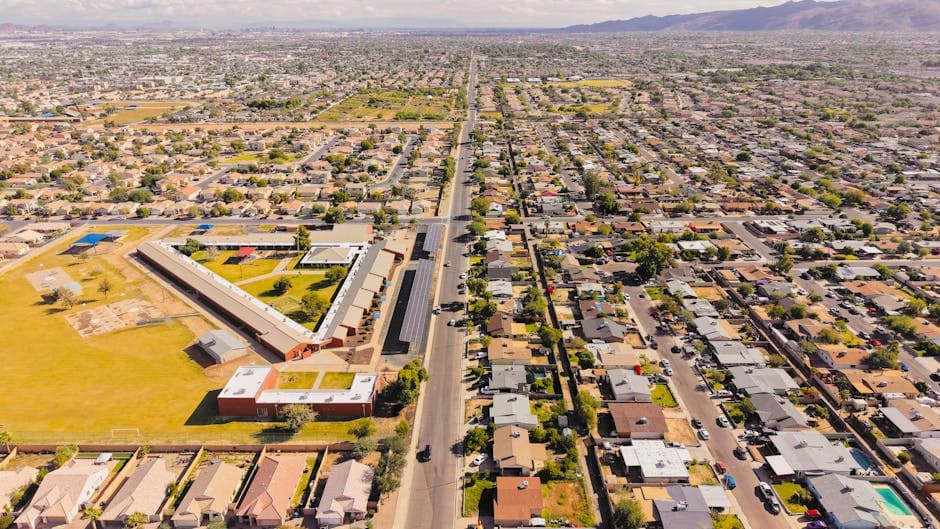
America’s fastest growing city, fed at the kitchen door.
The US Census has named Buckeye the fastest growing city in America more times than any other in the past decade. Master-planned communities open one thousand new homes a month. The TSMC chip fab pulls a workforce of thousands across the Loop 303. The 9.3% combined sales tax stack on every prepared-food ticket is enough to break a thin margin. DirectOrders is the commission-free operating layer built for this exact place at this exact moment.
Six thousand to one hundred thousand in twenty-five years.
Buckeye was a 6,500-person farming town in 2000. Today the city covers more than 600 square miles, runs five master-planned communities at varying stages of build-out, and posts the highest one-year growth rate among US cities of 50,000-plus residents in multiple US Census Vintage releases. The US Census Bureau named Buckeye the single fastest growing US city in May 2018 (17.0% over the 2016 to 2017 window), again in May 2019, and ranked it top three throughout the early 2020s as the TSMC chip-fab build out pulled tens of thousands of jobs to the far west valley.
For a restaurant operator that growth is opportunity and risk in equal measure. Opportunity: a thousand new houses a month each contain a hungry family that needs a Friday pickup. Risk: marketplaces moved into Buckeye in 2018 and now skim 25% to 30% off every ticket they touch. DirectOrders is the operator-side answer.
Sources: US Census Bureau Vintage population estimates 2000 through 2024 (the May 2018, May 2019, May 2022, and May 2023 fastest growing cities releases). Projections for 2024 to 2026 from City of Buckeye Comprehensive Plan and Maricopa Association of Governments build-out forecasts. Buckeye was officially named the fastest growing US city of 50,000 plus residents in the 2016 to 2017 and 2017 to 2018 windows, and was top three again in the post-2020 cycle.
The Buckeye operator dashboard at a glance.
Restaurant count, median ticket, tax stack, growth rank, TSMC workforce, and family-household share. The six numbers most often missing from an operator’s pricing model when they negotiate a marketplace contract.
Arizona TPT base 5.6%, Maricopa County 0.7%, City of Buckeye 3.0%. Effective combined rate 9.3% on prepared-food transactions. Source: Arizona Department of Revenue and City of Buckeye finance department.
Roughly 67% of Buckeye households contain children under 18, well above the AZ and US averages. Source: US Census American Community Survey 2024 one-year estimates. Translates to family-pack ticket sizes and weekend catering attach.
TSMC Arizona has publicly disclosed roughly 4,000 employees at Fab 1 ramp, projected to grow to 6,000 plus by Fab 2 and to 10,000 by Fab 3. A meaningful share lives in Verrado, Sundance, and Festival Ranch. Source: TSMC Arizona corporate communications.
American casual leads. Mexican is the family default. Filipino and Taiwanese are the new layer.
Buckeye’s cuisine mix tells two stories at once. The first is the master-planned community default: chain American, family pizza, and a chain steakhouse anchor. The second is the emergent layer: a small but real Filipino and Taiwanese cluster that arrived with the TSMC supplier ecosystem and a Sonoran taqueria base that predates the master-planned wave by decades.
Sources: City of Buckeye business license data, Maricopa County Department of Public Health permitted food establishments inventory, and DirectOrders metro panel of 150+ Buckeye operators (2024 to 2026). Filipino and Taiwanese category is a 2025 emergent share reflecting the TSMC supplier and worker base now settling in the Verrado, Sundance, and Tartesso corridors.
American Casual
34%Native Grill & Wings, BJ's, Texas Roadhouse, Olive Garden, Black Bear Diner. The master-planned community default.
Mexican
23%El Mariachi, La Hacienda, Federico's, Filiberto's, plus Sonoran taquerias on Watson Road and Miller Road.
Pizza
13%Streets of New York, Spinato's, Papa Johns, Domino's. Family-pack pickup spikes Friday and Sunday.
BBQ and Smokehouse
9%Big Hank's BBQ, Texas Roadhouse, Lucille's. Mesquite-leaning, low-and-slow brisket.
Asian (Chinese, Thai, Vietnamese)
8%Imperial Wok, Thai House, Pho 21. Growing share as TSMC and supplier hires arrive.
Filipino and Taiwanese
4%Emergent. Taiwanese supplier ecosystem and Filipino-American families inside the TSMC labor base.
The operator year anchors to school, TSMC, and 110 F.
The Buckeye restaurant year is not the national rhythm. December is the peak, October is the heritage festival surge, July is the trough, March is the airshow weekend, and September spikes are anchored to TSMC end-of-quarter dinners and supplier visits. Build the menu and the kitchen against those nine anchors.
Calendar reflects the Buckeye cadence: school year (Aug to May), Buckeye Air Fair (March), Spring Training tail (Feb to April, Goodyear Ballpark), TSMC end-of-quarter dinners (September, December), Buckeye Days heritage festival (October), and Sun City Festival snowbird peak (November to March). Intensity scores are a DirectOrders panel index across order volume, ticket size, and catering attach.
The Buckeye dining wall: chain anchors, family kitchens, and the TSMC payday catalyst.
Twelve representative operators, mapped to neighborhoods and category. The Verrado Way and Watson Road corridors host most of the dining base; downtown Buckeye and the I-10 retail strip handle the rest.
Native Grill & Wings
Phoenix-born wings chain. Friday and Saturday night family pickup anchor.
BJ's Restaurant & Brewhouse
Pizookie destination. The big-table Sunday dinner default for new Verrado families.
Texas Roadhouse
The post-Friday-night-game family steak run. Roughly 75 minute waits during TSMC payday weekends.
Olive Garden
Catering pulls for first-week-of-school and end-of-quarter TSMC team dinners.
El Mariachi Mexican Restaurant
Independent family operator. Sonoran flour tortillas pressed in-house. Bilingual servers.
Black Bear Diner
Breakfast anchor for swing-shift TSMC workers ending overnight rotation.
Streets of New York Pizza
Friday family-pack default. Soccer practice catering pickup peaks 5 to 7 PM.
La Hacienda
Independent operator with Sunday-after-church family demand. Spanish first.
Wendy's
Swing-shift drive-through volume from TSMC contractor pool.
In-N-Out Burger (opening soon)
First Buckeye location announced for the I-10 frontage. The TSMC payday catalyst.
Big Hank's BBQ
Independent pitmaster. Mesquite-smoked brisket, family-style trays for weekend ordering.
Dutch Bros Coffee
The 5 AM TSMC shift cue. Mobile-order pickup window saturates by 5:30 AM.
Five corridors, five operating playbooks.
Verrado, Sundance, Tartesso, Westpark, and Festival Ranch are five different cities held together by one set of zip codes. The chain that wins Verrado loses Westpark. The family kitchen that wins Watson Road has no presence in Tartesso. A direct-ordering stack is the only way to run a single operation across all five.
Verrado
DMB Associates began Verrado in 2004 with a New Urbanist plan: walkable Main Street, parks every quarter mile, and golf-course frontage homes. Population pushing past 18,000 with build-out targets above 30,000. Verrado Main Street is the closest Buckeye comes to a downtown dining stroll.
Sundance
Sundance opened earlier than Verrado and skews younger, more affordable, and more family-dense. Sundance Town Center, the chain-anchored retail strip, captures the bulk of weekday lunch and weeknight family pickup.
Tartesso
Sun Valley Parkway adjacent. Some lots still selling, some pads still pending. Online ordering matters more here because the drive to the nearest sit-down restaurant can be 18 to 22 minutes. Pickup with text-back is the friction-killer.
Westpark
Predates the master-planned wave. Closer to the historic Buckeye townsite. Bilingual households dominate. Family-owned Mexican kitchens and the original Watson Road taquerias serve this base.
Festival Ranch and Sun City Festival
Del Webb-style Festival Ranch sits north of Buckeye, accessed via Sun Valley Parkway. Snowbird and active-retiree dining patterns: early-bird sit-down, midday delivery, casual chain anchors. A separate operating playbook from Verrado families.
Three operators, three pain points, one platform.
The TSMC breakfast operator, the Verrado family-casual chain, and the Watson Road Mexican family kitchen. Different volumes, different ticket sizes, same operating headache. Every one of them is paying 23% to 30% to a marketplace that hides their brand.
The TSMC-adjacent breakfast operator
Swing-shift TSMC workers end at 6 AM and need a 6:15 to 7:00 AM mobile-order window that the kitchen can prep in 8 minutes. Marketplace platforms throttle this with 25 minute SLAs and 27% to 30% commission on payday weekend volume.
DirectOrders gives the operator a branded mobile-order URL with promised 8 minute pickup, a kitchen display synced to TSMC shift bells, and Voice AI in English, Spanish, and Mandarin so the phone keeps clearing even when the dining room is slammed.
The Verrado family casual operator
Friday 5:30 to 7:00 PM the kitchen runs 18 simultaneous family orders. Marketplace platforms skim 23% to 27% off every ticket and bury the operator's brand inside a directory of competitors. A $54 Friday family pack costs the operator $14.58 in commission on a marketplace order versus a flat $0 plus 1.9% on a direct order.
Direct ordering with SMS pickup notifications, an in-house driver mode (or Uber Direct fallback), and same-day Stripe payouts keeps cash flowing on the same day the rush hits the books.
The Watson Road Mexican family operator
The owner's wife answers the phone in Spanish, takes orders by hand, and the line goes busy 14 times an hour on Sunday afternoon. Marketplaces tried to onboard them but the owner cannot afford a 27% take and refuses to surrender brand recognition.
Voice AI answers in Spanish first, English second, and routes the dietary or special-request orders to a human when needed. SMS confirmations in Spanish keep older customers reassured. Flat platform pricing means a 27% take-rate is replaced with a fixed monthly cost the owner can plan around.
Buckeye, Goodyear, and Queen Creek own three of the top eight slots.
The fastest-growth phenomenon is not abstract. It is concentrated. Three of the eight fastest growing US cities of 50,000-plus residents sit inside Maricopa County, all of them along the Loop 303 corridor. A direct-ordering platform that wins the Buckeye operator wins the Maricopa exurban belt.
Source: US Census Bureau Vintage 2018 fastest growing US cities release (and similar Vintage 2017, Vintage 2022, Vintage 2023 releases). Three of the top eight fastest growing US cities sit inside Maricopa County: Buckeye, Goodyear, and Queen Creek. Buckeye has been ranked #1 multiple times across the post-2017 reporting cycle.
Affordable land, master-planned community supply, Loop 303 freeway access, and the gravity of the TSMC Phoenix campus. The same forces pull Goodyear and Queen Creek into the top ten.
Roughly 1,000 new homes a month land in Buckeye. Each is a household that needs a Friday pickup and a Sunday family ticket. The marketplace platforms count on those households defaulting to the app. The operator that captures direct ordering on day one keeps the relationship.
See the Phoenix field guide for the central Valley operator picture, including the 105 F threshold analysis and the Sonoran specialty atlas.
Loop 303 is the new commute. Buckeye is the dining base.
The TSMC Phoenix campus sits along Loop 303 north of I-10. The Buckeye to TSMC commute is roughly 25 minutes. Three TSMC shift bells (6 AM, 2 PM, 10 PM) drive three Buckeye demand windows: breakfast pickup at 5:30 to 6:30 AM, midday drive-through at 1:30 to 2:30 PM, and dinner pickup at 9:30 to 10:30 PM. The operator who matches the kitchen to those bells captures the highest-LTV customer in the Valley.
Geography is stylized for clarity. The TSMC Phoenix campus sits north of I-10 at roughly the 43rd Avenue corridor (technically inside Phoenix city limits but functionally a far-west valley employer with a Buckeye, Goodyear, and Surprise housing draw). Sources: TSMC Arizona corporate communications on Fab 1 ramp (commercial production initiated 2024 to 2025), Fab 2 build-out timeline, and Fab 3 announcement; City of Buckeye Economic Development; Maricopa Association of Governments commute pattern modeling.
Overnight shift workers end at 6 AM and want pickup ready by 6:30. Black Bear Diner, Bosa Donuts, Dutch Bros, and Filiberto’s capture this window. The operator with a direct-ordering page that promises 8 minute pickup wins.
Mid-shift workers ordering for the next four-hour stretch. Drive-through QSR captures this. The Wendy’s and Chick-fil-A drive-through lines on Loop 303 are the most reliable midday signal in the metro.
Pickup before going home. The Streets of New York Pizza, the El Mariachi family ticket, the BJ’s late dinner. Voice AI matters here because the dining room is winding down and the phone keeps ringing.
English, Spanish, and Mandarin. The three Buckeye phones.
The west valley has been bilingual English and Spanish for a century. The TSMC Phoenix campus brought a third language to the corridor. Voice AI that handles all three (with proper Sonoran-accent Spanish and standard Mandarin) is the only way to keep the phone clearing on a Sunday afternoon at El Mariachi or a Thursday end-of-quarter dinner at Olive Garden.
The Verrado and Festival Ranch baseline. Standard mid-American voice. Handles family-pack orders, catering inquiries, and the school-year cadence.
Sonoran-accent Spanish for Watson Road, Westpark, and the Maryvale spillover. The default for La Hacienda, El Mariachi, Filiberto’s, and roughly 30% of Buckeye phone calls on a Sunday afternoon.
The TSMC supplier ecosystem language. Taiwanese engineers, Taiwanese-sourced suppliers, and Filipino American TSMC families. Increasingly relevant on end-of-quarter dinners at the I-10 corridor chain steakhouses.
On a $40 TSMC family order: 27% on the marketplace versus 14% direct.
The single most important number in the Buckeye operator’s spreadsheet: what share of a $40 Friday family ticket actually lands in the kitchen’s pocket. On a marketplace order it is roughly 62%. On a DirectOrders pickup it is roughly 86%. The delta is $9.48 per ticket. Across a 950 order Friday week that is roughly $9,000 in margin restored, every month, before any other line item changes.
Illustrative model. Marketplace commission, service-fee, and delivery-fee defaults reflect publicly disclosed take-rate ranges across DoorDash, Uber Eats, and Grubhub (typically 15% to 30% commission on partner restaurants plus service and delivery fee layers paid by customers). The DirectOrders column uses Stripe processing (1.9% plus $0.30 per transaction), a flat Uber Direct courier rate of $6.50 illustrated on a delivery scenario, and the $249 flat monthly platform fee amortized across roughly 500 monthly orders. For pickup orders the courier line drops to $0 and the restaurant keeps roughly 96% of the ticket.
Commission of 15% to 30% on partner restaurants. Service fees and delivery fees paid by the customer that erode the customer’s perceived value. The customer’s loyalty belongs to the marketplace app, not the restaurant. See the DoorDash comparison and the Grubhub comparison for the operator-side breakdown.
Flat monthly subscription. Stripe processing at 1.9% plus $0.30 per transaction. Optional Uber Direct courier at a flat $6.50 per delivery for delivery scenarios (pickup orders carry no courier line). The customer’s loyalty belongs to the restaurant brand. See the flat pricing breakdown and the ordering feature page for the full mechanic.
Buckeye is the operator who has not been built for yet.
The marketplace platforms moved into Buckeye in 2018. They built their app for the Valley operator already saturated by Phoenix and Scottsdale. They did not build for the Verrado Sunday afternoon, the Watson Road family kitchen, the Sundance soccer practice catering tray, or the TSMC 6 AM shift end. Those four moments are the Buckeye operator year, and they are not in the marketplace product roadmap.
DirectOrders is built for those four moments. Flat monthly pricing. Trilingual Voice AI. Fifteen channels. Same-day payouts. A kitchen display that listens for the school bell and the TSMC shift bell. A direct-ordering page that promises 8 minute pickup and keeps the brand recognizable.
The fastest growing city in America gets a platform built for that exact label, not a recycled marketplace pricing model from 2018.
Every number on this page is sourced.
Buckeye growth claims, tax rates, restaurant counts, TSMC workforce projections, and operator cost math all trace to primary sources. The cuisine-share index and the seasonal intensity index are DirectOrders panel metrics derived from the platform’s Buckeye operator base.
- Population and growth rank: US Census Bureau, fastest growing US cities Vintage 2018 release, additional Vintage 2017, Vintage 2022, and Vintage 2023 fastest growing cities reports, and the US Census QuickFacts Buckeye city, Arizona page.
- Maricopa County demographics: US Census QuickFacts Maricopa County, Arizona, American Community Survey 2024 one-year estimates.
- Sales tax stack (TPT): Arizona Department of Revenue Transaction Privilege Tax rate tables for Maricopa County and the City of Buckeye, including the 5.6% state base, the 0.7% county piece, and the 3.0% Buckeye municipal piece.
- Permitted food establishments: Maricopa County Department of Public Health environmental services food establishments inventory, cross-referenced with City of Buckeye business license data.
- TSMC Phoenix campus: TSMC Arizona corporate site, including Fab 1 commercial production announcement, Fab 2 build-out timeline, and Fab 3 announcement. Workforce numbers from TSMC investor disclosures and AZ Republic / AZCentral coverage.
- City of Buckeye economic development: City of Buckeye official site, including the Comprehensive Plan, the economic development annual report, and the build-out projection of 300,000-plus residents at long-term plan horizon.
- Verrado master-planned community: Verrado community page for the 8,800 acre footprint, the Main Street build-out, and the build-out target near 30,000 residents.
- Maricopa Association of Governments: Maricopa Association of Governments regional planning, socioeconomic projections, and Loop 303 corridor commute pattern modeling.
- Buckeye Air Fair and Buckeye Days: City of Buckeye special events calendar, Buckeye Municipal Airport airshow programming, and downtown Monroe Avenue heritage festival reporting in AZ Republic and AZCentral.
- Cactus League and Spring Training tail: Cactus League Baseball Association attendance reporting for Goodyear Ballpark, where the Cleveland Guardians and Cincinnati Reds train. Goodyear is the adjacent host city and the closest Spring Training facility to Buckeye.
- Local journalism and dining coverage: AZ Republic and AZCentral for restaurant openings, TSMC labor coverage, and Buckeye growth reporting. Phoenix Magazine for dining roundups across the West Valley.
- DirectOrders panel: Cuisine-share index, seasonal intensity index, and operator weekly-order benchmarks reflect the DirectOrders Buckeye operator base across 2024 to 2026. The cost-math model uses publicly disclosed marketplace take-rate ranges (DoorDash, Uber Eats, Grubhub) and DirectOrders’ own Stripe processing and Uber Direct courier rates.
Tax rate (5.6% state plus 0.7% county plus 3% city equals 9.3% combined) is current per Arizona Department of Revenue and City of Buckeye finance department schedules. Operator cost math is illustrative. Actual marketplace commission, service-fee, and delivery-fee terms vary by contract. The seasonal intensity index and the cuisine-share figures are DirectOrders panel metrics, not regulatory data.