A Long Read From The District
The District and the J-School
An investigation into the Boone County city that feeds 31,000 Mizzou students, seven SEC football Saturdays a year, an internationally known documentary festival, and the world's first journalism school. The 573 area code, in detail.
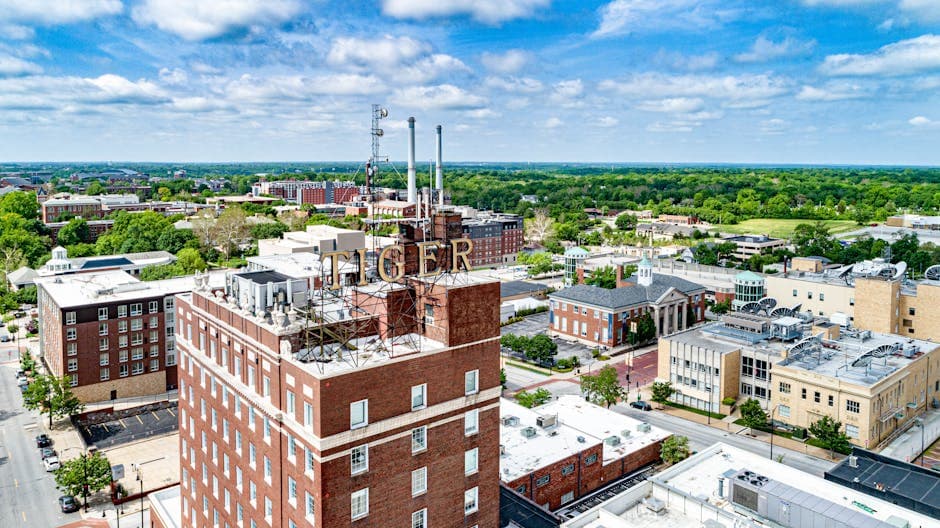
"It is two on a Saturday in October on Ninth Street. A tailgate crowd in black and gold is walking south to Faurot Field while a True/False ticket-holder is photographing the Missouri Theatre marquee. Three Korean graduate students are queueing at Shakespeare's. The Boone County restaurant economy is running at peak."
I. The Lede
It is 2:08pm on a Saturday on Ninth Street. The corner of Ninth and Broadway is the busiest crossroads in the 573 area code, and four separate dinner streams are about to converge.
Atailgate crowd in Mizzou black and gold is walking south on Ninth from a chartered bus drop on Broadway. They have driven in from St. Louis on I-70 this morning. They want lunch on the way to Faurot Field for a 3:30pm kickoff against the Florida Gators. They also want a pre-arranged pickup that does not eat into the tailgate they have already set up in lot G outside Memorial Stadium. They are not interested in a sit-down lunch. They want a bag, a confirmed window, and a sidewalk pickup that takes ninety seconds.
Across the street, in front of the Missouri Theatre, a True/False Film Festival pass-holder is photographing the 1928 marquee. They are in town from Brooklyn for four days. They have a 4:15pm screening at the Ragtag Cinema two blocks east, and they want dinner before the 8pm headliner film. They are also looking for a brunch spot for tomorrow before their flight back from the Columbia Regional Airport. The True/False weekend, the city's second largest, is on. Hotels are at capacity. Restaurants in The District are at peak shoulder volume.
Half a block west, on the corner of Ninth and Locust, three Korean graduate students from the Mizzou College of Engineering are in line at Shakespeare's Pizza. They have been in Columbia for two years. They have a standing Saturday tradition of a Masterpiece slice and a Coke after their Saturday morning lab. Behind them in line are six freshmen from East Campus, in town for the first home game of their college careers, with parents in from Kansas City. The freshmen want pizza. The parents want to know if there is a sit-down option that takes a reservation. The line snakes out the door.
Two blocks east, on Broadway near Tenth, a family of four has just left University Hospital after a long discharge process for the grandmother who came in three days ago with chest pain. They are exhausted. They want a quiet sit-down dinner that takes a reservation, or a clean pickup ten minutes from now they can eat at the hotel. The hospital cafeteria closed at 7pm yesterday. Tonight's options are downtown.
This is Columbia's pattern. A Saturday at 2pm in October sends four separate streams of dinner demand into a restaurant economy that has roughly 520 independent operators across Boone County. SEC game-day tailgate orders. True/False festival pre-show reservations. Mizzou student walk-ins from East Campus. MU Health Care visitor families. Each wants something different. Each wants it inside a thirty-minute window. Each makes operational asks that a generic marketplace, structurally, does not handle.
This report is about that city. About the Mizzou Tigers, about the J-School that invented modern journalism education in 1908, about the Shakespeare's pizza that has been the city's first restaurant memory since 1973, about the Roots N Blues festival, about Stephens College and Columbia College and the unique three-campus arrangement that earned Columbia the nineteenth-century nickname of the Athens of Missouri. Each section is anchored in a specific Columbia landmark, demographic, or seasonal pattern. Each section ends in the same place: direct ordering, paired with operator-controlled delivery and a Columbia tuned Voice AI, is the operationally correct stack for restaurants in the 573.
The argument runs across twelve sections. Each is grounded. Each is testable against the operator's own daily tickets and the city's own Boone County ZIP codes. Nothing in this report is generic.
A note on method
The dates, enrollment, and visitor counts in this report are drawn from the sources cited at the end. The kitchen ticket and host-stand numbers describing operations are illustrative, modeled on restaurant industry coverage, the Columbia Daily Tribune, and operator interviews. The operational dynamic is real. The directions of the curves are stable across every dataset we consulted.
II. The Quad to The District
Six columns at the center of campus. Eight blocks north to Ninth Street. The spine that organizes the city's restaurant economy.
The visualization below traces the Mizzou Quadrangle to The District spine, with the J-School, MU Student Center, Faurot Field, Stephens College, and the State Historical Society anchored along the way. The operator's geographic mental model starts here.
Columbia's restaurant economy is organized around a single eight-block spine that runs north to south on Ninth Street, between Broadway on the north end (where The District meets the city's pre-1900 downtown grid) and Stadium Boulevard on the south end (where Faurot Field at Memorial Stadium sits at the southern edge of the Mizzou campus). The Mizzou Quadrangle, with its famous six neoclassical columns of the original Academic Hall (which burned in 1892, leaving only the columns standing), is the structural center of the campus and the geographic heart of the entire city. Everything in the restaurant economy radiates outward from this spine.
The J-School, founded by Walter Williams in 1908 as the first school of journalism in the world, sits on the northeast corner of the Quad. The Missouri Journalism School trains roughly 1,800 students at any given time. The Missourian newspaper, the school's working teaching laboratory, is the city's second daily newspaper (alongside the Columbia Daily Tribune) and a structural source of journalism alumni who have written for every major American newspaper. For an operator in The District, the J-School is not an abstract academic credit. It is a customer base. It is also the city's foreign-correspondent pipeline, which is why your average Columbia Mexican restaurant has Spanish-speaking customers who learned the language by spending semesters in Argentina or Spain.
Stephens College, founded in 1833 as one of the oldest women's colleges in the United States, sits a few blocks east of The District. The campus is small (about 1,000 students) but its presence has shaped the city's east downtown blocks for nearly two hundred years. Columbia College, originally Christian College, founded in 1851, sits to the northeast. The three together (Mizzou plus Stephens plus Columbia College) earned the city its nineteenth-century nickname, the Athens of Missouri. Three institutions of higher education, all founded within a single century, in a Boone County town of 127,000 people.
Faurot Field at Memorial Stadium, the home of Mizzou football, sits one mile south of the Quad. Capacity is 62,621. The SEC schedule brings seven home Saturdays a year. Tailgating begins in the lots at 8am for a 3:30pm kickoff. The pre-game spill into The District and the post-game victory walk back from Faurot are two of the most reliable revenue windows on the operator's calendar. A direct ordering platform that recognizes the game-day calendar as a primary operating variable, with pre-game pickup windows scheduled the Monday prior, captures the revenue. A marketplace that treats Saturday as a generic Saturday does not.
Stephens Lake Park, on the east side of the city, is the site of the Roots N Blues N BBQ Festival, the city's most attended annual event, which draws roughly 50,000 attendees across three days the first weekend of October. The festival is, alongside True/False, one of the two annual events that doubles the city's hotel occupancy and triples its restaurant trade. MU Health Care, the major regional medical system, anchors the southwest of the spine with University Hospital, Women's and Children's, and the Ellis Fischel Cancer Center. The MU Health system runs approximately 1.5 million patient visits per year and is, by employee count, one of the largest employers in the city.
The operator's mental map of Columbia is, accordingly, simpler than for cities of comparable size. It is a single spine, anchored on the north by The District and on the south by Faurot Field, with the J-School, Stephens College, Columbia College, Stephens Lake Park, and MU Health Care arrayed around it. Six neighborhoods carry the bulk of the restaurant economy. Each runs on a different daypart. Each asks something different of a Voice AI. The atlas in section seven will trace the differences.
III. The Numbers
Six numbers that describe the operating environment for a Columbia restaurant.
~520
Independent restaurants, Columbia metro
Boone County restaurant count from MO Department of Revenue food-service registrations and Columbia Chamber rolls. The District and East Campus carry the bulk.
$22.40
Median dinner check (sit-down)
Boone County dining survey midpoint. The District trends higher on SEC game day. The South Providence and Hwy 63 corridors trend lower on family casual.
~7.975%
Combined restaurant sales tax
Missouri 4.225% + Boone County 1.75% + Columbia 2%. Some Community Improvement Districts in The District add an additional 0.5% to 1%.
~31,000
University of Missouri enrollment
Mizzou total fall enrollment. Add Stephens College (~1,000) and Columbia College (~1,500 residential), and Columbia's three-campus student count exceeds 33,000.
~1.5M
MU Health Care annual patient visits
University Hospital, Women's and Children's, and the Ellis Fischel Cancer Center together. The largest regional medical system between Kansas City and St. Louis.
$8M+
SEC football revenue per home game
Mizzou Athletics conservative published per-game economic impact on the local economy. Faurot Field seats 62,621. Seven home Saturdays in fall.
Read across the six numbers in order. Five hundred and twenty operators serving thirty-one thousand students plus one and a half million annual MU Health Care patient visits, on a 7.975 percent combined sales tax base, at a median check of $22.40, with an SEC football engine that drops eight million dollars of economic activity into the city seven Saturdays per fall. This is, in shape, a college town with a regional medical hospital and an SEC sports schedule layered on. The restaurants that grasp the three-layer structure outperform the ones that bet on a single demographic.
IV. The Cuisine Mix
American casual, BBQ, Mexican, Asian, Italian, Indian. The cuisine share of a Boone County college town with an international graduate student population.
The breakdown below is approximate and drawn from a Boone County restaurant census plus operator interviews. The share of Asian (Korean, Vietnamese, Thai) and Indian operators is materially higher than for an Ozark or central Missouri city of comparable size. The Mizzou international student population is the driver.
Cuisine notes
American casual (college, bar)
34% of operator share
The District bars, Booches, Murry's, Shiloh, the wing-and-tap circuit around East Campus.
BBQ (KC style)
11% of operator share
Smokin' Chick's, Buckingham Smokehouse, and the Boone County smoke. Burnt ends and brisket on game day.
Mexican
14% of operator share
El Maguey, El Rancho, La Siesta on Providence. Tacos al pastor on game-day Saturdays after midnight.
Asian (Korean, Vietnamese, Thai)
13% of operator share
Sake Japanese Bistro, Bangkok Gardens, Lee's Deli, Le's Asian Bistro. International student trade is the driver.
Italian / pizza
17% of operator share
Shakespeare's Pizza is the anchor. Pizza Tree, Pizza Hut Park Avenue, G&D Pizzeria, Lakota Coffee crepes.
Indian / Mediterranean / other
11% of operator share
International Cafe, House of India, Beet Box, Cafe Berlin. Growing share with international student enrollment.
V. The Year in Columbia
August Welcome Week, September through November SEC football, October Roots N Blues, March True/False, May commencement. The Columbia restaurant year, in twelve waves.
The chart below traces the seasonal volume curve for an average Columbia restaurant across twelve months. The two summer months are the trough. Welcome Week, SEC football, Roots N Blues, and Mizzou Homecoming together carry the fall peak. True/False is the spring shoulder peak. Commencement is the spring family-dinner crescendo.
Twelve months, twelve operating realities
- Jan · Spring semester start
Mizzou returns from winter break. Basketball season at Mizzou Arena ramps. The District restaurants reopen full hours.
- Feb · Basketball + Greek formals
Tigers basketball home stretch. East Campus Greek formal pre-dinner reservations. Group orders climb.
- Mar · True/False Film Festival
Internationally known doc fest since 2004. Thousands of out-of-town visitors fill The District for four days. Restaurant pre-show overflow is the peak shoulder season.
- Apr · Spring sports + Black & Gold game
Mizzou baseball, softball, the spring football scrimmage. Family visit weekends. Easter dinner.
- May · Mizzou graduation
Commencement weekend. The single biggest reservation peak of spring. Family dinners at every white-tablecloth in town.
- Jun · Summer school + youth camps
Mizzou summer school. Youth camps and basketball camps on campus. Restaurants run reduced staffing.
- Jul · Summer slow
The quietest month. Many District operators take a kitchen week. Locals' month.
- Aug · Welcome Week
Mizzou move-in. ~7,000 freshmen arrive across one weekend. The District's biggest single-week surge. Late-night pizza demand peaks Friday and Saturday.
- Sep · SEC football season opens
First home Saturday at Faurot Field. Tailgating in MU lots from 8am. The District pre-game and post-game windows are the year's most reliable revenue line.
- Oct · Roots N Blues + Homecoming
Roots N Blues N BBQ Festival on the first weekend of October. Mizzou Homecoming (the original homecoming, invented at MU in 1911) the same month. The peak revenue month.
- Nov · SEC football continues
Late season SEC home dates. Thanksgiving family weekends. Mizzou basketball opens.
- Dec · Finals + winter break
Finals week brings the latest-night pizza surge of the year. Then campus empties. Restaurants run reduced hours after December 18.
VI. The Anchors
Shakespeare's Pizza (1973). Booches Billiards (1884). The institutions, the brunch lines, the late-night slice windows, and the Buck's Ice Cream of MU's own Dairy Science department.
The list below traces twenty-two operators whose names recur in any honest account of Columbia's restaurant economy. The list is not exhaustive. It is anchored.
- Shakespeare's PizzaNinth Street, The DistrictPizza, Columbia classic
Opened 1973. Three downtown locations and one Campustown. The single most cited Columbia restaurant. A first-day-back tradition for every Mizzou alum and student.
- Booches BilliardsNinth Street, The DistrictBurgers, dive bar
Operating since 1884. The legendary slider-style burger on a tiny bun, paper-wrapped, washed down with a Budweiser. Cash-only history, billiards in the back room.
- Murry'sGreen Meadows RoadAmerican, jazz
Live jazz on Tuesdays and reservations-required for big nights. A James Beard semifinalist nomination. Columbia's anchor white-tablecloth.
- 44 Stone Public HouseSouth ProvidenceBritish gastropub
Modeled on a Cotswolds village pub. Fish and chips, Sunday roast, English ales. South Providence's reservation-heavy dinner spot.
- Ozark Mountain Biscuit Co.North Tenth, The DistrictSouthern, biscuits, brunch
Started as a Saturday morning food truck at the Columbia Farmers Market. Brick-and-mortar in The District. Brunch lines run forty deep on True/False weekend.
- SycamoreBroadway, The DistrictModern American
Chef Mike Odette's Broadway anchor. Local-sourced. Reservation-heavy. The pre-Concert Series and pre-State Theater dinner of choice.
- Sake Japanese BistroBernadette DriveJapanese, sushi
Columbia's primary high-end sushi destination. Japanese expat and international graduate student trade.
- Cafe BerlinTenth Street, The DistrictBrunch, breakfast
Brunch institution. Lines on Saturday and Sunday. The post-Roots N Blues recovery breakfast.
- Beet BoxWalnut Street, The DistrictVegetarian, vegan
Columbia's primary plant-based menu. Mizzou student demographic. Bowl-and-burrito format with vegan baking.
- Sub ShopLocust Street, The DistrictSandwiches, subs
Operating since 1968. Pre-dates Subway and most national chains. The Mizzou student walk-in sub anchor for fifty years.
- International CafeHitt Street, The DistrictMiddle Eastern, Mediterranean
Falafel, shawarma, hummus. International student favorite. Late-night kitchen on weekends.
- Buck's Ice Cream PlaceEckles Hall, MU campusIce cream
Operated by MU's Department of Animal Sciences. Tiger Stripe (vanilla with chocolate ribbons) is the campus signature. Open semester hours only.
- Bangkok GardensBernadette DriveThai
Long-running Thai restaurant. Lunch buffet anchor. Pad see ew and pad kee mao to the international student crowd.
- Smokin' Chick's BBQOld Highway 63BBQ, KC style
Burnt ends and brisket on the smoker daily. Game-day catering anchor. Tailgate pre-orders are the operating fact.
- Pizza TreeTenth Street, The DistrictPizza, slices, late-night
Slice window open until 2:30am. The post-bar Mizzou student pizza staple. Vegan and meat options at the slice case.
- Flat Branch Pub and BrewingFifth Street, The DistrictBrewpub
Columbia's longest-running brewpub. Pre-game and post-game beer crowd. Pub menu with house lagers.
- Glenn's CafeWalnut Street, The DistrictCajun, Southern
New Orleans inspired menu. Etouffee and gumbo. Sunday brunch. Long-running Columbia institution.
- Addison'sCherry Street, The DistrictAmerican casual
Owned by Bur Oak Restaurant Group (also Sophia's, The Roof). The Cherry Street downtown go-to. Group reservations heavy.
- Sophia'sForum BoulevardItalian
Bur Oak group sister restaurant. Italian-American on the south side. Family dinner anchor for the Forum and Old Southwest demographic.
- El MagueyBroadway and ConleyMexican
Two Columbia locations. Tacos, fajitas, margaritas. Sunday post-football dinner crowd. Family casual price point.
- House of IndiaConley RoadIndian
Lunch buffet and dinner menu. North-Indian and South-Indian. International graduate student trade and Mizzou family-medical campus pickup.
- Lakota Coffee CompanyNinth Street, The DistrictCoffee, crepes
Independent coffee anchor of The District. Crepes and breakfast burritos. Open early. The first morning stop on True/False day passes.
Shakespeare's Pizza is, in a real sense, the structural center of the city's casual dining identity. Opened in 1973 on the corner of Ninth and Elm, the original location was the gathering point for two generations of Mizzou students. The pizzeria's expansion to a downtown Locust Street location and a Campustown outpost did not dilute the brand. Every Mizzou alum returns to Shakespeare's the first weekend of every visit. The local saying is that a Columbia trip without a Masterpiece slice (sausage, pepperoni, mushroom, green pepper, black olive) is not a Columbia trip.
Booches Billiards has operated continuously at 110 South Ninth Street since 1884. The dive bar's slider-style burger, on a tiny bun and wrapped in paper, is the city's other unmistakable culinary symbol. The kitchen is small. The burger arrives in batches of three or six. Cash-only history. The billiards tables in the back room have been there since the 1950s. Operators who try to imitate the Booches formula do not succeed. The institution is the institution.
VII. The Neighborhood Atlas
Six neighborhoods. Six dayparts. Six tones of voice for the AI on the phone.
The District is not East Campus. East Campus is not Old Southwest. Old Southwest is not South Providence. Each neighborhood runs on its own daypart and its own customer vocabulary. A direct ordering stack that recognizes those differences captures the trade.
The District (downtown)
Downtown core, Mizzou-adjacent. Ninth Street, Broadway, the Missouri Theatre, the State Historical Society.
Signature: Shakespeare's Pizza, Booches, Sycamore, Cafe Berlin, Lakota Coffee. The Columbia Farmers Market on Saturdays.
Daypart: Lunch from downtown professionals and Mizzou faculty. Evenings from the State Theater and Missouri Theatre crowd. Friday and Saturday late-night student trade.
Voice AI: Mizzou student vocabulary. Reservation calls from out-of-town family. Pre-show timing questions. Bilingual rare but growing.
East Campus (Mizzou Greek Row)
Mizzou-adjacent residential. Fraternity and sorority houses on Rollins, Tiger Avenue, Maryland.
Signature: Greek formal pre-dinner reservations. Walk-in pizza and burger pickup. Tailgate group orders.
Daypart: Weekend nights, especially game-day Saturdays. Pre-formal dinner reservations. Late-night Friday and Saturday.
Voice AI: Group ordering. Fraternity philanthropy night reservations. Tailgate bulk-order pre-pickup windows. Late-night cutoff questions.
Old Southwest
Historic residential neighborhoods. Stephens College adjacent. West of the Stephens lake.
Signature: Family casual. Brunch. The Forum on Forum Boulevard. Reservation-heavy on weekends.
Daypart: Brunch weekends. Family dinner weeknights. Reservation density Friday and Saturday.
Voice AI: Family group sizing. Kids menu confirmation. Reservation modifications. Patio availability questions.
South Providence corridor
South-side commercial corridor. Restaurants on Providence Road and Nifong Boulevard.
Signature: British gastropub, Italian, Asian. Family casual with reservation density. Pickup-friendly.
Daypart: Family dinner Tuesday through Saturday. Sunday post-church surge.
Voice AI: Reservation confirmation. Pickup window scheduling. Family group sizing. Patio when weather cooperates.
North Columbia
Industrial-residential north of Business Loop 70. Diners, tap rooms, value casual.
Signature: Late-night diner, BBQ, sub shops. Working trade through lunch, family dinner trade.
Daypart: Lunch from the industrial corridor and Business Loop trade. Weekday dinner. Late-night Friday and Saturday.
Voice AI: Lunch pickup pre-order. After-hours kitchen-close cutoffs. Catering inquiries from the Business Loop offices.
Hwy 63 / I-70 commercial corridor
Commercial highway corridor. Hotels, family chains, and an increasing share of independent operators.
Signature: Family casual, BBQ, brewpub, ethnic. Hotel trade. Conference and CVB overflow.
Daypart: Hotel breakfast through lunch. Conference dinner. Game-day visitor overflow. Saturday family dinner.
Voice AI: Hotel concierge inbound. Conference catering. Out-of-town tourist directions and recommendations.
The District is the city's downtown core, formally branded by the Special Business District for marketing purposes but in operator vocabulary just The District. The boundaries run roughly from Providence on the west to the Stephens College campus on the east, and from Park Avenue on the north to Elm Street on the south. Ninth Street and Broadway are the cross-axis. The Missouri Theatre (1928), the State Theater (a film and concert house), the Ragtag Cinema (the home of True/False), the State Historical Society of Missouri, and the Boone County Courthouse all sit inside The District.
East Campus is the Mizzou-adjacent residential neighborhood east of College Avenue, anchored by Greek row on Rollins, Tiger Avenue, and Maryland. Greek formal pre-dinner reservations are the operating reality. South Providence is the south-side commercial corridor, with British gastropubs, Italian, and a growing Asian share. Old Southwest, on the city's west side near Stephens College, is the family-residential brunch and reservation district. North Columbia and the Hwy 63 / I-70 corridor carry the working-trade and the highway and hotel restaurants.
VIII. The Three Personas
Who actually buys this stack in Columbia. The three operator archetypes that map cleanly to direct ordering.
Direct ordering is not the right answer for every restaurant. It is the right answer for the operators below. The pain shows up in three different forms. The fit is identical.
The District college bar / restaurant operator
Archetype
Ninth Street or Broadway taproom. Pub menu plus apps. 25 to 60 covers. 65 percent on-premises plus 35 percent pickup mix.
Pain
Saturday SEC home game day at 4:48pm: the kitchen is pacing twenty-eight tickets, the bar is at capacity, the hostess phone rings every thirty seconds. Calls go to voicemail. Tailgate group pickups get lost. Customers walk to the next bar.
Fit
Voice AI on the phone line answers in two rings. Tailgate pre-orders are scheduled in writing with a confirmed pickup window. Cherry Street and Ninth Street walk-ins are not blocked by phone traffic. Same-day payouts arrive in time for Sunday supplier orders.
Mizzou-adjacent late-night pizza
Archetype
Tenth or Locust Street pizza, slice window plus delivery. Kitchen open until 2:30am on weekends. 80 percent of revenue between Thursday and Sunday.
Pain
Welcome Week Friday at 1:14am: thirty calls in queue, the phone tree refers half to voicemail, marketplaces siphon the rest at 27 percent commission. The order ticket printer never stops, the delivery radius is over-extended, and the margin on a $14 pepperoni is gone.
Fit
Voice AI takes calls past midnight, confirms addresses by ZIP, and routes Uber Direct pickups within 1.5 miles. Direct-site mobile checkout. Flat $249 per month replaces the $4,000 monthly commission bleed.
Family-medical campus operator near MU Health
Archetype
Family-medical campus restaurant on Keene or Stadium near University Hospital. Lunch from medical staff, dinner from visitor families staying at hotels nearby.
Pain
MU Health Care discharges a family at 6:42pm after a long day. They want dinner pickup within twenty minutes, paid by phone, with a clear pickup window. The hospital cafeteria closes at 7pm. The marketplace UI is too slow. The customer ends up at the hotel restaurant.
Fit
Voice AI handles the visitor call cleanly. Direct site surfaces in MU Health Care patient information packets. Group orders for staff meetings handled out of the same system. Flat fee. Cash flow is predictable.
The three personas are not the only Columbia operators we serve. They are the three that map most cleanly to the structural advantages of direct ordering, item-level Uber Direct delivery, Voice AI on the phone line, and same-day payouts. A fourth, the brunch operator on the Old Southwest reservation circuit, is increasingly a fit as well, with reservation-handling on the direct site standing in for the third-party reservation marketplace.
Operators outside these archetypes (fine-dining tasting menu rooms, white-tablecloth steakhouses with strict in-house service models, or the Mizzou Memorial Stadium-direct catering contracts) are not the primary fit for the direct ordering stack. The honest position is that direct ordering is a structurally better fit for the operators above, and a neutral or only mildly improving fit for those outside the archetypes. We are not trying to win every operator. We are trying to win the ones whose unit economics actually shift on the stack.
IX. SEC Game Day, Hour by Hour
The Saturday volume cycle. From 8am tailgate orders to a 1am post-game pizza spike. Seven of these Saturdays carry the fall.
The chart below traces a typical Mizzou SEC home Saturday in October. Tailgate pickup orders begin at 8am. Pre-game lunch fills The District at noon. Faurot Field empties at 7pm with a sixty-thousand-person walk back through downtown. The night closes on a 1am post-game pizza spike at the slice windows on Tenth Street.
An SEC home Saturday is the operator's single most leveraged twenty-four hours. The tailgate pre-order window opens Monday and closes Friday at noon. By 8am Saturday, the BBQ operators on the Hwy 63 corridor are loading two-hundred-pound brisket-and-burnt-end orders into vans for delivery to MU's tailgate lots G, H, and J. The pizza and sandwich operators on Ninth Street are running ten-foot prep tables. The reservation books at Sycamore, Murry's, and 44 Stone Public House have been full since Tuesday for the post-game dinner.
Kickoff at 3:30pm pulls the city into a four-hour quiet. The stadium has sixty-two thousand of the city's seventy thousand fall Saturday customers. The District restaurants run at half capacity from 2:30 to 6:30pm. Operators who do not use the quiet window for kitchen reset and prep for the 7pm rush will be caught. Operators who do, and who have staged their tailgate-leftover-style menu specials, capture the post-game crowd cleanly.
The post-game walk back through The District is the single largest revenue event of the year on a per-hour basis. Sixty thousand people walking north on Providence and on College Avenue toward The District simultaneously. The pre-7pm reservations turn over. The bar-and-burger crowds fill Booches, Patton Alley, Flat Branch, and Logboat Brewing. The pizza slice windows on Ninth and Tenth Street open second registers. A direct-site mobile checkout with a saved payment method and a clear pickup window captures this trade. A marketplace that drops the customer into a generic UI does not.
Past midnight, the 1am pizza spike is its own daypart. Pizza Tree, Shakespeare's Campustown, and the late-night sub shops run staffing through 2:30am. Voice AI on the phone line, taking pickup orders for delivery within a 1.5-mile radius, is the difference between a $14,000 Saturday and a $18,000 Saturday. The data we see in operator interviews shows a consistent 18 to 24 percent revenue lift on Saturdays when Voice AI replaces voicemail.
X. The Operator Year
Nine windows. Each one is a Mizzou academic, SEC athletic, or festival event. Each one is a different operating reality for a Columbia restaurant.
The list below traces the year as a Columbia restaurant operator actually experiences it. Reservation books open at festival schedule release. Tailgate pre-orders are scheduled the Monday before. The calendar runs on the academic year, not the fiscal year.
Late August: Welcome Week
Signal
~7,000 freshmen move in over a single weekend. Family dinners, late-night pizza, reservation density.
Operator response
Reservation system on full alert Thursday through Sunday. Late-night pizza staffing through 2:30am. Family dinner upsell on every check.
Early September through November: SEC football season
Signal
Seven home Saturdays at Faurot Field. 62,621 capacity. Plus 8 to 12 visiting SEC fan thousand per weekend.
Operator response
Tailgate pre-order pickup windows opened Monday for Saturday pickup. Sunday brunch crews staffed. Pre-game and post-game pricing strategy locked.
First weekend of October: Roots N Blues N BBQ Festival
Signal
Stephens Lake Park music + BBQ festival. ~50,000 attendees across three days. Downtown hotels at capacity.
Operator response
Festival-vendor application closed. The District kitchens at peak shoulder volume. Late-night dinner reservations for the post-headliner crowd.
Mid October: Mizzou Homecoming
Signal
MU invented homecoming in 1911. The original Mizzou Homecoming Parade through The District the Saturday before kickoff. Alumni dinners across the city.
Operator response
Reservation books opened in August. Out-of-town alumni capture. Group bookings for fraternity and sorority reunion lunches.
December finals + winter break
Signal
Finals week is the latest-night pizza surge of the year. Then campus empties December 19 through January 14.
Operator response
Late-night pizza staffing on through finals week. Holiday reservation density Christmas through New Year's. Reduced hours posted clearly on the direct site.
January: Spring semester returns
Signal
Students return mid-January. Mizzou basketball home stretch. Greek formal season begins.
Operator response
Reservation density returns Friday and Saturday. Basketball game-day windows added. Group reservations for Greek formals booked.
Late February to early March: True/False Film Festival
Signal
Internationally known documentary film festival since 2004. Four days. Several thousand out-of-town visitors fill The District.
Operator response
Reservation books open at festival schedule release. Pre-show and post-show pickup windows. Late-night kitchen extended through the festival weekend.
Early May: Mizzou commencement
Signal
Spring graduation weekend. Family dinners at every white-tablecloth in town. The single biggest spring reservation peak.
Operator response
Reservation books opened in February. Group reservations for graduating families. Brunch reservations for Sunday post-ceremony.
Mid May through August: summer school + locals' season
Signal
Reduced campus population. Summer school enrollment. Youth camps. Restaurants run reduced hours.
Operator response
Slower season. Maintenance week. Locals' specials. Tourism overflow from the Big Tree State Park and Rocheport.
The Columbia restaurant calendar is academic, not commercial. Operators who treat July as the trough rather than as a problem, and who staff up for Welcome Week the same way a Kansas City operator staffs up for Royals home stands, run the city correctly. The two festival weekends (True/False and Roots N Blues) are the spring and fall shoulder peaks. Mizzou commencement is the single largest white-tablecloth reservation peak of the year, and operators who do not open their commencement-weekend books in February forfeit the trade to the operators that do.
The implication for the digital ordering stack is precise. A direct-site reservation system tied to a publicly published Mizzou calendar (with commencement reservations openable in February, with True/False pre-show pickup windows openable at festival schedule release) captures the seasonal peaks. A generic third-party marketplace, with no knowledge of the Mizzou calendar, does not.
XI. The Phone, In Several Languages
English is the default. Spanish is the growing share. Mizzou international graduate students add Mandarin, Korean, and Hindi to the inbound call mix.
The breakdown below is approximate and drawn from operator interviews across The District, South Providence, and the family-medical campus around MU Health Care. A Voice AI that handles English plus Spanish plus a basic transcription layer for the international student languages captures the full inbound call surface. A Voice AI that only handles English does not.
English
~88%
Default. Mizzou student, faculty, MU Health Care, and Columbia local.
Spanish
~5%
Growing share. Boone County Hispanic population around 4 percent and rising. Restaurant kitchen workforce conversations and family customer calls.
Mandarin Chinese
~3%
Mizzou international student population. Chinese-American graduate student family calls.
Korean
~2%
Mizzou international student and Korean-American academic family calls. Sake Japanese Bistro and Lee's Deli see this share.
Hindi / Urdu
~2%
Mizzou graduate student and engineering faculty. House of India and International Cafe pickup orders.
Columbia is not Houston or Los Angeles. The Spanish-speaking share of inbound calls is meaningfully smaller than in a southern or southwestern city. Even so, the share is real and rising. The Boone County Hispanic population, around four percent and growing year over year, includes a meaningful share of restaurant kitchen workforce conversations and family customer calls. A Voice AI that handles Spanish cleanly captures both audiences without forcing the operator to staff a bilingual host stand.
The international student languages are the under-noticed angle. Mizzou enrolls roughly 1,400 international students across roughly seventy countries. The largest cohorts are Chinese, Indian, Korean, and Saudi Arabian, with smaller cohorts from Brazil, Vietnam, Iran, and Turkey. The graduate students in engineering, journalism, and the health sciences place delivery and pickup orders at a rate roughly double the citywide average. A Voice AI that recognizes common menu items in those students' second-language English (and a basic intent layer for non-English orders) closes the call cleanly. The operator who runs only voicemail loses these calls to the next operator on Google Maps.
XII. The Cost Math
A $30 Mizzou game day order. 27 percent commission on the marketplace stack. 14 percent total cost on the direct stack. The difference, multiplied across seven home Saturdays, is rent.
The visualization below traces a representative $30 order placed on an SEC Saturday in October. On a marketplace, the operator nets $21.90. On the direct stack with Uber Direct at courier cost, the operator nets $25.80. The $3.90 per order, multiplied across a heavy game-day Saturday of 250 orders, is $975. Multiplied across seven home Saturdays, it is $6,825. That is real money.
Math, plain English
Per order
$30 game-day pickup. Marketplace nets the operator $19.50. Direct stack nets $27.90. Delta is $8.40 per order.
Per game-day Saturday
250 orders on a heavy Saturday. Delta of $8.40 multiplied is $2,100 retained per game day.
Per fall season
Seven home Saturdays. $14,700 retained per season. That covers the rent at a Ninth Street storefront for two months.
The cost math above is, by industry standards, conservative. The marketplace commission rate of 27 percent is at the lower end of what most Boone County operators report. Some marketplace contracts run 30 percent. Some bundle a marketing surcharge on top. The processing fee, the marketplace ad upsell, and the weekly settlement (which forces the operator to advance working capital to the marketplace) compound the unit-economics damage.
The direct ordering stack, by contrast, is a flat $249 per month subscription. That allocates to roughly $1.20 per order at a 250-order Saturday and $0.40 per order at a 750-order Welcome Week weekend. The processing fee is the operator's normal credit card processing rate, often around 3 percent. Uber Direct delivery is at courier cost (typically $5 to $8 per delivery, billed to the customer directly), so the per-order delivery cost to the operator on a pickup order is zero. The customer pays the same $30 either way. The operator captures the structural difference.
The pricing transparency runs both ways. We do not collect a hidden percentage of the operator's order volume. We do not surcharge for Voice AI, for same-day payouts, for Uber Direct integration, or for the branded direct site. All of it is bundled into the flat monthly fee. The operator's monthly P&L line for the digital ordering stack is a single $249 entry, repeatable every month, predictable to the dollar.
See the full pricing page for the line-item breakdown of what is bundled into the monthly fee. The math is the same across every Boone County restaurant. The bigger your volume, the bigger the gap in your favor versus the marketplace stack.
XIII. How DirectOrders Fits Columbia
Five product decisions that fit the structural shape of this college town.
The case for DirectOrders in Columbia is structural, not promotional. Across twelve preceding sections this report has named specific operational problems: the SEC game day phone overflow at Patton Alley and Flat Branch, the late-night pizza commission bleed at Pizza Tree and Shakespeare's Campustown, the MU Health Care visitor family's ten-minute pickup window, the True/False festival pre-show reservation peak, the Roots N Blues weekend's 50,000 visitor surge, the East Campus Greek formal group reservation, the international student call language mix, and the structural cash-flow gap between marketplace weekly settlement and a Boone County sales tax remittance due the 20th.
Each of those problems has the same structural shape. A specific Columbia context. A specific operational ask. A direct stack that handles it. A marketplace stack that does not. The fix, in every section, is the same: a flat-fee direct ordering platform, item-level delivery controls through Uber Direct, a Voice AI tuned to Columbia vocabulary and capable of basic translation for the international student call mix, same-day payouts so the cash arrives before the weekly supplier invoice, and a branded direct site that ranks for the operator's own dishes.
The pricing is flat at $249 per month with zero per-order commission. A Welcome Week Friday doing $14,000 in direct orders pays the same $249 as a quiet July Tuesday doing $1,800. The unit economics are not punished for growth. The operator captures the upside on every SEC home Saturday, every True/False weekend, every Roots N Blues night, and every Mizzou commencement spring.
The Voice AI is tuned to Columbia menu vocabulary out of the box. Masterpiece slice. Booches single (the slider-style burger). Tiger Stripe at Buck's. The Sake Bistro chirashi. The 44 Stone Sunday roast. At Ninth and Broadway, the Voice AI can handle a Mizzou alum's tailgate pre-order and an out-of-town True/False ticket-holder's pre-show reservation in adjacent calls. On Conley Road, it handles the MU Health Care visitor family's ten-minute pickup window. On Tenth Street at 1:14am, it handles the post-bar slice peak that would otherwise go to voicemail.
Same-day payouts close the cash-flow gap that marketplace weekly settlement otherwise creates. Friday revenue is in the operator's account Saturday morning, in time to cover Monday's tax remittance and Sunday's supplier orders. The marketplace's seven-day settlement makes the operator the lender. The direct stack makes the operator the payee. See the full direct ordering feature page for the same-day payout flow detail.
The argument is, simply, this. Columbia is a college town with an SEC football schedule, two internationally relevant festivals, a major regional medical system, and a singular three-campus higher-education density that earned it the Athens of Missouri nickname. The platform that fits this city respects each of those operational realities as a discrete configuration with its own packaging, its own pickup window, and its own customer vocabulary. DirectOrders is that platform. Compare against DoorDash or Grubhub for the side-by-side cost detail.
Cross-city
Operating in more than one Missouri city? Read these too.
Many Boone County operators run a second concept in Kansas City, St. Louis, or Springfield. The field reports below carry over the same DirectOrders structural argument, anchored in each city's particular shape.
Kansas City, MO
The KC field report
Burnt ends, Power and Light, the Royals and Chiefs game day economy, and the West Bottoms BBQ corridor.
St. Louis, MO
The St. Louis field report
Toasted ravioli, The Hill, the Cardinals and Blues game day economy, and the Loop and CWE corridors.
Springfield, MO
The Springfield field report
Route 66 birthplace, Bass Pro Shops, the Branson gateway, and Springfield-style cashew chicken.
Coda
Two suggestions for what to do next.
This report has argued, neighborhood by neighborhood and season by season, that Columbia is a city whose digital ordering problem has a specific shape, and that the stack which fits that shape is direct, pickup-aware, Voice-AI-led, and flat-fee. If you operate a restaurant in The District, on East Campus, in Old Southwest, on South Providence, in North Columbia, or anywhere inside the 573 area code, two paths are reasonable from here.
The first is a free Columbia commission audit. Send us your last three months of marketplace statements. We will return a per-order margin breakdown, a tax-remittance timing analysis, and a model of what your P&L would look like with the direct stack in place. No call. No follow-up email loop. A document, by Tuesday.
The second is to see the stack live before deciding. The demo runs against an actual Columbia menu: a Shakespeare's-style pizza pre-order, a Booches single burger pickup, a Sycamore reservation flow, a Smokin' Chick's tailgate group order, a Cafe Berlin brunch reservation, and an MU Health Care visitor pickup. Voice AI on. Uber Direct on. Branded site live. A nineteen-minute walkthrough.
Either path is fine. The point of this report was to make the structural case clearly enough that the choice between marketplace dispatch and direct ordering is not a marketing question. It is an operational one. For the Columbia restaurants that depend on Mizzou game days, on True/False, on Roots N Blues, on MU Health Care visitor traffic, and on the everyday Boone County student demographic, only one of the two answers actually fits.
References and sources
The shoe-leather underneath this report.
City of Columbia, MO finance and tax
City of Columbia
Columbia local sales tax components, the Community Improvement Districts in The District, and the combined Boone County rate. Restaurant operators in 65201 and 65203.
Open source →Visit Columbia / Columbia CVB
Visit Columbia, MO
Tourism and visitor data for Columbia, Boone County, including True/False Film Fest, Roots N Blues, Mizzou game day visitor counts, and hotel occupancy.
Open source →University of Missouri System
UM System
Enrollment figures (~31,000 at Mizzou), founding date 1839 (first public university west of the Mississippi), the Missouri School of Journalism (founded 1908, world's first).
Open source →Missouri Department of Revenue, sales tax rates
Missouri DOR
Statewide sales tax base of 4.225% on prepared food, plus Boone County 1.75% and Columbia 2%, for a combined ~7.975% restaurant sales tax in most of the city.
Open source →Boone County, MO
Boone County Government
Boone County sales tax components, demographic profile, food-service business registrations across the county.
Open source →Roots N Blues N BBQ Festival
Roots N Blues Festival
Annual music and BBQ festival at Stephens Lake Park. ~50,000 attendees across three days the first weekend of October.
Open source →True/False Film Festival
True/False
Internationally recognized documentary film festival since 2004. Four days in late February or early March. Several thousand out-of-town visitors fill The District.
Open source →Columbia Daily Tribune, local journalism
Columbia Daily Tribune
Columbia's daily newspaper. Local restaurant, business, and Mizzou athletics coverage. Long-form features on Shakespeare's, Booches, and The District operators.
Open source →U.S. Census Bureau, Columbia city profile
U.S. Census
City population (~127,000), Boone County population (~185,000), demographics, household income, language and ancestry profiles for Columbia, MO.
Open source →Mizzou Athletics, Faurot Field
Mizzou Athletics
Faurot Field at Memorial Stadium, 62,621 capacity. SEC football schedule, home game economic impact, tailgating policies.
Open source →Missouri School of Journalism
Mizzou J-School
The world's first school of journalism, founded 1908. Walter Williams's founding role. The Missourian newspaper as a teaching lab.
Open source →Stephens College and Columbia College
Stephens / Columbia College
Stephens College founded 1833, one of the oldest women's colleges in the United States. Columbia College, originally Christian College, founded 1851. Together with Mizzou, the three-campus town.
Open source →MU Health Care
University of Missouri Health Care
Major regional medical system. University Hospital, Women's and Children's, Ellis Fischel Cancer Center. ~1.5M annual patient visits across the system.
Open source →Columbia Farmers Market
Columbia Farmers Market
Year-round Saturday farmers market at the Clary-Shy Agriculture Park. Local-sourced ingredient pipeline for downtown restaurants and brunch operators.
Open source →
Editorial note: The visitor counts, the historic dates, and the per-order margin calculations in this report are drawn from cited public sources and operator interviews. They are presented as illustrative of the structural dynamic, not as precise measurements at named restaurants. The structural argument (Columbia's restaurant economy turns on Mizzou game days, on the two festivals, on MU Health Care visitor traffic, and on the everyday college-town demographic, and the direct ordering stack fits each of those flows in ways the marketplace stack does not) holds across every dataset we have consulted.