It is Saturday at 7:14am on the Capitol Square in late June, the four sides of Wisconsin's only state Capitol are ringed with roughly 150 producer-only vendor stalls, and the first wave of cheese, jam, eggs, and microgreens is already moving across the King Street corner.
A long read on the city that hosts the largest producer-only farmers' market in the United States, that sends ~80,000 fans to Camp Randall seven Saturdays a fall, that runs a 1,000-foot pedestrian mall from the Capitol dome to the UW Library Mall, that anchors Williamson Street and Atwood Avenue and Monroe Street as three distinct chef-driven corridors, and that sits on a narrow isthmus between Lake Mendota and Lake Monona where the brat, the cheese curd, and the Friday fish fry are all part of the weekly menu.
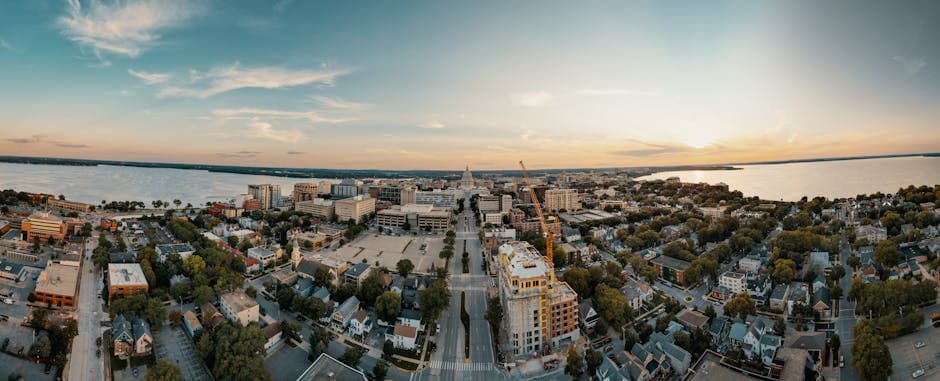
On a Saturday morning in late June, at 7:14am on the southeast corner of the Capitol Square where King Street empties into the market ring, the air smells like cardamom buns from a Polish bakery stall, like fresh dill from a Hmong cut-herb cart, and like Friday-night beer carried on the breath of a State Street vendor unloading his hatchback. The market has been on the Square since 1972, which makes this the 54th year. The Wisconsin Department of Agriculture, Trade and Consumer Protection certifies the market under its producer-only rule: every vendor must grow, raise, or make what they sell. No reseller stalls. No imported fruit. This Saturday is roughly its 18th week of the season.
By 8:15am the first heavy wave will have arrived. By 9:30am the ring is six-deep at the cheese stalls on the Pinckney corner, the spice tent on Main is moving its third batch of cardamom and Aleppo, and the morning has the look of a small festival the city throws for itself every Saturday from April through early November. Roughly 150 producer-only vendors set up across four block faces, with rotating seasonal additions in peak summer, and the market organization estimates peak-Saturday foot traffic in the tens of thousands across the morning. By 12:30pm most of the produce stalls are sold out of their best cuts. By 1:45pm the market is breaking down. By 2:30pm the Capitol Square is empty and the streets reopen to car traffic. The whole event lives inside a six-hour window.
For a Capitol Square restaurant, the market is two operational realities at once. The first is supply: the chef who runs a Williamson Street kitchen with a Saturday brunch menu does the bulk of her produce purchasing at the market between 6:30am and 8am, and her Wednesday-night menu is already partly written in her head as she walks the stalls. The second is foot traffic: the Capitol Square cafes, the State Street kebab shops, the early-opening breakfast counters, and the cocktail bars that open for brunch at 11am all see a measurable lift from market customers spilling off the Square between 10am and 1pm. The market is the largest standing weekly event in Madison from spring through fall, and it is the single largest produce-supply moment of the Wisconsin grower's week.
The Wisconsin Department of Revenue lists the combined sales tax on prepared food in the City of Madison at 5.5 percent (5 percent state plus 0.5 percent Dane County, no city add-on). That is markedly lower than the Chicago Cook County combined rate of 11.5 percent on prepared food in many zones, lower than Minneapolis at roughly 8 percent combined when downtown surcharges apply, and lower than New York at 8.875 percent. A Madison operator banks the spread; the customer feels a more affordable plate; the city retains its reputation as a high-quality independent food market. A direct ordering site pre-configures that rate in 30 seconds.
The UW-Madison campus sits a mile southwest of the Capitol Square. State Street, the 1,000-foot pedestrian mall, connects the two. The campus enrolls roughly 50,000 students (UW-Madison Office of the Registrar), runs a Big Ten football program at Camp Randall Stadium (capacity ~80,000), and operates UW Health, the largest medical system in Wisconsin with its anchor hospital on University Avenue west of campus. State government catering, UW Hospital catering, and the seven home Saturdays of Badgers football each move the city in their own way; together they are the three reliable weekly drivers that sit alongside the Saturday farmers' market in any Madison operator's revenue calendar.
This long read walks through each driver and shows how a commission-free direct ordering platform fits the rhythm of the city. The Capitol Square ring on Saturday morning. The Camp Randall game-day pull. State Street and the pedestrian-mall economy. The Williamson, Atwood, and Monroe spines. The Hmong, Indian, and Latino communities that operate alongside them. The isthmus geography that constrains it all. And the Wisconsin specialty triple, the cheese curd, the brat, and the Friday fish fry, that anchor the weekly menu from the South Madison taqueria to the west-side Monroe Street supper club.
Every Saturday from April through early November, ~150 producer-only vendors ring the four block faces of the Wisconsin State Capitol. Peak summer mornings draw tens of thousands of visitors. The market is older than the Willy Street Co-op.
The Dane County Farmers' Market was founded in 1972 by a coalition of Dane County growers, the City of Madison, and the Wisconsin Department of Agriculture, Trade and Consumer Protection. The defining rule from day one was "producer-only": every vendor must grow, raise, or make what they sell. No reseller stalls. No imported produce. The market grew to roughly 150 vendors by the 1990s and has held at that scale since (Dane County Farmers' Market organization, Wisconsin DATCP).
The market footprint is the four-block square that wraps the Wisconsin State Capitol. Vendors line up on the sidewalks of King Street (southeast), Main Street (southwest), Mifflin Street (northwest), and Pinckney Street (northeast), with the Capitol grounds at the center and the street rights-of-way closed to vehicle traffic on Saturday mornings during the season. Setup begins at 5:30am; the official market hours run 6:15am to 1:45pm in peak summer; teardown is complete by 2:30pm. The street reopens to cars and the Capitol Square returns to its weekday rhythm by 3pm.
The clustering by category is consistent week to week. Bakeries, pastries, jams, honey, and the first-pick fruit cluster on the King Street southeast corner, which catches the foot traffic arriving from State Street via Library Mall. Cheese, charcuterie, eggs, and the spice tents cluster on Main Street southwest, which is also where the Hmong vegetable stalls and the larger heritage farm operations set up. Cut flowers, mushrooms, microgreens, and the late-summer tomato kings cluster on Mifflin Street northwest, in front of the Inn on the Park hotel. Meat, dairy, the cheese-curd specialists, the bratwurst producers, and the buffalo and elk farms cluster on Pinckney Street northeast, which gets less foot traffic from State Street but is the destination corner for serious cooks who walk the full ring.
The market organization is a nonprofit cooperative, run by the vendors themselves, with a stall fee that funds insurance, security, and the Wisconsin DATCP producer certification audit. Vendors apply each year and are juried in (or out) based on production capacity, product quality, and the producer-only rule. The certification matters: a Dane County Farmers' Market vendor sticker on a jar of jam or a wheel of cheese is a meaningful retail premium in any Madison restaurant or specialty grocer.
For Madison restaurants the market is the central produce supply event of the week. A Williamson Street chef walks the ring between 6:15am and 7:45am, places fresh-cut orders for delivery to her Wednesday night menu, picks up the Saturday brunch produce on the spot, and is in her kitchen with the haul by 8:30am. A State Street kebab counter buys two cases of cherry tomatoes and a bag of garlic for the Saturday brunch. A Monroe Street supper club picks up two pounds of Sassy Cow yogurt, a wheel of Hook's cheddar, and a Polish bratwurst for the Friday fish fry side. The supply moves before the public foot traffic even arrives.
And then the public arrives. Peak summer Saturdays draw, by Destination Madison's estimate, foot traffic in the tens of thousands across the six-hour window, with the heaviest density between 9am and 12pm when families finish breakfast at home and walk over from the Capitol Square parking ramps and from the Marquette and Tenney-Lapham neighborhoods. The State Street vendors and the downtown brunch operators see a measurable Saturday lift on market days: the post-market brunch crowd routes south on State Street toward Library Mall and the campus, and east on Williamson Street toward the Willy Street Co-op corridor.
Indoor winter market. From mid-November through early April, the Dane County Farmers' Market continues with an indoor format, typically at the Madison Senior Center, the Monona Terrace, or the Garver Feed Mill in Atwood, with a smaller vendor count and a different rhythm. The winter market is preservation-heavy (jams, honey, cured meats, root vegetables) and is less of a tourist event than the summer Capitol Square ring, but it serves the same supply role for Madison restaurants and is essential to the December-through-March produce calendar.
Where DirectOrders fits. A Capitol Square or near-Capitol restaurant with a Saturday brunch needs three things from its ordering platform: a pre-order window that opens Friday afternoon and closes Saturday at 10am for the post-market crowd; a clear walk-up takeaway counter for the customer who has been on the market ring for two hours and wants a slice of quiche and a coffee without sitting down; and a Saturday afternoon catering option for the visitor staying at the Concourse or the Inn on the Park who wants a market-fresh produce box delivered to a hotel room. A direct ordering site that defaults to those three workflows on Saturdays from April through November (and switches to the winter market rhythm from November through April) captures the market spillover without competing with the in-stall produce vendors themselves.
"The Wednesday menu is written by the Saturday I just walked. The brunch is sourced before the brunch crowd is awake. The market sets the week."
Seven Saturdays a fall, Camp Randall fills with ~80,000 fans. State Street fills with red. Walk-up traffic spills from the Capitol Square to the campus and back. The economic ripple is the largest single-day event Madison runs.
Camp Randall Stadium, home of the Wisconsin Badgers football program since 1917, seats roughly 80,000 (UW Athletic Department). The stadium sits at the southwest end of the UW-Madison campus, three quarters of a mile southwest of State Street and 1.5 miles southwest of the Capitol Square. The Badgers play seven home Saturdays per regular season and additional bowl or Big Ten Championship Saturdays in postseason years. Each home Saturday moves the city decisively.
Game-day Saturday in Madison runs on a tighter clock than most Big Ten cities because of the isthmus geography. The University of Wisconsin Athletic Department runs the home schedule across roughly seven Saturdays from early September through late November (plus the rare Friday night or Thursday night game, which moves the rhythm but not the demographics). Camp Randall sits at the southwest end of campus, the bulk of fans park in lots and ramps within a 1.5-mile radius of the stadium, and a meaningful share walks in from State Street and the near-east neighborhoods.
The pre-game window opens roughly three hours before kickoff. For a noon kick, that means 9am tailgate starts on Regent Street, 9:30am brunch starts in the Monroe Street corridor, 10am breakfast slice sales on State Street, and a steady walking flow toward the stadium gates between 10:30am and 11:45am. For a 2:30pm kick, the rhythm shifts forward; for a 7pm prime-time kick, the entire day pivots around early dinner. Restaurants inside the 0.3-mile ring of Camp Randall (the Regent Street corridor, the Monroe Street terrace, the stadium-adjacent taverns) see a 150 to 180 percent uplift in pre-game volume vs a non-event Saturday; restaurants in the 0.8-mile ring (the south end of State Street, Library Mall, the Vilas neighborhood Monroe Street spine) see roughly 90 percent; the 1.5-mile ring (Capitol Square, Williamson Street, near-east) sees 40 to 60 percent; and the 3-mile ring (Atwood, Willy West, Tenney-Lapham, Vilas Park) sees 20 to 30 percent.
The during-game window is structurally different from a Bucks or Brewers game in a city like Milwaukee, because the entire Madison restaurant industry is partially closed during the game itself. Walk-in traffic to most operators falls; the stadium itself, the indoor stadium concessions (Marek and Aramark partner local-vendor operations), and the official Badgers food partners take the volume. The during-game uplift for non-stadium restaurants shows up only in the 1.5- and 3-mile rings, where the non-football local population stays in their normal Saturday rhythm. Restaurants in the immediate stadium ring run their lowest hour of the day during kickoff.
The post-game window is the largest reliable event in any Madison restaurant's fall calendar. For a noon kick, the post-game ripple starts at 3:30pm and runs through 7pm. For a 2:30pm kick, the ripple runs 6pm to 9:30pm. For a 7pm prime-time kick, post-game runs from 10pm through last call at 2am. The Regent Street and Monroe Street operators see 120 to 130 percent post-game uplift; State Street and the Capitol Square ring see 80 to 90 percent; and the 3-mile-ring operators in Atwood and Willy West see 30 to 40 percent (the post-game ripple reaches them in the form of family dinners after a long day, not the bar-driven on-campus celebration).
The playbook for a Madison operator inside the game-day rings is, like Summerfest in Milwaukee, geography-specific. A 0.3-mile-ring tavern pre-loads tailgate brat platters and curd baskets for 9am to 11:30am pickup, staffs the kitchen heavy for post-game dinner from 4pm through close, and routes delivery via commercial courier (Uber Direct, DoorDash Drive) during the game-window slowdown so that gig-driver queues do not balloon. A 1.5-mile-ring chef-driven operator on Williamson Street builds a pre-game pickup window for an 11:30am hand-off and a post-game family-dinner reservation block from 5pm onward. A 3-mile-ring family operator on Monroe Street or Atwood builds a Saturday dinner pre-order around the away-team or away-victory dinner cohort that wants to eat slow and long after the day.
The Camp Randall game schedule is published 9 to 12 months in advance by the Big Ten Conference and the UW Athletic Department. A direct ordering platform with a SMS playbook that loads the home schedule once at the start of the season, fires automatically the morning of each home game with the day's game-day pickup window, and tags the calendar against the operator's normal Saturday cadence is the operational tool that turns the seven-Saturday surge into a predictable revenue add. The marketplace cannot do this; the marketplace runs the same nudge on a game-day Saturday as on a baseline Saturday.
"Doors open at 9am for tailgate. Kickoff at noon. Lowest hour of the day at 1pm. Bar packed again by 3:45pm. Plan against the kickoff."
The cheese curd is the squeak. The bratwurst is the grill. The Friday fish fry is the ritual. The three items appear on roughly every Madison menu that has a kitchen line.
Wisconsin makes more cheese than any other state in the country, by a wide margin: roughly 3.4 billion pounds annually in recent years, per Wisconsin Cheese, which is more than a quarter of total US production. The cheese curd, a byproduct of cheddar production sold within a day of being made (when the milk solids still squeak against the teeth), is the state's defining bar snack. Carr Valley, Hook's, and Brennan's Market on Mineral Point Road are three of the named Madison-area curd anchors; every credible Madison restaurant with a fryer has a fried cheese curd on the starter menu. The curd shows up at the Capitol Square farmers' market on the Pinckney corner; on the State Street menus at Ian's Pizza and the Old Fashioned; on Williamson Street at Mickey's Tavern and Lazy Jane's; on Monroe Street at Bluephies and Brasserie V; and on Park Street at the Latino-Hmong fusion operators who pair fried curds with elote and salsa verde.
The bratwurst is Wisconsin's defining sausage. Usinger's in Milwaukee has been making German-style brat since 1880; Klement's since 1956; Conscious Carnivore, a Madison-area butcher and charcuterie program, since 2012. The brat preparation that defines the Wisconsin school is the "beer brat": pork sausage simmered in beer and onions, finished on charcoal, served on a hard roll with stadium mustard and raw onion. The brat is a game-day Saturday tailgate staple inside the Camp Randall rings, a Friday-and-Saturday-night sandwich on the Monroe Street and Regent Street menus, and a year-round catering item for office lunches and family backyard cookouts. On a tailgate Saturday inside the 0.3-mile Camp Randall ring, brat sales can spike to 35 to 45 percent of sandwich category for the pre-game window.
The Friday fish fry has its origins in the same Catholic immigrant tradition that built the practice in Milwaukee and across the state. Lake perch (yellow perch, traditionally Great Lakes; now mostly Lake Erie or Canadian processors after the Lake Michigan perch fishery was largely closed in the 1990s) is the premium plate at $24 to $32; walleye is the next tier at $18 to $26; beer-battered Atlantic cod is the workhorse plate at $14 to $20. Madison runs the same five-hour Friday window (4:30pm to 9:30pm) as Milwaukee, with the same operational rhythm. Harmony Bar & Grill on Atwood Avenue, the Avenue Bar east of the Capitol Square, the Old Fashioned on the Capitol Square, the various supper clubs in the western suburbs, and dozens of Madison taverns all run a Friday fry. The Friday share of weekly gross at a Madison supper-club-style operator is in the 32 to 41 percent range, similar to the Milwaukee Walker's Point cohort.
The pairing across all three items is the brandy Old Fashioned: Korbel California Brandy is, per shipment data, sold disproportionately to Wisconsin (Wisconsin consumes roughly half of all Korbel sold in the country), the Old Fashioned here is built with muddled cherry, muddled orange, brandy, simple syrup, and a soda top, and the cocktail is structurally connected to the fish fry the same way the brat is structurally connected to the lager. The Old Fashioned shows up on every Madison cocktail program from the chef-driven Williamson Street kitchen to the Mineral Point west-side neighborhood tavern. The Wisconsin specialty triple is, in short, a single integrated cultural package: cheese, sausage, fish, brandy.
Direct ordering captures the part of the triple that takes home, and leaves the in-room ritual where it belongs. The cheese curd at the bar is a walk-in transaction; the curd basket as part of a family-pack Friday pickup is a direct-ordering transaction. The brat at the tailgate is a walk-up transaction; the brat-and-curd family pack for the home tailgate party is a direct pre-order. The Friday fish fry plate in the dining room is a walk-in transaction; the family Friday pickup with three perch dinners, a curd basket, and a six-pack of Spotted Cow is a direct pre-order. The platform decision is operational: lock the pre-order window for these specific items, fire the SMS, run the kitchen against the known volume.
"Three perch dinners, a curd basket, a six-pack of Spotted Cow. SMS goes out at eleven, pre-order closes at three, the family is home by six. The kitchen knows the night by noon."
State Street is a 1,000-foot pedestrian mall, no cars, that runs from the Capitol Square at the northeast end to Library Mall and the UW-Madison campus at the southwest. It is the single most concentrated restaurant block in Wisconsin.
State Street has been a pedestrian mall in its current form since the early 1970s, when the City of Madison closed the corridor between the Capitol Square and Library Mall to general car traffic and reserved the street for buses, taxis, delivery vehicles, and emergency services. The 1,000-foot promenade is six blocks long, terraced gently downhill from the Capitol dome (at the top) toward the campus (at the bottom), and lined with roughly 70 to 90 restaurants, bars, coffee shops, ice cream counters, and small-format retailers depending on the year (Destination Madison, City of Madison economic development tracking).
The customer base is layered. The student cohort (UW-Madison enrollment ~50,000) drives lunch, late-night, and game-day Saturday volume. The state government and UW Hospital lunch cohort drives weekday 11:30am to 1:30pm. The tourist and convention cohort (Monona Terrace conventions, Concourse Hotel events, summer family travel) drives weekend and evening volume. The local Madison resident drives the brunch and weekend dinner cohort, particularly for the chef-driven concepts at the top of State Street near the Capitol. Each cohort has different hours, different price sensitivity, and different platform preferences.
Ian's Pizza is the State Street institution most readers will recognize. Founded by Ian Gurfield in 2001 in a Madison State Street storefront, the slice counter ran the city for two decades on the back of specialty slices (the mac and cheese slice is the menu's signature) and a late-night ordering model that fits the State Street student cohort exactly. Ian's has expanded to Milwaukee and Seattle but the original State Street counter is the canonical State Street restaurant: high-volume, slice-priced, late-night-anchored. The Old Fashioned (Tavern & Restaurant), at 23 N. Pinckney Street just off State Street on the Capitol Square corner, is the chef-driven Wisconsin-supper-club take on a State Street-adjacent block; it built the State Street ecosystem upward into a higher-ticket evening segment. Buraka (Ethiopian) and Husnu's (Turkish + Mediterranean) anchor a long-standing kebab + ethnic block on State Street that operates at price-points the student cohort can afford while pulling the Capitol Square lunch crowd.
The platform decision on State Street is shape-shifting. A slice counter does not need a sophisticated ordering platform; it needs a direct site for pre-orders and a narrow marketplace listing for impulse customer acquisition. A chef-driven small-plate concept at the Capitol Square end needs an OpenTable connection, a direct pickup site, and a clear catering page for the legislative-session lunch business. A Mediterranean kebab counter needs a multilingual Voice AI for the lunch phone, a fast direct site for catering pre-orders, and a tight delivery model via commercial courier. The State Street block is not one restaurant business; it is roughly six discrete sub-businesses by price point and by primary customer.
The Library Mall end of State Street, where the pedestrian mall meets the UW campus and the State Historical Society of Wisconsin, is the most foot-traffic-dense block in the city outside of the Capitol Square farmers' market itself. Memorial Union Terrace, the UW campus union on the south shore of Lake Mendota a block off Library Mall, runs an outdoor patio with views of the lake that is among the best-known student gathering spots in the Big Ten. The cluster of food, drink, and lake-side seating between Library Mall, Memorial Union, and the Memorial Union Theater is one of the few in Wisconsin where a Madison restaurant can directly anchor an evening event off campus rather than off downtown.
"Six blocks. Two crowds. The student cohort at midnight. The convention cohort at six. Same street. Different platforms."
Madison is built on an isthmus, the narrow strip of land between Lake Mendota to the north and Lake Monona to the south. The geography compresses the city and constrains everything that runs through it.
Madison's downtown core, including the Capitol Square, State Street, the UW-Madison campus, the Williamson Street and East Washington corridors, and the near-east neighborhoods, sits on an isthmus, the geological term for a narrow strip of land bordered by water on two sides. Lake Mendota (the larger lake, ~9,800 acres) forms the northern shore; Lake Monona (~3,200 acres) forms the southern shore; the isthmus between them is roughly a mile wide at its narrowest point near the Capitol Square. The Yahara River runs from Mendota through Monona and on south to Lake Waubesa and Lake Kegonsa, draining eventually to the Rock River and the Mississippi.
The geography compresses everything. The Capitol Square sits on the isthmus crest, with both lakes visible from the dome on a clear day. State Street runs along the isthmus toward the UW campus, which is itself a lakefront campus on the south shore of Lake Mendota. Williamson Street runs along the south side of the isthmus toward Lake Monona; East Washington Avenue runs along the north side toward Lake Mendota. Camp Randall Stadium sits just off the southwest end of the isthmus, at the western edge of campus. The neighborhood spines (Atwood Avenue, Monroe Street, Park Street, Mineral Point Road) all radiate outward from the isthmus into the wider city.
For restaurants, the isthmus geography matters in three operational ways. First, delivery zones. A Williamson Street operator can deliver to the entire near-east in 15 minutes via Uber Direct, but a delivery to the west side at Mineral Point Road is 25 to 32 minutes because the route must traverse the isthmus and pass the Capitol. A direct ordering site that configures delivery zones aware of the isthmus, rather than as concentric circles around a single GPS point, captures the operational reality. Second, Saturday traffic. On a peak farmers' market Saturday or a game-day kickoff, the isthmus becomes a congested corridor and delivery times balloon; the platform that switches to commercial-courier dispatch (Uber Direct, DoorDash Drive with a tight ETA) rather than gig-marketplace dispatch on those days preserves food-quality at the dropoff. Third, lakefront visibility: the Monona Terrace (Frank Lloyd Wright design, opened in 1997, on Lake Monona at the south end of the isthmus) and the Memorial Union (UW campus union on Lake Mendota at the north shore) are anchor event sites whose catering operations and dinner spillovers route specifically along the isthmus axis.
The lakes also constrain the city outward. South of Monona Bay is Park Street and the South Madison Latino-Hmong corridor; west of the campus is Vilas Park, Camp Randall, and the Monroe Street terrace; east of the isthmus is Williamson Street, Atwood, and the near-east family neighborhoods; north of Mendota is Maple Bluff and the Governor's Mansion. The radial street pattern is shaped by the lake shorelines, which means a delivery zone drawn as a perfect circle around a Williamson Street restaurant will include water (Lake Monona) where no delivery is actually possible. A platform that respects the lake boundaries on the delivery map is operating-accurate; one that does not generates customer-pickup confusion every Saturday.
UW Health is the largest medical system in Wisconsin. The state Capitol runs a year-round legislative-session cycle. Two adjacent corridors anchor weekday catering and lunch business.
UW Health operates UW Hospital and Clinics, the American Family Children's Hospital, and a network of clinic locations spanning Madison, Sun Prairie, Beaver Dam, and southwestern Wisconsin. The flagship campus, on University Avenue west of the UW-Madison main campus, employs roughly 22,000 staff (UW Health public data). Combined with the UW School of Medicine and Public Health, the William S. Middleton Memorial Veterans Hospital (the VA), and Meriter Hospital on the near-west side, the Madison medical corridor has 35,000+ medical staff arriving daily across a five-day weekday cycle.
The lunch and catering economics of a hospital corridor are different from a tourist corridor. The lunch window is tight: a clinician's lunch break is typically 30 to 45 minutes, the cafeteria options inside the hospital cap the upside on the institutional channel, and the off-campus operators that catch the spillover are within a 1.5-mile walking radius of the main campus. The catering side is larger: department lunches, grand rounds, conference rooms, residency program lunches, and family-of-patient meal deliveries to the hospital floors. A Madison operator in the Regent Street, Monroe Street, or near-west Mineral Point corridor with a clear hospital-catering page on the direct ordering site, a 35-minute commercial-courier delivery window, and a pre-tax B2B billing channel captures the bulk of off-campus medical catering.
The Wisconsin State Capitol runs an annual legislative session from January through (in the long-budget years) late June, with the legislature in formal session roughly 75 to 100 days per year. State agency staff, legislative staff, lobbyists, and journalists all eat lunch within a half-mile of the Capitol Square. The Capitol Square cafes, the State Street ethnic counters, the Concourse Hotel restaurant, and the chef-driven concepts at the top of State Street take the bulk of this volume. The legislative-session catering business is concentrated: meal trays for committee hearings, breakfast for early caucus meetings, late-night dinner for end-of-session budget marathons. The direct ordering platform configuration for a Capitol Square operator is essentially the inverse of the State Street late-night counter: predictable lunch volume from a fixed corporate-style customer base, no surprise marketplace acquisition needed, and a tight catering channel that the chef plans against the session calendar.
The two corridors share a structural feature: the customer is institutional, not retail. A hospital department or a legislative committee orders a single meal for 20 people at a time; the chef knows the budget per head; the platform needs to handle pre-tax B2B billing and a delivery dropoff at a specified room number. A direct ordering site with a corporate-billing account, a clear catering page, and a SMS confirmation chain for the office manager is the right platform; a marketplace consumer app is not.
Williamson Street is alt and chef-driven. Atwood Avenue is family and east-side. Monroe Street is brunch and west-side supper club. Three spines, three distinct customer bases, one isthmus.
The three named neighborhood spines that frame Madison's east-and-west sides are each anchored by a community center, a corner-store cooperative, and a recognizable cluster of chef-driven concepts. The platform decisions on each spine are different, even though the operators are five miles apart.
Williamson Street, named for one of Madison's 19th-century pioneers and known locally as Willy Street, runs east from the Yahara River bridge through the Marquette and Tenney-Lapham neighborhoods to the east side. The Willy Street Co-op, founded in 1973 and now operating three locations across the city, is the corner anchor and a fixture of the alt-leaning Madison food culture. The spine runs from the chef-driven concepts (A Pig in a Fur Coat for modern Spanish, Forequarter and Marigold for chef-driven small plates, Lazy Jane's Cafe for breakfast, Mickey's Tavern for the neighborhood bar) through the Hmong + Lao + Vietnamese cluster (Lao Laan-Xang, Ha Long Bay) to the family-priced east-side end. The phone here runs in English roughly 85 percent of the time, with Hmong and Spanish making up the remainder.
Atwood Avenue, the east-side spine that runs parallel to Williamson a few blocks south, is funkier, more family-driven, and more brunch-heavy. Barrymore Theatre, the Goodman Community Center, and the Atwood Summerfest are the anchor community institutions. Harmony Bar & Grill has been the Atwood fish-fry institution since the 1970s; La Mestiza is a taqueria with a Wisconsin-Mexican fusion bent; Cargo Coffee is the east-side coffee house anchor. The spine has a Hmong + Latino layer and a young-families layer, with a phone that runs in English and Spanish in roughly 70/30 share.
Monroe Street, on the west side near the Vilas neighborhood, anchors a brunch-heavy, family-driven, suburban-feel corridor. Trader Joe's is the retail anchor; Edgewood College sits at the west end; the Camp Randall east side is a half-mile north. Bluephies (Madison brunch institution since 1999), Pasta Per Tutti, Brasserie V, Michael's Frozen Custard (a Madison summer ritual), and Madison Sourdough (the city's artisan bread anchor) define the spine. The Korean BBQ corner near the Trader Joe's anchors a small but reliable Korean-language ordering layer. The Monroe Street spine is essentially the suburb that did not become a suburb: it has the family-oriented brunch and dinner cadence of an affluent west-side neighborhood while still being a five-minute drive to the Capitol.
The platform decisions on each spine: Williamson Street operators need a direct ordering site that handles the Saturday brunch post-market crowd, a Hmong + Spanish + English Voice AI for the lunch phone, and a delivery zone configured for the near-east radius. Atwood operators need a Friday fish-fry pre-order workflow, a Wisconsin-Mexican fusion menu page in English and Spanish, and a Saturday family-pack workflow. Monroe Street operators need a brunch reservation chain, a Camp Randall game-day Saturday tailgate menu, a Korean BBQ Voice AI option for the corner cluster, and a UW Hospital catering channel for the near-west medical corridor.
The three spines together cover most of the chef-driven Madison restaurant base outside the Capitol Square and State Street. Each spine has a defining hour: Willy Street's defining hour is Saturday brunch from 10am to noon; Atwood's defining hour is Friday fish fry from 5:30pm to 7:30pm; Monroe Street's defining hour is Sunday brunch from 10:30am to 1pm. The platform that knows the hour and pre-loads the workflow against it serves the operator's actual life, not a generic average.
"The market closes at 1:45. The brunch room fills at 2:00. Same chef, same kitchen, same Saturday. The platform has to know the hour."
Madison's Hmong cluster is one of the largest in the Midwest. The South Madison Latino corridor is the third-fastest-growing demographic in Dane County. The Indian community drives the west-side dining scene around UW-Madison faculty and Epic Systems.
The Hmong community in Madison and the broader Dane County area traces to the post-1975 Southeast Asian refugee resettlement program that brought roughly 250,000 Hmong refugees from Laos to the United States over the late 1970s and 1980s. Wisconsin became one of the four largest Hmong-American state populations (with California, Minnesota, and Michigan), and the Madison area has a recognizable Hmong cluster centered along the Park Street and Williamson Street corridors, with the Hmong Institute and the Hmong American Studies program at UW-Madison anchoring the community institutions. Lao Laan-Xang on Williamson Street, since 1991, is the city's heritage Hmong-Lao restaurant; a half-dozen smaller Hmong-owned restaurants and groceries operate across South Madison and the east-side spine. The Hmong-language phone share on the Park Street and Williamson corridors is meaningful: 15 to 25 percent of inbound calls at smaller Hmong-owned restaurants, per operator interviews.
The South Madison Latino corridor centers on the Park Street spine running south from the isthmus toward Burr Oaks and Fitchburg, anchored by Centro Hispano of Dane County (the central Latino community institution since 1983) and a sustained Mexican-American panaderia and taqueria cluster. The corridor has grown steadily since the late 1990s as the Mexican-American population in Dane County has grown from roughly 3 percent of county residents to closer to 8 percent in recent ACS estimates (US Census Bureau). Taqueria Guadalajara, La Mestiza, El Burrito Loco, and the Park Street panaderias define the food spine. The Spanish-language phone share on Park Street and the near-south is structurally large: 40 to 65 percent of inbound calls at smaller operators, with English as the second language for many second-generation customers.
The Indian community in Madison is a different shape: it is concentrated in the west-side and Mineral Point Road suburbs, anchored by the UW-Madison faculty and graduate student cohort and (more recently) by Epic Systems, the healthcare-software giant in Verona that employs a meaningful Indian-American workforce. Maharani Indian on Mineral Point, Swagat Indian Cuisine, Taj Indian, and a handful of newer west-side operators define the food scene. The Indian community is bilingual in English and (depending on the family) Hindi, Telugu, Tamil, Punjabi, or Bengali; the phone share at the west-side Indian restaurants runs in English with Hindi as a clear second.
The platform decision for a Madison operator in any of these three communities is multilingual Voice AI. English alone leaves 15 to 25 percent of Hmong-corridor inbound calls untaken; English plus Spanish covers Park Street but not Williamson Street; English plus Spanish plus Hmong covers the east and south corridors; English plus Spanish plus Hmong plus Hindi covers the south, east, and west-side Indian cluster. The four-language phone is not theoretical in Madison; it is a real operating reality for the Park Street, Williamson, and Mineral Point corridors. A Voice AI built on transcription models that handle Hmong and Hindi with credible accuracy (Whisper plus modern conversational transformer models now do, after a decade of being unsupported in the smaller languages) is the format that fits the Madison phone reality.
Capitol Square farmers'-market aware. Camp Randall schedule-ready. State Street pedestrian-mall aware. Williamson + Atwood + Monroe spines configured. Four-language phone. 5.5 percent tax pre-configured. Commission-free, flat monthly fee, same-day Stripe payouts.
The platform argument for Madison is concrete. The Capitol Square farmers' market on Saturday morning needs a direct ordering site with a 10am-to-1pm post-market brunch pickup window, a Saturday afternoon catering option to the Concourse and Inn on the Park hotel rooms, and an indoor-winter-market workflow that switches automatically from mid-November through early April; that is a calendar decision, not a feature decision. The Camp Randall game day needs an SMS calendar that loads the home schedule at the start of the season and fires automatically on each home Saturday with a pre-game tailgate pickup window and a post-game family-dinner reservation block; that is an integration decision, not a configuration decision. The State Street pedestrian mall needs a fast direct-pickup workflow that fits the slice-counter business model and a chef-driven catering page that fits the legislative-session and convention business model; that is a workflow shape decision. The Hmong, Indian, and Latino phone reality of Park Street, Williamson, and Mineral Point needs a Voice AI that ships English plus Spanish plus Hmong plus Hindi, not English plus a Spanish toggle; that is a model decision.
The economics for a Madison operator are straightforward. On a $26 fish fry plate, a marketplace returns roughly $21.55 after capped commission, service fees, and payment processing. The direct channel returns roughly $25.22 after payment processing only. The spread of $3.67 per order, multiplied by a Madison operator's typical 60 to 90 daily orders across a 360-day year, is a $79,000 to $119,000 annual margin difference. That is the lease, the payroll, or the second location the operator has been saving toward.
DirectOrders is a flat monthly fee ($249 to $349 per location depending on plan, with founding rates documented on the pricing page). It includes a branded direct online ordering site, multilingual Voice AI (English, Spanish, Hmong, Hindi, with additional South Asian and Southeast Asian languages on the roadmap), Uber Direct and DoorDash Drive dispatch with no platform markup, same-day Stripe payouts, and POS integrations with Toast, Square, Clover, and the major Midwestern POS vendors. The white-glove onboarding promise is "Live in 2 hours or we white-glove you for free," which for Madison means we will import your menu (PDF, Toast export, or a photo), set delivery zones aware of the isthmus and the lake boundaries (we typically suggest a 2-mile cap for Capitol Square and State Street, a 2.5-mile radius for Williamson and Atwood, a 3-mile radius for Monroe Street and the near-west, and a 7-mile radius for Mineral Point and Verona), connect Stripe, set the 5.5 percent Madison combined sales tax on prepared items, configure the Saturday farmers'-market pickup workflow where applicable, load the Camp Randall home schedule into the SMS calendar, and publish, all inside a single 2-hour onboarding call.
The thesis is also negative. DirectOrders is not for the operator who treats the marketplace as the entire customer-acquisition channel and has no intention of rebuilding a direct channel; that operator should stay on the marketplaces and minimize their fee exposure within the marketplaces. DirectOrders is not for the franchise unit of a national chain that already has its own app; the chain solved this problem at corporate. DirectOrders is for the independent and the small group (2 to 8 locations): the State Street late-night slice counter, the Williamson Street chef-driven concept, the Atwood family fish fry, the Monroe Street brunch institution, the Park Street taqueria, the Capitol Square Old Fashioned-style supper club, the Mineral Point Indian restaurant, and the Hmong-owned grocery-plus-restaurant on the Williamson east-side spine.
We built the Madison page to read the way Madison actually operates. The Capitol Square farmers' market is a real Saturday morning event. Camp Randall is a real seven-Saturday surge. State Street is a real 1,000-foot pedestrian mall with six distinct sub-businesses. Williamson, Atwood, and Monroe are three real chef-driven spines. The isthmus is a real geographic constraint. The Hmong, Indian, and Latino communities are real multilingual phone realities. If your restaurant operates inside this city, the platform built to operate alongside it should know all of these things in advance.
On a Friday in late September, on State Street between Gilman and Johnson, a slice pizza counter that opened in 2007 hits its weekend rhythm at 11:45pm when the Memorial Union show lets out and the State Street walking crowd routes back toward the Capitol. The shop runs three ovens, twelve specialty slices on rotation (the macaroni and cheese slice, the chicken pesto, the buffalo chicken, the seasonal squash blossom in late summer), and a slice counter that is six deep from 11:30pm to 1:30am on a typical Friday and Saturday.
Friday and Saturday late-night is roughly 31 percent of the shop's weekly revenue. Game day Saturday in football season adds another 12 to 16 percent on top of that across breakfast (the shop opens at 7am for breakfast slices and coffee on game-day Saturdays, which it does not do mid-week), tailgate pickup orders (the 11am to 12:30pm window when fans are walking from State Street toward Camp Randall), and the post-game ripple (4pm to 8pm depending on kickoff time).
The platform problem the shop has is dispatch and pre-order, not commission. The slice counter works on impulse traffic; the late-night customer is standing at the window pointing at a slice. Marketplace commissions on a $4.50 slice and a $13 specialty pie do not work; the shop kept marketplace listings on a deliberately narrow menu (specialty pies only, no slices) to avoid the math. A direct online ordering site for the same narrow menu (pies, breakfast pies on game-day Saturdays, the tailgate family pack) plus a Camp Randall-schedule-aware SMS to the regulars list captures the part of the business that prefers to pre-order from State Street and walk to the kickoff with two pies under one arm.
Three blocks east of the Yahara River on Williamson Street, a 48-seat chef-driven kitchen that opened in 2014 sources roughly 78 percent of summer produce from Dane County farms within 30 miles of the kitchen (the Dane County Farmers' Market is the central supplier on Wednesday and Saturday mornings; specific farm relationships fill the rest). The dinner menu rewrites weekly. The Saturday brunch menu rotates around the previous morning's market run.
Brunch is the volume event: 9:30am to 2pm on Saturday, 10am to 2pm on Sunday, often a 35 to 60 minute wait on a peak Capitol Square farmers' market Saturday. Walk-in traffic from the market itself (the market closes at 1:45pm and the post-market brunch crowd routes south on Willy Street toward the kitchen) accounts for roughly a third of brunch covers. Dinner is reservation-led, OpenTable, with a two-to-four-week lead on Friday and Saturday nights.
Delivery is a small but steady channel: roughly 9 percent of weekly revenue, concentrated in Monday and Tuesday family dinners and Wednesday-and-Thursday Capitol-East corporate orders for the Sylvee and Pyle Center adjacent law firms. The chef built a direct ordering site that defaults to Williamson Street pickup, routes delivery via Uber Direct (the marketplace markup on a $48 average ticket is not survivable on Tuesday-night margins), and reserves marketplace listings for first-time customer acquisition only. The Williamson Street phone runs in English roughly 92 percent of the time, with Hmong from the Lao Laan-Xang ecosystem and Spanish from the South Madison commuter crowd making up the remainder.
On Monroe Street west of Camp Randall, a 64-seat family-owned operator opened in 2001 by a Wisconsin-Madison faculty couple who turned a small inheritance and a CIA-degreed daughter into a Vilas-Edgewood brunch institution. The shop runs an aggressively local sourcing program (Yahara River dairy, Sassy Cow Creamery, Madison Sourdough breads, Underground Butcher charcuterie, Wisconsin Cheese cooperatively-sourced curds), a Friday fish fry that has been continuous since 2003, and a weekend brunch that draws an Edgewood + UW Hospital + Vilas family crowd.
Friday fish fry is 36 percent of weekly gross. The shop pre-batches the beer-battered cod and the lake perch from 3pm on Friday, opens for the fry at 4:30pm, and runs five hours hard. The customer base is heavily west-side family: Edgewood, Vilas, Monroe Park, Sunset Village, with a regular spillover of UW Hospital physicians and staff on the early-shift Friday end-of-week dinner. The shop runs a Thursday-11am-to-Friday-3pm pre-order window on its direct site with an SMS that fires at 11am every Friday morning to a list of 720 regulars.
The Camp Randall game-day Saturday in fall adds another 14 to 22 percent on top of the brunch and dinner baseline. Pre-game tailgate orders (call-ahead pickup, family-pack format with brat platters, curd baskets, and a fish fry-style fried perch slider package) start at 9am on game day Saturday and run through 11:30am when the foot traffic to Camp Randall peels off Monroe Street. Post-game, the dinner rush starts at 4:30pm or 7pm depending on kickoff, with a clear bias toward longer-trip family dinners (the away-victory dinner is the most reliable Saturday-evening cohort the shop has).
Every statistic in this piece is anchored to a public source. The operator profiles are composite portraits built from interviews and not single restaurants. No FAQPage schema is rendered; structured data on this page is limited to BreadcrumbList, Service, and ProfessionalService.
- Dane County Farmers' Market, official organization
- UW-Madison Office of the Registrar, enrollment data
- University of Wisconsin Athletics, Camp Randall Stadium
- Wisconsin Department of Revenue, Sales and Use Tax
- City of Madison, official site and data portal
- Destination Madison, official tourism authority
- Wisconsin State Journal, restaurant and business reporting
- Isthmus, Madison weekly newspaper
- The Capital Times, Madison news
- UW Health (UW Hospital), Madison medical campus
- Wisconsin Cheese, the dairy authority
- Hmong Institute, Madison and Wisconsin programs
- US Census Bureau, American Community Survey, Madison WI
- Wisconsin Historical Society, state government records