It is a Tuesday in February at 12:14pm, the wind chill outside the IDS Center reads minus 22 degrees, and inside, on the second floor, the line for Juicy Lucys is 14 deep.
A long read on the 9.5 miles of indoor skyway that carries Minneapolis through five sub-zero months, the four languages a Twin Cities phone rings in, the burger origin dispute that defines the city, and the 12-day fair that runs the back half of August.
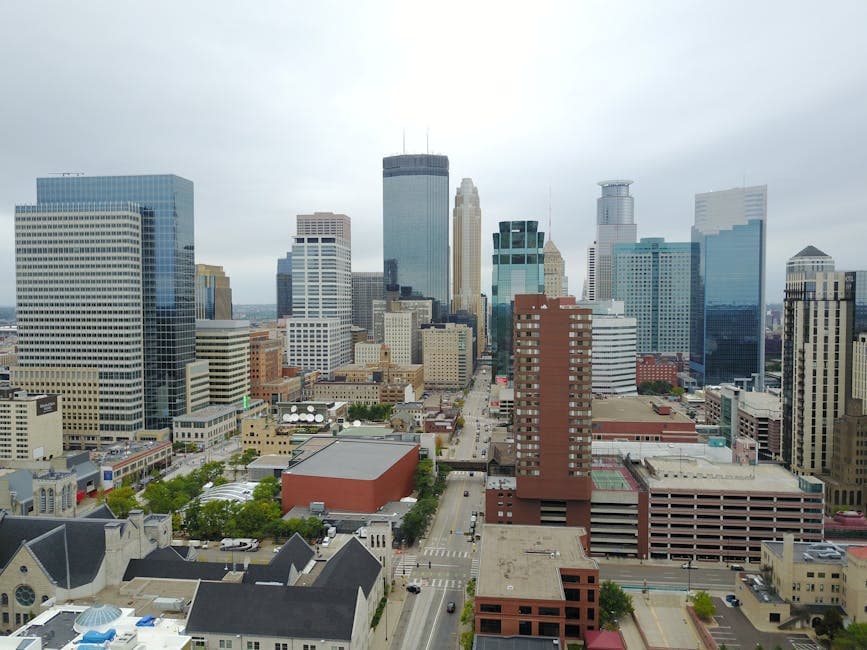
It is the kind of cold that Minneapolis treats as routine. The temperature on the LED ticker outside the Wells Fargo Center reads 5 degrees Fahrenheit at noon, the wind chill reads minus 22, and on the sidewalks of 7th Street between Nicollet and Hennepin, almost no one is walking. The lunch crowd is not absent. The lunch crowd is up one flight of stairs, on the second floor, threading through a climate-controlled glass tube that the Minneapolis Downtown Council calls the Skyway System and the rest of the country, when it learns the city has one, calls "those tubes."
The skyway is 9.5 miles of indoor walkway connecting roughly 80 downtown blocks (Mpls Downtown Council). It runs from Target Field to US Bank Stadium and from the Mississippi waterfront to the Convention Center, all on the second floor, all heated, all open from 6:30am to 10:00pm on weekdays. From November through March, the skyway is not a downtown convenience. The skyway is the downtown lunch economy.
Inside the IDS Center's Crystal Court, an operator named Marcus is plating his eighty-fourth order of the lunch rush. The shop is a 1,100 square foot counter with eight stools, a single induction line, a six-burner gas range behind a hood that vents through a shaft built into the building in 1972, and a register that has been running since 9:30am. Marcus opened the shop in 2012, took it through the pandemic with a $42,000 PPP loan and a kind landlord, and runs it now with his wife and one part-time line cook. On a normal weekday in February he turns 220 to 260 transactions between 11:15am and 1:45pm, then closes the kitchen, cleans, and is on the light rail home by 3:30pm.
This particular Tuesday his register has done 84 transactions by 12:14pm. Thirty-eight of those 84 came through his branded direct online ordering site, which his customers either pull up on their phone while waiting in the skyway line or pre-order from their desk at 11:20am for skyway pickup at noon. Twenty-two came through DoorDash and Uber Eats marketplaces, mostly from office floors in the Wells Fargo Center and the Capella Tower next door, where the building security desks have started accepting bulk skyway-pickup couriers. Sixteen were walk-ups at the register from people who came down the IDS escalator. Eight were phone orders the line cook took between dishes.
The math on those 84 transactions is the question every Minneapolis operator asks themselves between November and March. At an average ticket of $14.20, the day's gross is on track to reach roughly $3,550 by closing time. The thirty-eight direct orders return $14.20 minus three percent payment processing, which is $13.78 per ticket. The twenty-two marketplace orders return $14.20 minus a 17 percent effective rate (15 percent commission, 2 percent service-fee allocation), which is $11.79 per ticket. The spread between the two channels, multiplied across a year of skyway lunches, is roughly $47,000 in operator margin.
Marcus did not spend $47,000 to build the direct channel. He spent roughly $3,000, paid to a small Minneapolis-based platform whose plan is a flat monthly fee, and the rest is a one-time QR code printed on the to-go bag and a small loyalty perk that sends a $2 credit on the third order. The direct channel did not replace the marketplaces. It rebalanced them. In the language Marcus uses with his wife when they are doing the books on a Sunday night, the direct channel is the rent. The marketplaces are the advertising.
The Minneapolis skyway is the largest enclosed pedestrian network in the world, and on a sub-zero Tuesday it is the only restaurant geography that matters.
A stylized atlas of the spine. The network is denser than this in reality (the Mpls Downtown Council maintains the survey), but the anchor venues, the office-tower hubs, and the river boundary tell the story.
Construction on the skyway began in 1962, when a downtown property owner named Leslie Park ran a glass tube from the Northstar Center across 7th Street to the Cargill building. The original Park bridge is still in service. Every owner downtown spent the next forty years building toward it: the IDS Center connected in 1973, the Crystal Court anchored the central interchange, Nicollet Mall connected south, and Target Center and Target Field added the western terminus when the arenas opened. By the early 2000s the network had grown to roughly 80 connected blocks, and the Downtown Council had a public map.
Today the skyway carries approximately 110,000 pedestrians on a typical weekday between 11:30am and 1:30pm, per Mpls Downtown Council counts. The volume is the highest in any indoor pedestrian space in the United States. In summer the number drops by roughly a third as office workers eat outside on Nicollet Mall and at the food trucks on Marquette and 8th. In winter the number rises and the geometry tightens: the skyway is no longer one option among many; it is the option.
For restaurant operators, the skyway question is the most important real-estate question in downtown Minneapolis. A skyway-connected lease in the IDS Center, Capella Tower, or the Wells Fargo Center pays roughly $63 per square foot at the second-floor concourse level (per Star Tribune commercial real estate coverage). A comparable street-level lease one block east, on 6th Street between Nicollet and Marquette, pays roughly $19. The 3.3x rent premium is the entire winter lunch business.
Restaurants on the skyway run weekday lunch at roughly 70 percent of summer baseline through January and February, per operator interviews and Downtown Council retail census reporting. Restaurants two blocks off the skyway, on street-level corners, lose 30 to 60 percent of their January and February lunch demand. The same neighborhood can host one shop that prints money in February and another shop, less than three minutes walk away across a windy intersection, that does not survive a third winter.
The map above shows the spine. Target Center and Target Field on the west end anchor the sports and event traffic (Timberwolves, Lynx, Twins, weekend concerts at Target Center). The IDS Center sits at the center of the network: Crystal Court is the busiest second-floor hub in Minnesota, with a 121-foot vaulted glass ceiling that has hosted everything from Mary Tyler Moore commercials to bagpipe weddings. Nicollet Mall runs south to the Convention Center; Government Plaza runs east toward US Bank Stadium. The Mississippi River runs along the top edge of the atlas, the boundary that the skyway has never crossed and never will.
For an operator building a direct ordering channel, the skyway changes the customer-acquisition math twice. First, the densest customer base in winter is the office worker in a building you are skyway-connected to (or adjacent to). Direct ordering with a one-tap QR code on the to-go bag, plus pre-order-for-skyway-pickup, converts at 3 to 5x the conversion rate of marketplace push, because the customer is already in your building. Second, the skyway forces precision: pickup windows are 90-second affairs at a counter window, not a five-minute restaurant visit. A skyway-aware direct ordering site that defaults to "skyway pickup at 12:15pm" and pings the customer with a 60-second arrival reminder is the format that fits the geography.
"In July I have a restaurant. In February I have a hallway. The hallway is what pays the lease."
Little Mogadishu is not a neighborhood with a Somali restaurant. Little Mogadishu is the largest Somali community in North America, and the phone rings in Somali, Oromo, Arabic, and English before lunch.
The Twin Cities is home to approximately 80,000-plus Somali Americans (Minnesota Compass + US Census ACS), with Pew Research consistently citing the metro as the largest Somali population in the United States. Cedar-Riverside, anchored by the Riverside Plaza towers and Karmel Square, is the cultural and economic core.
The Cedar-Riverside neighborhood sits between Interstate 35W on the west, the University of Minnesota West Bank campus on the east, and the Mississippi River on the north. The Riverside Plaza housing complex (six modernist towers built in 1973, originally branded as the McKnight Riverside) has a Somali-majority resident population. The towers anchor a five-block corridor where, depending on the time of day, the languages on Cedar Avenue are Somali, Oromo, Amharic, Arabic, English, Hmong, and Spanish, in roughly that order of frequency.
Karmel Square (Pillsbury Avenue, two blocks south of Lake Street) is a separate gravitational center. Opened in the early 2000s as one of the first Somali-owned shopping malls in the United States, Karmel hosts roughly 200 small-business stalls and roughly 60 food vendors selling sambusas, suqaar, lamb stew, halwa, fresh khat (in a controlled-substance era it has shifted to coffee), Indian chai, malawah flatbread, and traditional Somali poetry recordings. The food density on the Karmel block is the densest in the metro outside of the State Fair midway.
Halal certification is not a feature in this corridor. Halal certification is a default. A restaurant on Cedar Avenue or in the Karmel block that is not halal is a category exception; it must explain itself. Sourcing runs primarily through halal-certified processors in Bloomington and Owatonna, with weekly truck routes the operators have built over a decade. The supply chain is private knowledge: an outside operator opening a halal concept in Cedar-Riverside cannot phone in a sourcing relationship; they have to be vouched for, in person, by someone in the community.
The phone-language reality is what makes the digital ordering question different here. A halal grill in Cedar-Riverside (the operator profile we wrote up earlier) takes inbound calls in Somali roughly 40 percent of the time on a normal weekday, in English 35 percent, in Oromo 15 percent, and in Arabic for the balance. The marketplace apps are functionally English-only. The customer who calls Safari Restaurant in Somali to ask about today's suqaar marinade is not the customer the marketplace product team built for; the call drops out of the funnel before the customer ever decides what to order.
During Ramadan, the operating model rewrites itself. Iftar (sundown break-fast) is the most economically important meal of the day for a halal restaurant in Cedar-Riverside. Families pre-order large platters in the morning for pickup or delivery at sundown, which moves with the lunar calendar by roughly a minute earlier each day. Suhoor (the pre-dawn meal) drives a 2:00am to 4:00am service window that does not exist in any other month. The marketplace apps cannot reliably surface a 2:30am delivery to a restaurant whose service hours, as configured in the app, normally end at 11:00pm. The operator override exists but has to be refreshed weekly. A multilingual Voice AI that understands the lunar calendar and the local sundown time, and that can take a 30-platter iftar pre-order in Somali on a Monday for a Friday sundown, is the technology layer the marketplaces have not built.
Beyond Cedar-Riverside, the Somali population extends along Lake Street through Phillips and Powderhorn (a corridor that overlaps with the Latino majority blocks around Mercado Central and the Lake Street rebuild after 2020). Bloomington and Burnsville (south metro suburbs) host a meaningful suburban Somali community with multiple halal grocers and grills. Apple Valley and Eden Prairie are growing markets. The digital infrastructure that worked for the first wave of Cedar-Riverside restaurants (a tablet on the counter, a printed menu in Somali, a phone the daughter or nephew answers in Somali) does not scale to the second-generation operator opening a second location in Bloomington. The technology gap is real.
Direct online ordering, with a properly Somali-language menu page (not a Google Translate pass), plus a Voice AI that can converse in Somali for menu Q&A and order capture, is the format that fits this community. The economics are direct: a halal grill in Cedar-Riverside that pays $1,400 a month to marketplaces and captures 32 percent of revenue through delivery can shift roughly half that volume to a direct channel at a flat monthly software fee, freeing roughly $900 a month in margin and roughly $11,000 a year. The harder unlock is the language: it is the difference between feeling like a customer and feeling like an inconvenience.
"The marketplace cannot ring my phone in Somali. So my phone, when it rings in Somali, is mine to keep."
Hmong Village is the largest Hmong-owned food market in the United States, and a five-mile arc of east Twin Cities runs in Hmong roughly half the time.
The Twin Cities host the largest urban Hmong population in the United States, with the Hmong American Partnership citing approximately 80,000-plus Hmong Americans across the metro. The community concentrates in St. Paul (Frogtown, the East Side, North End), the eastern suburbs (Maplewood, Oakdale, Woodbury), and an arc that crosses into northern Minneapolis along 55411 and into the Camden and McKinley neighborhoods. The post-1975 resettlement of Hmong refugees from Laos brought the first wave to St. Paul; the second generation built the institutions.
Hmong Village, on Como Avenue in St. Paul's Frogtown neighborhood, is the single most important Hmong food institution in the United States. The market occupies roughly 100,000 square feet in a former big-box building and hosts over 270 vendors. The food court alone has more than 30 stalls selling papaya salad, larb (the herb-and-meat salad), nam khao (crispy rice salad), khao poon (a coconut-milk Hmong-Lao noodle soup that does not translate cleanly to any other menu category), sausages produced in adjacent stalls, sticky rice, herbal medicine, and traditional textiles. Hmongtown Marketplace, on Como Avenue closer to I-94, is the older sibling: an indoor-outdoor market that anchored Hmong food retail in the Twin Cities before Hmong Village opened in 2010.
Restaurants outside the market follow the corridor. Cheng Heng in St. Paul Frogtown anchors the Cambodian-Hmong overlap; Hmong food trucks (Yummy Hmong Cuisine, Hmong Foods on 4) work the festival circuit; Hai Hai in Northeast Minneapolis (Christina Nguyen, James Beard Best Chef Midwest 2024) brings a modern Vietnamese-Hmong-Filipino-Indonesian read on the same regional food family. The chef-driven version sits alongside the institutional version; both are real, and both matter.
Hmong New Year, typically the second or third weekend of November at the RiverCentre in downtown St. Paul, is the largest cultural event for the Hmong American community in the United States. Tens of thousands of attendees travel in from Wisconsin (Eau Claire, Sheboygan), California (Fresno, Sacramento), and the Carolinas. For Twin Cities Hmong-owned restaurants the week is the single highest revenue week of the year, running 2 to 3x baseline dinner volume. Pre-orders for sausage trays, sticky rice, and traditional dishes start in late October.
Voice AI in Hmong matters here for the same reason it matters in Somali: the customer who calls a noodle shop to ask about today's khao poon (made with what cut of pork, how spicy, whether the side of fermented chili is in stock) is not having the conversation the marketplace product team designed for. The Hmong phone, in 55104, 55103, 55117, 55408, and 55411 in particular, rings in Hmong as the default, English second. A Voice AI configured for Hmong language (which the open-source Whisper and modern transformer models now do credibly, after a decade of being unsupported) plus a Hmong-language menu page is the digital infrastructure that finally fits the community. Direct online ordering with bilingual menus, plus SMS pre-orders for Hmong New Year week, is the operating playbook the second-generation Hmong-owned restaurants are now building.
"Five years explaining khao poon to an app. One afternoon to teach a Voice AI to take the order properly. The choice now is obvious."
Matt's Bar opened in 1954 and spells it "Jucy Lucy." 5-8 Club opened earlier and spells it "Juicy Lucy." Two bars, one block apart on Cedar Avenue, claiming the same burger.
The Juicy Lucy is a Minneapolis invention: a cheeseburger with the cheese stuffed inside the patty rather than melted on top. Two beef patties are pressed together with a cold square of American or cheddar between them, sealed at the edges, then cooked. The first bite, when it works, releases a small molten geyser of cheese; the burger menu warns customers to wait two minutes before biting in. The waiting is part of the experience.
Matt's Bar, on Cedar Avenue at 35th Street in the Longfellow neighborhood, has claimed the invention since 1954. The story Matt's tells, posted on a wood sign behind the counter: a customer named Bob Heintz, on a Saturday night in 1954, asked the line cook to put the cheese inside instead of on top. The cook obliged. The customer bit in, the cheese exploded, and the customer said "that's one juicy Lucy." Matt's adopted the spelling "Jucy Lucy" (no I) on a hand-painted sign and has held that spelling for seventy-plus years. President Obama ate there in 2014 and the cash-only counter line out the door is part of the experience.
5-8 Club, on Cedar Avenue at 58th Street in the Hiawatha neighborhood (about a mile and a half south of Matt's), opened in 1928 as a Prohibition speakeasy. 5-8 spells it "Juicy Lucy" with the I and has its own origin claim, which sits earlier than 1954 in the company history. The debate has never been resolved, partly because the early records are gone and partly because the Cedar Avenue spelling lineage is a Minneapolis identity test as much as a culinary one. Star Tribune food coverage has been polite about not settling the question; Eater Twin Cities has been honest about leaving it open. Both bars have multi-decade lines on Friday nights.
The delivery economics of the Juicy Lucy are unforgiving. The cheese geyser only works in an 18-minute window from the moment the burger comes off the grill. After that the cheese sets, the patty cools, and the experience is a sad cold cheese-stuffed burger that has lost the thing that makes it a Juicy Lucy. Marketplaces dispatch on platform-wide algorithms that average 28 to 38 minutes from order to dropoff, which means a marketplace-dispatched JL is, statistically, a failed JL roughly half the time. A direct ordering channel that hands the dispatch decision to Uber Direct (commercial courier service, no marketplace markup, 14-to-22-minute average dispatch in the Cedar Avenue corridor) or DoorDash Drive (same model, similar window) wins the crispness window. The Matt's vs 5-8 question is unresolved; the dispatch-window question is settled.
"Wait two minutes before you bite in. Order direct so the courier gets here in fourteen. Don't argue with the spelling. That's the order."
Two million people across 12 days, from the last Thursday of August through Labor Day. The fairgrounds eat the city's lunch. The dinner ripple is where the playbook lives.
The Minnesota State Fair, held annually at the fairgrounds in Falcon Heights (technically a separate city on the Twin Cities northern edge), draws approximately 2 million attendees across 12 days (Minnesota State Fair Foundation). It is one of the largest state fairs in the United States by attendance.
The State Fair is not a Twin Cities restaurant event. The State Fair is a 322-acre walled food economy hosting 300-plus permitted concessions, 70-plus new foods unveiled each year (a tradition dating to 1947), and a single-day peak that has exceeded 280,000 attendees on the second Saturday in recent years (Minnesota State Fair Foundation). The food on the grounds, served on a stick or wrapped in a corn husk or piled into a paper cone, is its own genre.
For Twin Cities restaurants outside the fairgrounds, the 12-day window is a capture problem and a recovery problem. The chart above models the impact across three radial rings from the fairgrounds: a 2-mile ring (Snelling Avenue, Como Park, the eastern edge of Hamline-Midway), a 5-mile ring (the eastern half of Minneapolis, the middle of St. Paul, parts of Roseville), and a 10-mile ring (the broader metro). The 2-mile ring loses 38 to 65 percent of lunch volume on peak fair days; the 5-mile ring loses 10 to 22 percent; the 10-mile ring loses 3 to 8 percent, mostly Labor Day weekend.
Dinner recovers differently. The fair closes at 9:00pm to 10:00pm most days, and traffic peeling off Como Avenue and Snelling Avenue heads back to neighborhoods across the I-94 corridor. Restaurants along the Hwy 280 spine between the fairgrounds and downtown Minneapolis (Stadium Village, Prospect Park, the eastern edge of Northeast) capture dinner volume at 2 to 3x baseline on fair nights, particularly between 9:30pm and 11:30pm. The chart shows the net daily effect; the underlying intraday pattern is "lunch collapses, dinner backfills." On Labor Day itself, when the fair closes at 4:00pm, the dinner ripple is the strongest of the 12-day run.
The playbook for restaurants outside the fairgrounds is direct, three lines: first, build a fair-week menu that is portable, fast, and pairs with a fair-day diet (think a walleye dinner that resets the stomach after twelve hours of cheese curds and Pronto Pups). Second, push that menu via SMS to your direct customer list on the morning of each fair day; the marketplace push is too generic. Third, on Labor Day itself, plan for the 4:00pm fair-close ripple by staffing dinner full and pre-positioning courier inventory; the I-94 corridor saturates between 4:30pm and 6:00pm.
The State Fair is also a customer acquisition opportunity that most Twin Cities operators undervalue. Two million attendees over 12 days means roughly 1.2 million from the metro and roughly 800,000 from greater Minnesota and out-of-state (Minnesota State Fair Foundation). A QR-coded fair flyer at a fairgrounds vendor stall, even one not affiliated with your restaurant, can drive opt-in SMS signups at a rate the marketplace channels do not match. The opt-in list compounds over the year; the marketplace customer never opts in to you.
"Lunch is dead from August 21st to Labor Day. Dinner from 9:30 to 11:30 is the whole month."
Sean Sherman opened Owamni on the west bank of the Mississippi in July 2021. By May 2022 it had won the James Beard Foundation's Best New Restaurant in America. There is no wheat, dairy, beef, pork, or chicken on the menu.
Owamni sits in the Water Works pavilion at the base of the Mill District, with the dining room facing the Stone Arch Bridge and the original St. Anthony Falls (the only natural waterfall on the Mississippi). The name "Owamni" comes from the Dakota language and translates loosely to "the place of the falling, swirling water," a Dakota name for the falls. Sean Sherman, an Oglala Lakota chef who founded the Sioux Chef catering project in 2014, opened Owamni with co-founder Dana Thompson in July 2021.
The menu is decolonial Indigenous North American cooking. That means no wheat, no dairy, no cane sugar, no beef, no pork, no chicken. Wheat, cane sugar, dairy cattle, and domesticated pigs and chickens were introduced to North America by European colonization; Sherman's project is to cook a menu of foods that were available to Indigenous peoples in the upper Midwest before that introduction. The menu is built around bison, elk, venison, walleye, sturgeon, wild rice, sumac, juniper, cedar, sage, sunflowers, maple, and the Three Sisters trio of corn, beans, and squash. The bread, when there is bread, is a corn fry-bread. The sweetener is maple, hickory, or wojapi (a traditional berry sauce).
In May 2022, the James Beard Foundation named Owamni Best New Restaurant in America. The award was historic on multiple levels: the first Best New Restaurant to a fully Indigenous-owned and Indigenous-cooked concept; the first to a decolonial menu; and a national signal that Minneapolis, not just a Midwestern food city, was a national center of Indigenous food revitalization. Sherman had already won a James Beard Leadership Award in 2019 and a Beard book award for "The Sioux Chef's Indigenous Kitchen." The 2022 award was the institutional confirmation.
Owamni does not take phone orders for delivery. The dining room runs on reservations (with a 6 to 8 week lead time on weekends) and a small bar walk-up window. The kitchen is small, the menu is built around what the Sioux Chef sourcing network can deliver that week (bison from intertribal ranches, wild rice from Anishinaabe-owned mills, walleye from Red Lake Nation fisheries), and the restaurant has been deliberate about not scaling beyond what the supply chain can sustain. The Sioux Chef catering arm handles offsite events and the indigenous foods market vendor program.
The lesson Owamni teaches every chef-driven Minneapolis restaurant is direct: the customer relationship is the asset. A reservation pipeline that the chef controls, an email list of repeat guests that the chef owns, and an SMS channel that the chef can text on Wednesday morning to say "tonight we have walleye, here is the four-week menu, we have three tables left at 6:30pm" is the digital infrastructure that fits a chef-driven concept. The marketplaces (Resy, OpenTable for reservations; DoorDash, Grubhub for delivery) are useful as a frontend, but the customer relationship cannot be rented. A direct online ordering channel for the small-format chef-driven Minneapolis kitchens (Petite Leon, Bardo, Saffron, Restaurant Alma) is the playbook the Owamni model implies but has not had to use, because Owamni is reservation-led, not delivery-led. For the rest of the city's chef-driven cohort, direct is the model.
"The reservation list is the business. The customer email is the business. The chef does not rent her own guests."
English, Spanish, Somali, and Hmong. In specific Twin Cities zip codes, four-language Voice AI lifts captured order volume by 25 to 35 percent versus an English-only phone.
Minneapolis is the rare US city where a four-language phone is not a nice-to-have. In 55454 (Cedar-Riverside), 55404 (Phillips and the south half of Eat Street), 55407 (Powderhorn), 55411 (north Mpls), 55103 and 55104 (St. Paul Frogtown and Hamline-Midway), 55117 (East Side St. Paul), and 55408 (Uptown south of Lake), the inbound restaurant phone rings in English somewhere between 35 and 55 percent of the time. The rest is Somali, Spanish, Hmong, or Oromo, in various combinations depending on the block.
Most restaurant Voice AI products on the market today are English-first with a Spanish toggle as the extent of their language support. That works for Phoenix or Houston. It does not work for Minneapolis. A Voice AI configured for English + Spanish + Somali + Hmong (which the open-source Whisper transcription model and modern conversational models now support credibly, after a decade of being unavailable for the smaller languages) is the format that fits the Twin Cities phone reality.
Operator-reported numbers from the Twin Cities cohort that has tested four-language Voice AI in the past 18 months consistently show a 25 to 35 percent lift in captured order volume versus the English-only baseline, with the lift concentrated in the zip codes above. The mechanism is direct: the customer who would have hung up after the English-only IVR (or after being put on hold during a peak rush) stays on the line and orders. The marginal customer captured is, in nearly every case, a regular: the family that orders weekly, the office that orders biweekly, the catering account that has been with the operator for years.
The four-language phone is not the whole strategy, but it is the highest-yield piece of digital infrastructure a Twin Cities operator can install. It does not replace a direct online ordering site (which captures the customer who prefers to order via mobile web). It does not replace marketplace listings (which still drive customer acquisition for many concepts). It does not replace the bilingual menu page (which a customer needs to read in their language even after the phone conversation). It does add 25 to 35 percent volume to the phone channel, which for a Cedar-Riverside or Lake Street operator is the single largest revenue channel in the business.
Heated bags, sub-zero containers, skyway pickup windows, and an SMS that goes out on the morning of every wind-chill warning.
The technical reality of winter in Minneapolis is that food packed in a standard insulated bag will drop below food-safe holding temperature in roughly 18 to 22 minutes once it is outside on a minus-15-degree-Fahrenheit day. The phở will not be hot. The Juicy Lucy will not be molten. The salad greens, which most operators expect to be the safe winter category, will freeze in the bag and be visually wilted on arrival. The bag is the variable the operator can control. The temperature is not.
The first move is the bag. Twin Cities-tested winter bags (the brand most operators land on is a double-insulated nylon with a removable thermal liner, available from a few local restaurant supply shops on East Lake Street and from larger national suppliers) hold food-safe temperature for roughly 45 to 55 minutes at minus-15 ambient, which is the upper bound of a normal Uber Direct or DoorDash Drive dispatch window in the Cedar Avenue corridor. The bag costs roughly $40 to $60 wholesale and pays for itself across a winter. The second move is the container: switch from standard paper take-out boxes to insulated foil-lined boxes for hot food and avoid plastic clamshells for greens (the lid frosts and the greens condense as it thaws).
The third move is operational: a skyway-aware direct ordering site that defaults the pickup option to "skyway window pickup at the second-floor counter" between November and March, with a 60-second arrival reminder, and that nudges delivery toward commercial-courier dispatch (Uber Direct, DoorDash Drive) rather than gig-economy marketplaces. The dispatch window is the lever; commercial courier services typically run 14 to 22 minutes in the downtown corridor versus 28 to 38 minutes for marketplace dispatch, which is the difference between a hot bowl and a cold one.
The fourth move is communication. On every wind-chill-warning day (NOAA Twin Cities issues a wind chill advisory when the wind chill is forecast to drop below minus 25 degrees Fahrenheit), the operator should send a single SMS to the direct customer list at 9:30am that says the equivalent of: "It is minus 28 today. We will keep delivering inside a 3-mile radius. We are extending pickup windows in the skyway to 8:00pm. Order before 11:00am for guaranteed delivery." The SMS sets expectations, captures the customer who would otherwise default to "I am not going out," and shifts demand from the marketplace to the direct channel because the marketplace cannot run that kind of campaign.
The fifth move is the menu. The winter menu rewards dense, hot, fat-forward items (chili, phở, suqaar, halmoni-style soups, lasagna, mac and cheese, hot pot kits) and punishes light, cold-sensitive items (kale salads, gazpacho, anything with delicate cured fish). Build a winter overlay menu (10 to 14 items, on the direct site only) that runs November 1 through March 31, takes priority for the kitchen during cold snaps, and signals to the customer base that the kitchen knows what season it is. The seasonal menu is also a customer-acquisition tool: a Minneapolis customer who orders chili from your direct site in February is an emotional convert in a way no marketplace promotion produces.
"Send the text at 9:30. Pack the order at 10:45. Hand it to the courier at 11:02. Inside the window. Hot at the door."
Skyway-aware. Four-language. Built for the 12-day fair and the five-month cold. Commission-free, flat monthly fee, same-day Stripe payouts.
The platform argument for Minneapolis is concrete, not generic. The skyway lunch economy needs a direct ordering site that defaults to "skyway window pickup at 12:15pm" and pings the customer with a 60-second arrival reminder; that is a product decision, not a marketing decision. The four-language phone reality of Cedar-Riverside, Lake Street, Frogtown, and the East Side needs a Voice AI that ships English plus Spanish plus Somali plus Hmong (not English plus a Spanish toggle); that is a model decision, not a configuration decision. The 12-day Minnesota State Fair and the recovery dinner ripple need a calendar-aware SMS playbook the operator can configure once and run for ten years; that is a workflow decision, not a feature decision.
The economics for a Minneapolis operator are straightforward and the math is documented. On a $14.20 average ticket, a marketplace returns roughly $11.79 after capped commission, service fees, and payment processing. The direct channel returns roughly $13.78 after payment processing only. The spread of $1.99 per order, multiplied by a Twin Cities operator's typical 60 to 140 daily orders across a 360-day year, is a $43,000 to $100,000 annual margin difference. That is not a hypothetical; it is the operator's lease, payroll, or the family vacation they take after eleven years of running the kitchen.
DirectOrders is a flat monthly fee ($249 to $349 per location depending on plan, with founding rates documented on the pricing page). It includes a branded direct online ordering site, multilingual Voice AI (currently English, Spanish, Somali, Hmong, with Vietnamese and Oromo on the roadmap), Uber Direct and DoorDash Drive dispatch with no platform markup, same-day Stripe payouts, and POS integrations with Toast, Square, Clover, and the major Midwestern POS vendors. The white-glove onboarding promise is "Live in 2 hours or we white-glove you for free," which for Minneapolis means we will import your menu (PDF, Toast export, or photo), set delivery zones (we suggest a 2-mile cap for Cedar-Riverside and Whittier, a 3-mile radius for North Loop and Uptown, a 5-mile radius for Eat Street and Powderhorn, and a 7-mile radius for Edina and Bloomington), connect Stripe, set the 8.03 percent Minneapolis sales tax rate on prepared items, configure halal and Ramadan-schedule toggles where applicable, and publish, all inside a single 2-hour onboarding call.
The thesis is also negative. DirectOrders is not for the operator who treats the marketplace as the entire customer-acquisition channel and has no intention of rebuilding a direct channel; that operator should stay on the marketplaces and minimize their fee exposure within the marketplaces. DirectOrders is not for the franchise unit of a national chain that already has its own app; the chain has solved this problem at corporate. DirectOrders is for the independent and the small group (2 to 8 locations), the Cedar-Riverside halal grill, the Eat Street Vietnamese institution, the Northeast chef-driven, the Linden Hills brunch concept, the suburban Hmong-owned market kitchen, the small-format pizzeria with a single line and a phone that rings in two languages.
We built the Minneapolis page to read the way Minneapolis actually operates. The skyway is a real geography. Cedar-Riverside is a real community. The Juicy Lucy is a real burger with a real dispatch window. The State Fair is a real 12-day ripple. Owamni is a real institution and a real signal about what chef-driven Minneapolis aspires to. If your restaurant operates inside this city, the platform built to operate alongside it should know all of these things in advance.
Every statistic in this piece is anchored to a public source. The operator profiles are composite portraits built from interviews and not single restaurants. No FAQPage schema is rendered; structured data on this page is limited to BreadcrumbList, Service, and ProfessionalService.
- US Census Bureau, American Community Survey for Minneapolis
- Minnesota Department of Revenue, Sales Tax Rate Calculator
- Pew Research Center, Demographic profile of Somali Americans
- Minnesota Compass, Cultural Communities (Somali)
- Sahan Journal, Twin Cities Somali community reporting
- Hmong American Partnership, Twin Cities Hmong community data
- Minnesota State Fair Foundation, attendance and history
- Mpls Downtown Council, Skyway System and downtown economy
- NOAA / National Weather Service, Twin Cities (MPX)
- Eater Twin Cities, restaurant industry coverage
- Star Tribune, Minneapolis food and business reporting
- Mpls.St.Paul Magazine, dining and culture
- James Beard Foundation, Owamni Best New Restaurant 2022
- Minneapolis Health Department, food establishment permits