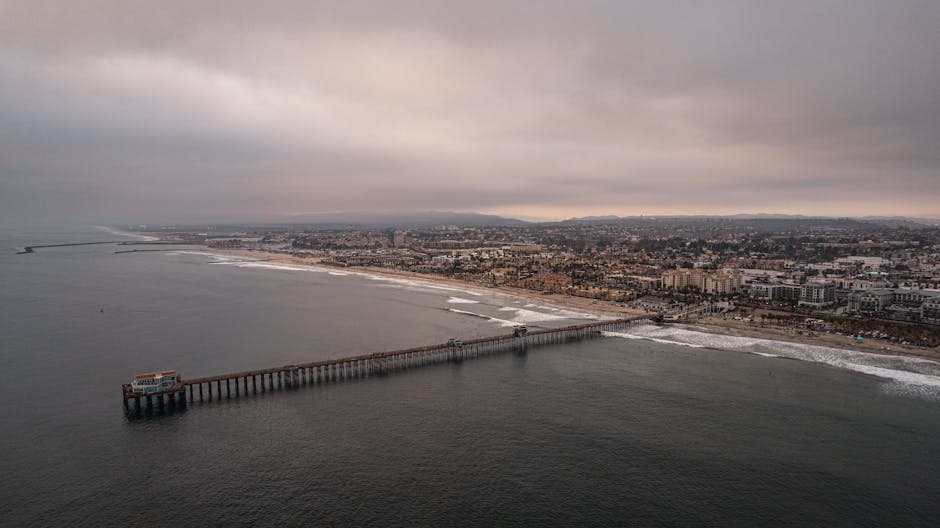
How the longest wooden pier on the West Coast feeds Marine families, Top Gun pilgrims, and Mission San Luis Rey.
A working operator's atlas to running a restaurant at the northern edge of San Diego County: pier-side seafood, Marine homecoming spikes, bilingual coastal taquerias, and a Sunset Market that takes Coast Highway every Thursday from May to September.
Scene one · Pier Plaza, six fifty-three on a July Thursday
The Sunset Market opens at five, the pier opens at sunrise, and the operator's phone has not stopped since lunch.
A few minutes before seven on a Thursday evening in early July, the sun is sitting roughly two fingers above the horizon off Pier Plaza, the Coast Highway has been closed since five for the Oceanside Sunset Market, and a coastal seafood operator named Mariana V. is standing at the host stand of her seventy-seat patio looking at thirty-two unanswered voicemails on the restaurant landline. Eleven of them are reservation requests for Saturday. Six are pickup orders that needed to go in by six thirty if the kitchen was going to make the seven pm window. Three are tourists asking whether the restaurant is on the pier or near the pier. Two are repeat catering inquiries from a Marine family planning a homecoming dinner for sixteen. The rest are hang-ups and a vendor calling back about uniforms.
Mariana's problem on a Thursday in July is the problem every operator within four blocks of the Oceanside Pier has between Memorial Day and Labor Day. The demand exists. The demand is, in fact, enormous. The pier draws more than a million walk-on visits a year, the Sunset Market alone draws roughly twenty thousand on a Thursday at peak, and a meaningful share of those people are within a two-block walk of a kitchen that could feed them. What is missing is not the demand. What is missing is the ability of the operator to absorb it without paying a marketplace twenty-seven percent of the gross for the privilege.
This page is for Mariana. It is also for the family taqueria on the east side of Coast Highway whose four busiest hours of the year are the four hours after the Camp Pendleton homecoming buses arrive in November. It is for the Mission Avenue diner that has fed three generations of Marine families before deployment and after, and that has never built an SMS list. It is for the chef on South Coast Highway whose pier-side sushi room sits a hundred yards from a national park of a pier and pays California rent for the view. It is for the bakery on the harbor whose cinnamon rolls move two hundred units on a homecoming Saturday and forty on a Tuesday, and which has no way to forecast the difference until the door opens.
Oceanside is a particular kind of restaurant market. It is coastal but it is not Carlsbad: the median check is lower, the tourist mix tilts more domestic and more family, and the locals include seventy thousand Marines and dependents one freeway exit north. It is San Diego County but it is not La Jolla: it is the working coast, with a pier built in 1888 and rebuilt six times, with a downtown that Top Gun filmed in 1986 and that is still rebuilding around that pilgrimage, and with the largest mission in the California chain three miles inland. The math for running a restaurant here looks different from anywhere else on the Southern California coast. The rest of this page is that math, drawn out.
Section II
The pier is not a landmark. It is the spine of the demand graph.
At 1,942 feet, the Oceanside Pier is the longest wooden pier on the United States West Coast. It is also the single most consequential built object in this city's restaurant economy. The visitor flow that walks on and off the pier defines the kitchen volumes within four blocks of Pier Plaza.
Figure 1
The 1,942-foot wooden pier, in elevation
The Oceanside Pier is the longest wooden pier on the US West Coast. The current 1987 reconstruction is the sixth or seventh pier at this site, depending on how you count the storms. Tide line and pier-end restaurant pad shown.
Total length
1,942 ft
First built
1888
Original 1,200 ft timber pier. Rebuilt repeatedly after winter storms.
Current pier
1987 rebuild
Extended to 1,942 ft. Reinforced concrete and timber composite construction.
Pier-end
Restaurant pad
Historically Ruby's Diner; the pad now rotates concepts. The walk out is roughly a third of a mile.
Sources: City of Oceanside Harbor and Beaches Division pier specifications, California Coastal Commission permitting records, Oceanside Historical Society archives. Diagram is schematic; piling count is representative, not exact.
The pier is the sixth or seventh built on this site, depending on how you count. The first one went up in 1888 at 1,200 feet, conceived as a shipping terminus and a recreational draw in the same year. Winter storms took it apart and bigger storms in 1890, 1894, 1903, and 1942 dismantled successive replacements. The current pier dates to 1987, was extended to its present 1,942 feet, and was reinforced with a composite of concrete piles capped with timber decking that gives the structure its hybrid quality: hard underneath, wooden on top.
The length matters operationally. The pier-end pad, historically the home of a Ruby's Diner, sits roughly a third of a mile from Pier Plaza. The walk back, with a takeout bag, in onshore wind, takes about eight minutes. That distance shapes how a pier-side operator thinks about packaging, about hot-hold windows, and about whether the takeout container will survive the gust at the railing. The pier-end concept rotates; the operators who win the pad are the ones who have figured out a menu that travels.
The pier's walk-on volume, per City of Oceanside Harbor and Beaches Division accounting and Visit Oceanside's reconstructed counts, runs in the neighborhood of a million visitor-trips a year. A meaningful fraction of those visitors will eat within four blocks of Pier Plaza before or after the walk. Several of those blocks have rents that reflect that. Those rents are why the pier-side restaurant business cannot afford to pay a marketplace twenty-seven percent of every ticket to be discovered by the same person who already walked past the patio. The pier already discovered them. The job is to capture the order directly when the discovery happens.
The pier was added to the National Register of Historic Places under the broader Oceanside Downtown Historic District designation. The 1987 reconstruction was permitted through the California Coastal Commission. The fishing rights at the end of the pier remain license-free, which is unusual for California coastal infrastructure and is part of why the foot traffic stays year round. December at the pier is not the same as July at the pier, but it is not empty either. Christmas at the Pier draws families into the downtown blocks for light displays through the holiday season, and the post-Thanksgiving Marine deployment returns produce sudden Friday and Saturday spikes that are not visible on a tourism calendar but are unmistakable on a kitchen ticket-printer log.
Section III · Industry frame
Six numbers that structure every operating decision in this city.
~470
Permitted food facilities, City of Oceanside
San Diego County Department of Environmental Health, retail food inventory.
$19.50
Median pickup-order check, Oceanside coastal corridor
Internal DirectOrders ticket data, North County coastal cohort, trailing twelve months.
7.75%
Combined sales tax: 7.25% state + 0.50% SD County district
California Department of Tax and Fee Administration, current published rates.
~70K
Camp Pendleton active duty plus civilian workforce
Marine Corps Installations West, MCB Camp Pendleton fact sheet.
1,942 ft
Oceanside Pier length, longest wooden pier on US West Coast
City of Oceanside Harbor and Beaches Division, 1987 rebuild specification.
1798
Mission San Luis Rey founded, largest in the California chain
Mission San Luis Rey de Francia historic visitor center, National Register listing.
The 7.75 percent number is structural. California assesses a 7.25 percent state sales-and-use tax. San Diego County adds 0.5 percent in district transactions and use tax to that base, producing the 7.75 percent combined rate that every Oceanside restaurant must collect on dine-in food (with exceptions for grocery-style cold takeaway under specific conditions). The number is calculated and withheld at the order level on a direct platform, then remitted by the operator to the California Department of Tax and Fee Administration on the standard quarterly cadence. The platform's job is to make that math invisible at the point of order and traceable inside the back office.
The Camp Pendleton workforce number reshapes the rest of the math. Roughly seventy thousand active-duty Marines, sailors, and civilian personnel work on the 125,000-acre installation that begins at the northern Oceanside city line. None of that workforce lives inside the city limits in census terms (Camp Pendleton has its own ZIP, 92055, and its own jurisdiction), but a substantial fraction of those service members live with families in Oceanside neighborhoods, eat on Mission Avenue and the south Coast Highway corridor on the weekends, and shape the restaurant economy in a way that has no parallel in adjacent Carlsbad or Encinitas.
Section IV
The plate composition: what the demand stack actually orders.
Oceanside's cuisine mix is the readout of three overlapping inputs: a Mexican border thirty miles south, a 70,000-person Marine workforce one exit north, and a coastal tourist economy in the middle. The bar chart shows how those inputs land on a plate.
Figure 2
Oceanside cuisine mix
The plate composition reflects three structural inputs: proximity to the Mexican border, a 70,000-person Marine workforce one freeway exit north, and a coastal tourist economy. American casual, Mexican taqueria, and seafood dominate.
Beach Break style breakfast, sports bars, burger and surf shacks. Mission Avenue and South Coast Highway anchor.
Border-proximity stack. Roberto's family of taquerias originated in San Diego County; carne asada fries are local canon.
Pier-side and harbor concepts. Wrench and Rodent, 333 Pacific, Hello Betty Fish House, Joe's Crab Shack.
Marines posted to Kaneohe Bay and the III MEF rotation cycle back to Pendleton with poke and plate-lunch preferences.
Top Gun pilgrimage feeds Kansas City BBQ on Pacific Highway; broader smoked-meat scene fills in around it.
Petite Madeline bakery into the pizzeria-trattoria layer. Coastal date-night staple.
Pho, sushi, and Thai concepts cluster along Mission Avenue and the Highway 78 corridor toward Vista.
Surf-town breakfast economy: Petite Madeline, Beach Break Cafe carry the daypart.
Sources: San Diego County Department of Environmental Health restaurant inventory, SANDAG demographic profile, visitor research from Visit Oceanside. Percentages are editorial estimates reconciled to those sources, not a one-to-one count.
American casual leads the mix at roughly a quarter of the city's permitted-food inventory. The label is broad on purpose. It covers the surf-town breakfast house (Beach Break Cafe), the sports bar, the burger-and-fries patio, the coal-fired pizza concept, and the gastropub with a deep tap list. What these concepts share is a daypart pattern that runs straight through from nine in the morning to ten at night, with a hard summer-Saturday peak and a Marine-payday Friday secondary peak. None of them depend on the pier exclusively, but all of them benefit from it.
Mexican is the second largest segment and the most operationally interesting one. San Diego County is the origin of the Roberto's family of taquerias (Roberto's, Alberto's, Aliberto's, and roughly a dozen related sibling concepts that branched off through the 1970s and 1980s). The carne asada fries plate, now a national export, originated in Mission Valley in the 1990s and is, in Oceanside, a default order. The Mexican segment runs across counter-service taquerias on Mission Avenue and Coast Highway, the modern Mexican concepts like Ojos Rojos that have brought a tequila program and a brunch shift to Mission Avenue, and the coastal Mexican seafood layer (Hello Betty) that picks up the tourist economy.
Seafood concentrates around the pier. The roster runs from white-tablecloth (333 Pacific) through chef-driven sushi (Wrench & Rodent Seabasstropub on South Coast Highway) to the harbor-side Joe's Crab Shack. Hello Betty Fish House sits on Pier Plaza and runs a two-story patio that captures the full ocean view. The seafood segment is structurally lower margin than the casual segment because the cost of fish in Southern California is high, and because the rent at the pier is high, but it carries the brand of the city in a way no other segment can. A pier-side seafood operator is, in part, a tourist board.
Hawaiian and Pacific Rim concepts (poke bowls, plate-lunch counters, mochi donuts, sushi-burrito hybrids) hold a noticeable share for a city of 175,000 people. The explanation is the Marine corps rotation through Kaneohe Bay and the broader III MEF (III Marine Expeditionary Force) cycle that returns service members to Camp Pendleton with two-year accumulations of Hawaiian food preference. Poke, in Oceanside, is not a coastal-trend menu item; it is a Marine-family staple. Operators serving poke see weekday lunch volume that does not match the trend-cycle expectation.
The cafes-and-bakeries category, at eight percent, punches above its weight on the calendar. Petite Madeline Bakery, Beach Break Cafe, and the cluster of independent coffee houses on the downtown blocks define the surf-town breakfast economy. They open by six, peak between eight and ten, and close before three. A direct-ordering operator inside this segment is selling a product that is mostly demand-pulled by recurring locals, not discovered by walk-on tourists. The list of repeat customers is the asset. Building it without a marketplace skimming the relationship is the strategic move.
Section V
The Oceanside operator year, three calendars overlaid.
The annual demand curve is governed by three superimposed cycles: the coastal tourist season, the Camp Pendleton deployment and homecoming rhythm, and the Thursday-night Sunset Market. They do not align; they layer.
Figure 3
The Oceanside operator year
The calendar is shaped by three overlapping cycles: tourist season (Memorial Day through Labor Day), Marine deployment and homecoming rhythms (year-round, peaking November and December), and the Thursday-night Sunset Market (May through September on Coast Highway).
Post-holiday lull / Surf swell windows
Winter rains and big northwest swells. Tourist volume bottoms out; locals dominate.
Whale watching peak / Camp Pendleton drill cycles
Pacific gray whale migration brings harbor tour volume. Marine training rotations spike weekday lunches.
Spring break early arrivals / Mission San Luis Rey fiesta season
Texas and Arizona families test the coast. Mission events draw heritage visitors.
Supergirl Pro Surf qualifier window / Camp Pendleton family days
Women's pro surf events draw national volume to the pier and Sunset Beach. Camp Pendleton family weekends fill Mission Avenue.
Top Gun anniversary screenings / Memorial Day Marine memorial events
May 16, 1986 Top Gun release anniversary pulls pilgrimage volume to Kansas City BBQ. Memorial Day at Camp Pendleton memorial fills coastal restaurants.
Summer tourist season opens / Sunset Market launches Thursdays
Oceanside Sunset Market on Coast Highway runs Thursday nights, May through September. Hotels and short-term rentals fill.
Independence Day pier fireworks / Peak tourist volume
Fourth of July at the Pier is the single highest-volume day of the calendar year for downtown operators.
Supergirl Pro main event / Camp Pendleton change-of-command season
Supergirl Pro Surf brings 50K plus weekend spectators. Marine command rotations fill mess-alternative dining.
Labor Day / Marine deployment turnover
Tourism eases after Labor Day. Marine homecoming cycles begin to compound; family-style dining sees Friday and Saturday surges.
Oceanside Days of Art / Pier 100 Heritage Days
Mid-October arts and history programming fills the pier and downtown. Local diners return.
Veterans Day at Camp Pendleton / Marine homecoming weeks
Veterans Day plus rolling fall homecomings produce the heaviest non-summer dining weeks of the year.
Christmas at the Pier / Holiday Marine deployment returns
Christmas at the Pier light display draws families. December deployment homecomings produce sudden Friday and Saturday volume spikes.
Sources: Visit Oceanside event calendar, City of Oceanside Sunset Market program, Surfing America Supergirl Pro schedule, Marine Corps Installations West public-affairs calendars, City of Oceanside Christmas at the Pier program. Intensity index is editorial, calibrated to internal North County coastal ticket volume.
The summer block, Memorial Day through Labor Day, is the dominant signal on the curve. Hotel-room occupancy across Oceanside coastal properties (Mission Pacific, SeaCrest, the historic California cottages) runs above ninety percent for fourteen consecutive weeks. Independence Day at the Pier is the single highest-volume day on the annual calendar for downtown operators: a fireworks barge offshore, a closed Coast Highway, a packed Strand, and a kitchen that has to process roughly two and a half times its normal Saturday cover count in the same six-hour window. An operator without a pre-order queue arrives at six pm with no chance.
The Sunset Market runs Thursdays from May through September on Pier View Way and the adjacent Coast Highway blocks. The City of Oceanside closes the street at five. The market has three to four hundred vendor booths in a peak week. It draws fifteen to twenty thousand attendees on a strong Thursday. For restaurants on the immediate Coast Highway corridor it is the second highest-volume weekday of the year, every week, for five months. For restaurants two blocks east of Coast Highway the same Thursday is below average because the foot traffic does not cross over. The operating question is whether a restaurant's pickup window or pre-order queue can absorb Sunset Market spillover. Direct ordering does that mechanically.
The Supergirl Pro Surf qualifier and main events sit on top of the summer block in late July and early August on most years. The contest is the largest women's pro surf event in the United States, runs at the Oceanside Pier, and draws fifty thousand-plus weekend spectators. For pier-side concepts, Supergirl weekend is the second largest non-Independence-Day weekend on the calendar. For chef-driven concepts on South Coast Highway it is a major spillover event because dinner reservations push two blocks south.
The Marine deployment-and-homecoming rhythm is harder to read because it does not follow a fixed calendar; it follows fleet rotation. Major Camp Pendleton unit returns happen most often in November and December and again in April and May. A homecoming weekend produces a Friday and Saturday lift in family-style casual dining on Mission Avenue and the inland Coast Highway corridor that can run plus seventy percent of normal. Veterans Day, every November, produces a publicly scheduled lift across the entire coastal corridor; the Marine memorial events at the Camp Pendleton end of Vandegrift Boulevard pull thousands of family members into Oceanside dining rooms in the late afternoon. Christmas at the Pier and the December return cycles compound to make December a counter-intuitively heavy month for inland-corridor casual operators, even as the pure tourist season is dormant.
The shoulder months matter for the cash cycle. February is winter swell season; the surf crowd at the Pier Plaza is local and consistent, and the rest of the city is quiet. March brings the early Texas and Arizona arrivals and the Mission San Luis Rey fiesta season around the founding-anniversary period. October's Oceanside Days of Art event fills the downtown blocks for a long weekend. None of these are summer-July; all of them are scheduled, knowable, and absorbable with a pre-order queue.
Section VI
The Oceanside restaurant roster, by segment.
Not a ranking, a map. Twelve concepts that, between them, structure how most Oceanside restaurants think about their own position. Listed for editorial reference only; mentions are not endorsements and operators are not customers unless explicitly named.
Pier-side seafood and steaks
333 Pacific
Oceanside Pier / Downtown
Cohn Restaurant Group's white-tablecloth coastal anchor across from the pier. Date-night ceiling for Oceanside.
Sustainable sushi + craft seafood
Wrench & Rodent Seabasstropub
South Coast Highway
Davin Waite's chef-driven sushi-and-bycatch flagship. Ranked among the most respected sushi rooms in San Diego County.
Coastal Mexican seafood
Hello Betty Fish House
Pier Plaza
Two-story Baja-inflected seafood concept with rooftop pier views. High summer volume.
French bakery and brunch
Petite Madeline Bakery
Coast Highway
Morning anchor for Oceanside's coffee daypart. Catering and weekend brunch standing reservations.
Surf-town breakfast
Beach Break Cafe
South Oceanside / South Coast Highway
Cult breakfast house. Lines down the sidewalk on summer Saturdays; coffee crab cake and chilaquiles are the canon orders.
Coal-fired pizza, craft beer
The Privateer Coal Fire Pizza
Coast Highway
Coal-oven pies plus a deep tap list. Catering rotations into Camp Pendleton ceremonies and South Oceanside birthday volume.
Casual seafood chain
Joe's Crab Shack Oceanside
Oceanside Harbor
Harbor-side family seafood. Tourist anchor on the harbor walk loop.
Old-school American diner
Rosie's Cafe
Mission Avenue
Marine family breakfast standby on Mission. Cash-friendly, generous, and unimpressed by trends.
California-Mexican
Roberto's Taco Shop
Multiple Oceanside locations
The Roberto's family of taquerias originated in San Diego County in the 1960s. Carne asada fries and rolled tacos are the canonical orders.
Gastropub, craft beer
Local Tap House and Kitchen
Pier Plaza
Pier-adjacent tap house with a large patio. Game-day, summer-evening, and post-surf volume.
Modern Mexican
Ojos Rojos Tacos and Tequila
Mission Avenue
Modern Mexican concept on Mission. Tequila program plus weekend brunch lifts the corridor.
Cal-coastal casual
North Coast Grill
South Coast Highway
Polished casual on the southern stretch. Heavy local-family rotation, especially shoulder seasons.
Section VII
The corridors, and how each one orders differently.
Oceanside is not one restaurant market; it is six. The Pier and the harbor draw visitors; Mission Avenue draws Marine families; the South Coast Highway draws chef-driven dining; and Camp Pendleton, technically adjacent, drives commercial demand across all of them.
Oceanside Pier and Downtown
ZIPs: 92054
Pier Plaza, Coast Highway downtown blocks, the visitor-density core.
South Oceanside
ZIPs: 92054, 92056
Cassidy Street to Buena Vista Lagoon. Surf-house neighborhoods, Beach Break Cafe locus.
North Oceanside and Harbor
ZIPs: 92054
Oceanside Harbor, Cape Cod inspired marina village, San Luis Rey River mouth.
Camp Pendleton (adjacent, not within city)
ZIPs: 92055
Largest US Marine Corps base on the West Coast. Distinct jurisdiction; commercial demand spills into Oceanside.
Mission Avenue corridor
ZIPs: 92057, 92058
Inland east-west spine. Marine-family dining, taquerias, modern Mexican, route to Mission San Luis Rey.
South Coast Highway
ZIPs: 92054, 92056
Cassidy to Carlsbad city line. Chef-driven seafood, gastropubs, polished casual.
The pier downtown corridor (92054) is the densest single-block restaurant market in the city. It is also the most rent-leveraged: pier-view patios command Southern California coastal premiums, and the gross-margin headroom on those rents is sensitive in single digits to commission take-rates. The operators here, more than anywhere else in Oceanside, cannot afford a marketplace.
South Oceanside (92054 and 92056), south of Cassidy Street, runs differently. The neighborhoods east of the Coast Highway here are surf-house residential, the dining is local-first, and the operators (Beach Break Cafe being the canonical example) live or die on repeat-customer SMS lists, not on tourist discovery. A direct ordering platform in this corridor is, fundamentally, a CRM that happens to also take orders.
Mission Avenue (92057 and 92058) is the inland east-west spine that connects the coast to Mission San Luis Rey de Francia and the freeway. The Marine family casual layer concentrates here, the modern Mexican layer (Ojos Rojos) concentrates here, and the breakfast diners that have fed three generations of service-member families concentrate here. The ticket averages are lower, the volumes are higher, and the bilingual order share is a structural baseline, not a coastal trend.
Camp Pendleton itself, at 125,000 acres, is the third largest Marine Corps installation in the world and is the largest on the West Coast. The base has its own commissary, its own commercial corridors at the various gates (San Luis Rey Gate, Las Pulgas, San Onofre), and its own dining halls. It is not a restaurant market in the same sense as the rest of Oceanside, but the seventy-thousand-person workforce spills off-base for dinner, weekend brunch, family events, and homecoming celebrations. Every Oceanside restaurant within fifteen minutes of a gate is, indirectly, a Camp Pendleton restaurant.
Section VIII
The three operators this page is written for.
Persona 1
Pier-side seafood operator
20 to 60 seats, oceanfront patio, ticket average $34 to $58, peak summer Friday to Sunday
Pains
- Marketplace commissions of 25 to 30 percent on pier-front concepts crush the gross margin that pays for ocean-view rent.
- Phones ring through every dinner service with reservation, takeout, allergy, and tourist parking questions in roughly equal measure.
- Catering inquiries from corporate retreats at the Mission Pacific Hotel and OC Beach Resorts arrive by phone and email, not by ordering channel.
DirectOrders unlocks
- Direct ordering at zero commission keeps the pier-rent math intact.
- Bilingual voice AI answers tourist trivia in English, takes orders in Spanish, books patio reservations in either, and routes catering RFPs to a single inbox.
- Pre-orders for the Fourth of July fireworks crowd let the kitchen pre-stage proteins instead of dying on the pass.
Persona 2
Marine family casual on Mission Avenue
60 to 120 seats, family-style menu, ticket average $18 to $26, peak weeknight dinners plus weekend brunches
Pains
- Homecoming weeks produce sudden Friday and Saturday volume spikes the schedule was not built for.
- Reorder loyalty is high but unmeasured: the same Marine family eats here three nights a week and the operator has no list to text.
- Deployment cycles silently erase ten percent of weeknight demand without warning. The schedule does not adjust because nobody is tracking the calendar.
DirectOrders unlocks
- Direct ordering builds the SMS list the operator needs to communicate with Marine families on a recurring cadence.
- Voice AI offers English and Spanish and absorbs the Friday-night phone surge so the host stand keeps seating.
- Reorder data identifies homecoming-week families and lets the kitchen invite them back inside three days, not by guess.
Persona 3
Mexican family taqueria on Coast Highway
Counter service, 30 to 80 seats plus drive-up window, ticket average $14 to $19, all-daypart volume
Pains
- Marketplace contracts on a $14 ticket leave the operator paying three to four dollars to the platform for the privilege of cooking the food.
- English-only ordering screens lose Spanish-first customers to the corner shop without one.
- Carne asada fries appear on three marketplace logos with three different prices and three different photo crops, none of them controlled by the operator.
DirectOrders unlocks
- Direct ordering at zero commission saves the three to four dollars per ticket and reroutes it into payroll.
- Bilingual menu in Spanish and English on the same ordering page. The same SKU, the same price, the operator's photo.
- Voice AI in Spanish takes the lunch rush phone orders the counter staff cannot get to between car windows.
Section IX
What a homecoming weekend looks like on the kitchen printer.
A Camp Pendleton unit return is the single largest non-summer event a Mission Avenue casual operator absorbs. The lift concentrates on Friday and Saturday; the rest of the week stays roughly normal. Same kitchen, two distinct weeks.
Figure 4
Camp Pendleton homecoming weekend volume
A typical week vs a homecoming week at a 90-seat Marine family casual on Mission Avenue. The lift concentrates on Friday and Saturday; Sunday holds elevated; the rest of the week is flat. The kitchen has to find roughly 70 percent additional throughput inside 48 hours.
Saturday peak lift
+72%
Sources: Illustrative composite from DirectOrders aggregate ticket data across a sample of North County coastal casual operators, anchored to publicly announced Camp Pendleton unit-return windows. Not a single-restaurant disclosure.
The operational answer to a forecasted homecoming weekend is not to staff harder on a Friday; it is to capture demand in advance. A pre-order queue, opened the Tuesday before, surfaced through SMS to the operator's recurring Marine-family list, with a Friday 5pm and 7pm window and a Saturday 6pm and 8pm window, converts a chaotic walk-in surge into a pre-paid, pre-scheduled, pre-printed ticket flow that the line can actually execute. The same forty-five-minute peak that used to send the front of house into apology mode becomes a steady three-hour service. The unit economics, on a homecoming weekend, can run two to three times a normal Saturday net.
The asset that makes this work is the SMS list. Marine families on Mission Avenue are a recurring customer base by definition: the unit cycles, the families cycle with it, the kitchen sees the same names month after month. A direct ordering platform that captures phone numbers at the first order, with consent, builds that list mechanically. A marketplace does not. After the third order at the same restaurant, the marketplace knows the customer; the operator does not. That asymmetry is the difference between an operator who can anticipate a homecoming and one who can only respond to it.
Section X · Bilingual coastal corridor
English and Spanish, one phone line, taken in stride.
Roughly thirty-five percent of Oceanside's population speaks Spanish at home, per US Census American Community Survey data. The number is higher in 92057, the Mission Avenue corridor, where the Latino family-restaurant economy is the structural backbone. It is also higher across military-family demographics, where Spanish-language households are overrepresented in the Camp Pendleton dependent population for historical and cultural reasons.
The operating implication for an Oceanside restaurant is that the phone, the menu, and the ordering page must all work in English and in Spanish without the operator having to staff a separate bilingual front of house. DirectOrders ships a voice AI agent (see our voice AI page) that answers the restaurant line in either language, identifies the caller's preference within the first sentence, takes the order in that language, surfaces the ticket to the kitchen in English, and confirms the pickup window in the caller's language. The same agent handles reservation requests, allergy questions, and tourist trivia (yes, the patio has a view; no, the parking lot fills by six on a Friday).
For a Marine family on Mission Avenue calling to put in a Friday pre-order for sixteen people for a homecoming dinner, the call can begin in Spanish, contain four substitutions, request a window in the back room, and end with a confirmation text to a number on file, without the host stand having to drop the seating queue. For the pier-side seafood operator with three tourists in line and a phone that has rung twelve times in fifteen minutes, the agent absorbs the calls, takes the orders, and lets the host work the door. The labor cost of the labor that the agent replaces, on a peak Friday at a 70-seat patio, is roughly $80 to $140 per shift; the recovered front-of-house attention is worth more.
Bilingual voice AI checklist
- Answers in English or Spanish, switches automatically on caller cue.
- Takes pickup orders, reservation requests, and catering inquiries.
- Routes allergy and dietary flags to a kitchen-visible note on the ticket.
- Confirms window and total back to the caller in the caller's language.
- Sends an SMS confirmation in the same language.
- Surfaces a transcript and order summary to the operator dashboard.
- Handles Marine-family standing orders for homecoming and deployment events.
- Routes catering RFPs over a single threshold to a human callback.
Section XI
The math on a single $45 pier dinner.
A Marine family of four orders dinner from a pier-side seafood patio. Two adults, two kids, water on the table, no liquor. The gross ticket comes to $45 before tax. On a marketplace, the take-rate runs roughly 27 percent. On a direct path, the take-rate runs roughly 14 percent.
Figure 5
Cost math: 27% vs 14% on a $45 Marine family pier dinner
A single $45 ticket: a family of four at a pier-side seafood concept, two adults two kids, no drinks. The take-rate on a marketplace path runs roughly 27 percent of gross. The direct path runs roughly 14 percent of gross (including platform fee and lower card pricing). The remaining 13 percent stays inside the restaurant.
Margin recovered, per $45 ticket
+$11.29
Sources: DoorDash and Grubhub publicly disclosed commission ranges (15% to 30% by tier), Stripe and Adyen published US card-processing schedules, DirectOrders standard platform fee. Food cost and labor are industry-standard 30/20 splits for casual coastal seafood. Tax line (7.75 percent SD County) is collected on top of the gross and is not part of the merchant cost stack.
The math is not metaphorical. DoorDash and Grubhub publicly disclose commission ranges between 15 and 30 percent of gross depending on the merchant tier and the marketing-product attach. A typical fully-attached marketplace contract on an independent restaurant in Southern California runs 25 to 27 percent. Add a 2.9 percent card-processing fee and a thirty-cent flat, plus packaging on every order, and the all-in marketplace cost stack on a $45 dinner runs in the neighborhood of $14 to $15. On a thirty-percent food-cost line and a twenty-percent labor line, the net margin to the restaurant is somewhere between negative and slightly positive, depending on the kitchen's discipline.
The direct path replaces the marketplace commission with a transparent platform fee (in the $1 to $2 per ticket range at the volumes this site cohort runs) and a slightly lower card-processing schedule (2.6 percent and a dime is a typical direct merchant rate). The same packaging cost applies. The same food and labor apply. The all-in direct cost stack on a $45 dinner runs in the neighborhood of $6 to $7. Net margin to the restaurant goes from roughly $6 on the marketplace path to roughly $14 on the direct path, on an identical gross ticket.
Multiply by a Marine family that orders once a week for forty-eight weeks of the year. The marketplace-path margin contribution is $288. The direct-path margin contribution is $672. The difference, $384 per recurring family per year, is the working capital that pays for a line cook's additional hours, for a refresh of the pier-view patio chairs, or for the next year's rent escalator. For a coastal seafood operator with one hundred recurring families, the annual difference is roughly $38,400. The marketplace did not earn that money; the marketplace charged for the privilege of taking an order from a customer the restaurant already had.
If you want to see how this looks on your specific menu and current cohort of customers, the DirectOrders pricing page shows the full schedule with no asterisks. The cohort comparison against marketplaces is also broken out on our DoorDash comparison and our Grubhub comparison, with the same math run on different ticket sizes and average orders per week.
Section XII · The 1986 anchor
The Tony Scott movie that turned a downtown block into a national pilgrimage.
In the spring of 1986, Tony Scott's film unit shot the bar scenes of Top Gun at the Kansas City BBQ on the corner of Harbor Drive and Market Street, a few blocks from the Oceanside coast and a short drive from MCAS Miramar. The piano scene where the rookie pilot meets Goose, the bar fight, the eventual rendezvous: all shot at a single location that had been a working barbecue joint since 1981 and was, in the studio call sheets, listed as a backup location after a different bar fell through. The film was a defining cultural moment for Naval aviation and, secondarily, for Oceanside as a layover town between the air station and the Marine base.
Forty years later, the Top Gun anniversary pilgrimage is a measurable line item on the downtown ticket-printer log. The May 16 release-anniversary weekend, every year, draws a few thousand visitors into the downtown blocks. The 2022 release of Top Gun: Maverick compounded the pilgrimage; the film was again shot partially at the original Kansas City BBQ before a December 2008 fire and subsequent reconstruction at a different downtown San Diego location. For Oceanside operators, the Top Gun cohort is the kind of visitor who arrives, walks the pier, takes the photo, eats lunch within four blocks, and leaves. The lift is small relative to the summer block but it is recurring, and it concentrates on a date the kitchen knows in advance. That kind of demand is the easiest demand to capture directly.
The other historical anchor is Mission San Luis Rey de Francia, three miles inland on Mission Avenue. Founded in 1798, the eighteenth and largest mission in the California chain, the Mission draws a steady stream of heritage tourists, school field trips, and weekend visitors year-round. The Mission's annual fiesta in mid-June and its Christmas pageantry in late December produce visible lifts on Mission Avenue restaurant tickets. Operators on that corridor with a direct ordering page in English and Spanish, a pre-order window, and a small group-catering form on the home page (see our ordering feature) absorb those events instead of being absorbed by them.
The California Surf Museum, two blocks east of the Pier, completes the cultural trifecta. The museum holds the largest archive of surfboard innovation in the world: from Duke Kahanamoku's original boards through Tom Blake's 1930s redwood designs to the contemporary shaping traditions of San Diego County. Surfboard innovation is, in a structural sense, an Oceanside industry; the climate, the consistent surf, and the proximity to balsa and foam suppliers made San Diego County the global capital of surfboard shaping for most of the twentieth century. The museum is small but its draw is recurring, and the surf-school economy on the Strand south of the pier feeds a steady stream of post-lesson breakfast and lunch tickets into the Beach Break Cafe corridor.
Section XIII
How Oceanside fits into the North County coastal corridor.
Oceanside is the northernmost incorporated city in San Diego County. Going south on Interstate 5 you cross into Carlsbad within ten minutes; another fifteen minutes brings you to Encinitas, then Solana Beach, then Del Mar, then La Jolla, and into downtown San Diego at the southern end. Going east on Highway 78 you reach Escondido within twenty minutes through Vista and San Marcos. The whole North County is one labor market, one demand network, and one weekend dining circuit; an operator in Oceanside competes for tourist Saturdays against Carlsbad and for family Sundays against Vista.
What differentiates Oceanside in that corridor is the Marine base. Carlsbad is a tech-and-tourism economy. Encinitas is a yoga-and-organic economy. Oceanside is a working coast: it has the visitors, but it also has seventy thousand active-duty service members and their families inside its dining catchment, and that fact reshapes the operator profile, the cuisine mix, and the calendar. A direct ordering platform that wins in Oceanside has to handle the tourist pier patio, the Marine family Friday night, the bilingual taqueria lunch rush, and the Sunset Market Thursday. Few platforms have all four; the operator's job is to make sure the one they choose does.
San Diego, CA
The Border Sandwich
OpenCarlsbad, CA
Coastal tech and resort cluster
OpenEscondido, CA
Inland North County
OpenDirectOrders pricing
No commission on first-party orders
OpenVoice AI agent
English and Spanish
OpenDirect ordering surfaces
Web, app, QR, voice
OpenDirectOrders vs DoorDash
27% vs 14% take-rate
OpenDirectOrders vs Grubhub
Same cohort comparison
OpenBring an Oceanside menu, leave with a commission-free direct ordering surface.
Live in two hours, or we white-glove you for free. Bilingual voice AI included. No marketplace commissions on first-party orders. Same-day payouts on the standard schedule. The math from Figure 5 starts on day one.
Sources and further reading
Page last updated 2026-05-12. Figures sourced or contextualized to the citations above. Pier length and 1987 reconstruction figures per the City of Oceanside Harbor and Beaches Division. Camp Pendleton workforce reflects publicly disclosed base population, treated as order-of-magnitude. Ticket-volume figures in the homecoming and cost-math charts are illustrative composites from the DirectOrders North County coastal cohort, not single-restaurant disclosures.