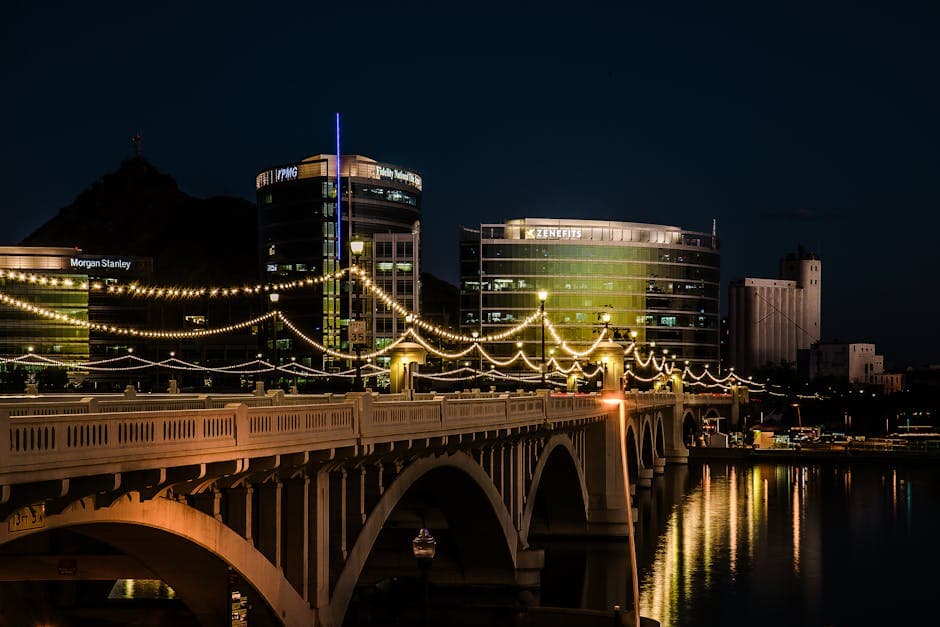
The Peoria Sports Complex and the surrounding P83 Entertainment District against an Arizona sky in spring training season.
A Peoria, Arizona Field Guide

Spring training and the lake.

Peoria, Arizona is the northwest Valley city built around two annual surges. The Peoria Sports Complex has been the shared spring training home of the San Diego Padres and the Seattle Mariners since 1994. That made it the first shared facility in MLB history. Lake Pleasant Regional Park, on the city's northern edge, is Arizona's second-largest lake by surface area and the West Valley's primary boating and fishing destination. Between the two, a city of roughly 200,000 (US Census ACS) doubles its restaurant demand on a predictable calendar and a predictable map. The food story is how an operator builds a stack that absorbs both.

~200K
Peoria residents (US Census ACS)
1994
Padres + Mariners shared since (MLB)
23,400 ac
Lake Pleasant surface area (Maricopa County Parks)
8.1%
Combined Arizona TPT on prepared food in Peoria
I. Two mornings

A 7:42 AM boat ramp, and a 12:15 PM first pitch.

Saturday, October 11  ·  7:42 AM, Lake Pleasant boat ramp

Castle Hot Springs road, north of Loop 303

The truck-and-trailer line at the Lake Pleasant main ramp is already eleven deep. The water is glass. The bass fishermen launched at 5:30 and are out past the narrows. The pontoon families are loading coolers from a Suburban backed onto the apron. A Yeti at the back of the trailer holds last night's pre-order from a Bell Road kitchen: forty-eight breakfast burritos, six dozen donuts, a half-gallon of carne asada salsa, two pounds of bacon, and two thermal carafes of black coffee. The order was placed at 9:14 PM Friday night through the restaurant's own website. The pickup window was set for 7:00 to 7:15 AM. The text confirmation hit at 6:51 AM. The pickup happened at 6:58 AM and the trailer pulled out by 7:12 AM.

The operator on the kitchen end paid zero commission on that order. Same-day Stripe payout will hit Monday morning. The customer's home zip is in Vistancia, fifteen miles up Lake Pleasant Parkway. The customer has now placed seven orders in eighteen months on the same site. The Bell Road kitchen owns the customer record. No marketplace owns the customer record.

Two months earlier, on a Tuesday in mid-March, the same kitchen ran a different surge. Padres at the Sports Complex versus the Mariners, 12:15 PM first pitch, ten minutes by car. The restaurant took 84 pre-orders by 11:00 AM for an 11:15 AM pickup window, drive-by-and-grab tailgate format, thirty-six of them set up for in-stadium consumption (the Sports Complex permits sealed outside food). Spring training fans skew older, drive in family parties, and order in volume. The phone rang 23 times that morning. The bilingual Voice AI picked up on the second ring every time. Twenty-one of the 23 turned into orders. Two were directions and one was a question about parking. None went to voicemail.

Two mornings, the same kitchen, the same stack. The Saturday lake morning is the year-round baseline. The Tuesday spring training morning is the seasonal surge. The operator did not re-platform between them. The customer file grew on both. The cash flow matched the calendar on both. That is the Peoria operating reality at the right level of granularity.

Spring training is the spike. Lake Pleasant is the baseline. P83 Entertainment District is the dinner-traffic spine. Old Town Peoria is the brunch corner. Vistancia and Trilogy at Vistancia are the pickup-heavy edge. The infrastructure that handles any one of those handles all of them, or it handles none of them well. That is the editorial frame for what follows.

II. The Cactus League month

Mid-February through late March. Daily.

The Peoria Sports Complex hosts roughly 30 home games across the Padres and the Mariners between mid-February and the final week of March. Average per-game attendance runs in the 7,000 to 11,000 range, with weekend dates and split-squad doubleheaders running higher. Spring break overlap in the second and third weeks of March produces the densest day-game windows of the year. The bilingual local language of the spring crowd is San Diego Spanish and Pacific Northwest English. The bilingual receptionist most local kitchens do not have is the reason most local kitchens lose fifteen orders an hour to voicemail. The Cactus League month is when that math becomes painful.

PEORIA SPORTS COMPLEX. CACTUS LEAGUE STRIP. PADRES + MARINERS.03,0006,0009,00012,0001.0x1.5x2.0x2.5x3.0xFANSCOVERS17Feb Mon8.5k22Feb Sat8.0k23Feb Sun7.2k27Feb Thu9.8k1Mar Sat9.2k7Mar Sat7.8k11Mar Wed10.8k14Mar Sat8.2k17Mar Tue10.4k21Mar Sat7.6k24Mar Tue9.0k28Mar Sat30Mar MonPadres homeMariners homeRestaurant cover index (1.0 = avg)

Source modeling: Cactus League Baseball Association published schedules and average attendance reporting, San Diego Padres spring training, Seattle Mariners spring training, operator-side cover ratio drawn from the DirectOrders metro panel.

The first shared facility in MLB.

The Peoria Sports Complex opened in 1994 as the first shared MLB spring training facility in the history of the sport. The Padres and the Mariners co-anchor the campus with two practice diamonds each, a shared 11,000-seat stadium, and a single shared clubhouse footprint. Every other Cactus League facility built since (Camelback Ranch for the Dodgers and White Sox, Salt River Fields for the Diamondbacks and Rockies, Sloan Park for the Cubs) followed Peoria's lead. The shared model is the standard now. Peoria invented it.

Operationally for restaurants, the shared format means two distinct fan bases arrive in the same parking lots six weeks a year. The Padres fans drive in from San Diego (a five-hour southwest approach via I-8 or a one-hour southwest flight into Sky Harbor). The Mariners fans arrive from the Pacific Northwest, generally by air, with a five-day weekend pattern. Both bases stay in the P83 hotel cluster, the Westgate hotel ring just over the Glendale border, and the Lake Pleasant Parkway corridor.

The 12:10 PM first pitch.

Most Cactus League games at Peoria run a 12:10 PM or 1:10 PM first pitch. The pre-game pickup window runs from 10:30 AM to 11:45 AM. That window collides with the late-breakfast and early-lunch surge that an independent kitchen on Bell Road or 83rd Avenue would normally absorb on a slower day. On a game day, the volume is two and a half to three times the comparable Tuesday. The post-game window from 3:30 PM to 5:30 PM is a second wave, generally lighter and more drink-driven, that lands in the P83 sports-bar cluster.

The strict-volume problem is not menu execution. The kitchen knows how to make the food. The strict-volume problem is order capture: a phone line that can handle 23 inbound calls an hour in two languages, a website that prints a kitchen ticket in fifteen seconds, and a pre-order pipeline that opens at 7:00 AM and stays open through the 11:45 AM cutoff. That is the volume the platform has to absorb. A spring training Tuesday is the proof.

What the spring training month means for tech

The Cactus League month is the six-week proof of platform. A Peoria restaurant that picks a $0-per-month plus 30% commission marketplace will hand thirty percent of the surge to a third party. A Peoria restaurant that picks a flat $249-per-month direct-ordering platform with a bilingual Voice AI line will keep the surge. The math compounds across forty weekend days a season and shapes the operator's cash flow into the slower summer months. The Cactus League is the spike. The platform a kitchen runs has to absorb the spike without a marketplace haircut.

III. The orbit

Restaurant clusters around the Sports Complex.

The Peoria Sports Complex sits at the corner of 83rd Avenue and Paradise Lane, two minutes north of the Loop 101 Agua Fria Freeway. The dining clusters around it sort themselves into concentric rings by drive time. The P83 plaza sits within walking distance. Arrowhead Towne Center and the Westgate dining row sit two to three miles out. Old Town Peoria sits a four-minute drive northwest along Grand Avenue. Vistancia and Trilogy at Vistancia sit eight miles north on Lake Pleasant Parkway, edging the lake. Each ring is its own operating regime.

1 mi2.5 mi5 mi8.5 miN -> LAKE PLEASANTS -> LOOP 101 (AGUA FRIA)W -> SURPRISEE -> GLENDALEPEORIASTADIUMPADRESMARINERSP83 Entertainment District0.4 miArrowhead Towne Center2.1 miOld Town Peoria3.5 miBell Road corridor1.2 miVistancia / Trilogy8.5 miLake Pleasant corridor6 miLoop 101 (Agua Fria)2.5 mi

Peoria Sports Complex

stadium

11,000 capacity. Shared MLB spring training home of the Padres and the Mariners since 1994. The first shared facility in MLB history.

0 mi from the stadium

P83 Entertainment District

anchor

Modern outdoor lifestyle center directly across from the stadium. Restaurants, bars, retail, and hotels. The default postgame stop.

0.4 mi from the stadium

Arrowhead Towne Center

anchor

Regional mall sitting just over the Glendale border on Bell Road and 75th. Food court, sit-down dining, and pre-game retail draw.

2.1 mi from the stadium

Old Town Peoria

cluster

Historic 1880s downtown grid on Grand Avenue and Washington Street. Local cafes and independent kitchens.

3.5 mi from the stadium

Bell Road corridor

corridor

The Valley's longest east-west arterial. Bell Road runs from Sun City through Peoria to Surprise and is the spine of northwest Valley dining.

1.2 mi from the stadium

Vistancia / Trilogy

cluster

Master-planned communities to the northwest along Lake Pleasant Parkway. Younger families and active retirees. Pickup-heavy.

8.5 mi from the stadium

Lake Pleasant corridor

corridor

Lake Pleasant Parkway runs north from Loop 101 to the Lake Pleasant Regional Park entry. The weekend boater pickup spine.

6 mi from the stadium

Loop 101 (Agua Fria)

corridor

Loop 101 forms the southern border of Peoria. The P83 district draws its name from the freeway exit at 83rd Avenue.

2.5 mi from the stadium

Sources: Peoria Sports Complex, Discover Peoria AZ, City of Peoria Economic Development.

The two-minute walking ring.

P83 Entertainment District is the only purpose-built walkable cluster adjacent to the stadium. Yard House, BJ's, Native Grill and Wings, Twin Peaks, Patsy Grimaldi's, and the surrounding hotel-cluster restaurants get the lion's share of pre-game and post-game foot traffic that walks rather than drives. For these operators, the spring training peak is reservation pressure on weekend nights and walk-in surge in the late afternoons.

The two-mile drive ring.

Arrowhead Towne Center mall and the Bell Road retail corridor sit two miles south and east. Mall shoppers spill into the P83 dinner traffic on weekend afternoons. Bell Road independents (Chompie's, Native Grill, Pita Jungle, the local Sonoran kitchens) pick up the pre-game-from-the-mall pattern at lunch and the post-game-on-the-way-home pattern at dinner.

The Old Town brunch ring.

Old Town Peoria, the 1880s-founded historic grid on Grand Avenue and Washington Street, sits a four-minute drive northwest of the Sports Complex. The El Encanto, Tradiciones, and Old Town cafe cluster runs a different pattern: long-format weekend brunch with retiree and tourist reservations, weekday lunch that mostly serves the surrounding office and senior-living population, and Saturday-evening special-occasion dinners.

The Vistancia outer ring.

Vistancia and Trilogy at Vistancia sit eight miles north on Lake Pleasant Parkway. These master-planned communities run a pickup-heavy pattern: family pickup on weekday evenings, retiree pickup at lunch, and Saturday-night dinner pickup for in-home consumption. Delivery share is meaningful here because the drive into P83 or Old Town runs fifteen minutes one way. Same-zip dispatch via Uber Direct or DoorDash Drive is the cheapest fulfillment.

IV. The lake

The Saturday boat ramp and the Bell Road kitchen.

Lake Pleasant Regional Park, on Peoria's northern edge, is a 23,400-acre lake operated by Maricopa County Parks. It is Arizona's second-largest lake by surface area, after Lake Mead. Year-round boating, fishing tournaments, kayaking, and pontoon-rental traffic make Lake Pleasant the West Valley's primary outdoor recreation destination. The Lake Pleasant Parkway corridor that runs from Loop 101 north to the park entrance is the operator-side spine: any restaurant on Bell Road or Lake Pleasant Parkway sits on the Saturday pickup line.

LAKE PLEASANT. SATURDAY. BOAT RAMP CLOCK + PICKUP CURVE.0501001500.5x1.0x1.5x2.0xLAUNCHES/HRPICKUP IDX5 AM6 AM7 AM8 AM9 AM10 AM11 AM12 PM1 PM2 PM3 PM4 PM5 PM6 PM7 PM8 PMMID-DAYBoat launches per hourRestaurant pickup index (1.0 = Sat avg)

Source modeling: Maricopa County Parks Lake Pleasant Regional Park visitor and ramp counts, Discover Peoria AZ recreation reporting, operator-side pickup index from the DirectOrders northwest Valley panel.

Two pickup peaks, twelve hours apart.

A Saturday at Lake Pleasant produces two distinct pickup spikes on Bell Road and Lake Pleasant Parkway. The first runs 7:00 AM to 10:30 AM, anchored on cooler-pack pickup: breakfast burritos, bagel-and-coffee runs, sandwich platters, and ice-and-snack stops on the way north. The second runs 6:00 PM to 8:30 PM, after the boats come off the water: family dinners, takeout pickup on the way home south, and the sunburn-and-pizza pattern that a Peoria operator could set a watch by. Bell Road kitchens that publish a clean pre-order window for both spikes capture the share that competitors leave on the table.

The year-round baseline.

Unlike Cactus League, which collapses to zero from April through January, Lake Pleasant runs year-round. The cooler-pack pickup pattern survives June and July (when the rest of the Phoenix metro shifts indoors) because boaters are on the water by 5:00 AM, off by 11:00 AM, and back to the AC by noon. The shoulder seasons (October through May) are the biggest weekend volume windows, with March, April, and October peaking on Saturdays. A Bell Road operator can plan a year of cash flow against the lake calendar with reasonable confidence.

The pre-order channel matters more than the menu.

The Lake Pleasant pickup is not a complicated kitchen problem. Breakfast burritos are a fifteen-minute production. Bagel platters are a two-minute assembly. The complicated part is the order capture: a customer in Vistancia ordering at 8:14 PM Friday for a 7:00 AM Saturday pickup, paying through a saved card, getting a text confirmation, and trusting that the order will be ready in a thermal bag with the customer's name on the receipt when the truck pulls up. That is a software problem, not a kitchen problem. DirectOrders is built for the software problem.

V. P83

P83 Entertainment District: the lifestyle spine.

P83 is the modern outdoor lifestyle district anchored on 83rd Avenue and Bell Road, the freeway exit that gives the district its name (Loop 101 exit at 83rd Avenue). It pulls together the Peoria Sports Complex, a national-chain dining row, an independent restaurant cluster, a sports-bar cluster, and the Peoria hotel ring within a half-mile walking radius. The district is the spine of Peoria's dinner economy. The Cactus League month inflates it. The rest of the year, it runs as the standard northwest Valley restaurant cluster.

AZ-101 (LOOP 101 / AGUA FRIA FREEWAY)83rd AVENUEBELL ROADPADRES + MARINERSPEORIA SPORTS COMPLEX11,000 capacity. Shared MLB spring training since 1994.P83 PLAZAOpen-air spineNational-chain dining rowdiningSports bar clusterbarIndependent restaurant rowdiningArrowhead retail crossoverretailPremium Outlets / Bell Road retailretailP83 hotel clusterhotelN

Peoria Sports Complex

anchor

Stadium anchor. 11,000 capacity. Padres and Mariners spring training.

P83 plaza spine

anchor

Open-air pedestrian spine connecting the stadium with the dining and bar cluster.

National-chain dining row

dining

Yard House, BJ's Restaurant and Brewhouse, Buffalo Wild Wings, Olive Garden, Cracker Barrel. The pre-game family-dining anchors.

Sports bar cluster

bar

Native Grill and Wings, Twin Peaks, Native New Yorker. Late-afternoon postgame.

Independent restaurant row

dining

Patsy Grimaldi's, Slice of Italy, 32 Shea Peoria, local Sonoran kitchens. The dinner reservation traffic.

Arrowhead retail crossover

retail

Spillover from Arrowhead Towne Center mall just south. Mall-shopper to P83-dinner pattern.

Premium Outlets / Bell Road retail

retail

Bell Road retail crossing through Peoria to Surprise. Saturday all-day shopper baseline.

P83 hotel cluster

hotel

La Quinta, Hampton Inn, Residence Inn, and a Hilton-family cluster within walking distance. Spring training visitor lodging.

Sources: Discover Peoria AZ, City of Peoria Economic Development, P83 Entertainment District directory.

P83 was developed in the 2000s and 2010s as the West Valley's answer to Old Town Scottsdale and the Westgate Entertainment District in Glendale. The footprint is smaller than Westgate but the operator mix is more balanced: roughly half national-chain dining (Yard House, BJ's, Cracker Barrel, Olive Garden, Buffalo Wild Wings) and half independent restaurants and sports bars (Patsy Grimaldi's, Slice of Italy, Native Grill and Wings, Twin Peaks, 32 Shea Peoria). The chains take the pre-game and post-game family-volume share. The independents take the dinner-reservation share. The sports bars take the late-afternoon and night share.

The operating reality for an independent on P83 is that the Cactus League month does about three times a normal March's reservation volume, the NFL Sunday afternoons through autumn do about two times a normal Sunday's bar volume, and the rest of the year runs on the standard northwest-Valley pattern of weekday-dinner family traffic and weekend brunch crowds. A direct ordering site that ranks for "P83 dinner reservation" or "P83 takeout" pulls customers off the Google search surface that the chain operators dominate. A bilingual Voice AI line picks up weekend brunch volume that would otherwise route to voicemail.

VI. Old Town

The 1880s grid on Grand Avenue.

Old Town Peoria is the historic core of the city, founded in 1886 by Mormon settlers from Peoria, Illinois (the source of the city's name) and platted around the intersection of Grand Avenue and Washington Street. The downtown grid is roughly six blocks by six blocks, with a small business association, a handful of independent restaurants and cafes, the historic Peoria Train Depot, and the Peoria Center for the Performing Arts. Visitor and resident foot traffic is modest by the standards of P83 or Westgate, but the corridor has its own loyal weekend brunch and dinner following.

The operating model for an Old Town restaurant is different from the P83 model. Old Town runs on a reservation-and-relationship pattern: customers are second- and third-decade regulars who book two weeks ahead for Saturday dinner, drop in for weekday lunch with a known menu in mind, and refer their friends and family by word of mouth rather than by Google or Yelp. The kitchen does not need to win the search-engine race against Yard House. The kitchen needs a clean direct website where loyal customers can book, order takeout, and stay in touch by SMS through a customer list the kitchen actually owns.

Tradiciones and El Encanto are the Sonoran Mexican anchors. The Sunday brunch line at El Encanto runs forty-five minutes from 10:00 AM to 1:00 PM most weekends. Tradiciones runs a strong dinner book Friday and Saturday. The operating tax problem here is the same as it is everywhere else in Peoria: a 5.6% Arizona TPT base plus 0.7% Maricopa County plus 1.8% City of Peoria adds up to 8.1% combined TPT on prepared food, owed in real time on every gross sale, against marketplace payouts that arrive a week later. Same-day Stripe payouts close the gap. Old Town operators feel that gap acutely because their working capital is smaller than the chain operators on P83.

VII. The northwest edge

Vistancia, Trilogy, and the pickup-heavy edge.

Vistancia and Trilogy at Vistancia are the major master-planned communities on Peoria's northern and western edges, sitting along Lake Pleasant Parkway and Happy Valley Parkway. Vistancia is the all-ages community: younger families, working professionals commuting south to Phoenix and Scottsdale, and a meaningful retiree share. Trilogy at Vistancia is the active-adult community for residents 55 and over: smaller homes, golf-course access, and a different ordering pattern. Together the two communities house roughly 30,000 residents and growing.

Vistancia: family pickup, weekday evening.

Younger families in Vistancia drive a weekday-evening pickup pattern from 5:45 PM to 7:30 PM, Tuesday through Thursday especially. The Lake Pleasant Parkway corridor runs hot during those windows. Bell Road kitchens that publish clean family-meal pricing (a $59 family pack feeding four, a $39 weeknight pizza-and-salad combo, a $79 Friday taco kit) capture the share. Delivery via Uber Direct or DoorDash Drive runs roughly $7 to $11 per trip for an eight-mile dispatch.

Trilogy: retiree lunch, daily.

Trilogy at Vistancia runs a different pattern. The active-adult population orders lunch in the 11:00 AM to 1:00 PM window most weekdays, with a Wednesday-night dinner pattern that lands early (4:30 PM to 6:00 PM). The retiree share is higher per-transaction than family share, delivery patience is lower, and reliability matters more than novelty. A direct-ordering site with consistent menu, consistent pricing, and a phone line that picks up on the second ring is the entire competitive moat.

The structural reading on the master-planned communities is that they have outgrown the legacy Peoria restaurant cluster on 83rd Avenue and Grand Avenue. Restaurants in P83 and Old Town that want to capture Vistancia and Trilogy demand have to publish their menu, take pre-orders, and dispatch delivery into the eight-to-twelve-mile zip codes north on Lake Pleasant Parkway. Restaurants that only operate on a walk-in basis will not reach those zip codes. The bilingual receptionist that handles 23 calls an hour during Cactus League is the same Voice AI line that handles the Vistancia family pickup on a Thursday at 5:48 PM. The stack does not change. The customer base widens.

VIII. La cocina

The growing Hispanic-Latino kitchen ecosystem.

Roughly 22% of Peoria residents identify as Hispanic or Latino per the US Census ACS, and the share has grown faster than the overall city population over the last decade. Sonoran Mexican kitchens cluster in Old Town, along Grand Avenue, and along Olive Avenue south of the Sports Complex. Tradiciones, El Encanto, and a generation of newer family operators define the category. Voice AI in Spanish is not a customer-experience nicety here. It is the operating default.

The Sonoran Mexican kitchen has its own grammar that distinguishes it from Tex-Mex, California Mexican, and Mexico City Mexican. Carne asada is grilled over mesquite. Machaca is dried, shredded, and rehydrated. Tortillas are flour, not corn, and they are the size of a dinner plate. The Sonoran hot dog (a bacon-wrapped frankfurter on a soft bolillo with pinto beans and pico) is a Tucson invention that traveled north into the West Valley and stuck. A Peoria taqueria menu that respects the Sonoran tradition runs the Tucson grammar with West Valley scale.

For the operator, the bilingual phone line is the practical difference between capturing the Saturday-night family dinner crowd and routing those calls to voicemail. Most independent kitchens cannot afford a full-time Spanish-language receptionist. The math on a bilingual hire runs $20 to $24 an hour fully loaded plus benefits. A Voice AI line that picks up in Spanish on the second ring, reads the menu by category, takes the order, and SMSes the receipt in Spanish runs at a fraction of that, with no PTO, no benefits, and no shift coverage gap. The operating economics are not close. The customer-experience economics are even more lopsided: a customer who calls and gets voicemail in their second language places the next order somewhere else. A customer who calls and gets a clean Spanish-language pickup at 1:42 PM on a Saturday becomes a repeat customer.

The growing Asian-American share of the Peoria population (Filipino, Korean, Vietnamese, and Chinese-American families clustering along Bell Road and the 75th Avenue retail corridor) adds a second multilingual dimension. The four-language Voice AI stack on DirectOrders (English, Spanish, Tagalog, Vietnamese) covers the great majority of the multilingual Peoria customer base in one back-end configuration.

IX. The retiree spend

Sun City, Sun City West, and the Trilogy line.

Peoria sits between two of the largest age-restricted retirement communities in the United States. Sun City (founded 1960) and Sun City West (founded 1978) sit immediately west of Peoria along Grand Avenue, with a combined population of roughly 65,000 residents 55 and over. Trilogy at Vistancia adds another roughly 8,000 active-adult residents inside Peoria's own city limits. Combined, the retiree demand line that touches a Peoria restaurant on any given weekday lunch is one of the largest age-tilted local consumer bases in the metro Phoenix area.

The operating pattern is consistent and predictable. Lunch volume runs 11:00 AM to 1:30 PM and outpaces dinner volume by roughly two to one Monday through Thursday. Reservation patience is low: a kitchen that does not answer the phone on the second ring loses the customer to the next taqueria or diner on Bell Road. Pickup share is high because driving at night becomes harder with age. Delivery share is even higher in the summer months when the 105 F afternoon heat keeps seniors indoors. Snowbirds (residents who own Peoria homes but live north or east the rest of the year) inflate the demand pattern from October through April, then collapse it from May through September.

For the operator, the retiree customer base is the highest-LTV customer base on the demographic map. The order rhythm is consistent, the spend is reliable, the price sensitivity is moderate, and the loyalty horizon is measured in years rather than visits. The platform decision that matters here is owning the customer record. A Sun City customer who orders weekly from a Peoria kitchen through a marketplace is owned by the marketplace. A Sun City customer who orders weekly through the kitchen's direct site is owned by the kitchen. The difference is the entire LTV difference between a marketplace operator and a direct operator over a ten-year retiree life cycle.

X. The TPT stack

Arizona TPT, Maricopa County, and the City of Peoria.

Arizona's prepared-food Transaction Privilege Tax stacks three layers. The state base sits at 5.6%. Maricopa County adds 0.7%. The City of Peoria adds 1.8% on top. The combined rate on a Peoria restaurant sale is 8.1%. That is the rate the operator owes to the state in real time on every transaction. The problem for a marketplace-dependent operator is timing: the operator owes the tax on the gross sale at the moment of sale, but the marketplace holds the cash for seven to fourteen days. Same-day payouts close the gap. Marketplace payouts open it.

Peoria, AZ restaurant TPT breakdown

8.1% combined

5.6%0.7%1.8%Arizona state TPTMaricopa County TPTCity of Peoria TPT

Arizona state TPT

5.6%

State Transaction Privilege Tax base on retail and prepared food sales. Applies to every Peoria restaurant transaction.

Arizona Department of Revenue

Maricopa County TPT

0.7%

County add-on collected through Arizona Department of Revenue. Funds county general services, jails, and public health.

Maricopa County

City of Peoria TPT

1.8%

City Transaction Privilege Tax on top of the state and county base. Funds general city services, parks, public safety, and capital projects.

City of Peoria

For a Peoria restaurant running twenty-five thousand dollars a month through a marketplace channel, the TPT timing exposure is roughly two thousand dollars a month in tax obligations against cash the operator has not yet received. The Arizona Department of Revenue does not wait for the marketplace payout. The state collects on the gross sale, in real time, on the operator's TPT license. Same-day Stripe payouts on a direct-ordering platform align the cash flow with the tax obligation. The operator collects on Saturday and remits on Monday. The math is uncomplicated and the operator-side relief is immediate.

The City of Peoria's 1.8% layer is the most operator-visible part of the rate because it fluctuates more often than the state and county layers. Bond elections, capital projects, and public safety budgets are funded through the city TPT. Operators who follow the city council calendar watch this rate for shifts in either direction. The overall stack at 8.1% sits in the middle of the Phoenix metro range: lower than Tempe's combined rate, higher than Scottsdale's, and roughly comparable to Glendale and Surprise.

XI. Two languages on the line

The Peoria phone picks up in Spanish on the second ring.

Roughly 22% of City of Peoria residents identify as Hispanic or Latino per US Census ACS estimates. The share runs higher along Olive Avenue, Grand Avenue south of Old Town, and the 67th Avenue retail strip that traces the Peoria-Glendale boundary. A Voice AI line that handles Spanish-language order capture on the same back end as the English line is the operating default in this market, not a feature flag.

English

The default channel

The English line picks up on the second ring, reads the menu by category, takes the customer through modifiers, confirms pickup time, and fires the kitchen ticket. Pacific Northwest English (the Mariners crowd, the snowbird-from-Seattle pattern) and West Valley English (the native northwest Valley customer) run on the same configuration.

"Hi, thanks for calling. What can I get started for you today? The carne asada plate is the popular special right now."

Espanol

El segundo timbre

La linea en espanol toma el pedido completo, confirma la hora de recogida, y envia el recibo por mensaje de texto. El menu se lee por categoria. El cliente paga con tarjeta guardada o con enlace de Stripe.

"Hola, gracias por llamar. Que le puedo preparar hoy? La carne asada esta lista en quince minutos."

Why bilingual Voice AI is the Peoria default

A bilingual receptionist in Peoria costs roughly $20 to $24 an hour fully loaded plus benefits. Most independent kitchens cannot staff a second language line on a Saturday afternoon, which is exactly when the Spanish-language family-dinner volume hits. So the calls go to voicemail. Voicemail orders convert at roughly 9 to 12% in our metro data. Voice AI picks up on the second ring in either language, reads the menu by category, takes the order, fires the kitchen ticket, sends the SMS receipt, and dispatches Uber Direct if delivery is needed. The unit economics are not close. The customer-experience math is even more lopsided.

XII. The roster

A Peoria field guide of operators.

The following is a non-exhaustive field guide to the real restaurant operators across the Peoria clusters that this report has referenced. Listing here is descriptive rather than promotional. Independent operators on this list have their own platforms, websites, and channel mixes. The listing exists to ground the rest of the report in real names.

Patsy Grimaldi's Pizzeria

P83 Entertainment District
Coal-fired New York pizza

Coal-fired brick-oven pizzeria, Patsy Grimaldi's brand. A P83 dinner anchor with consistent spring training reservation pressure.

Slice of Italy

P83 / Bell Road
Italian American

Family Italian kitchen on Bell Road. Stadium-overflow dinner business mid-February through late March and Lake Pleasant weekend pickup the rest of the year.

Tradiciones Restaurant

Old Town / Grand Avenue
Sonoran Mexican

Sonoran Mexican kitchen in the historic Peoria corridor. Carnitas, machaca, and mariscos. Bilingual ordering is the operating default here.

Native Grill and Wings

P83 / Bell Road
Sports bar, wings

Arizona-founded wings chain with a Peoria flagship near the Sports Complex. Game-day pre-game and post-game volume.

Twin Peaks Peoria

P83 Entertainment District
American sports bar

P83 sports-bar anchor. Big-screen NFL and NBA coverage, late-afternoon and night spring training crowd.

32 Shea Peoria

P83 / Lake Pleasant Parkway
Modern American

Modern American cafe and bakery. Brunch reservations on Lake Pleasant Parkway weekends, lunch and dinner the rest of the week.

El Encanto Mexican Cafe

Old Town Peoria
Mexican

Family-run Mexican cafe in Old Town Peoria. Long-format weekend brunch with shaded patio. A retiree-and-tourist favorite on the Grand Avenue corridor.

Chompie's Peoria

Bell Road / Arrowhead corridor
Jewish deli, New York breakfast

Phoenix-metro Jewish deli with a Bell Road / Arrowhead location. Bagels, deli boards, and a strong winter-snowbird and Saturday-morning family pattern.

Stockyards (Peoria-edge)

Bell Road retail strip
Steakhouse, Western

Western-themed steakhouse on the Peoria-Surprise edge. Special-occasion dinner traffic. Vistancia retiree and snowbird reservation pattern.

Pita Jungle Peoria

P83 / 83rd Avenue
Mediterranean

Arizona-founded Mediterranean chain. Healthy-format lunch and dinner across an active patio. Spring training day-game brunch overflow.

Westgate dining row crossover

Westgate (Peoria-adjacent)
Multiple chains

Westgate Entertainment District sits across the Loop 101 boundary in Glendale, but operates as a Peoria-edge dining anchor for stadium and Lake Pleasant traffic.

Lake Pleasant Marina cafes

Lake Pleasant Regional Park
Marina concessions, casual

Lake Pleasant Park concession cafes and marina-side stops. The cooler-pack pickup baseline for the boater Saturday.

XIII. The thesis

How DirectOrders fits Peoria.

The argument is not that DirectOrders is a generic restaurant ordering platform that happens to work in Peoria. The argument is that the specific stack we ship is the one stack we know of that handles the Cactus League month, the Saturday Lake Pleasant pickup, the P83 dinner reservation pressure, the Old Town brunch line, the Vistancia family pickup, and the Sun City retiree lunch order together, on a flat $249-per-month commission-free price.

1. Built for the surge

Padres Tuesday, Saturday lake, no re-platform.

The order ledger that takes 84 pre-orders for a Padres day-game window is the same ledger that takes 48 breakfast burritos for a 7:00 AM Saturday lake pickup. No engine swap. No fee surge. No marketplace hand-off. The infrastructure scales with the day.

2. Bilingual Voice AI

English and Spanish on one line.

Picks up on the second ring. Reads the menu by category. Takes the order. SMSes the receipt in the customer's language. Routes the ticket to the kitchen printer without staff intervention. Tagalog and Vietnamese available on the same back end for the growing Asian-American share.

3. Uber Direct + DoorDash Drive

Dispatch, not commission.

Family dispatch into Vistancia and Trilogy at Vistancia eight miles north. Stadium-hotel dispatch into the P83 hotel cluster. Pay the per-trip dispatch fee (typically $7 to $11), not the 30% marketplace commission. The math is night and day on a $79 family meal.

4. Same-day Stripe payouts

Saturday lake sales, Monday bank.

Cooler-pack pickup sales arrive in the operator's bank account on Monday morning, not Friday of next week. Spring training Saturday sales arrive on Monday. The 8.1% TPT timing gap closes. The working-capital cycle aligns with the kitchen calendar.

5. Customer file you own

Vistancia families stay in your list.

Every direct order writes the customer record to your database with home zip, language preference, and order history. The Sun City retiree returning in October stays in your file. The Vistancia family on a Thursday rebuild every week. The Mariners snowbird in March reconnects from Seattle.

6. Catering inbox for spring training

Stadium tailgate trays.

Spring training fan parties book tailgate trays five to seven days ahead. A clean catering page with per-head menus, deposit capture, and a single PDF confirmation closes the 36-person tray order without a phone call. The catering inbox runs alongside walk-in volume on game day.

The stack a Peoria operator wants.

Flat $249/month. Commission-free direct ordering. Bilingual Voice AI on the second ring. Uber Direct and DoorDash Drive dispatch on demand. Same-day Stripe payouts. A customer database that survives the Cactus League month, the Saturday Lake Pleasant rush, and the November snowbird return alike. Fifteen capture channels on one order ledger. Built once, runs every Peoria Saturday in the calendar.

XIV. Who this fits

Specific operator types, specific cluster fits.

Sonoran taqueria, Old Town or Grand Avenue

The bilingual family-dinner anchor.

Weekend lunch and dinner volume, strong family-platter and catering pattern, Spanish-language customer base around 40% to 60% of inbound calls. The platform decision that matters is bilingual Voice AI and same-day payouts.

P83 independent dinner room

The reservation-and-walk-in operator.

Cactus League month does three times normal volume. Reservation pressure on weekends. The platform decision that matters is a clean direct site that ranks for P83 search, reservation capture, and pre-order takeout for the families who want to eat in-stadium.

Bell Road family kitchen

The lake-pickup machine.

Saturday lake-pickup runs the year-round baseline. Cooler-pack family meals, breakfast burrito boxes, and weeknight Vistancia delivery via dispatch. The platform decision that matters is the saved-card pre-order, the timed pickup window, and Uber Direct fulfillment.

Old Town breakfast and brunch

The reservation regular.

Sunday brunch line, weekday lunch from surrounding senior-living, occasional Saturday-evening special-occasion dinner. The platform decision that matters is the customer list (so the weekly regular hears about the Sunday special), reservation capture, and a direct site that does not depend on marketplace search.

Lake Pleasant marina cafe

The seasonal-baseline concession.

Operates inside Lake Pleasant Regional Park. Year-round boater pickup, summer ramp peak in June and July, shoulder-season peaks in March-April and October. The platform decision that matters is offline-resilient kiosk capture and a direct site that ranks for Lake Pleasant recreation search.

Vistancia family-meal kitchen

The dispatch operator.

Operates from a Bell Road or P83 location but lives on the Vistancia and Trilogy zip codes. Weeknight family meal pattern, Sunday-evening pickup-for-the-week pattern. The platform decision that matters is delivery dispatch margin (Uber Direct cost versus marketplace commission) and a customer list that survives the eight-mile drive.

XV. Coda

The first shared facility, the second-largest lake, one restaurant stack.

Peoria was founded in 1886 by Mormon settlers who took the town's name from Peoria, Illinois, where their wagon train had originated. The city grew slowly for a century as a small West Valley farming and ranching community on Grand Avenue. The shift happened in 1994, when the Peoria Sports Complex opened as the first shared spring training facility in MLB history. By 2000 the city's population was 108,000. By 2010 it was 154,000. By 2020 it had crossed 190,000. The growth is still running. Vistancia, Trilogy at Vistancia, and the master-planned communities on Lake Pleasant Parkway are still filling in. The Cactus League month at the Sports Complex is more crowded than it was even ten years ago. The Saturday boat ramp at Lake Pleasant runs longer lines than it used to.

Peoria restaurant operators have been adapting to this growth in real time for thirty years. The challenge has shifted from finding customers (the population is here, the demand is here, the spring training and lake spikes are here) to handling them well on the platform side without giving up the per-order margin. The stack the kitchen runs has to absorb the Cactus League day-game, the Saturday boat ramp, the Vistancia family pickup, the Sun City retiree lunch, and the bilingual phone line, on the same software, with no migration window between the regimes.

DirectOrders is built for that pattern. Flat $249/month. English and Spanish on the line. Fifteen channels. Same-day payouts. Built for the Peoria Sports Complex and Lake Pleasant, for Old Town and P83, for Vistancia and Sun City. Same software. Same Peoria kitchen.

Sources and citations

Pre-order and pickup-window volume claims, cover-index ratios, Lake Pleasant Saturday pickup index, and Cactus League day-game cover spikes are drawn from the DirectOrders metro panel for the West Valley and operator interviews across the P83, Old Town Peoria, Bell Road, and Lake Pleasant Parkway footprints. All cited population, hosting, attendance, lake-area, and tax-rate figures are from the primary sources linked above.

Keep exploring

More Arizona cities and nearby markets

All Arizona cities →