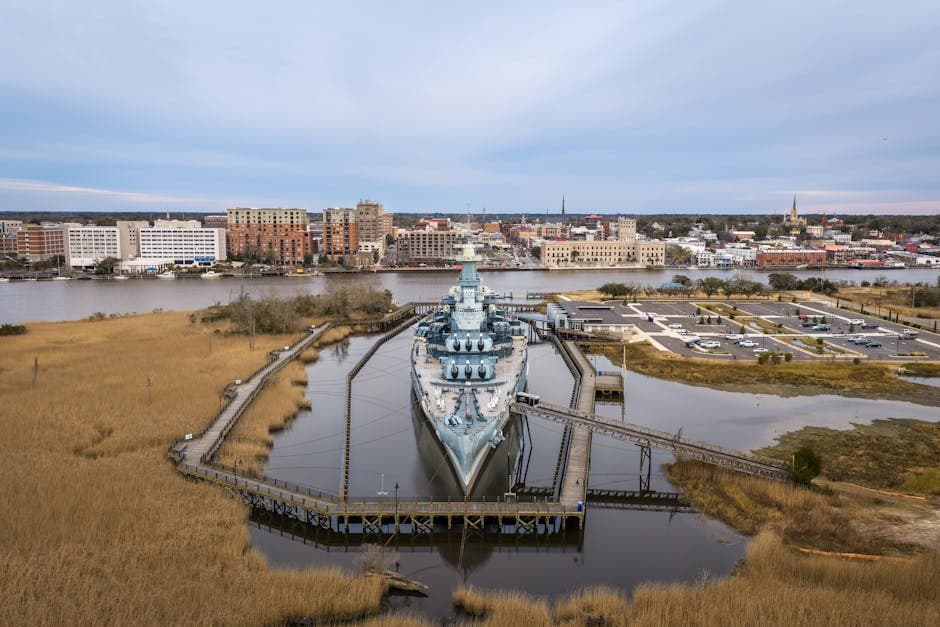
Wilmington NC riverwalk along the Cape Fear River with the historic district to the east and the USS North Carolina battleship moored on the west bank
Hollywood East · Cape Fear · Atlantic Port CityWilmington, NC · New Hanover County

Hollywood East and the Cape Fear: how an NC port city feeds film crews, Dawson's Creek pilgrims, and three-mile riverwalk brunches.

A working operator's read on the Wilmington restaurant economy: Cape Fear Riverwalk dining rooms, EUE/Screen Gems Studios catering trunks, Wrightsville Beach seasonal seafood houses, UNCW Seahawks game days, NC Azalea Festival surge weeks, and the Greek-American kitchens that built the city's mid-century dining grammar.

The Wilmington restaurant market, at a glance

~640

Restaurants in greater Wilmington

NC Restaurant & Lodging Association estimate, New Hanover County

$38

Median dinner check, downtown Riverwalk

Cape Fear CVB merchant survey range, 2024 to 2025

7.00%

Combined sales tax

NC state 4.75% plus New Hanover County 2.25%

$300M+

NC film production spend (annual)

NC Film Office, 5-year average across the state

~18K

UNCW enrollment

UNC Wilmington fact book, total headcount

~3.5M

Wrightsville Beach annual visitors

NC Beaches CVB and Cape Fear CVB estimates

Scene one · Water Street, dusk, a Friday in late April

The Azalea Festival weekend, a soundstage on 23rd Street, and the boat-charter brunch that turned ten thousand dollars.

Dusk on a Friday in late April. Maria L. is closing out lunch service at her Front Street restaurant, three blocks east of the river, half a block south of Market. The patio is a low hum of pre-dinner cocktail talk, the dining room is mid-turnover, and her catering lead is in the back office reconciling the day's tickets. There are three open orders on the screen. The first is a five-tray drop for an EUE/Screen Gems shoot wrapping on Stage 4 at the Front Street lot on 23rd, a crew call of one hundred and eight, scheduled for the wrap party at eight that night. The second is a thirty-cover boat-charter brunch booked for tomorrow morning out of Bennett Brothers Yachts on the Riverwalk, a private party of Azalea Festival visitors from Charlotte. The third is a Sunday tailgate tray for an alumni group driving down from Greensboro for the UNCW Seahawks home baseball game at Brooks Field.

The three tickets total nine thousand seven hundred forty dollars and change. Maria knows that number without looking. She knows it because all three orders rolled directly through her restaurant's ordering page, the same page that has been quietly building her catering record for the last fourteen months. The Screen Gems production accountant booked the wrap-party order yesterday morning on his desktop, attached a single line-item PO from the studio, and selected the loading-dock instruction template Maria has saved for his account. The boat-charter brunch went through the yacht broker's assistant on a phone call answered by her voice AI at four oh two yesterday afternoon, in English, with a Spanish handoff option that the assistant did not need. The Greensboro tailgate tray came in on the alumni group's recurring weekly reorder, the same order shape they have run for nine consecutive home Saturdays this spring season.

None of the three orders moved through a marketplace. None of the three carried a thirty percent skim. The nine seven four oh sits on Maria's ledger, less ingredient cost and labor and the seven percent in combined NC and New Hanover County sales tax the platform calculated, withheld, and will remit on her behalf. The Friday wrap-party order will land in her operating account same-day. The Saturday brunch will land Monday morning. The Sunday tailgate already landed Friday morning because Maria has the option to release pickup-paid orders at prep-complete, and her kitchen has been on this account long enough that she trusts the timing.

Eighteen months ago, the same three orders would have moved through a marketplace catering channel and a third-party reservations platform. The combined effective rate on the three tickets, with marketing fees, processing, and commission stacked, would have been somewhere between twenty-seven and thirty percent on the gross. Twenty-eight percent of nine seven four oh is two thousand seven hundred twenty-seven dollars. Per weekend. Across an April-to-September peak season of twenty-three peak weekends, that single line item recovered, on Maria's ledger, sixty-two thousand seven hundred twenty-one dollars she was paying to a logo with a headquarters in California. That sixty-two thousand is now in her operating account, the largest single line item in last year's independent-restaurant operating ledger. It is what bought her sous chef a raise. It is what bought a new walk-in cooler. It is what makes the case for a second location in Mayfaire pencil for the first time in eight years.

This is what Wilmington does to a restaurant operator who decides to own the demand. The Cape Fear River, the Riverwalk, the USS North Carolina battleship on the west bank, the historic district behind, the EUE/Screen Gems studios on 23rd Street, Wrightsville and Carolina and Kure beaches just to the east, the UNCW Seahawks campus on College Road, the Azalea Festival every April, the Greek Festival every fall: each of these is, individually, a meaningful demand surface. Stacked together, they make Wilmington one of the highest-leverage independent-restaurant markets in the Carolinas for an operator willing to run a direct portal. The rest of this page is for the operators in that camp. We have written it the way a Wilmington restaurant owner would actually use it: with a block diagram of the Riverwalk and its USS NC sightline, with a cuisine bar chart, with a twelve-month seasonal calendar anchored to the Azalea Festival and the Atlantic hurricane window, with an essay on the Hollywood East film economy and what it asks of a catering kitchen, with a tour of the operator personas the city actually contains, and with a single cost-math chart on what a $60 Riverwalk brunch leaves on your ledger versus on a marketplace ledger.

Section II

The Cape Fear Riverwalk, the USS NC sightline, and the dining grid east of the river

Wilmington's downtown is small enough to walk in an hour and dense enough to support more independent restaurants per linear block than any other NC coastal town. The Riverwalk on the east bank, restored and extended in phases since the 1980s, is the operational spine. The USS North Carolina battleship, moored on the west bank since 1961, is the photographic anchor of every Riverwalk dining-room marketing image.

Figure 1

The Cape Fear Riverwalk block diagram

The downtown Wilmington Riverwalk is one of America's longest at roughly 1.75 miles, with the USS North Carolina battleship memorial moored on the west bank and a dense band of restored 1800s buildings on the east bank. The food anchors run a tight north-south spine.

Riverwalk length

~1.75 mi

Cape Fear Riverflow south to AtlanticUSS NORTHCAROLINAmemorial since 1961BoardwalkWalnut StPrincess StChestnut StMarket St (axis)Dock StOrange StFront StN 2ndN 3rdHISTORIC DISTRICTone of largest in USPilot HouseThe GeorgePinPointCaprice BistroManna AvenueRx RestaurantThe BasicsN
  1. USS North Carolina Battleship Memorial

    Moored on the west bank of the Cape Fear River since 1961. The battleship is the city's most photographed civic landmark and the sightline that anchors every Riverwalk dinner menu marketing image.

  2. 1.75 mile boardwalk, east bank

    One of the longest continuous urban riverwalks in the United States, restored and extended in phases since the 1980s. Walking traffic peaks Friday and Saturday evenings April through October.

  3. Front Street and the historic grid

    Wilmington's Historic District is one of the largest in the country by area, restored 1800s commercial buildings on a 230-block grid east of the river. Front Street is the dining spine.

  4. Market Street axis

    Market runs east from the river to UNCW, splitting downtown north-south. The corridor carries the heaviest restaurant density per block in the metro.

Sources: City of Wilmington Planning Department, Cape Fear Convention & Visitors Bureau Riverwalk overview, USS North Carolina Battleship Memorial official site, Wilmington Downtown Inc. district maps. Anchor placement is schematic, not to survey scale.

The Cape Fear River runs north to south through the western edge of the city, draining out of the central Piedmont and feeding into the Atlantic Ocean roughly thirty miles south at the river's mouth at Bald Head Island and Fort Caswell. Wilmington sits on the east bank of the river at roughly the lowest navigable point, which is what made it the principal Atlantic port of North Carolina from the colonial period through the present. The Port of Wilmington, three miles south of downtown on the same east bank, remains one of the East Coast's significant container ports and continues to shape the city's working economy in ways that are largely invisible to Riverwalk visitors but real to operators along the south end of the historic district.

The Riverwalk itself is, by Cape Fear Convention & Visitors Bureau measurement, roughly one and three-quarter miles end to end, running from the Cape Fear Memorial Bridge at the north past Chandler's Wharf, the Pilot House, the foot of Market Street, the Hilton Riverside, and on south through the Live Oak Bank Pavilion to the south end at Riverfront Park. It is among the longest continuous urban riverwalks in the country and the single most-walked tourist surface in coastal North Carolina between Norfolk and Charleston. The boardwalk carries roughly two million walking visits per year, with peak Friday and Saturday evening volume from April through October.

The USS North Carolina battleship memorial, moored on the west bank directly opposite the historic district, has been a permanent museum since 1961. Visitors reach it by car across the Cape Fear Memorial Bridge or by water taxi from the east-bank pier near Market Street. The battleship is one of the most-photographed civic landmarks in coastal North Carolina, and the sightline from the east bank, particularly at golden hour, anchors essentially every Riverwalk dining-room marketing image. For a Wilmington restaurant operator running a portal-owned customer record, the USS NC sightline is the visual asset every catering email and confirmation page should be built around. A marketplace template will not let you tell that story. Your direct portal will.

The dining grid east of the river is, by national standards, unusually preserved. Wilmington's Historic District covers roughly two hundred and thirty blocks of restored 1800s commercial and residential buildings on the original colonial-era street grid. It is one of the largest contiguous historic districts in the United States by area, ahead of Charleston's and roughly the same scale as Savannah's. Front Street is the immediate parallel to the boardwalk, running the length of the Riverwalk one block east. Market Street is the east-west axis carrying traffic from the river inland through downtown, past UNCW, and on to Wrightsville Beach. Princess Street and Walnut Street, north of Market, and Dock Street and Orange Street to the south, complete the dining-density block grid.

For an operator inside the Riverwalk band, the customer mix is roughly half tourist, half local, with the share weighted more local during the September-to-March shoulder months and more tourist from April through August. The catering and pickup mix is meaningfully different. A direct-ordering portal that knows the difference, that surfaces the right menu page to the boat-charter brunch booking versus the Tuesday law-firm conference-room order, and that re-surfaces the right prior order to the returning Charlotte couple booking their Azalea-weekend lunch, beats a marketplace template that treats every customer record as anonymous. This is the operational reason that Wilmington kitchens running direct ordering on a portal they control are pulling away from the kitchens still listed only on marketplace channels.

Section III

What Wilmington cooks: oysters, vinegar pork, kalamata, and the Pleasure Island Mexican corridor

The Wilmington cuisine mix is, on the surface, the predictable coastal-southern profile. Underneath, it is one of the more interesting urban food economies in North Carolina, with a long-tenured Greek-American kitchen tradition, an emerging Vietnamese and Thai presence, and a growing Mexican corridor along Carolina Beach Road that the visitor guides under-represent.

Figure 2

What Wilmington kitchens cook

An editorial profile of the share of greater-Wilmington independent menus that feature each category. Seafood is the unsurprising plurality on a coastal market; Greek (legacy) is small but historically anchored; the Mexican share reflects a growing Hispanic community along the Market and Carolina Beach Road corridors.

Plurality

31% Seafood

0%8%16%24%32%Seafood (NC oysters, shrimp)31%Southern comfort18%Eastern NC BBQ9%Italian10%Mexican12%Greek (legacy)6%Asian (Pan-Asian, Sushi, Thai)9%Other (French, vegetarian, brunch-only)5%share of independent menus that feature category (editorial profile)

Sources: Cape Fear Convention & Visitors Bureau restaurant index, NC Restaurant & Lodging Association membership scan, Eater Carolinas and Star News dining coverage. Percentages reflect menu-category coverage in an editorial scan, not exhaustive census.

Seafood, at roughly thirty-one percent of independent menus, is the unsurprising plurality on a coastal market. North Carolina oysters from Stump Sound and the Pamlico, Brunswick County shrimp landed at the docks in Southport, and locally caught flounder and grouper define the category. Wilmington operators with the resources to source directly from coastal watermen build a meaningful menu differentiator that a marketplace template cannot photograph or describe with enough specificity. PinPoint Restaurant, under Dean Neff, has been a James Beard semifinalist multiple years and has built its identity around exactly this kind of direct coastal sourcing. Catch, under Keith Rhodes, runs an Asian-influenced seafood program with a similar coastal-direct supply chain.

Southern comfort and Eastern North Carolina barbecue together cover roughly twenty-seven percent of menus and the higher-tenure end of the independent-restaurant market. Eastern NC barbecue, the whole-hog vinegar-pepper tradition, is the regional default. Wilmington sits well east of the I-95 line that traditionally divides Eastern from Lexington (Piedmont) style, which means a Wilmington diner expects whole-hog, chopped, with vinegar and crushed red pepper, with white mayo-based slaw, with hush puppies. Menu copy that does not say so loses the diner who came in expecting it.

Italian, at roughly ten percent, reflects the long suburban dining footprint along Market Street, Oleander Drive, and out to Mayfaire. Mexican, at twelve percent, captures the growing Hispanic community along Carolina Beach Road and the Monkey Junction corridor as well as the Baja-style beach-corridor restaurants like K38 Baja Grill that have been part of the Wrightsville-adjacent dining grammar for two decades. The Greek (legacy) share, at six percent, is small in absolute count but historically anchored: Wilmington has one of the older Greek-American communities in the South, with the annual Greek Festival at St. Nicholas Greek Orthodox Church drawing visitors from across the state, and several Greek-American owned and operated restaurants that have been part of the city's dining grammar since the 1960s.

The Asian (Pan-Asian, Sushi, Thai) share, at roughly nine percent, has grown meaningfully in the last decade. Indochine, on Wayne Drive, is the long-tenured Vietnamese and Thai anchor with a garden patio that operates a separate seasonal calendar from the Riverwalk dining rooms. Bento Box Sushi, on Oleander, runs a recurring film-set catering line that is invisible to non-industry diners but accounts for a meaningful share of its weekly volume. Several newer Korean and Japanese rooms have opened in Mayfaire in the last five years.

For an operator in any of these categories, the practical implication is menu copy specificity. If you label your dish "BBQ" without specifying Eastern NC whole-hog with vinegar-pepper, you lose half of a long-tenured local and half of a homesick transplant in roughly equal measure. If you label your seafood as generic "catch of the day" without naming the sound or the boat, you under-monetize a sourcing decision your kitchen is already making. If you list your Greek dishes in English only without the Greek diacritic and a one-line story about kalamata or about your grandmother's recipe, you under-tell your own identity. A direct portal carries menu copy at the granularity you write. A marketplace template flattens it.

Section IV

The Wilmington operator's year: Azalea, beach season, hurricane window, film calendar

No other large North Carolina metro has a restaurant calendar this seasonal. The peak runs from April's NC Azalea Festival through Labor Day at the beaches, with a film-production layer running mostly summer-fall, a hurricane-watch window in September, and a quiet December. Operators who plan the year around this curve win the year. Operators who do not, do not.

Figure 3

The Wilmington operator's seasonal calendar

Wilmington has the most distinctly seasonal restaurant calendar of any large NC metro: peak from April's NC Azalea Festival through Labor Day, a film-production layer that runs late summer through fall, a hurricane-watch window in September, and a quiet December.

Peak month

July

025507510042Jan
Quiet downtown, film soundstage prep
50Feb
Wilmington Wine & Chocolate festival
68Mar
Spring break, UNCW Seahawks season
95Apr
NC Azalea Festival (one of NC's largest)
88May
Beach season opens, Wrightsville fills
94Jun
Carolina Beach Music Festival, full beach
100Jul
Fourth of July fireworks over the river
92Aug
Late summer beach, hurricane watch begins
70Sep
Hurricane season peak, school back at UNCW
78Oct
Riverfest weekend, fall film production
64Nov
Cape Fear Wine & Food (late month)
58Dec
Festival of Lights at Hugh MacRae
relative volume index (July = 100)peakmidlow

Sources: NC Azalea Festival schedule, Cape Fear CVB visitor reporting, NC Film Office production summaries, NC State Climate Office Atlantic hurricane season averages, Cape Fear Wine & Food. Volume index is an editorial composite.

The NC Azalea Festival, founded in 1948 and held every April, is one of the largest annual festivals in the state, drawing roughly three hundred thousand attendees across four days of garden tours, parades, a coronation ball, and concert events. The festival anchors the city's spring season and effectively marks the start of the beach-economy run. For Riverwalk operators, the Azalea weekend is the highest single-weekend volume of the calendar; for downtown rooms three to six blocks east of the river, the festival generates a meaningful share of the year's walk-in dinner volume in four nights. The operational playbook is a pre-built festival menu surfaced on the direct portal two weeks ahead, a tightened pickup-window block for boat-charter brunches Saturday morning, and a delivery slot allocation for the festival-adjacent hotels along Water Street and Market Street.

Beach season runs Memorial Day weekend through Labor Day, with shoulder weeks meaningful in May and September. Wrightsville Beach, a separate municipality just east of Wilmington across the Intracoastal Waterway, attracts roughly three and a half million visitor-days per year, per Cape Fear CVB and NC Beaches CVB estimates. Carolina Beach and Kure Beach, on Pleasure Island fifteen miles south of downtown, add a complementary family-beach economy with a different demographic mix. Wilmington restaurants east of downtown and on the beach itself operate a five-month volume curve that has to fund twelve months of fixed cost. For these operators, the marketplace tax during the peak weeks is the single largest controllable expense on the year-end ledger.

The film-production layer is what makes Wilmington distinct from every other NC coastal town. EUE/Screen Gems Studios, on 23rd Street north of the historic district, has operated continuously since 1984 as one of the largest soundstage complexes outside California. The lot has hosted Iron Man 3, the Dawson's Creek series (1998 to 2003), One Tree Hill (2003 to 2012), and a long roster of features, miniseries, and streaming productions. Together with location shoots across the historic district, the riverfront, the beaches, and a roster of rural Pender, Brunswick, and New Hanover County locations, the production volume earned Wilmington the nickname "Hollywood East." The North Carolina Film Office tracks the state's annual production spend at somewhere north of three hundred million dollars on a five-year rolling average, with Wilmington consistently the single largest production hub.

The hurricane window opens, statistically, in late August and runs through October, with September the peak month for Atlantic basin activity. Hurricane Florence in 2018 was the most recent major event to substantially disrupt the Wilmington restaurant economy; multiple downtown rooms closed for weeks. The operational reality for every Wilmington operator is that the kitchen carries hurricane insurance, the staff carries hurricane-week labor planning, and the customer record has to be portable across an emergency closure of three to fourteen days. A direct portal lets you push a single-update closure notice to your entire customer record inside ten minutes. A marketplace makes you call seven separate logos.

Riverfest, the Cape Fear River-themed festival held the first weekend of October, marks the transition from peak summer to fall shoulder season. The Cape Fear Wine and Food festival, held in November, anchors the fall culinary calendar. Together with UNCW's home football season (the program competes at the FCS Coastal Athletic Association level) and the start of Seahawks basketball, the fall calendar runs a moderate cadence that operators plan menu rotations around. December is the quiet month, with the city's annual Festival of Lights at Hugh MacRae Park drawing a moderate evening tourist crowd and the historic-district holiday displays carrying the rest. The operational opportunity in December is the catering trunk: corporate office parties at the medical campuses and the legal corridor, year-end booster events for UNCW programs, and the Greek-American community's Christmas Eve and Vasilopita services at St. Nicholas drive a tight catering week.

Section V

The Wilmington rooms that built the modern dining grammar

A hand-picked working list of Wilmington restaurants whose operations, chefs, and customer record offer a portrait of what the modern Cape Fear dining grammar looks like. The list is not exhaustive and intentionally mixes chef-driven concepts, long-tenured neighborhood institutions, and the kind of operationally distinctive kitchens that anchor real customer records.

Downtown / Front Street

PinPoint Restaurant

Dean Neff · New Southern with NC coastal sourcing

James Beard semifinalist multi-year. Dean Neff sources Cape Fear oysters and Brunswick County shrimp directly. The catering ticket is a specific reservation, not a marketplace listing.

Downtown / Princess Street

Manna Avenue

Billy Mellon (owner) · Contemporary American tasting menu

Dinner-only chef-counter concept. Long-tenure local press anchor for the modern Wilmington dining grammar.

Castle Street

Rx Restaurant & Bar

James Doss · Farm-to-fork in a former drugstore

Castle Street arts-district anchor. The patio model relies on owned bookings, not third-party reservations.

South Front Street

The Basics

Lyn Bonney (owner) · Southern brunch and sandwiches

Brunch-heavy daytime restaurant in the Cargo District. Beach-weekend pickup runs are the catering wedge.

Market Street

Catch

Keith Rhodes · Asian-influenced seafood

Keith Rhodes has competed on Top Chef and represented Wilmington nationally. Catering for film-set wraps is a recurring line.

Wayne Drive / Forest Hills

Indochine

Solange Thompson (owner) · Vietnamese and Thai

Two-decade neighborhood institution. Garden patio in summer. Bilingual ordering moves real volume.

Princess Place

Folks Cafe

Owner-run kitchen · Breakfast and lunch all day

Daytime diner with Riverwalk-tourist overflow. The takeout window doubles as a beach-day pickup point.

Oleander Drive / Wrightsville-adjacent

K38 Baja Grill

Owner-run kitchen · Baja-California Mexican

Beach-corridor Mexican with surfer-bar lineage. Family pickup orders peak Saturday afternoons.

Riverwalk / Water Street

The George on the Riverwalk

Owner-run kitchen · Seafood and steaks with a river view

Riverwalk-anchored dining room with USS NC sightlines. Tourist-volume venue with predictable seasonal swing.

Chandler's Wharf / Riverwalk

Pilot House

Owner-run kitchen · Lowcountry-style seafood

One of the oldest restaurants on the Riverwalk. Boat-charter brunch runs are a quiet but real revenue line.

Market Street downtown

Caprice Bistro

Owner-run kitchen · Classic French bistro

Two-decade downtown French anchor. Pre-theater bookings drive a tight 5pm to 7pm dinner window.

Oleander Drive

Bento Box Sushi

Owner-run kitchen · Japanese sushi and small plates

Recurring film-set catering operation. Long-tenured Wilmington dinner stop.

Military Cutoff Road

Henry's Restaurant

Owner-run kitchen · American comfort and bar food

Mayfaire-adjacent destination. The catering side is structured for medical-office and corporate office park accounts.

Sources: Star News dining coverage, Eater Carolinas Wilmington reports, James Beard Foundation semifinalist lists, Cape Fear CVB restaurant index, individual restaurant websites and press kits.

Section VI

Hollywood East, EUE/Screen Gems, and the catering trunk that runs Tuesday to Friday

Wilmington's status as "Hollywood East" is not marketing copy. The city has hosted continuous film and television production since 1984, when Dino De Laurentiis built what is now EUE/Screen Gems on 23rd Street. The lot is among the largest soundstage complexes outside California. For a Wilmington restaurant operator, the production calendar is one of the most lucrative catering surfaces in the state, if you know how to receive it.

Figure 4

The film-set catering 12-week cycle

A typical Wilmington feature film at EUE/Screen Gems Studios runs about 12 weeks: two weeks of pre-production with light catering, seven weeks of principal photography at near-peak crew calls, and three weeks of wrap. The standing catering trunk is a Tuesday-through-Friday rhythm for the middle stretch.

Peak crew call

~140 / day

0255075100PRE-PROPRINCIPAL PHOTOGRAPHYWRAP18W1
Office staff only
30W2
Dept heads arrive
78W3
Crew call ~120
88W4
Cast in town
95W5
Night shoot week
90W6
Location week
92W7
Stage week
96W8
Studio at peak
84W9
Wrap setup
52W10
Strike crew
30W11
Post handoff
14W12
Office only
relative catering load (peak crew = 100)

Sources: EUE/Screen Gems Studios production summaries, NC Film Office incentive disclosures, IATSE Local 491 (Wilmington crew local) industry reporting, Star News film coverage. Curve is a representative composite of multi-shoot averages.

Dino De Laurentiis opened the original DEG (De Laurentiis Entertainment Group) studio on a 32-acre lot at 1223 North 23rd Street in 1984, primarily to film Stephen King's Firestarter. The complex passed through several ownership changes over the next two decades and is now EUE/Screen Gems Studios, operated by EUE/Screen Gems out of New York, with the Wilmington lot remaining its largest production facility. The complex contains nine soundstages, including the largest (Stage 4 at 37,500 square feet), and has hosted Iron Man 3 (2013), Dawson's Creek (1998 to 2003 across all six seasons), One Tree Hill (2003 to 2012 across nine seasons), Halloween Kills (2021), Eastbound & Down, and a long roster of feature films, miniseries, and streaming productions.

The North Carolina Film Office, a division of the state Department of Commerce, tracks annual production spend across the state. For the five-year rolling average through 2024, North Carolina's total production spend hovered above three hundred million dollars per year, with Wilmington and surrounding New Hanover, Brunswick, and Pender counties consistently the largest single hub. The state operates a film and entertainment grant program, replacing the older tax-credit incentive, that has continued to attract major productions despite the state's less competitive incentive structure compared with Georgia and Louisiana.

The cultural footprint, fan footprint, and tourism footprint of past Wilmington productions matters in operationally specific ways. Dawson's Creek visitors still arrive in Wilmington at a meaningful weekly volume more than two decades after the show wrapped, with a tour operator running organized Dawson's Creek pilgrimage routes that anchor at the riverfront and at the show's on-location residential blocks in the historic district. One Tree Hill, which ran twice as long as Dawson's Creek and overlapped with the rise of social-media-driven fan culture, drives ongoing visitor volume that the city's tourism bureau and the show's actor-owned local businesses (including the now-closed Karen's Cafe at a downtown location) have woven into the dining-and-tourism economy in ways that no other small US city has institutionalized.

For a Wilmington restaurant operator, the production calendar generates two distinct catering surfaces. The first is the on-set craft services and meal-period catering, which is largely served by the production's contracted craft-services and catering companies and is therefore not directly addressable by a downtown independent restaurant. The second, more interesting surface, is the wrap-party, location-shoot, and off-set crew meal economy. Production assistants book Tuesday-and-Thursday standing orders for sub-crews working at locations across the historic district, the Riverwalk, the beaches, and a roster of rural Pender County locations. Crew calls for these orders run between sixty and two hundred meals at a time. Production accountants want a single line-item invoice per week, not twenty-three marketplace receipts, and they want a Stage 4 or Lot B routing instruction baked into the order record. A direct portal does all three. A marketplace does none of them.

The wrap-party economy is, on its own, one of the highest-margin catering surfaces in the city. A feature wrap or a season-ending TV wrap typically generates a single five-thousand-to-twenty-thousand-dollar food-and-beverage order on roughly forty-eight hours of notice, for a crew of one hundred to three hundred. The operational requirement is a kitchen that can scale production rapidly, deliver to a location anywhere from the Screen Gems lot on 23rd Street to a beach house on Wrightsville to a rural plantation house in Pender County, and bill cleanly to a production-accountant PO. The Wilmington operators who have invested in a direct portal with a production-accountant template account have, over the last five years, captured a disproportionate share of this category.

Voice AI, in this corner of the catering market specifically, earns its keep. Production assistants are early-career, often working long days, and the booking call still comes by phone for time-sensitive late-add orders. A voice AI that knows the difference between Stage 4 and Lot B, that knows the production accountant's PO format, that confirms a one-hundred-thirty-meal order at sixty-five-dollars-per-head in under sixty seconds, beats a staffing model that puts a catering lead on hold for the same call. We have built this into the DirectOrders platform with this exact use case in mind, and it works in English and in Spanish.

Section VII · Operator profiles

Three Wilmington operators, three calendars, one ledger problem

The Wilmington restaurant economy contains three operator profiles that, in some combination, account for most independent volume in the metro. Each runs a different seasonal calendar, each has a different cost structure, and each is solving the same marketplace-skim problem from a slightly different angle.

Persona 1

Downtown Riverwalk operator

Profile
60 to 110 covers, two seatings, river-view patio
Pain
Cruise-ship overflow weekends, late-night film-crew walk-ins, marketplace 27% commission on weekend brunch volume
Win with direct ordering
Direct portal carries the river-view photo on every order. Same-day payout. Voice AI takes the boat-charter brunch reservation in under a minute.

Persona 2

Beach-season seafood operator

Profile
Wrightsville or Carolina Beach, 80 to 150 covers May to September
Pain
Five-month operating window has to fund twelve months of fixed cost. Marketplace skim during peak season is the difference between black ink and red ink for the year.
Win with direct ordering
Own the customer record across the summer. Re-surface the August booking as a Memorial Day reorder next year. Eliminate the 27% marketplace tax across the peak window.

Persona 3

Film-crew catering operator

Profile
Industrial-scale catering, crew calls of 60 to 200, Screen Gems lot or location shoots
Pain
Production assistants book Tuesday-and-Thursday standing orders by phone. Marketplaces cannot route to a soundstage by stage number; production accountants want a single line-item invoice, not 23 marketplace receipts.
Win with direct ordering
Direct portal with stage-number routing and a single weekly invoice. Bilingual voice AI for production crews. Catering trunk that runs Tuesday to Friday across an entire 12-week shoot.

Section VIII

The languages on the phone: English, Spanish, and the international beach week

New Hanover County's Hispanic and Latino population, per US Census Bureau American Community Survey 2024 estimates, is approximately six percent and growing, with the largest concentration along the Carolina Beach Road corridor south of downtown, along Market Street out past UNCW, and in the working-housing band around the Port of Wilmington. The growth rate over the last decade is materially higher than the absolute share suggests, with both family-restaurant entrepreneurs and back-of-house labor anchoring the corridor. Several of the most operationally important Mexican kitchens in the city, particularly along Carolina Beach Road and the Monkey Junction corridor, operate primarily in Spanish and accept the marketplace tax mostly because the marketplace happens to be the only digital channel they have, not because the math works.

For these operators, a direct portal that handles English and Spanish out of the box, that runs a voice AI that takes a catering call in either language without a language-switch handoff, and that prints receipts and confirmation emails in either language, is the single largest unmet technology need we encounter. The DirectOrders voice AI handles both English and Spanish natively and, in a Wilmington context, picks up an additional non-trivial share of the call traffic: the international vacationer calling from a Wrightsville Beach rental, the Canadian film-crew assistant on a coastal location shoot, the German tour group at the boutique hotel on Market Street. The phone, in a tourist-and-film economy, is still a meaningful inbound channel for catering and group bookings, and the staffing model for a multilingual reservation desk does not pencil for an operation the size of most family restaurants. Voice AI does.

The other quiet language presence in Wilmington is Vietnamese. Indochine, on Wayne Drive, has been part of the city's long-tenured Vietnamese-and-Thai restaurant lineage since the late 1990s. Several smaller Vietnamese-owned kitchens around the city operate in a mix of Vietnamese and English. Greek, the legacy language of the early-20th-century Wilmington Greek-American community, remains a counter-language at several of the older family restaurants and a public-life language at the annual Greek Festival held by St. Nicholas Greek Orthodox Church. None of these languages is well-served by marketplace platforms. All three are served by a direct portal whose owner controls the language settings on the menu page, the receipt template, and the voice AI prompt. We have built the platform with that scope of language coverage in mind.

For operators reading this in any of these corridors, the practical step is to start small. Turn on the Spanish voice-AI handoff for the next two months and watch how the inbound catering call mix changes. Translate the catering page and the FAQ on the order portal into Spanish and watch how the conversion rate moves on the corridor where it matters. The marketplace will not let you do either of these. Your direct portal will.

Try the bilingual voice AI on your kitchen's number

English plus Spanish, configured for your menu, your tax rate, and your loading-dock routing. Live in two hours or we white-glove you for free.

Section IX · The cost math

The $60 Riverwalk brunch, two ways

Every conversation with a Wilmington operator eventually arrives at the cost math. We have written ours out, in dollars per ticket and dollars per year, for a representative $60 Riverwalk brunch ticket. The number that matters is what your ledger keeps. The arithmetic is the same arithmetic any operator's accountant will run.

Figure 5

What stays at home: a $60 Riverwalk brunch, two ways

A representative Wilmington Riverwalk brunch ticket of $60. On a third-party marketplace at the all-in 27% rate (commission, marketing, delivery fees, payment processing), the operator keeps $43.80. On a direct platform with a flat effective 14% (payment processing plus platform amortization), the operator keeps $51.60. The $7.80 per ticket compounds.

Annual delta at 2,000 tickets

+$15,600

$0$15$30$45$60$43.80 keptof $60 ticketMarketplace27% all-in commissionloses $16.20$51.60 keptof $60 ticketDirectOrders14% effective (processing + platform)loses $8.40+$7.80 per ticket

Per ticket

+$7.80

What a direct platform leaves in your pocket on every $60 Riverwalk brunch ticket versus a marketplace.

At 2,000 tickets a year

+$15,600

Typical mid-volume Riverwalk brunch operator. This is the line where the choice between marketplace and direct stops being academic.

At 5,000 tickets a year

+$39,000

A high-volume Riverwalk operator running brunch on a busy Saturday-Sunday split. Roughly a full-time line cook's annual wage.

Sources: National Restaurant Association margin benchmarks, marketplace commission disclosures (DoorDash, Uber Eats, Grubhub merchant terms), Cape Fear CVB brunch check averages. Effective direct rate includes Stripe payment processing and the DirectOrders flat platform subscription amortized over an illustrative mid-volume operator.

The figure compares an all-in twenty-seven percent marketplace commission against an effective fourteen percent on a direct platform. The twenty-seven percent figure is the publicly disclosed range on third-party catering and pickup tickets across DoorDash, Uber Eats, and Grubhub merchant agreements; the all-in number stacks commission, marketing-tier surcharges, payment processing, and (where applicable) delivery fees. The fourteen percent figure on DirectOrders is an effective composite: roughly three percent in payment processing (Stripe), plus the amortized flat monthly platform subscription across an illustrative mid-volume operator. There is no per-order commission on first-party direct orders.

For a Wilmington Riverwalk operator running a mid-volume brunch and pickup program of roughly two thousand qualifying tickets per year, the delta compounds to fifteen thousand six hundred dollars a year. For a high-volume Riverwalk operator running closer to five thousand tickets, the delta is roughly thirty-nine thousand dollars a year, which is roughly the annual wage of a full-time line cook. Said differently: the difference between a marketplace platform and a direct platform, at typical Wilmington Riverwalk brunch volume, is a full-time kitchen hire. That is the line at which the choice between the two stops being academic.

None of this accounts for the secondary benefits. The customer record on a direct portal is yours, which means the re-marketing email goes out from your domain, the loyalty program is your loyalty program, and the prior-order reorder surface is a single tap. The marketplace customer record is theirs. Multiply that across a five-year operator horizon and the comparison gets considerably wider.

Wilmington neighborhoods served

28401

Downtown / Riverwalk

Tourist spine, USS NC sightline, 1.75 mile boardwalk

28401

Historic District

One of largest US historic districts, restored 1800s grid

28480

Wrightsville Beach (separate town)

Barrier island, primary beach destination

28428

Carolina Beach (separate town)

Pleasure Island boardwalk, family-beach economy

28449

Kure Beach

South end of Pleasure Island, quieter shoreline

28403

UNCW Campus

Seahawks corridor, ~18K students, College Road spine

28405

Mayfaire

Mixed-use lifestyle center, family + corporate

28412

Monkey Junction

South Wilmington commercial corridor, big-box adjacency

Section X · The argument

How DirectOrders fits Wilmington

The argument for direct ordering in Wilmington is, in the end, a single argument repeated across three audiences. The audiences are downtown Riverwalk operators, beach-season seafood operators on Wrightsville and Carolina Beach, and the film-crew catering kitchens that service Hollywood East. The argument is the same in each case: the demand belongs to the restaurant, not to a marketplace. Every other operating decision in a Wilmington kitchen flows from that single recognition.

For the Riverwalk operator, direct ordering means the boat-charter brunch booking next April carries the USS NC sightline on the confirmation page, the prior-Azalea-Festival visitor record re-surfaces the right Saturday-morning booking inside one tap, and the seven-eighty per ticket that would have wired to California stays on your ledger.

For the beach-season seafood operator, direct ordering means the five-month operating window funds twelve months of fixed cost without the marketplace tax flattening the peak weeks. The August booking from last summer re-surfaces as a Memorial Day reorder next May, by name. The customer record is yours, not a logo's.

For the film-crew catering operator, direct ordering means a Stage 4 routing instruction baked into the production accountant's recurring account, a single weekly line-item invoice instead of twenty-three marketplace receipts, and bilingual voice AI that takes the late-add hundred-thirty-meal Tuesday call without a staffing decision. The marketplace cannot do any of those three. Your direct portal can do all three.

We can show you the platform on your menu, with your prices, with your New Hanover County 7.00% combined tax rate, with your loading-dock instructions baked into your studio-account records, inside two hours. The demo is free. The setup is white-glove. If we cannot get you live in two hours, we will white-glove you for free until you are. The Wilmington Friday at dusk is yours to keep.

Live in two hours, or we white-glove you for free

Bring Wilmington's Friday at dusk onto your own ledger.

See the platform configured for the way Wilmington restaurants actually work: Riverwalk brunches, Wrightsville Beach seafood houses, EUE/Screen Gems wrap parties, Azalea Festival weekend surge, UNCW Seahawks game days, bilingual voice AI for the Carolina Beach Road corridor.

Sources & further reading

Page last updated 2026-05-12. Figures sourced or contextualized to the citations above. NC sales tax rate of 7.00% reflects the combined NC state 4.75% and New Hanover County 2.25% rates as published by the NC Department of Revenue. Production-spend figures reflect the NC Film Office five-year rolling average; year-to-year totals vary materially. Catering load curves and brunch-check averages are editorial composites drawn from public industry sources and operator interviews; treat as order-of-magnitude rather than exact.

Keep exploring

More North Carolina cities and nearby markets

All North Carolina cities →