Commissary and Central Kitchen Guide for Restaurants (2026)
What is a commissary food service system? Definition, central kitchen examples, cook-chill rules, 2026 rental costs, and when to centralize production.
Updated Aug 18, 2026
Central kitchen
one production hub
Cook-chill holds up to 30 days
Produce centrally, finish and serve at the satellites
TLDR
A commissary or central kitchen system concentrates food production in one facility while satellite locations finish and serve. It is one of the four classic foodservice systems, used by Domino's (22 US supply chain centers), school districts serving 29.4 million daily lunches, and airline caterers producing 225,000 meals a day. Renting commissary space runs $15 to $45 per hour or $250 to $1,500 monthly as of July 2026. Cook-chill under an approved HACCP plan extends shelf life up to 30 days. Most restaurants centralize at three or more locations.
TLDR
A commissary or central kitchen system concentrates food production in one facility while satellite locations finish and serve. It is one of the four classic foodservice systems, used by Domino's (22 US supply chain centers), school districts serving 29.4 million daily lunches, and airline caterers producing 225,000 meals a day. Renting commissary space runs $15 to $45 per hour or $250 to $1,500 monthly as of July 2026. Cook-chill under an approved HACCP plan extends shelf life up to 30 days. Most restaurants start centralizing at three or more locations.
This is the deep-dive companion to our pillar guide on the 4 types of foodservice systems. That article compares all four models. This one goes deep on the commissary model alone: the definition, the real operators running it at every scale, the economics, the food safety rules, the rental market, and the decision framework for centralizing your own production.
What is a commissary food service system?
A commissary food service system, also called a centralized food service system, produces food in one central production kitchen and transports it to separate satellite locations, where staff finish, plate, or serve it. Production and service are split across different places, which is the defining trait that separates it from the other three foodservice systems.
The taxonomy comes from foodservice management scholarship. University texts, most notably Gregoire's Foodservice Organizations: A Managerial and Systems Approach (9th edition, Pearson), classify every commercial and institutional kitchen into four systems based on where food is prepared, when it is prepared, and how it reaches the guest: conventional, commissary, ready-prepared, and assembly-serve.
In industry conversation the word "commissary" carries two related meanings, and it helps to keep them straight:
- A commissary system or central kitchen: a production hub that one organization owns to supply its own satellite units. Think of a bakery plant feeding 200 restaurants, or a school district kitchen feeding 60 schools.
- A commissary kitchen for rent: a licensed, shared commercial kitchen where food trucks, caterers, bakers, and ghost kitchen brands legally prep, store, and clean. Same word, different business arrangement.
Both meanings share the core idea: cooking happens in an inspected production facility that is not the point of sale. The satellite side of the model is what makes it work. Satellite locations need less equipment, less space, and fewer skilled cooks, because the hard production work already happened somewhere cheaper and more controlled.
How is a commissary different from the other foodservice systems?
The commissary system is the only one of the four defined by geography: production and service happen in different buildings. The other three systems differ mainly on timing (cook now versus cook ahead) and on how much production happens in-house versus being purchased already prepared.
| System | Where food is cooked | Timing | Typical operator |
|---|---|---|---|
| Conventional | On-site, same kitchen that serves | Cooked and served same day | Independent restaurants |
| Commissary (centralized) | Central kitchen, shipped to satellites | Produced ahead, finished at satellite | Chains, school districts, caterers |
| Ready-prepared | On-site or central, then chilled or frozen | Cooked days ahead, reheated at service | Hospitals, universities |
| Assembly-serve | Manufacturer or supplier | Purchased ready, assembled on-site | Low-labor institutional operations |
Real operations hybridize. A central kitchen that blast-chills its sauces and braises is running commissary logistics with ready-prepared preservation techniques, and most large central kitchens do exactly that. For the full comparison of costs, staffing, and margins across all four systems, the pillar guide covers each one in depth.
What are real examples of commissary and central kitchen systems?
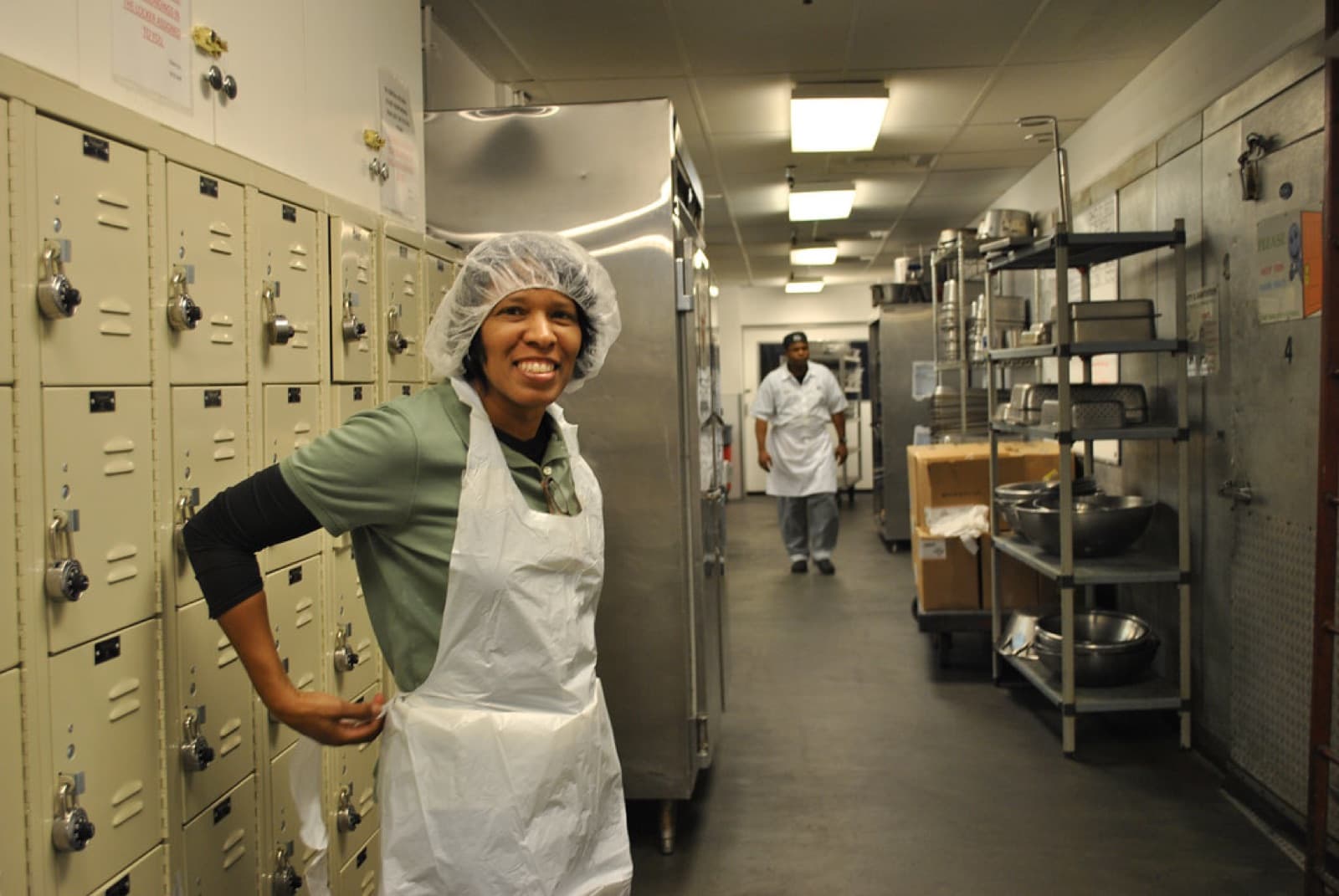
The commissary model runs at every scale of American foodservice: pizza chains with regional dough plants, dessert factories feeding hundreds of restaurants, school districts producing six-figure daily meal counts, and airline caterers loading food onto planes that serve it at 35,000 feet. Here are the documented examples by category.
Multi-unit restaurant chains
Domino's operates 22 regional dough manufacturing and supply chain centers in the United States, plus five in Canada, two thin crust facilities, and a vegetable processing center (Domino's FY2024 Form 10-K). Stores receive fresh dough and ingredients on scheduled truck routes, which is why a franchisee needs no dough production capacity in the store.
The Cheesecake Factory bakes its namesake cheesecakes and other desserts in two company bakery plants: a 60,000 square foot facility in Calabasas Hills, California and a 100,000 square foot facility in Rocky Mount, North Carolina, with a third announced for Charlestown, Indiana in October 2023 (company 10-K filings). Restaurants thaw, garnish, and serve; they never bake a cheesecake.
Panera Bread is the instructive counter-example. For decades it ran a network of fresh dough facilities that mixed and shaped dough, then trucked it daily to cafes for overnight baking. After closing several facilities in 2024 and early 2025, including two California plants that had supplied about 196 cafes, Panera confirmed in May 2025 that it would wind down its remaining nine fresh dough facilities over roughly 24 months and switch to par-baked bread from third-party bakeries (Restaurant Dive, May 2025). Central production is a trade, not a law of nature: when distribution costs outgrow the consistency benefits, even a famous network gets unwound.
Ghost kitchen operators
CloudKitchens, the shared-kitchen company led by Uber co-founder Travis Kalanick, reportedly raised $850 million at a $15 billion valuation in 2021 through parent company City Storage Systems (Los Angeles Business Journal, 2024), buying up industrial buildings and subdividing them into rentable delivery-only kitchen units. Kitchen United raised a $100 million round in 2022 with investors including Kroger, then shut the eight food halls inside Kroger stores in November 2023 (44% of its 18-unit footprint) and exited physical operations entirely in a pivot to software (Restaurant Dive, 2023).
The lesson from the ghost kitchen shakeout is that renting production capacity solves the kitchen problem, not the demand problem. A delivery brand in a commissary still lives or dies on channel economics: 25% to 30% marketplace commissions against thin margins. The operators that survive build a direct ordering channel, which is exactly the gap a flat-fee platform like DirectOrders ($249 per month, zero commission, as of July 2026) exists to close: the central kitchen creates the margin, and the direct channel lets the brand keep it.
Schools, hospitals, and corporate dining
The National School Lunch Program served lunches to about 29.4 million children on a typical day in the 2023-24 school year, more than 4.8 billion lunches across fiscal year 2024 (USDA Economic Research Service). A large share of that volume flows through district central kitchens with trayline or satellite finishing models. Los Angeles Unified alone serves more than 530,000 meals a day across 680+ school cafeterias (LAUSD Food Services Division), a scale only possible with centralized production, menu planning, and distribution.
Hospitals run the same geometry with a preservation layer added: central production plus cook-chill, retherming trays at the point of service. Contract caterers apply the identical playbook to corporate dining, stadium suites, and senior living, which is why "commissary" job titles show up across all of institutional foodservice.
Airline catering
Airline catering is the purest commissary system in existence, since the service location is an aircraft with almost no cooking capacity. Emirates Flight Catering produces an average of 225,000 meals per day at its Dubai facility, with capacity above 250,000, serving more than 100 airline customers (Emirates Flight Catering fact sheet, 2023). Global players like gategroup (Gate Gourmet) and LSG Group run networks of flight kitchens beside major hubs on the same model: cook, chill, tray, seal, truck, load, reheat in the galley.
What are the economics of a central kitchen?
A central kitchen makes money by consolidating skilled labor, buying in bulk, standardizing yields, and moving production square footage from expensive retail rent to cheap industrial rent. It costs money through the facility itself, refrigerated distribution, packaging, and an added food safety burden. The model wins when the first list outweighs the second.
| Cost lever | In-store production | Central production |
|---|---|---|
| Skilled prep labor | Duplicated at every location, every day | Consolidated into one scheduled production team |
| Purchasing | Per-site orders at small-volume prices | Bulk contracts, one receiving dock |
| Rent on prep space | Retail rates, averaging $24.59 per sq ft (CBRE, Q1 2026) | Industrial rates, $10 to $11 per sq ft (Cushman & Wakefield, Q1 2026) |
| Equipment | Full cook line replicated per site | One heavy production line, light finishing equipment at satellites |
| Consistency and waste | Varies by site and shift | Standardized recipes, portioning, and yield tracking |
| Distribution | None | Refrigerated trucks, drivers, fuel, routing (the big offset) |
Two of those levers are worth putting numbers on.
Labor consolidation. If each of four locations staffs 6 hours of prep a day at a $22 fully loaded hourly cost, that is about $193,000 a year of largely duplicated work (4 sites x 6 hours x $22 x 365 days). A central kitchen replaces much of it with one production team working predictable daytime shifts, which also recruits and retains better than split shifts across four sites. This model is illustrative, but the structure of the saving is why every large chain runs some version of it. The National Restaurant Association's 2026 State of the Industry report projects $1.55 trillion in industry sales against persistent food and labor cost pressure, and labor is precisely the line central production attacks.
Rent arbitrage. Prep space inside a restaurant sits on retail rent. As of Q1 2026, US retail asking rents average $24.59 per square foot per year (CBRE) versus roughly $10 to $11 for industrial space (Cushman & Wakefield). Moving 1,600 square feet of combined prep out of four storefronts into an industrial-zone central kitchen saves about $22,500 a year on rent alone, before the freed-up retail space earns anything as added seating or storage.
The offset is distribution, and it is not a rounding error: trucks, fuel, drivers, insurance, refrigeration, and the route-time ceiling on how far satellites can be from the hub. Panera's 2025 retreat from fresh dough facilities is the public case study of that line item winning the argument. Food cost discipline still applies at both ends of the truck route; our restaurant food cost percentage guide covers the targets central production is trying to hit.
How do HACCP and cook-chill work in a central kitchen?
Central kitchens hold food between production and service, so food safety law treats them more strictly than cook-and-serve restaurants. The controlling framework in the US is the FDA Food Code, adopted with variations by states, plus a written HACCP plan whenever the kitchen uses specialized processing like reduced oxygen packaging.
The rules that matter most in central production, from the FDA Food Code 2022:
| Process step | Requirement |
|---|---|
| Cooling (section 3-501.14) | 135 to 70 degrees F within 2 hours, then to 41 degrees F within 6 hours total |
| Cold holding | 41 degrees F or below for TCS (time/temperature control for safety) foods |
| Cook-chill or sous vide in ROP bags (section 3-502.12) | HACCP plan approved by the regulatory authority |
| ROP cook-chill held at 41 degrees F | Use within 7 days |
| ROP cook-chill cooled to 34 degrees F within 48 hours | Hold up to 30 days |
| Frozen | No time limit while frozen |
That cooling curve is why blast chillers are the signature equipment of central production. Dropping a 40-pound batch of sauce from 135 to 41 degrees F inside 6 hours is nearly impossible in a standard walk-in; a blast chiller does it by design. As of 2025 pricing guides, compact units run about $1,000 to $10,000, mid-size reach-ins $10,000 to $25,000, and roll-in units for high-volume central kitchens $33,000 to $51,000+ (The Restaurant Warehouse, 2025).
Cook-chill is the preservation technique that makes the distribution math work: cook in bulk, chill fast, hold safely, retherm at the satellite. Conventional cook-chill practice holds product about 5 days, while reduced oxygen packaging under an approved HACCP plan stretches that to 30 days at 34 degrees F, which converts daily truck routes into two or three per week.
One regulatory boundary to know: once a central kitchen supplies locations under different ownership, or sells wholesale, many states reclassify it as a food processing establishment requiring separate licensing, and products like meat can pull in USDA inspection. Confirm the classification with your state health or agriculture department before signing a lease.
How much does it cost to rent a commissary kitchen?
As of July 2026, shared commissary kitchen access in the US typically costs $15 to $45 per hour, or $250 to $1,500 per month for membership plans, based on marketplace listings and rental guides. Location, equipment, storage, and time of day drive the spread, with outliers from $12 per hour to $50.
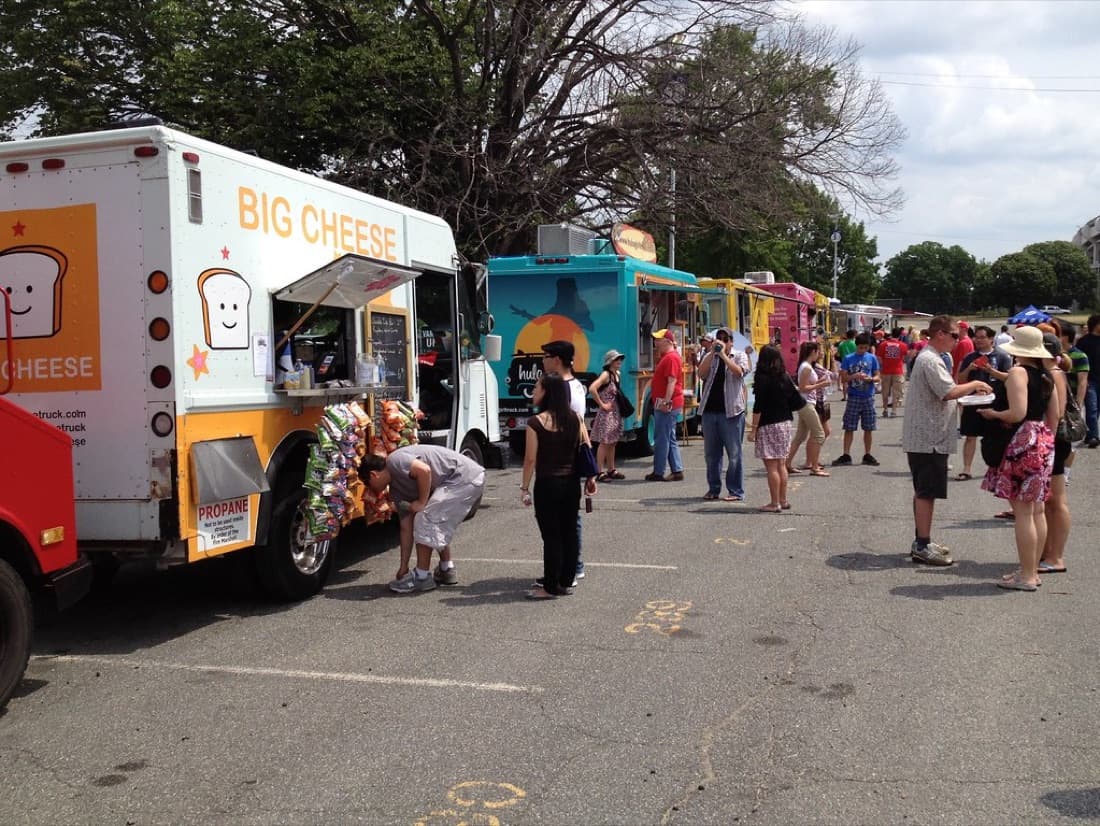
Representative live listings on The Kitchen Door, the rental marketplace built by The Food Corridor, as of July 2026:
- Marietta, Georgia: $12 per hour on a 20-hour minimum membership plan, or about $1,000 per month for a private 120 square foot cubicle with 24/7 access
- Burlington, North Carolina: $30 per hour peak (7am to 8pm), $25 off-peak
- St. Louis County, Missouri: $30 to $40 per hour standard rates
What a commissary membership generally includes, and what to verify before signing:
1. Licensed production space with commercial cooking, ventilation, and warewashing (the point of the whole arrangement)
2. Storage, usually priced separately by the shelf, rack, or pallet across dry, cooler, and freezer
3. Food truck servicing: potable water fill, wastewater dump, grease disposal, and overnight parking, which matter because the law often requires them
4. Scheduling and access: peak-hour availability is the real constraint in busy urban kitchens, so ask what hours are actually bookable
5. Compliance paperwork: health permit status, insurance requirements, and whether the facility supports your specific license type (retail, catering, wholesale, or cottage-to-commercial transitions)
For food trucks, commissary use is usually not optional. California Health and Safety Code section 114295 requires mobile food facilities to operate in conjunction with an approved commissary, and mobile food preparation units must report to it at least once each operating day for cleaning and servicing. Most other states and counties impose similar requirements through their retail food codes, with limited exemptions (community events, some low-risk carts), so the commissary fee belongs in every food truck's fixed-cost budget.
When should a restaurant centralize production?
Centralize when duplicated prep labor, inconsistency between locations, and cramped satellite kitchens cost more than a production facility plus daily distribution would. For most operators that math starts working somewhere between three and five locations with a substantially shared menu, and almost never before the second location is stable.
Run this checklist before committing capital:
1. Three or more locations sharing 70%+ of the menu. Below that, the shared-production volume rarely covers the facility overhead.
2. Duplicated skilled prep of 4 to 6+ hours per site per day. That is the labor block a central kitchen absorbs; if satellites mostly assemble already, you have less to consolidate.
3. Documented consistency problems. If the same dish varies by location, centralization is the structural fix, not more training memos.
4. Satellite kitchens out of space. When prep is displacing service capacity at retail rents, moving it to industrial square footage pays twice.
5. Satellites within a practical delivery radius. Daily refrigerated routes work within roughly an hour of the hub; past that, distribution costs and food quality both degrade.
6. A menu that holds. Sauces, braises, doughs, dressings, and portioned proteins centralize well; cooked-to-order items do not, so plan on finish-at-satellite.
7. Demand data you trust. Forecast production from real per-location order history, not gut feel; your direct online ordering data is the cleanest demand signal you own.
8. A rent-first path. Renting commissary space by the hour ($15 to $45 as of July 2026) lets you pilot centralized production for one category, like sauces or baked goods, before building a facility.
The rent-first path deserves emphasis because it converts a seven-figure capital decision into a monthly operating expense you can unwind. Many regional chains ran years of production out of rented commissary space before signing an industrial lease.
How does online ordering work with a central kitchen?
Customers never order from the central kitchen. Orders flow to the satellite location that will finish and hand off the food, while the central kitchen works from aggregated demand: par-level replenishment orders from each satellite plus forecasts built on order history. The technology layer's job is to keep those two loops synchronized.
The daily rhythm looks like this. Each satellite carries par levels for centrally produced components (quarts of sauce, trays of dough, portioned proteins). Satellites transmit replenishment orders on a cutoff schedule, the central kitchen batches them into production runs and truck routes, and satellites finish dishes to order during service. Inventory software that supports multi-site transfers and recipe-level depletion is what keeps the paperwork honest; our guide to restaurant inventory management features covers what to look for.
On the customer-facing side, a multi-location restaurant needs ordering infrastructure that routes each online order to the correct serving location and keeps per-location order history clean, because that history is the production forecast. This is where DirectOrders fits for commission-free operators: one flat $249 per month (as of July 2026), every order routed to the right location, and the demand data stays yours instead of living inside a marketplace's dashboard. If delivery is part of the model, dispatch and driver coordination add their own layer; see our guide on how to streamline restaurant delivery operations.
The strategic point is that centralization concentrates production risk and data value in one place. The operators who win with central kitchens treat order data as a production input, as important as flour, because every point of forecast accuracy shows up directly as less waste and shorter routes.
Sources
- FDA Food Code 2022, US Food and Drug Administration
- HACCP Principles and Application Guidelines, US Food and Drug Administration
- California Health and Safety Code section 114295, California Legislative Information
- National School Lunch Program, USDA Economic Research Service
- LAUSD Food Services Division, Los Angeles Unified School District
- Domino's Pizza FY2024 Form 10-K, US Securities and Exchange Commission
- The Cheesecake Factory FY2024 Form 10-K, US Securities and Exchange Commission
- Emirates Flight Catering fact sheet, Emirates Flight Catering
- Panera to close remaining fresh dough facilities, Restaurant Dive, May 2025
- Kitchen United sells or closes all physical units, Restaurant Dive, November 2023
- Travis Kalanick, Wealthiest Angelenos, Los Angeles Business Journal, 2024
- The Kitchen Door commissary kitchen listings, The Food Corridor
- How much does it cost to rent a commercial kitchen, UpMenu, 2025
- 2026 State of the Restaurant Industry, National Restaurant Association
- US Quarterly Figures, CBRE, Q1 2026
- US Industrial MarketBeat, Cushman & Wakefield, Q1 2026
- How much is a blast chiller, The Restaurant Warehouse, 2025
Taxonomy reference: Gregoire, M. B., Foodservice Organizations: A Managerial and Systems Approach, 9th edition, Pearson. Pricing figures throughout are as of July 2026 and drawn from the linked public sources; rental rates reflect live marketplace listings, which change by market and season.
Frequently Asked Questions
A commissary kitchen is a licensed commercial kitchen used for food production away from the point of service. The term covers two things: shared rental kitchens where food trucks, caterers, and ghost kitchen brands prep legally, and central production kitchens that multi-unit restaurants own to supply their satellite locations. Both exist so that cooking, storage, and cleaning happen in an inspected, code-compliant facility.
Related resources
Related Articles
4 Types of Food Service Systems Every Restaurant Should Know
The 4 types of food service systems: conventional, commissary, ready-prepared, and assembly-serve, compared by cost, staffing, and profit margin.
Pankaj Avhad
Restaurant Online Ordering Trends Shaping 2026
From AI ordering to the commission-free movement, here are the trends reshaping how restaurants sell food online in 2026.
Pankaj Avhad
Key Features of a Restaurant Inventory Management System
The inventory management features that actually matter for restaurants -from real-time tracking and auto-reorder alerts to recipe costing and auto-86'ing items when stock runs out.
Pankaj Avhad