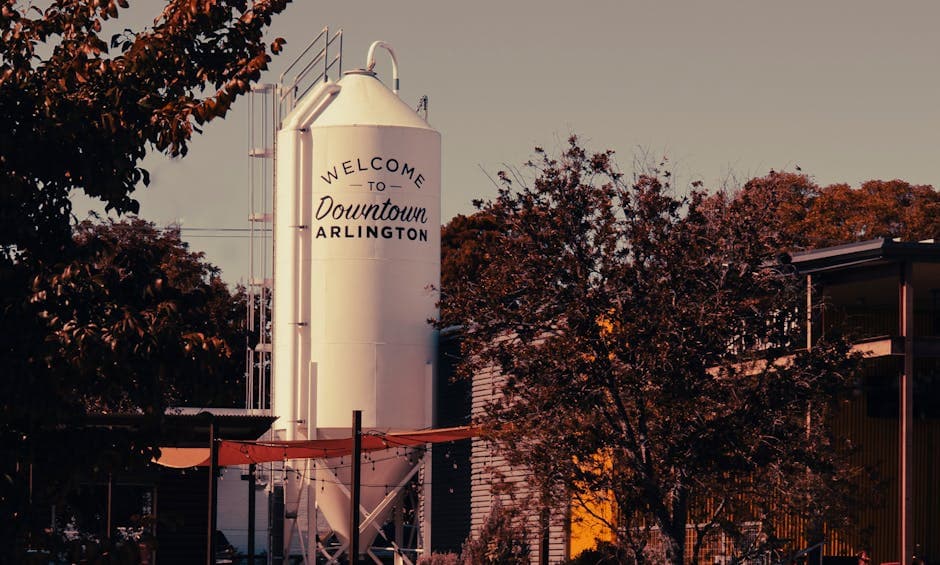
Stadiums, coasters, and a college town.
A long read on operating a restaurant in Arlington, the ~395,000-resident city wedged between Dallas and Fort Worth at the center of the DFW Entertainment District. AT'T Stadium and Globe Life Field sit on the same parking grid. Six Flags Over Texas, the original 1961 park, draws roughly 2.5 million visitors a year next door. UTA, the largest public Texas university by enrollment, runs a ~42,000-student calendar through downtown. The General Motors assembly plant runs full-size SUVs three shifts a day on Abram. Five operating modes, one zip-code cluster.
- Population
- ~395K
- Six Flags annual visitors
- ~2.5M
- UTA enrollment
- ~42K
- Combined sales tax
- 8.25%
US Census ACS
Six Flags / TEA AECOM
UT System reporting
Texas Comptroller
I. Sunday, 11:48 A.M., Entertainment District
Two stadiums, one parking grid.
On a Sunday in late September, at 11:48 in the morning, a restaurant on Randol Mill Road between AT&T Stadium and Globe Life Field is fielding two calendars at once. The Cowboys kick at 3:25 against the Eagles. The Rangers host the Astros at 7:05. The west parking grid belongs to the Cowboys today. The east grid belongs to the Rangers. The kitchen is staffed for both, plus a Six Flags Saturday hangover (Fright Fest opens next weekend) on the same shift.
The host stand prints out a 40-tray catering order at 12:04 p.m., picked up by a corporate hospitality buyer with a suite at AT&T Stadium. Spinach dip, brisket sliders, jalapeno- cheddar sausage trays, a cold-cut platter for forty people. The same printer fires a 12-cover family catering tray at 12:18 p.m. for a Rangers section-104 group buyout. Both orders need to be cold-hold by 1:30 p.m., loaded into the buyers' SUVs, and rolled into the lots before the 2:00 p.m. parking gates close on the Cowboys side.
Outside, the southbound TX-360 frontage is already two lanes deep with Cowboys jerseys. Randol Mill is moving at maybe 12 miles an hour. The courier pool inside a generic marketplace dispatch reads the area as a flat 4-mile delivery zone. It does not know about the parking-gate close. It does not know that the I-30 exit ramp at Ballpark Way will, at 1:45 p.m., back up to the Six Flags Drive exit. It does not know that, for the next eight hours, the radius math runs on stadium-event physics and not on Sunday afternoon physics.
The owner of the restaurant has learned, over four NFL seasons and four MLB home openers, that Arlington is not Dallas and it is not Fort Worth. It is its own operating problem. The Cowboys catering Sunday looks like nothing else on the calendar. The Rangers home stretch in July compresses every weeknight. Six Flags weekends in March and October bring family trade. Fright Fest brings late-night windows. Holiday in the Park resets the entire fourth quarter. UTA classes start. UTA classes end. The GM plant runs three shifts.
And the I-30 corridor sits across the middle of it all, joining a Dallas-anchored daytime economy to a Fort Worth-anchored evening economy on a freeway that, at the wrong hour, is another stadium parking lot. The 12-mile radius this page covers is, at 11:48 on a game-day Sunday, four different cities sharing a zip code.
This is a page about how a restaurant runs through those four cities at once. It is about stadium catering windows, theme-park weekend cadence, a Hispanic-Serving Institution that runs the largest public university by enrollment in Texas, a first-of-its-kind esports stadium, and an assembly plant that builds the Tahoe and the Yukon and breaks for lunch in shifts that the marketplace apps were not written for.
II. The Sunday Crush
AT&T Stadium reshapes eight Sundays a year. The catering ledger has to know which eight.
AT&T Stadium opened in Arlington in 2009 as the new home of the Dallas Cowboys. The base seating capacity sits at roughly 80,000. With standing-room and expanded configurations, the building has hosted crowds north of 105,000. It was the site of Super Bowl XLV in 2011, has been the regular host of the College Football Playoff National Championship rotation in years it lands at the venue, hosted the NBA All-Star Game in 2010, and runs a concert and major-event calendar through the remainder of the year.
For an Arlington restaurant, the eight regular-season Cowboys home dates plus preseason plus any postseason dates plus the rotating mega-events are the operating spine of the fourth quarter and the operating wedge of the first quarter. Pre-game catering for suite buyers, corporate-hospitality drops to surface lots, and game-day pickup volume inside the 4-mile Entertainment District ring all compress into a narrow Sunday window that opens at roughly 9:00 a.m. and shuts when parking gates close.
The Cowboys suite count is roughly 340 across the suite tiers (figure varies by configuration; consult Dallas Cowboys hospitality). Hospitality catering inside the building runs through the team's exclusive concessionaire. External catering reaches the building only through the parking-lot tailgate cohort, which is large but operates on a different procurement rhythm. Restaurants that fit the Sunday catering window do not fight the in-stadium contract; they fit alongside it.
The corporate hospitality tier is the highest-ticket catering opportunity in Arlington on a Cowboys Sunday. Suite buyouts that bring outside catering reach into the four-figure range per ticket. The pre-game window between 10:00 a.m. and noon is when those orders pick up. The parking-gate close at 2:00 p.m. is the back wall of the window. A dispatch layer that knows that wall is the difference between an order that makes it in and an order that does not.
The College Football Playoff rotation adds a second layer. Years AT&T Stadium hosts the CFP National Championship, the city runs a week-long event compression in early January that reshapes the dining demand on Lamar, Randol Mill, and Division. The Cotton Bowl Classic, which moved from Fair Park in Dallas to AT&T Stadium in 2010, runs a New Year's Day or late-December cadence. Concerts add Friday and Saturday night windows in months that the NFL is dark.
The NBA All-Star Game has rotated into AT&T Stadium in the past, with the basketball floor laid across the football field at a configuration that pushed seating capacity past 100,000. That weekend is one of the largest catering compressions on the metro calendar in the years it lands. For an Arlington restaurant, the question is not whether the building reshapes the Sunday. The question is which Sundays in the twelve-month calendar it reshapes.
The playbook reads: lock the suite-buyer relationship through one or two repeat accounts; tighten the kitchen prep schedule to a 9:30 a.m. cold-hold deadline on home Sundays; protect the courier dispatch from the I-30 backup pattern; and treat the CFP and the All-Star rotations as separate operating modes when they land.
Cowboys Home + Rangers Home, 12-month cadence
| Month | Cowboys | Rangers | Operating notes |
|---|---|---|---|
| Jan | 1 | 0 | NFL playoffs possible. CFP National Championship rotation lands here some years. |
| Feb | 0 | 0 | AT&T Stadium hosts concerts, NCAA basketball regionals, NBA All-Star rotations. |
| Mar | 0 | 4 | Rangers home opener week. Six Flags weekend opening cadence builds. |
| Apr | 0 | 12 | Rangers home cadence. Spring break compresses Six Flags. |
| May | 0 | 13 | Memorial Day weekend opens Hurricane Harbor. Rangers home heavy. |
| Jun | 0 | 14 | Pure baseball cadence. Hurricane Harbor in full operation. |
| Jul | 0 | 13 | MLB All-Star break midmonth. Holiday compression on the 4th. |
| Aug | 1 | 14 | Cowboys preseason home opener possible. Six Flags into Fright Fest planning. |
| Sep | 3 | 13 | NFL regular season opens. UTA classes in session. Rangers in season finish. |
| Oct | 3 | 4 | Postseason Rangers possible. Fright Fest weekend cadence at Six Flags. |
| Nov | 2 | 0 | Cowboys Thanksgiving home game. Holiday in the Park opens at Six Flags. |
| Dec | 2 | 0 | Year-end Cowboys home cadence. Holiday in the Park park-wide overlay. |
III. 81 Home Dates
Globe Life Field is the weeknight engine. Eighty-one home dates make the schedule.
Globe Life Field opened in 2020 as the new home of the Texas Rangers. The retractable roof is what separates the building from its predecessor across the parking lot. The capacity sits at roughly 40,300. The Rangers schedule runs 81 regular-season home dates from late March into late September, plus playoff dates when the team is in postseason contention.
The catering and pickup pattern differs from AT&T Stadium in a key respect. Rangers home dates are weeknight-heavy, with 7:05 p.m. first pitch the dominant slot. Saturday and Sunday afternoon games are roughly thirty of the 81. The weekday compression is the operating story: a restaurant on the east side of the Entertainment District works Tuesday through Thursday around 5:30 to 7:00 p.m. pickup windows for game-bound families, then catches a 9:30 to 11:00 p.m. post-game wave on weeknights.
Group catering buyouts on the Rangers side typically run smaller per ticket than the Cowboys hospitality tier. The volume runs higher. Section buyouts for company outings, youth-league nights, civic and corporate group sales, and church groups produce a structurally regular weeknight catering channel from April through September that does not exist in any other 5-mile circle in Tarrant County.
Off-season, Globe Life Field hosts a roster of concerts, college baseball events, and special-event programming. The catering pattern for an off-season Saturday looks more like a Cowboys Sunday in compression than a Rangers Tuesday in cadence. A platform that holds the schedule with the day-by-day shape, not the season abstract, is the one that fits.
The playbook reads: tighten the weeknight pickup window from late March into late September; build a group-sales catering relationship through the Rangers community sales office or directly with the buying companies; treat the post-game 9:30 to 11:00 p.m. wave as a recoverable shift on weeknights when most Tarrant County restaurants have already shut their kitchens.
IV. 1961 to Now
The original Six Flags opened in Arlington in 1961. The 2.5M-visitor weekend cadence has not stopped.
Six Flags Over Texas opened on August 5, 1961, on a 212-acre property east of TX-360 in Arlington. It was the first Six Flags park, the prototype that grew into the chain that bears the original Arlington park's name. The visitor cadence sits at roughly 2.5 million annual visitors per Six Flags Entertainment Corporation investor reporting and the TEA / AECOM Global Theme Park Attendance Reports.
Hurricane Harbor, the waterpark next door, runs a Memorial Day through Labor Day season on a 47-acre footprint. The two parks combined produce a weekend trade pattern that no other Arlington address sees. Spring weekends in March and April. Summer evenings on weekdays in June and July. Fright Fest weekends in October. Holiday in the Park Fridays and Saturdays from mid-November through New Year's.
The catering opportunity is in the school and corporate group buyouts. Six Flags Over Texas runs a group-sales operation for school field trips, church groups, and company outings on a calendar that is published well in advance. A restaurant that sits on the Lamar Boulevard or TX-360 frontage gets two distinct pickup waves on a typical operating day: a 10:30 a.m. to noon family wave on the way into the park, and a 4:30 to 7:00 p.m. wave on the way out.
Fright Fest in October runs an evening compression that no other Six Flags property runs the same way as the original park. The original 1961 footprint, with its well-known coaster set and its Lone Star section, is the operating spine for the seasonal events that drive the back half of the calendar.
The playbook reads: build a weekend pickup window that fits the 10:30-to-noon park- open wave and the 4:30-to-7:00 park-close wave; price a family-meal pickup bundle that fits the gate-day economics; consider a group-sales catering relationship with schools and corporate buyers who book the park weeks in advance.
NFL home of the Dallas Cowboys
AT&T Stadium
Opened 2009 (then-Cowboys Stadium) / Capacity 80,000 fixed, expandable to 105,000-plus
8 regular-season home dates, preseason, plus concerts, CFP, NBA All-Star rotations
Pre-game suite catering, corporate hospitality, tailgate trays. The Sunday catering crush.
MLB home of the Texas Rangers
Globe Life Field
Opened 2020 (retractable roof) / Capacity 40,300
81 regular-season home dates, plus playoff dates, concerts, off-season events
Weeknight-heavy March through September. Family-style trays into the parking lots.
Former Rangers ballpark (now multi-use)
Choctaw Stadium
Opened 1994 (as The Ballpark in Arlington) / Capacity ~38,000
XFL, concerts, college football, special events on a calendar that shifts year to year
Variable. Catering pattern follows the event-by-event lineup, not a season.
First dedicated US esports stadium
Esports Stadium Arlington
Opened 2018 (inside Arlington Convention Center) / Capacity ~2,500
Tournament weekends, league finals, regional qualifiers across multiple games
Tournament catering for teams plus retail food for spectators. Late-night windows common.
Theme park (the original 1961 Six Flags)
Six Flags Over Texas
Opened August 5, 1961 / Capacity Park footprint roughly 212 acres
Approximately 2.5 million visitors annually plus Hurricane Harbor waterpark next door
Weekend pickup spikes in spring and fall. Group catering for school and corporate buyouts.
Six Flags waterpark
Hurricane Harbor
Opened 1983 (as Wet 'n Wild) / Capacity Park footprint roughly 47 acres
Memorial Day through Labor Day. Summer-only operation. Roughly 800K visitors per season
Summer family pickup and dinner-after-the-park traffic on US 360 and I-30.
UTA Campus Ledger
| Metric | Value | Operating note |
|---|---|---|
| Total enrollment | ~42,000 | Largest public university in Texas by enrollment per UT System reporting cycles. |
| Undergraduate population | ~33,000 | Heavy first-generation cohort. Online and hybrid enrollment is structurally large. |
| Hispanic-Serving Institution status | Yes | Federally designated HSI. Bilingual menu and ordering present on the campus operating model. |
| Residential beds | ~5,000 | Most students commute. The campus catering window is heavier midday than evening. |
| Athletics | NCAA Division I (Western Athletic Conference / WAC) | Basketball and baseball lead. College Park Center seats roughly 7,000 for basketball. |
V. The Largest Public TX University
UTA carries roughly 42,000 students. The campus catering window is structural.
The University of Texas at Arlington enrolls roughly 42,000 students in recent UT System reporting cycles, the largest enrollment among public Texas universities. The campus sits at the south edge of downtown Arlington, with College Park Center, the residence halls, and the College Park District retail strip along Spaniolo Drive and Center Street creating a four-block dining and pickup spine.
UTA is a federally designated Hispanic-Serving Institution. The campus dining, catering, and pickup operations run a bilingual menu and ordering presentation on the institutional side. For the off-campus operators on Cooper Street and Abram Street, the bilingual presence is not optional; it is the price of operating on the campus edge.
The campus catering window is midday-weighted, not evening-weighted, because most UTA students commute. Residential beds run roughly 5,000 against the 42,000 total enrollment. The weekday catering pattern looks like faculty senate meetings, graduate program lunches, RA training meals, departmental catering for dean's lectures, and a steady residential-college dinner pattern that runs Sunday through Thursday during the academic calendar.
UTA Athletics runs NCAA Division I programs in the Western Athletic Conference (WAC). Basketball and baseball lead. College Park Center seats roughly 7,000 for basketball home dates. Athletic department catering runs through the building's exclusive concessionaire for in-game food service, with external catering for team travel, alumni events, and athletic department meetings opening through the department's vendor channels.
The playbook reads: present a bilingual menu and ordering surface on the campus edge; align the weekday catering window with the 11:30-to-1:00 faculty and graduate slot; treat residential-college dinner as a Sunday-through-Thursday repeat-order opportunity; fit College Park Center event catering into the department vendor list where applicable.
VI. The First Dedicated US Esports Stadium
Esports Stadium Arlington opened in November 2018 inside the Arlington Convention Center.
Esports Stadium Arlington sits inside the Arlington Convention Center, on the south side of Randol Mill between AT&T Stadium and Globe Life Field. It opened in November 2018 as the first dedicated esports stadium in the United States. The venue seats roughly 2,500 and is built specifically for live-broadcast esports production, with the LED wall, broadcast booth configuration, and team-room infrastructure designed in from day one.
The tournament calendar runs across multiple esports titles, with league finals, regional qualifiers, and invitationals booking the venue on a rolling schedule. The catering pattern is structurally different from a typical stadium. Tournament teams require dedicated catering for the days the players are in town, which often includes practice days before the broadcast date. Spectator catering is concession-driven, with external pickup volume light during tournament hours but heavy in the dinner window before evening broadcasts.
The economic shape that distinguishes esports catering from traditional stadium catering is the late-night window. Tournament broadcasts often run past 10:00 p.m. Catering requests for production crews, team rooms, and post-event hospitality can extend into the midnight hour on broadcast nights. The Arlington restaurants that fit this window are running a service schedule closer to a downtown dinner-and-after-hours operation than to a typical 9:00 p.m. close.
The team-room catering is the highest-fit opportunity. Most tournament organizers provide vendor lists or open requests for proposals for the multi-day catering contracts during major events. A restaurant that holds the late-night service capability and the dietary specificity that competitive esports teams typically request (vegetarian, low-carb, allergen-aware) has a structural advantage in the bid.
The playbook reads: register on the Arlington Convention Center vendor list; quote a multi-day tournament catering option with late-night service; build a dietary-specificity presentation into the menu offering; treat broadcast-day evenings as a recoverable shift, the way a Cowboys Sunday is.
VII. East Abram, Three Shifts
The GM Arlington Assembly plant builds the Tahoe, the Suburban, the Yukon, and the Escalade.
The General Motors Arlington Assembly plant sits on East Abram Street, north of I-30 and east of TX-360. The plant builds full-size SUVs: the Chevrolet Tahoe and Suburban, the GMC Yukon and Yukon XL, the Cadillac Escalade and Escalade ESV. It runs a multi-shift operation, with shift schedules and lunch windows that do not match a typical office catering schedule.
The catering opportunity sits in shift-overlap windows. A typical assembly-plant shift runs a half-hour to forty-five-minute lunch window inside the shift. The catering volume spikes at the shift-change overlap, when supervisors, plant engineers, and visiting executives are on-site simultaneously. For an Arlington restaurant on the East Abram or Avenue E corridor, the GM plant is a structurally non-standard catering account that rewards the operator who can deliver between 9:30 and 10:30 in the morning, again at noon, and a third time in the early afternoon.
The dietary range on a plant catering ticket is wide. Volume catering for line workers tilts toward filling, portion-driven, low-fuss formats: family-style trays, sandwich builds, taco bars, BBQ trays. Engineering-and-management catering tilts toward more specific formats: salads, vegetarian options, individual boxed lunches. A single plant event can request both styles in the same drop.
The playbook reads: build a relationship through the GM Arlington plant operations office or through the standard GM vendor onboarding; quote a shift-aware delivery window with two or three drop times built into the ticket; price for volume and for specificity in parallel.
GM Arlington is one of the largest single-employer catering opportunities in the Arlington footprint. Like the Cowboys catering ledger, the math works through repeat tickets across the year, not through one-off drops.
VIII. The Atlas
Five districts inside a 12-mile circle.
Arlington reads as one city on a map and five operating problems on a calendar. The Entertainment District anchors the spine, with AT&T Stadium, Globe Life Field, Choctaw Stadium, the Arlington Convention Center, and Live! by Loews all on the same parking grid. Six Flags Over Texas and Hurricane Harbor sit on the west edge of that spine, separated from the stadiums by the surface lots and frontage roads.
Downtown Arlington runs along Front and Abram between Cooper and Center Streets, with City Hall, the Levitt Pavilion, and the UTA-adjacent retail frontage forming the core. The College Park District sits to the south, anchored by College Park Center and the UTA residence-hall belt. South Arlington opens out along Cooper Street toward Parks Mall and the I-20 corridor, a structurally suburban district that runs higher household pickup and lower stadium spillover.
East Arlington sits across TX-360 and into the 76018 zip code, a residential and commercial mix with lower density and a more traditional drive-through and pickup cadence. North Arlington runs the TX-360 corridor toward the airport, where the GM Arlington plant, Texas Health Arlington Memorial, and the hotel belt all sit on the same industrial-and-medical spine.
The platform implication shifts by district. The Entertainment District operates on event-day physics. The Six Flags / Lamar district operates on weekend park-day physics. Downtown and College Park operate on a UTA academic-calendar weekday. South and East Arlington operate on a suburban weeknight-and-weekend cadence. North Arlington operates on shift catering and hospital catering. A single Arlington restaurant typically sits inside one of these patterns and chases another.
| District | Zip | Vibe | Catering idiom | Lang skew |
|---|---|---|---|---|
| Entertainment District | 76011, 76010 | AT&T Stadium, Globe Life Field, Choctaw Stadium, Esports Stadium, Arlington Convention Center, Live! by Loews | Gameday spikes, corporate hospitality, tournament catering. Calendar-driven, not week-driven. | English plus Spanish |
| Six Flags / Lamar Boulevard | 76011, 76012 | Theme-park gateway, hotels, restaurants serving park-day families | Weekend pickup waves, group catering buyouts in spring and fall. | English plus Spanish |
| Downtown Arlington | 76010 | City Hall, Levitt Pavilion, UTA-adjacent storefronts, Front Street and Abram Street corridor | City offices, civic events, UTA faculty and graduate lunches. | English |
| College Park District | 76010, 76013 | UTA campus edge: College Park Center, residence halls, retail and food strip | Student dining, faculty meetings, athletics catering at College Park Center. | English plus Spanish (HSI campus) |
| South Arlington (I-20 and Cooper) | 76015, 76016, 76017 | Parks Mall area, residential retail clusters, family dining concentration | Suburban weekday and weekend volume. Lower stadium spillover, higher household pickup. | English plus Spanish |
| North Arlington (TX-360 corridor) | 76011, 76012 | Industrial spine including the GM Arlington assembly plant, hotels, hospitals | Shift catering for the GM plant, hospital catering at Texas Health Arlington Memorial. | English plus Spanish |
| East Arlington | 76018 | Residential and commercial mix, lower density, more drive-through and pickup trade | Pickup heavy. Family meal traffic in the evening rush. | English plus Spanish |
IX. Roughly 30 Percent Hispanic
Bilingual ordering is the operating baseline in Arlington.
US Census ACS 5-Year data places Arlington's Hispanic or Latino share at roughly 30 percent. The Hispanic-Serving Institution designation at UTA reflects a comparable campus-population share. The catering and pickup pattern at restaurants on the campus edge, along Cooper Street, in the Six Flags / Lamar corridor, in the GM plant catering window, and along the South Arlington residential belt runs a bilingual call mix that shapes the operating day.
The pattern is not exclusively concentrated in one part of Arlington the way Pleasant Grove and Oak Cliff carry the Spanish-first phone trade on the south side of Dallas. Arlington runs a more distributed bilingual presence, with mixed-language households, code-switching ordering, and a structural bilingual norm across most of the city. A Voice AI that listens, detects the language mid-call, and responds in either language fits the Arlington pattern more cleanly than an English-only or Spanish-only IVR.
The UTA campus dining and catering operations run bilingual menus and signage on the institutional side. Off-campus, the operators on Cooper and Abram who match that presentation pick up the campus catering trade and the off-campus student trade in the same offer. The mismatch case (English-only on the street, bilingual on campus) reads as an operator who has not learned the local pattern.
The playbook reads: stand up a bilingual menu and ordering surface on every channel (website, phone, voice AI, kiosk, QR table); train staff on the basic Spanish ordering vocabulary; treat code-switching mid-order as the norm, not the exception.
X. 6.25 + 2.0 = 8.25
The Texas 8.25 percent combined sales-tax close-read.
Texas charges a state sales tax of 6.25 percent on prepared food. Cities and local jurisdictions can add up to 2.0 percent on top of that, for a combined statutory maximum of 8.25 percent. The City of Arlington combined rate sits at 8.25 percent, the statutory maximum, matching the rate in Dallas, Fort Worth, Houston, and most of the Texas metro footprint.
For a single-location restaurant in Arlington, the 8.25 percent line item lives on the receipt at the bottom, separately stated. The Texas Comptroller publishes the rules on what is taxable: prepared food is taxable at the full combined rate; certain grocery items are not. Catering deliveries follow the same prepared-food rule; the catering ticket carries the 8.25 percent rate on the prepared-food portion.
Marketplace facilitators (DoorDash, Uber Eats, Grubhub) remit the 8.25 percent on the restaurant's behalf for orders that flow through their marketplaces, under Texas marketplace facilitator law. Direct orders (website, voice AI, phone, QR table) require the restaurant to remit directly. A platform that collects, separates, and reports the tax line on direct orders is doing the bookkeeping work that the marketplace did inside its own ledger.
The close read for an Arlington operator: a flat-fee ordering platform with proper tax-line collection on every channel is the math floor. Add the avoided commission on top, and the spread between a marketplace-only stack and a direct-channel-first stack widens at the catering ticket size, which is the largest ticket size in the Arlington year.
XI. The Stack
How DirectOrders fits the Arlington thesis.
An Arlington-fit ordering platform must hold five operating modes in parallel: Entertainment District event-day physics; Six Flags weekend cadence; UTA campus weekday; suburban South Arlington weeknight; and North Arlington shift catering. The platform must do that across both English and Spanish, on the prepared-food 8.25 percent tax line, and on a flat fee that does not punish the largest catering tickets of the year.
DirectOrders builds the stack that fits. The pricing is flat at $249 per month, with no per-order commission across the fifteen-plus channels we maintain (website, Google Search and Maps, Instagram, TikTok, Apple Maps, Alexa, Siri, voice phone, QR table, kiosk, and the rest). The Uber Direct integration handles courier dispatch with corridor awareness on I-30, TX-360, and I-20. The same-day payout sits on top of a Stripe and Adyen rail.
The Voice AI runs Spanish and English with mid-call language detection. The catering ticket builder writes in either language. The tax line collects, separates, and reports the 8.25 percent prepared-food rate on every direct channel. The Cowboys Sunday and the Rangers Tuesday and the Six Flags Saturday and the GM weekday lunch all run through one menu, one inventory, and one report.
That is the Arlington answer.
Flat $249 / month
No commission per order. No per-channel surcharge. Predictable spend at the Cowboys-suite ticket size where marketplace commission would compound the worst.
See pricing →Bilingual Voice AI
Spanish-and-English voice answering with mid-call language detection. Fits the Arlington distributed bilingual pattern.
How Voice AI works →Uber Direct dispatch
Corridor-aware courier routing on I-30, TX-360, and I-20. Pre-routed timing accounts for parking-gate closes and stadium-event volume.
Delivery stack →Same-day payouts
Stripe and Adyen rail with same-day settlement. The Friday prep cook is paid on Friday, not in seven business days.
Payments →Catering tools
Catering ticket builder, repeat-order presets for AT&T Stadium suite buyers, Globe Life group accounts, GM plant shift drops, and UTA faculty meetings.
Catering →Fifteen-plus channels
Website, Google Search and Maps, Instagram, TikTok, Apple Maps, Alexa, Siri, voice phone, QR table, kiosk, marketplace passthrough. One menu, one inventory, one report.
Channels →XII. Closing
Two suggestions for an Arlington kitchen.
For the Entertainment District operator
Book a thirty-minute walkthrough. We will map your Cowboys-Sunday and Rangers-Tuesday catering ledger against the parking-gate closes and the I-30 backup pattern, identify the suite buyers and group-sales accounts that fit your prep, and quote the dispatch on a flat-fee basis with no per-order commission.
For the College Park or South Arlington operator
Open the demo. The Voice AI listens in Spanish first when the call opens in Spanish. The catering ticket builder writes in either language. The 8.25 percent tax line collects, separates, and reports on every direct channel. The math changes after the first weekend.
Reading List and Sources
Where the numbers and the narrative come from.
Every number on this page traces to a primary source. The narrative draws on the official sites of AT&T Stadium, Globe Life Field, Six Flags Over Texas, the University of Texas at Arlington, the Esports Stadium Arlington, General Motors, the Visit Arlington CVB, the US Census Bureau, the Texas Comptroller, and the Texas Department of Transportation.
AT&T Stadium (Dallas Cowboys)
Dallas Cowboys official site
Cowboys home stadium since 2009. Base seating capacity roughly 80,000, expandable for events to more than 100,000. Hosted Super Bowl XLV, multiple CFP National Championship games, and 2010 NBA All-Star rotations.
https://www.dallascowboys.com/stadium/
Globe Life Field (Texas Rangers)
Texas Rangers official site
Texas Rangers home park since 2020. Retractable roof. Capacity roughly 40,300. Hosts the full 81-date MLB regular-season home schedule plus postseason dates and off-season concerts and events.
https://www.mlb.com/rangers/ballpark
Six Flags Over Texas
Six Flags Over Texas official site
Opened August 5, 1961. The first Six Flags park. Roughly 2.5 million visitors per year per Six Flags Entertainment Corp investor materials and theme-park industry reporting (TEA / AECOM Theme Index).
https://www.sixflags.com/overtexas
Hurricane Harbor
Six Flags Hurricane Harbor Arlington
Waterpark adjacent to Six Flags Over Texas. Originally Wet 'n Wild Arlington (1983). Memorial Day through Labor Day operating season.
https://www.sixflags.com/hurricaneharbortexas
University of Texas at Arlington
UT Arlington Office of Communications
Public research university in the UT System. Enrollment roughly 42,000, the largest by enrollment among public Texas universities in recent UT System reporting cycles. Federally designated Hispanic-Serving Institution.
https://www.uta.edu/
Esports Stadium Arlington
Esports Stadium Arlington official site
Inside the Arlington Convention Center. Opened November 2018. The first dedicated esports stadium in the United States. Hosts league finals and regional qualifiers across multiple titles.
https://www.esportsstadium.gg/
General Motors Arlington Assembly
General Motors corporate communications
Assembly plant on East Abram Street in Arlington. Builds full-size SUVs (Chevrolet Tahoe and Suburban, GMC Yukon, Cadillac Escalade). Multi-shift operation creates a structurally non-standard catering window.
https://www.gm.com/our-company/about-gm/our-plants
City of Arlington Convention & Visitors Bureau
Arlington CVB (Visit Arlington)
Convention and visitor information for the Entertainment District, downtown, and College Park. Operator of the Arlington Convention Center, host site for the Esports Stadium and tournament events.
https://www.arlington.org/
Arlington population and demographics
US Census Bureau (Arlington city, Texas)
Population roughly 395,000. Hispanic or Latino share roughly 30 percent in the most recent ACS 5-Year tables. Median household income mid-range for Tarrant County.
https://data.census.gov/profile/Arlington_city,_Texas
Texas Comptroller sales tax
Texas Comptroller of Public Accounts
State 6.25 percent plus local 2.0 percent. City of Arlington combined sales-tax rate on prepared food sits at 8.25 percent. Marketplace facilitators remit on the restaurant's behalf where applicable.
https://comptroller.texas.gov/taxes/sales/city.php
Texas Restaurant Association industry data
Texas Restaurant Association
State-level restaurant industry revenue and employment data. Tarrant County restaurant volume sits inside the DFW share that runs roughly 30 percent of statewide restaurant revenue.
https://www.txrestaurant.org/industry-data
TxDOT corridor reliability (I-30, US 360)
Texas Department of Transportation
TxDOT publishes corridor reliability and traffic-volume data for I-30 (Dallas to Fort Worth), TX-360 (the Six Flags / DFW airport spine), and I-20. Gameday volume on these corridors compresses for several hours before and after each AT&T Stadium home date.
https://www.txdot.gov/data-maps.html
Choctaw Stadium
Choctaw Stadium official site
Former home of the Texas Rangers (1994 to 2019) as The Ballpark in Arlington. Now multi-use venue used for XFL, concerts, college football, and special events.
https://www.choctawstadium.com/
Arlington Convention Center
Visit Arlington / Arlington Convention Center
Hosts Esports Stadium Arlington and a calendar of trade shows, conventions, and tournaments. Catering for events runs through the Convention Center exclusive list, but neighborhood catering volume for hotel-floor and external meetings is open.
https://www.arlington.org/meetings-conventions/arlington-convention-center/
Texas Health Arlington Memorial Hospital
Texas Health Resources
Major hospital in north Arlington. Shift-overlap catering windows for clinical staff, plus family-of-patient catering volume that runs structurally higher than the metro median.
https://www.texashealth.org/arlington
City Files
Other long reads from the DirectOrders city desk.
City File No. 08 / Arlington, TX / Updated 2026-05-11 / All DirectOrders city files
Editorial note: capacity, visitor, and enrollment figures reflect the official sites of AT&T Stadium, Globe Life Field, Six Flags Over Texas, the University of Texas at Arlington, the Esports Stadium Arlington, and Visit Arlington at the time of publication. Population and demographic figures reflect US Census ACS 5-Year reporting. The sales-tax rate reflects the Texas Comptroller of Public Accounts.