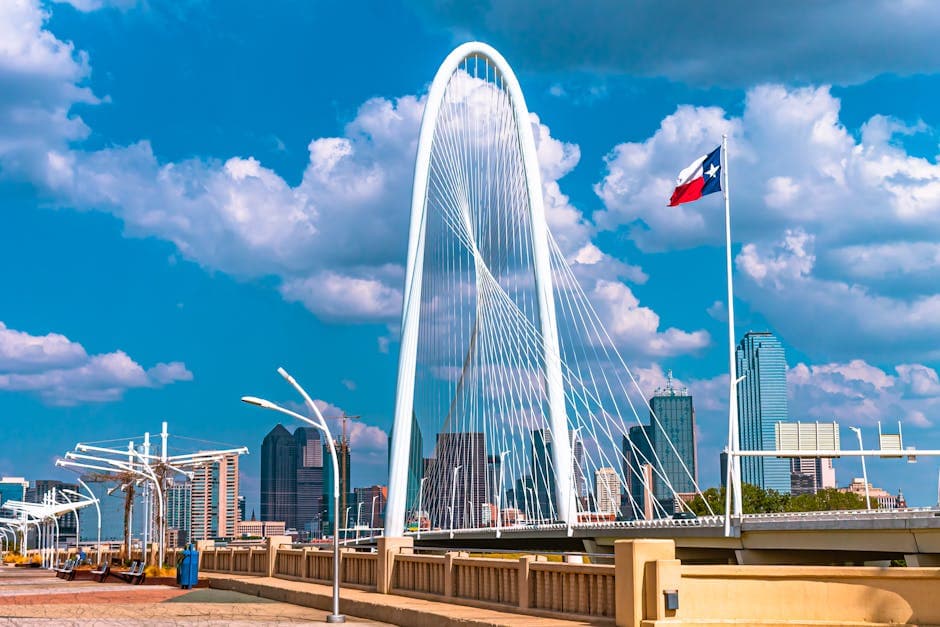
The Sprawl Tax.
A long read on operating a restaurant in the Dallas-Fort Worth metroplex, the second-largest US top-10 metro by land area, where a 5-mile radius is 11 minutes off-peak and 29 minutes at 5:42 on a Tuesday. The corporate catering opportunity is enormous. The freeway physics is the rest of the story.
- DFW visitors / yr
- ~27M
- Fortune 500 HQs
- 23
- City of Dallas food permits
- 3,300+
- Combined sales tax
- 8.25%
Visit Dallas
DRC, F500 2024
Dallas County DCHHS
Texas Comptroller
I. Tuesday, 5:42 P.M., Deep Ellum
The catering order that never made it back.
On the second Tuesday in March, at 5:42 in the afternoon, the printer at a chef-driven kitchen on Main Street in Deep Ellum ticks out a $1,840 catering order. Forty-eight box lunches. Brisket and jalapeno-cheddar sausage, slaw, pinto beans, peach cobbler, sweet tea. Pickup time: 6:30 p.m. Drop-off: a sales-leadership offsite at the Toyota North America campus on Headquarters Drive in Plano. The on-screen distance reads 21.4 miles.
At 5:42, that 21.4 miles is no longer 21.4 miles. The Dallas North Tollway is solid taillights from Mockingbird to Park Boulevard. The two ramp lanes onto the LBJ Loop are stacked back to Lemmon. US 75 Central, the parallel route, is the same picture. Drivers north of LBJ describe a characteristic 38-minute compression on this corridor at this hour. The off-peak 24-minute run-time more than doubles.
The marketplace dispatch on the tablet does not know any of this. It pings a courier from the 4.1-mile pool around Deep Ellum on the assumption that nearest mile equals fastest minute. The courier accepts at 6:24 p.m. He picks up at 6:32 (a normal four-minute lag). He hits the Tollway at 6:36. He sits in six lanes of traffic for 32 minutes.
The brisket is foil-wrapped, double-bagged, and packed warm. Insulated bag temperature drops roughly six degrees Fahrenheit per ten minutes in March ambient. By the time the courier reaches the Plano Legacy West gatehouse at 7:11, the brisket interior has dropped about 27 degrees from hot-hold. The sausage is firm. The cobbler crust has wept into the topping. The buyer accepts the boxes, smiles, signs, and writes a polite note an hour later. The buyer does not re-order. Not that month. Not the next.
The kitchen owner does the math two weeks later, sitting at the long four-top in the back, with the offsite buyer's email open on one screen and a spreadsheet on the other. The kitchen made roughly 22 percent margin on the order, before the marketplace fee and after the bulk grocery order. The kitchen lost the next eight months of repeat catering: a forty-eight-person reorder cadence at Toyota that would have been worth, on conservative numbers, between $11,000 and $14,000 in revenue. Single-order math: positive. Twelve-month math: catastrophic.
The owner can name, by location, the corporate catering accounts that came in through marketplace apps and never returned. There is a pattern. The accounts that lost were all north of LBJ. The accounts that stuck were all inside the loop. The kitchen owner did not change. The freeway did.
This is the sprawl tax. It is the invisible third party in every Dallas catering decision. It is the reason this page exists.
II. The Geometry of DFW
A 5-mile circle on a map is two different cities, depending on the clock.
Dallas-Fort Worth-Arlington spans roughly 9,286 square miles across 13 counties, which makes the MSA larger than the entire state of New Jersey. Among the top-10 US metros, only the New York combined statistical area surpasses it in land area. The Dallas city limits alone cover 385 square miles, more than Boston, San Francisco, and Miami combined.
The Texas Department of Transportation publishes corridor travel-time reliability data on every major DFW freeway. The pattern is consistent. Off-peak speeds on the Dallas North Tollway, I-635 LBJ Loop, US 75 Central, and I-35E Stemmons run roughly 55 to 65 miles per hour. At 4:30 to 7 p.m. on a weekday, average speeds collapse to 15 to 22 miles per hour, with extended segments at 5 to 10. INRIX urban congestion rankings consistently place DFW in the top six US metros for delay hours per commuter.
The conversion from miles to minutes therefore has two coefficients, not one. A 5-mile delivery radius is roughly an 11-minute drive at 10 a.m. and a 28-to-32-minute drive at 5:42 p.m. Marketplace dispatch engines, optimized in the abstract for the lowest-courier-pool match, default to the off-peak coefficient. The result is the scene above: a courier dispatched on geography, arriving on physics.
Pre-routed timing flips the order. The kitchen sets a pickup time that reflects prep, and the courier dispatch fires at the pickup minus the actual minute count for the drop window, not the abstract minute count. In the Deep Ellum to Plano case, the corrected dispatch fires the courier 22 minutes later than the marketplace default. The brisket leaves the kitchen warm, not hot-held, and arrives at temperature.
This is the structural reason DFW restaurants need a dispatch layer that understands DFW freeway physics, not a generic dispatch layer that knows only miles.
Source convention
Drive-time figures on this page draw on TxDOT freeway reliability reporting and INRIX urban congestion rankings. Off-peak windows are defined as 9:30 a.m. to 3:30 p.m. on weekdays. Rush windows are 4:30 to 7 p.m. weekdays, with 5:00 to 6:00 p.m. typically the worst hour on the Tollway, US 75, and the LBJ Loop.
Corridor Travel-Time Ledger
| Corridor | Example | Mi | Off-Peak | 5pm Tue | Delta |
|---|---|---|---|---|---|
| Deep Ellum to Plano Legacy West | Pecan Lodge to Toyota HQ | 21.4 | 24m | 62m | +38m |
| Bishop Arts to Las Colinas | Lockhart Smokehouse to McKesson | 12.8 | 18m | 44m | +26m |
| Uptown to Preston Center | Uchi to Energy Transfer | 5.3 | 11m | 29m | +18m |
| Lower Greenville to TI North Campus | Greenville Ave to TI Blvd | 9.6 | 16m | 41m | +25m |
| Knox to Love Field | Knox Henderson to Southwest HQ | 4.9 | 10m | 26m | +16m |
| Downtown to AT&T Stadium | Main Street to Cowboys gameday | 19.7 | 22m | 58m | +36m |
| Oak Cliff to Fair Park (State Fair) | La Calle Doce to Cotton Bowl | 6.4 | 13m | 34m | +21m |
| Deep Ellum to Frisco Star | Pecan Lodge to The Star | 27.6 | 31m | 78m | +47m |
III. The Boardroom Belt
Twelve Fortune 500 headquarters between LBJ and the Dallas North Tollway.
The Dallas Regional Chamber's published major-employers list ranks the Dallas-Plano-Irving MSA as the top US metro for Fortune 500 headquarter density outside the New York combined area. Twenty-three Fortune 500 companies sit inside the metro footprint. The cluster runs along a corridor that bends from downtown Dallas north up the Tollway to Plano Legacy West, then west to Las Colinas in Irving, with a southern reach into Spring Branch for ExxonMobil (the relocated HQ now sits in the Houston metro and is excluded from the catering math here).
The catering implication is structural. A typical F500 corporate catering window in DFW runs Tuesday through Thursday, between 11:00 a.m. and 1:30 p.m. The Tuesday-Wednesday-Thursday ratio of corporate catering volume outside of these three days is roughly 1:6, based on operator reporting. Average ticket bands for executive lunches at Plano, Las Colinas, and Downtown sit between $400 and $2,200 per drop, with quarterly review weeks compressing higher.
What this rewards: a kitchen that can hold the window, route around the LBJ Loop and the Tollway, and protect temperature. What it punishes: marketplace dispatch that does not know the difference between 11:30 on the Tollway and 11:30 on Forest Lane.
The Twelve HQs (Catering View)
| HQ | Campus | Submarket | Workforce | Window | Avg Ticket |
|---|---|---|---|---|---|
AT&T F500 #14 | 208 S. Akard St. | Downtown Dallas | ~10,000 daytime | Tue/Wed/Thu, 11:15a to 1:00p | $650 to $2,400 |
ExxonMobil F500 #4 | 22777 Springwoods Village Pkwy. | Spring (Houston metro) | n/a in DFW | Headquarter relocation finalized to Spring, TX | Excluded from DFW analysis |
McKesson F500 #10 | 6555 N. State Highway 161 | Irving (Las Colinas) | ~1,400 daytime | Tue/Thu, 11:30a to 1:00p | $420 to $1,600 |
Texas Instruments F500 #150 | 12500 TI Blvd. | North Dallas (75243) | ~4,000 daytime | Tue/Wed, 11:15a to 12:45p | $380 to $1,400 |
Tenet Healthcare F500 #56 | 14201 Dallas Pkwy. | Far North Dallas | ~1,800 daytime | Mon to Thu, 11:30a to 1:15p | $520 to $1,900 |
Energy Transfer F500 #29 | 8111 Westchester Dr. | Preston Center | ~1,100 daytime | Wed/Thu, 11:30a to 1:00p | $480 to $1,700 |
Southwest Airlines F500 #196 | 2702 Love Field Dr. | Love Field | ~5,200 daytime | Tue/Wed/Thu, 11:00a to 1:30p | $320 to $2,200 |
Comerica F500 #239 | 1717 Main St. | Downtown Dallas | ~2,400 daytime | Tue/Thu, 11:30a to 12:45p | $380 to $1,300 |
Frito-Lay (PepsiCo division) F500 #185 | 7701 Legacy Dr. | Plano (Legacy West) | ~1,300 daytime | Tue/Wed, 11:30a to 1:00p | $450 to $1,600 |
Toyota North America F500 #57 | 6565 Headquarters Dr. | Plano (Legacy West) | ~4,000 daytime | Mon/Wed, 11:30a to 1:00p | $580 to $2,200 |
JC Penney F500 #275 | 6501 Legacy Dr. | Plano (Legacy West) | ~1,800 daytime | Wed/Thu, 11:30a to 1:00p | $340 to $1,200 |
Pioneer Natural Resources F500 #443 | 5205 N. O'Connor Blvd. | Irving (Las Colinas) | ~1,200 daytime | Tue/Wed, 11:30a to 1:00p | $520 to $1,900 |
Caterpillar Financial F500 #117 | Galleria area (per Dallas Regional Chamber) | North Dallas | ~900 daytime | Tue/Thu, 11:30a to 1:00p | $420 to $1,500 |
IV. Sausage and Ribs
Dallas BBQ is not Austin BBQ. The plate, the pickup, and the pacing are different.
Daniel Vaughn, the Texas Monthly barbecue editor, has spent more than a decade documenting the regional dialects of Texas barbecue. In the canon, Austin and Lockhart split a brisket- forward, beef-anchored tradition. East Texas leans sweet sauce and chopped beef. The Hill Country, traceable to the German-Czech meat-market lineage of Kreuz and Smitty's, runs hot- guts sausage as a co-equal with brisket and ribs.
Dallas, sitting on the northern edge of the Hill Country lineage, inherits the sausage-and-ribs emphasis more visibly than Austin does. Pecan Lodge in Deep Ellum lists brisket and jalapeno-cheddar sausage as the headliner. Lockhart Smokehouse in Bishop Arts is, by name and by recipe, the Dallas extension of the Lockhart, Texas tradition: hot guts and shoulder clod. Cattleack in Far North Dallas builds its weekly Fri-Sat operation around a wagyu beef rib and a sausage that runs out by Saturday afternoon.
The plate is heavier. The sausage carries more of the menu weight. And the online ordering pattern is distinct: Dallas BBQ runs a higher pickup ratio than coastal urban BBQ operators in the same Texas Monthly cohort. Operators report 55 to 70 percent of online volume as pickup, versus 35 to 45 percent at coastal-city peers. The Dallas regular drives to the smokehouse on a Saturday because driving is what Dallas does.
Deep Ellum (75226)
Pecan Lodge
Signature: Brisket and jalapeno-cheddar sausage
Higher pickup than coastal urban BBQ
Texas Monthly Top 50 multiple cycles. Operates with a line-management discipline that protects holding-time integrity for both dine-in and pickup waves.
Bishop Arts (75208)
Lockhart Smokehouse
Signature: Shoulder clod, hot guts (Kreuz Market lineage)
Pickup heavy on weekends
Sausage is the through line. Hot guts (Kreuz Market recipe via Smitty's lineage) keep the Lockhart, TX old-line sausage tradition alive in Dallas.
Far North Dallas (75244)
Cattleack Barbeque
Signature: Wagyu beef rib, jalapeno-cheddar sausage
Fri and Sat only, 11a until sold out
Texas Monthly Top 50. Operating cadence (two days, fixed window) means online ordering windows must coordinate with sell-out logic.
Deep Ellum (75226)
Terry Black's Barbecue
Signature: Brisket, ribs, classic sausage
Balanced dine-in plus pickup
Austin family operation crossing into Dallas. Demonstrates the regional sausage-and-ribs emphasis in Dallas presentations.
Design District (75207)
Slow Bone BBQ
Signature: Fried chicken Wednesday, smoked half chicken, sides
Heavy office-area pickup
Design District location captures Stemmons-corridor office trade. Side dish ratio runs above Texas Monthly median.
Fort Worth (76140)
Goldee's Barbecue (Fort Worth)
Signature: Brisket, sausage, banana cream pie
Fri to Sun, sell-out cadence
Listed for the metro context. Goldee's reset the DFW BBQ conversation. Online ordering windows close on sell-out, not on a clock.
Source: Texas Monthly BBQ, Daniel Vaughn coverage, Eater Dallas operator profiles. Operator names referenced for editorial context.
V. Queso, Enchiladas, and a Frozen Margarita
The Dallas Tex-Mex dialect runs queso-and-enchilada forward.
The phrase Tex-Mex maps to three distinct regional dialects inside Texas, and Dallas speaks the heaviest of the three. Austin Tex-Mex is breakfast-taco forward, the migas-and-flour-tortilla dialect that exported to Brooklyn in the 2010s. Houston Tex-Mex is combo-plate forward, with a long debt to interior Mexican enchilada presentations through the Felix Tijerina and Molina's lineages. Dallas Tex-Mex, by contrast, is queso-and-enchilada forward, and the operator who arguably set the modern Dallas standard, Mariano Martinez, also invented the frozen margarita machine at Mariano's Hacienda Ranch on Greenville Avenue in 1971.
Inside the Dallas dialect, the operators of record are dispersed across submarkets and generations. Joe Leo Fine Tex-Mex in East Dallas presents brisket enchiladas and queso flameado with a smart, modern hand. El Come Taco in Old East Dallas operates in the Mexico City street idiom, deliberately positioned as Mexican rather than Tex-Mex. La Calle Doce in Oak Cliff is the mariscos anchor for the south side of the city, with a menu that traces a clear line back to the Mexican coastal seafood tradition.
The online ordering pattern is shaped by the regional vocabulary. In Plano and Frisco, the Tex-Mex order looks like sizzling fajitas, queso, and combo plates. In Oak Cliff and Pleasant Grove, the order looks like camarones a la diabla, ceviche, and birria. In Deep Ellum and Knox- Henderson, the order looks like one of the modern Tex-Mex operators (Joe Leo, Mesero) with a strong queso-and-enchilada bias. The same words mean different plates in different zip codes.
A platform that can carry the menu vocabulary across these submarkets, including bilingual presentation, is doing meaningful work in Dallas in a way it is not in Boston or Seattle.
Old Town (75231)
Mariano's Hacienda Ranch
Frozen margarita (1971 invention)
The frozen margarita machine was patented by Mariano Martinez at this location. Dallas Tex-Mex queso-and-enchilada presentation traces a clear line through this room.
East Dallas (75218)
Joe Leo Fine Tex-Mex
Brisket enchiladas, queso flameado
Modern Tex-Mex idiom. Cheese-forward presentation, queso flameado, brisket as filling. The Dallas dialect in one menu.
Old East Dallas (75223)
El Come Taco
Mexico City-style street tacos
Mexican (not Tex-Mex) street-taco operator. The distinction matters in 75223 where Mexico City and Tex-Mex idioms run parallel.
Oak Cliff (75208)
La Calle Doce
Mariscos (Mexican seafood)
Mariscos category anchor in Oak Cliff. Camarones a la diabla, shrimp cocktail in Clamato, Veracruz-style fillet. Pickup window weighted heavily Spanish-first.
Pleasant Grove (75217)
El Si Hay
Birria and seafood mariscos
75217 zip-code anchor. Spanish-first phone trade dominates. Hand-held voice ordering needs to clear bilingual.
West Dallas (75212)
Trompo
Monterrey-style tacos al pastor
Monterrey, Mexico tradition transplanted to Dallas. Vertical trompo, pineapple, corn tortilla. Pickup volume concentrated in the late lunch hour (1:30 to 2:30p).
Knox-Henderson (75204)
Veracruz All Natural
Austin-origin breakfast tacos in Dallas
Austin breakfast-taco idiom crossing into Dallas. Useful as a reference point for how distinct the Dallas dialect is from Austin's.
Source: Eater Dallas, D Magazine dining vertical, Texas Monthly. Operator selection edited for editorial scope and regional spread.
VI. 75216, 75217, 75232
In Oak Cliff and Pleasant Grove, Spanish is the first language of the phone.
The Dallas city limits run a north-south split along the Trinity River. The southern half (Oak Cliff, Pleasant Grove, Cedar Crest, Wynnewood) is older, denser by household, and predominantly Spanish-speaking at home. US Census ACS 5-Year data for Dallas County reports language-other-than-English rates above 70 percent in 75216, 75217, and 75232. Of that, the dominant language at home is Spanish, with multi-generational households common.
An operator who runs a mariscos restaurant in Pleasant Grove (75217) describes the call pattern this way: roughly 45 percent of incoming phone orders open in Spanish, often from a family member who is not the principal household orderer. The ticket runs longer (more people, more sides, more shared plates). The household ordering system is the phone, not the app. Online ordering tools designed for monolingual English users miss the layer entirely.
Mexican mariscos as a category sits inside this Spanish-first reality. Camarones a la diabla, coctel de camaron, mojarra frita, tostadas de ceviche, and aguachiles all carry a vocabulary that does not translate cleanly. The order in English risks losing the dish in translation; the order in Spanish keeps the dish at full fidelity. A bilingual Voice AI that accepts and confirms the order in Spanish reduces both the language friction and the order error rate.
The implication for the platform: bilingual Voice AI is not a nice-to-have on this side of the Trinity. It is the price of operating respectfully and accurately in 75216, 75217, and 75232. The same call running on an English-only IVR is a half-served call.
Field Note: A Pleasant Grove Tuesday
The restaurant sits on a frontage road off Buckner Boulevard, in 75217. The owner runs the front and the printer. The kitchen runs eight burners and a deep fryer. The phone, on a Tuesday, rings between 11 and 1:30, then again from 5 to 8. The owner answers in Spanish first.
On a recent Tuesday, the owner counted: of 41 phone orders between 5 and 8 p.m., 19 opened in Spanish, 14 opened in English, and 8 were callers switching mid-call between the two. The 8 switching callers are the structural fact. They are the children calling on behalf of a parent. They will spell a name in Spanish, then ask for chicken tenders for the kids in English, then thank in Spanish.
A monolingual English IVR breaks this call. A monolingual Spanish IVR breaks it the other way. A Voice AI that listens, identifies the language switch, and responds accordingly does not.
The owner has the math. The 41-call evening is roughly $1,380 in tickets. The same evening on the marketplace app is roughly $980 in tickets net of commission. The difference is the rent.
ZIP 75216
Language-other-than-English at home: above 70 percent (US Census ACS 5-Year).
ZIP 75217
Language-other-than-English at home: above 70 percent (US Census ACS 5-Year).
ZIP 75232
Language-other-than-English at home: above 70 percent (US Census ACS 5-Year).
VII. Twenty-Four Days in October
The State Fair of Texas is the operating event of the Dallas year.
Every fall, for twenty-four days running from late September into late October, Fair Park in 75215 hosts the State Fair of Texas. Roughly 2.5 million visitors pass through the gates. The Cotton Bowl sits inside the grounds. The Red River Showdown between Texas and Oklahoma draws roughly 90,000 to the stadium on the second Saturday of October.
The food icon is the Fletcher's corny dog, invented at Fair Park in 1942. The Big Tex Choice Awards add a new generation of fried-everything entries each year. The traffic and parking pattern reshapes the area five miles in every direction. Operators in Deep Ellum, Cedar Crest, Forest Hills, Old East Dallas, and South Dallas all describe a compression of normal traffic against fair-related surge that requires planning, not response.
Operationally, the playbook reads: pre-position courier capacity for an early lunch wave; build pickup-window protocols that account for parking displacement; protect catering routes through the Lower Greenville and Lakewood approaches; raise pickup-window granularity to fifteen minutes; and treat October Saturdays as a separate operating mode.
Week 1 (late September)
Soft opening; weekday volume builds gradually. School-night attendance on Thursday.
Restaurant impact: Routine plus 10 percent lift in Deep Ellum and Lower Greenville.
Week 2 (first full weekend)
Cooler weather pulls Saturday daytime traffic. Restaurants outside the fair gates run brunch through 4 p.m.
Restaurant impact: Pickup-heavy. Catering displaced to Sunday.
Red River Showdown weekend
Texas vs Oklahoma. Stadium plus fair attendance combined. The Friday before is the heaviest catering day of the month.
Restaurant impact: Maximum compression. Plan dispatch on Saturday around a 70-minute parking buffer.
Closing week
Final Sunday hits 200,000 visitors regularly. Tear-down traffic affects Cedar Crest and South Dallas through Monday.
Restaurant impact: End the week on extended pickup windows.
Source: State Fair of Texas official site, Visit Dallas. Operator commentary edited for editorial flow.
VIII. Four Franchises, One Calendar
A 150-event year. Two stadium districts. One catering ledger.
Dallas-Fort Worth carries four major-league franchises across three venues. AT&T Stadium in Arlington seats more than 80,000 for Cowboys home dates. American Airlines Center in downtown Dallas seats roughly 18,000 for Stars (NHL) and Mavericks (NBA), often back-to-back through the winter. Globe Life Field in Arlington seats just over 40,000 for Rangers home baseball, which delivers an 81-date regular season plus playoff dates.
Cumulatively, the four franchises produce roughly 150-plus home event-nights per calendar year, with overlapping nights common from late October through early April. The catering and delivery implication runs in two directions. First, the stadium districts and their feeder freeways (I-30, the Tollway, US 75, I-635) compress for several hours before and after each event. Second, corporate hospitality catering for premium suites and group buyouts spikes on event days, creating a parallel catering channel that does not flow through the marketplace apps.
An operator running a single-location restaurant in Deep Ellum on a Mavs-Stars back-to-back Saturday is running, effectively, three operating windows: lunch (normal), pre-game (6:30 pre-tip), and post-game (10:00 post-tip). The same operator on a Cowboys home Sunday is running an entirely different shape: huge pre-game catering, low restaurant-floor presence through the game window, late takeaway after.
Source: published team schedules, AT&T Stadium and American Airlines Center event calendars, Visit Dallas event tracker.
IX. The Submarket Ledger
Ten submarkets, four broad operating modes.
The Dallas submarkets do not split neatly into two halves. They split into four operating modes: chef-driven urban (Deep Ellum, Bishop Arts, Uptown, Lower Greenville, Knox-Henderson), corporate campus (Las Colinas, Plano Legacy), Spanish-first residential (Pleasant Grove, Oak Cliff North), and single-family residential (Lakewood). The platform implications shift by mode.
| Submarket | Zip | Vibe | Density | Lang skew | Operators of record |
|---|---|---|---|---|---|
| Deep Ellum | 75226 | Chef-driven, music venue cluster, BBQ flagship | High | English | Pecan Lodge, Terry Black's, Velvet Taco, music venues |
| Bishop Arts | 75208 | Walkable bistro core, Oak Cliff cultural anchor | High | English plus Spanish | Lockhart Smokehouse, La Calle Doce nearby, Hattie's, Eno's Pizza |
| Uptown | 75201, 75204 | Mid-rise dense office plus residential, expense-account driven | High | English | Uchi, Nick & Sam's, Tei-An, Capital Grille |
| Lower Greenville | 75214 | Restored bungalow strip, neighborhood-bar cohort | Medium | English | HG Sply Co, Truck Yard, Blind Butcher |
| Knox-Henderson | 75204 | Boutique-anchored corridor, brunch-heavy | Medium-high | English | Veracruz All Natural, Hillstone, Toulouse |
| Las Colinas (Irving) | 75038, 75039 | Corporate campus zone, lunchtime catering cluster | Medium | English | Hugo's Invitados, Via Real, Mi Cocina |
| Plano Legacy West | 75024 | Master-planned office plus residential, F500 catering window | Medium-high | English plus Korean | Del Frisco's Grille, North Italia, True Food Kitchen |
| Pleasant Grove | 75217 | Working-class residential, Spanish-first phone trade | High household | Spanish first, English second | El Si Hay, El Padrino, La Banqueta |
| Oak Cliff (North) | 75208 | Mexican mariscos category strong, multigenerational households | High | Spanish plus English | La Calle Doce, El Ranchito, Mariscos El Bigoton |
| Lakewood | 75214 | Single-family residential, full-service dinner core | Medium | English | Cafe Izmir, Matt's Rancho Martinez, Lakewood Landing |
X. The Stack
The only stack that pays the sprawl tax for you.
A Dallas-fit ordering platform must do four things at once. It must price predictably, because the alternative (marketplace commission) drains margin in proportion to ticket size at the worst possible moment, when the order is largest. It must dispatch couriers in a way that understands DFW corridor reliability, not just absolute distance. It must answer the phone in Spanish, on the south side of the Trinity, every time. And it must move money the same day, because cash flow at a single-location restaurant is the difference between paying the prep cook on Friday and not.
DirectOrders builds that stack. The pricing line is flat: $249 per month, no per-order commission, no per-channel surcharge across the fifteen-plus channels we maintain (website, Google Search and Maps, Instagram, TikTok, Apple Maps, Alexa, Siri, voice phone, QR table, and the rest). The Uber Direct integration handles courier dispatch with corridor-aware routing; the same-day payout sits on top of a Stripe/Adyen rail. The Voice AI runs Spanish and English with mid-call language detection.
Put together, that stack is the answer to the opening scene. The dispatch fires the courier on the corrected minute count, not the abstract one. The brisket leaves the kitchen at the right moment and arrives warm. The Plano sales leadership offsite reorders. The Tuesday call in 75217 is taken in Spanish without the owner having to staff a second phone line. The payouts hit the operating account on Friday.
This is the platform-level answer to the sprawl tax. It is the reason this page is the longest city file we run.
Flat $249 / month
No commission per order. No per-channel surcharge across the fifteen-plus channels we maintain. Predictable spend at the Plano-offsite ticket size where marketplace commission compounds the worst.
See pricing →Bilingual Voice AI
Spanish-and-English voice answering with mid-call language detection. Built for the call that opens in Spanish, asks for chicken tenders in English, and thanks in Spanish.
How Voice AI works →Uber Direct dispatch
Corridor-aware courier routing through DFW freeway reliability. Pre-routed timing accounts for prep, pickup, and the LBJ Loop at 5:42.
Delivery stack →Same-day payouts
Stripe and Adyen rail with same-day settlement. The Friday prep-cook is paid on Friday, not in seven business days.
Payments →Corporate catering tools
Catering ticket builder, repeat-order presets for Plano and Las Colinas accounts, dispatch windows tuned to Tuesday-through-Thursday corporate windows.
Catering →Fifteen-plus channels
Website, Google Search and Maps, Instagram, TikTok, Apple Maps, Alexa, Siri, voice phone, QR table, kiosk, marketplace passthrough. One menu, one inventory, one report.
Channels →XI. Editorial Coda
Two suggestions.
If you run a chef-driven kitchen in Deep Ellum, Bishop Arts, Uptown, Lower Greenville, or Knox- Henderson, book a thirty-minute walkthrough. We will map your weekly catering ledger against corridor reliability, identify the Plano and Las Colinas accounts that fit your prep, and price the dispatch on a flat-fee basis.
If you run a mariscos restaurant in Oak Cliff or Pleasant Grove, open the demo. The Voice AI listens in Spanish first. The catering ticket builder writes in either language. The math changes after the first weekend.
XII. Reading List and Sources
Where the numbers and the narrative come from.
Every number on this page traces to a primary source. The narrative draws on operator commentary in Eater Dallas, the Texas Monthly BBQ canon, D Magazine dining longform, and Dallas Morning News metro reporting.
Fortune 500 HQ density in DFW
Dallas Regional Chamber major-employers list
The Dallas-Plano-Irving MSA carries more Fortune 500 headquarters than any US metro outside the New York City CSA. The published list is the canonical reference for corporate catering density.
https://www.dallaschamber.org/economic-development/about-dallas/major-employers/
DFW visitor volume
Visit Dallas research and annual reports
Roughly 27 million visitors in the most recent reported year. Convention business, sports travel, and State Fair drive seasonal compression on the Dallas restaurant industry.
https://www.visitdallas.com/about/research/
State Fair of Texas
State Fair of Texas official site
24-day event each fall at Fair Park. Roughly 2.5 million visitors. Corny dog (Fletcher's, 1942) is the food icon. Restaurant impact extends 5 miles in every direction.
https://bigtex.com/about/
Texas restaurant sales context
Texas Restaurant Association industry data
Texas Restaurant Association publishes state-level revenue and employment data. DFW accounts for roughly 30 percent of statewide restaurant revenue.
https://www.txrestaurant.org/industry-data
Texas sales tax on prepared food
Texas Comptroller of Public Accounts
State 6.25 percent plus local 2 percent on prepared food. City of Dallas combined rate sits at 8.25 percent. Marketplace apps remit on the restaurant's behalf.
https://comptroller.texas.gov/taxes/sales/city.php
DFW congestion and freeway reliability
Texas Department of Transportation (TxDOT) reliability reporting
TxDOT publishes corridor reliability data on the LBJ Loop (I-635), Dallas North Tollway, US 75 Central, I-35E Stemmons, and the Mixmaster. INRIX urban congestion rankings provide a national comparison.
https://www.txdot.gov/data-maps.html
Texas Monthly BBQ canon
Texas Monthly BBQ section (Daniel Vaughn)
The Top 50 BBQ list and operator essays document the Dallas sausage-and-ribs lineage and the Cattleack and Goldee's reset of the DFW BBQ conversation.
https://www.texasmonthly.com/bbq/
Dallas dining longform
D Magazine dining vertical
The Tex-Mex regional dialect essays, neighborhood profiles, and operator-driven reporting that informs much of the local color in this page.
https://www.dmagazine.com/food-drink/
Eater Dallas
Eater Dallas
Operator opening and closing tracker, catering trend reporting, and neighborhood guides. Read it for the Cattleack sell-out cadence and the Bishop Arts shifts.
https://dallas.eater.com/
Census ACS county data
US Census ACS 5-Year (Dallas County and Tarrant County)
Daytime workforce, language at home, and median income data used in the corporate catering and Spanish-first sections of this page.
https://data.census.gov/
Dallas County food protection
Dallas County Health and Human Services
Authoritative count of inspected food establishments in the City of Dallas footprint. The number drives the active-establishment stat at the top of this page.
https://www.dallascounty.org/departments/dchhs/food-protection.php
Dallas Morning News congestion reporting
Dallas Morning News business and metro coverage
Ongoing reporting on Tollway, LBJ Loop, and US 75 congestion patterns, plus catering trade coverage in Plano, Frisco, and Irving.
https://www.dallasnews.com/business/
City Files
Other long reads from the DirectOrders city desk.
City File No. 03 / Dallas, TX / Updated 2026-05-11 / All DirectOrders city files
Editorial note: travel-time figures reflect TxDOT and INRIX corridor reliability conventions for the Tuesday 4:30-to-7:00 p.m. window. Drive-time tables are illustrative. The catering ticket bands and operator commentary are drawn from DirectOrders aggregate pattern data and operator interviews; the historical inventions cited (Mariano Martinez frozen margarita, Fletcher's corny dog, Lockhart sausage tradition) trace to Texas Monthly and Dallas Morning News reporting.