Columbia, South Carolina / Dispatch
Soda City and the Capital
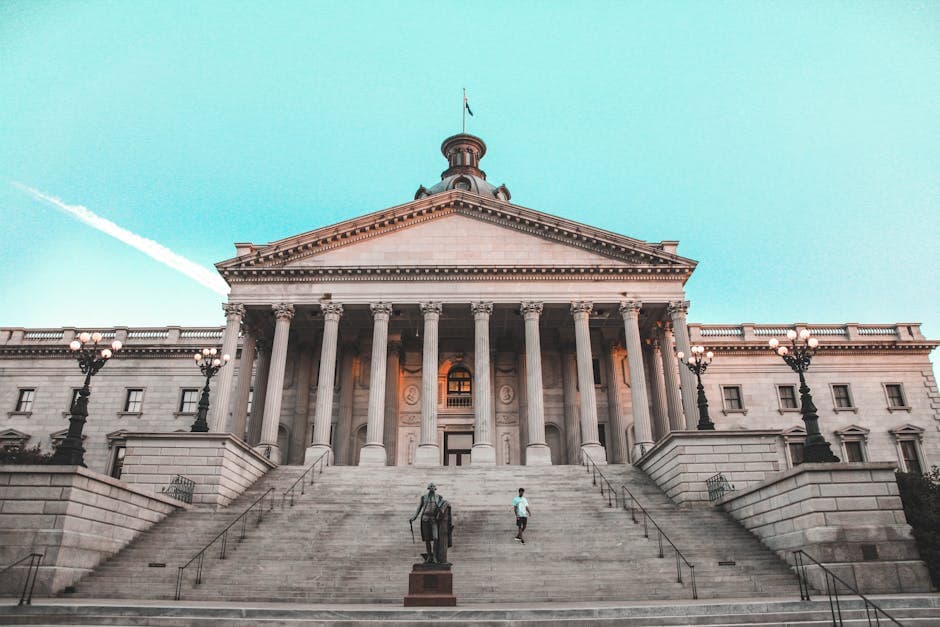
Three engines run this city: a stadium that holds eighty thousand on a Saturday, an Army base that graduates a trainee every few minutes of the year, and the State House that pays the weekday lunch tab. This is a dispatch about how Columbia restaurants operate inside that triangle.
Dispatch one / Opening scene
Saturday morning on the 1600 block of Main Street
Seven-fifty on a Saturday morning in late April. The 1500 block of Main Street is already half assembled. A produce farmer from Lexington County is unfolding a canvas over crates of strawberries and the first of the year's tomatoes. Two blocks north a tamale operator is firing up a steamer at her stall in front of an empty office building. The first food trucks are rolling in from Two Notch Road and Forest Drive. By nine the entire four-block stretch from Lady Street up to Blanding will be Soda City Market: roughly one hundred and fifty vendors, a few thousand walkers in the first hour, the State House dome visible at the south end of the spine and the Capitol corridor heading north past the market into the Vista's edge.
Columbia is a city with a nickname that confuses everyone who has never lived here. Soda City has nothing to do with soft drinks. It traces to an old shorthand for Columbia: COLA, which somebody once spelled out and the joke stuck. The market took the nickname and made it the name. The market itself is the most visible Saturday spine downtown, but it is one of three or four economic engines that actually run the city, and the dispatch you are reading is about all of them.
The three engines are USC Gamecocks football at Williams-Brice Stadium, Fort Jackson basic training graduations, and the State House government economy. Each one is its own calendar. Each one reshapes restaurant operations across the metro in its own way. The Vista's chef-driven kitchens, Five Points's USC-adjacent late-night, Devine Street's neighborhood family spine, Forest Acres's Fort Jackson catering corridor, the Bull Street District's brewery-and-baseball events, and the downtown Main Street spine that hosts the market on Saturday and the State House lunch crowd Monday through Friday, all of them run on a different mix of the same three engines.
For Margaret, who we will call composite (because the operator we are describing is composite, but every detail of her week is drawn from real Columbia interviews), Saturday morning starts at the market with two of her cooks running a stall on the 1600 block. She sells biscuit sandwiches and slow-stewed grits from a folding table for four hours. The stall does roughly twelve hundred dollars on a good Saturday. The bigger economics live elsewhere. The brick-and-mortar location she runs on Devine Street is booked for two Fort Jackson graduation lunches on Friday and three USC tailgate catering orders on Saturday. Combined the off-Main brick-and-mortar work clears ten times what the market stall does.
That ratio is the puzzle this dispatch is about. The market is the visible spine of downtown Columbia. The money that actually keeps Margaret's lights on is downstream of three other calendars she did not write and cannot change. The platform that fits her business has to fit all four.
The market is the picture. The graduations and the home games are the rent.
Dispatch two / Williams-Brice
Eighty thousand on a Saturday
USC Gamecocks home football at Williams-Brice Stadium is the largest single recurring event in Columbia. The stadium seats roughly eighty thousand and routinely sells out for SEC home games. The football calendar runs late August through November and reshapes catering operations across the Vista, Five Points, Devine Street, and the State Fairgrounds tailgate lots for thirteen weeks.
Twelve weeks
Williams-Brice Stadium and the Gamecocks calendar
Relative catering and reservation weight across a sample USC home schedule. Williams-Brice seats roughly eighty thousand and the stadium routinely sells out for SEC home games. Conference home weekends produce the catering ceilings; rivalry games and Homecoming sit at the top of the year.
Non-conference (home opener)
Late August. Move-in week at USC. Heat index above 95.
Tailgate kits dominate. Heat-tolerant menus, cold soups, frozen lemonade. Five Points bars open at 9am.
Power conference home
Labor Day weekend overlap in most years.
Volume peak for early-season catering. Devine Street family clubs hit capacity by Friday night.
Away SEC
Away travel. Crowds shift to Vista sports bars.
Vista watch-party catering for office and family groups. Less tailgate, more living room.
SEC home
First conference home game.
Annual catering peak for many operators. Wing trays, BBQ platters, and slider boxes book out by Tuesday.
Open week
Bye week or non-conference filler.
Operators reset inventory. Family weekends at Fort Jackson take some of the slack.
SEC home (rivalry adjacent)
October. Cooler weather, fall colors at Riverbanks.
Tailgate weather is finally tolerable. Family-style catering scales up. Vista brunch crowds expand.
Away SEC
Travel game, often a marquee road matchup.
Bar-and-grill catering surges. State Fair (mid-October) overlaps in most years.
SEC home + Homecoming
Homecoming weekend. Alumni events Thursday through Sunday.
Catering volume rivals the conference home peak. Reunion-class dinners book Friday and Saturday night.
Away SEC
Late October. Bowl-game positioning matters.
Watch-party orders shift to Vista and Forest Acres family rooms.
SEC home
November. Cool nights. Holiday catering inquiries begin.
BBQ surges. Hash-and-rice and pulled-pork platters dominate the tailgate.
Rivalry away (Clemson alternate years)
Late November Palmetto Bowl alternates Columbia / Clemson.
Family living-room catering. Wings, dips, and sides scale up across the metro.
Rivalry home (Clemson alternate years)
Late November. The single biggest game of the calendar in Columbia years.
Annual ceiling. Catering inquiries close two weeks out. Hotels at 100 percent occupancy across the metro.
Williams-Brice Stadium sits on Bluff Road, south of the USC campus, between Rosewood Drive and the South Carolina State Fairgrounds. The stadium opened in 1934 as Carolina Stadium, was renamed in 1972 after a benefactor, and has been expanded multiple times to its current capacity of eighty thousand two hundred and fifty. The Gamecocks play seven or eight home games a season. Every one of them sells out when the SEC schedule turns over.
The catering arithmetic is unlike anything else in the city's calendar. A conference home game in October produces tailgate demand that runs from Friday afternoon through Sunday brunch. The Fairgrounds parking lots open Friday at noon and fill by kickoff Saturday. Tailgate catering, the platters and slider boxes and wing trays and BBQ pans that operators in the Vista, Forest Acres, and Devine Street prep on Thursday night, is effectively a parallel restaurant operation. Some operators clear more revenue on game-day catering across six home Saturdays than they clear on regular dinner service across twenty weekdays.
The Vista runs the post-game economy. The Vista, formally the Congaree Vista, is the warehouse district along Gervais and Lady Streets between Assembly and the Congaree River. Chef-driven restaurants line the corridor: Motor Supply on Gervais, Bourbon on the corner of Lincoln, Hampton Street Vineyard, Pearlz Oyster Bar, and the bars along Lady Street feed everyone who is not tailgating. Reservations after a noon kickoff book three weeks out. Walk-in waits stretch to two hours by five in the afternoon. The host stand is the bottleneck.
Five Points runs the night. Five Points is the historic commercial intersection where Harden, Devine, Blossom, Greene, and Saluda meet, immediately south of USC's campus. The bar density per block is the highest in the metro. On a home Saturday night the entire district turns over to student crowds, alumni returning to old haunts, and the fraternity-sorority circuit. Pawleys Front Porch, Salty Nut, Yesterday's, and the late-night pizza-and-pita spots run at capacity from eight in the evening past last call.
Devine Street and Forest Acres take the next morning. Sunday brunch after a Gamecocks home win is, for many operators, the single highest-revenue brunch service of the year. Families staying at downtown hotels migrate east on Devine. Forest Acres residents wake up the morning after and book their neighborhood spots for ten-thirty seatings that fill by eleven-fifteen. Combine the Saturday tailgate, the Saturday night Five Points spillover, and the Sunday brunch wave and a single home weekend is effectively a three-day operational sprint.
The platform implication is two-fold. First, the catering inquiry desk has to capture the inbound on Monday and Tuesday of game week, because by Wednesday the kitchen is already prepping and a missed call becomes a lost ticket. Second, the direct-ordering site has to hold up during the tailgate window itself, when pickup volume can run five to eight times the operator's weekday lunch rush. A platform that charges percentage commissions takes the largest cut on precisely those weeks the operator is working hardest. A flat monthly fee aligns the cost with average volume and hands the operator the upside on the peak.
And then there is the rivalry. The Palmetto Bowl, USC versus Clemson, alternates between Columbia and Clemson in late November. In the years it lands at Williams-Brice, the catering ceiling lifts beyond any other game on the calendar. Hotels at full occupancy across the metro. Restaurants booking four weeks out. The platform shape that fits this week of the year is the platform shape that fits the entire fall.
Dispatch three / Fort Jackson
Fifty thousand trainees a year
Fort Jackson is the largest US Army Initial Entry Training installation in the country. Approximately fifty thousand soldiers graduate Basic Combat Training there every year. The training cycle runs nine to ten weeks per cohort, and every cycle ends in a Family Day and Graduation Day weekend that produces the highest non-football catering surge in the Columbia calendar.
Ten weeks
The Fort Jackson basic training cycle
Visitor and family volume across a single Basic Combat Training cycle. Fort Jackson is the largest US Army Initial Entry Training installation in the country, graduating around fifty thousand soldiers per year. Family Day and Graduation Day produce the highest catering surges in the Forest Drive and Two Notch corridors.
Week 0
New recruits arrive at the Reception Battalion. No visitors. Local restaurant impact limited to drill sergeant cadre and base personnel meals.
Weeks 1-3
Total control phase. No visitors permitted. Catering inquiries from cadre families continue at baseline.
Weeks 4-6
Marksmanship training. Operators near Forest Drive begin to see uptick in inquiries from families planning trips.
Weeks 7-9
Field training. Family Day inquiries surge. Hotels on Two Notch and Decker Boulevard fill 2 to 4 weeks out.
Thursday of grad week
Families arrive Wednesday night. Restaurants near the base see a 3x to 5x catering and reservation surge.
Friday of grad week
Ceremony at Hilton Field. Post-ceremony lunch catering at Devine Street, Forest Acres, and the Vista hits annual peaks.
Sat-Sun after grad
Families stay through Sunday. Multi-generational dinners, takeout boxes for the road home. Sunday brunch hits ceiling.
Fort Jackson covers roughly fifty-two thousand acres on the east side of Columbia, between Forest Drive and Percival Road. It was established in 1917, became the Army's primary basic training installation in the post Vietnam era, and today runs roughly half of the new soldier throughput of the US Army. Fifty thousand trainees a year. That is on the order of one thousand per week, every week, with predictable seasonal peaks in early summer and late summer when high school graduates ship to training.
The training cycle is the operational variable Columbia restaurants care about. Basic Combat Training runs ten weeks. Week zero is reception. Weeks one through three are the Red phase, the so-called Total Control phase, with no outside visitors permitted. Weeks four through six are White phase, marksmanship. Weeks seven through nine are Blue phase, field training. The cycle ends with Family Day on the Thursday of graduation week and Graduation Day on the Friday at Hilton Field on base. Families arrive Wednesday night, stay through Sunday, and produce a three- to four-day catering surge that compounds across multiple overlapping cycles.
The geographic concentration is sharp. The hotels along Two Notch Road and Decker Boulevard fill two to four weeks ahead of graduations. The restaurants along Forest Drive, the Garners Ferry corridor, and the Trenholm Plaza area of Forest Acres run at peak Family Day capacity. Catering orders for graduation luncheons, multi-generational dinners on Friday night, and Sunday brunch boxes for the road home run heavy. Many operators describe Fort Jackson graduation weekends as their second economy, an entirely separate demand stream that runs independent of USC and downtown government but covers a roughly equivalent share of annual catering revenue across the year.
The platform implication is structural. Fort Jackson families are out-of-town visitors who do not know the city. They will search online for restaurants near the base, near their hotel, with good reviews and a quick way to order. If the operator does not have a clean direct-ordering site, the family defaults to a marketplace app. Every marketplace order for a Family Day group of eight is roughly thirty percent of the ticket that does not go to the operator. Multiply across two thousand graduating soldiers per cycle and roughly forty-eight cycles a year and the lost margin is not small.
A direct-ordering site that ranks well for the family search terms (which is partly what this dispatch is doing) handles the inbound before the marketplace does. A Voice AI inbound desk captures the calls that come in from out-of-town families who do not want to download yet another app. Same-day Stripe payouts give the operator cash on Monday morning to pay the line cook overtime the graduation weekend required.
Dispatch four / The market
Saturday morning on Main Street
The Soda City Market runs every Saturday from 9am to 1pm on four downtown blocks of Main Street. Approximately one hundred and fifty vendors. The market is the public face of downtown Columbia and the venue most likely to put a restaurant in front of a new customer who lives in Forest Acres, Lexington, or Lake Murray and does not otherwise come downtown.
Saturday spine
Soda City Market on Main Street
Saturday morning, 9am to 1pm, across four downtown blocks of Main Street between Lady and Blanding. Approximately one hundred and fifty vendors on a peak Saturday, mixing Lexington and Edgefield produce farms, prepared-food stalls and food trucks, craft and specialty grocers. The market sits between the State House grounds at the south end and the historic Capitol corridor heading north.
South end of the market. Anchored by produce farms from Lexington County, peach growers from Edgefield, and a long-standing fishmonger from the McClellanville fleet.
The dense prepared-food block. Tamales, breakfast sandwiches, bao, falafel, biscuits, BBQ, and the densest concentration of food trucks set up curbside.
Crafts dominate, mixed with bakeries, jams, coffee roasters, and specialty grocers. Capitol dome visible north end.
North end. Smaller crowd density. Holds the live music stage on most Saturdays and seasonal pop-ups during the State Fair shoulder weeks.
The Soda City Market organized itself out of a smaller predecessor market in 2013 and grew along the Main Street redevelopment spine that the city has been building for the last decade. The market occupies four full blocks between Lady Street and Blanding Street, sits within walking distance of the State House grounds at the south end, and brushes against the Vista's northern edge. Live music stages anchor the north end. Food trucks line the curb. Crafts and prepared food occupy the southern blocks.
For a Columbia restaurant operator, the market is two things. First, it is a discovery channel. A market stall is the cheapest way to introduce a Devine Street kitchen to a Forest Acres customer who otherwise would not drive across town. The stall is not the profit center. The stall is the advertisement that turns into a Friday-night dinner reservation two weeks later. The platform implication is that the kitchen's main site has to be findable from the market stall: a QR code on the table, a clear menu, and a way to place a delivery order for the next Friday.
Second, the market is a Saturday volume spike for any operator who runs a stall plus a brick-and-mortar. The Saturday morning catering window for the rest of downtown (the State House staff who come downtown for coffee before the market, the convention groups at hotels, the family brunch crowd) overlaps the market hours by two of the four hours. Operators who run both have to staff for parallel service. Operators who run only the brick-and-mortar have to handle the Saturday morning traffic without losing accuracy when the market crowd spills into the dining room at one-fifteen.
The Main Street spine outside market hours is a government economy. The State House grounds run roughly six city blocks south of Main Street's southern anchor. The state government workforce, plus the lobbying corps, plus the legal community orbiting the Supreme Court of South Carolina at the Calhoun-Sumter intersection, anchor weekday lunch demand from eleven-thirty through one-thirty. Tazza Kitchen, Mast General Store's food hall, Cantina 76, and the rotating cast of fast-casual operators that have opened along Main since the redevelopment took hold all run on this pattern. Monday through Thursday is the volume peak. Friday is lighter (the legislature, when in session, often adjourns Thursday). The weekend is the market on Saturday and effectively closed on Sunday.
Dispatch five / Six districts
Vista, Five Points, Devine Street, and the others
Six commercial districts handle most of the restaurant economy in metro Columbia. The Vista is the convention and chef-driven anchor. Five Points runs USC-adjacent late-night. Devine Street is the neighborhood family spine. Forest Acres feeds Fort Jackson families. Main Street ties government to the Saturday market. The Bull Street District is the youngest, redevelopment-driven, anchored by Segra Park and breweries.
Six districts
Vista, Five Points, Devine Street, and the rest
Six commercial districts plotted by late-night-to-family mix on the horizontal axis and corporate-to-neighborhood mix on the vertical. The Vista pulls convention and corporate. Five Points runs late and student-anchored. Devine Street is the family neighborhood spine. Main Street ties government weekday lunch to Saturday market crowds. Forest Acres feeds Fort Jackson families. The Bull Street District is event-driven around Segra Park.
Chef-driven dining + convention hotels
Higher ticket, expense-account share, convention catering anchors.
Motor Supply, Bourbon, Hampton Street Vineyard, Pearlz Oyster Bar
USC-adjacent late-night + neighborhood
Late-night volume, student delivery, alcohol-anchored ticket sizes.
Yesterday's, Salty Nut, Pawleys Front Porch, Pita Pit
Neighborhood chef + family
Family dinner volume, neighborhood loyalty, school-event catering.
Devine Foods, Hampton Pharmacy soda fountain, Z's Sports Cafe
Government + Soda City Market spine
Weekday lunch tied to government, Saturday market spike, Sunday off.
Tazza Kitchen, Mast General Store food hall, Cantina 76
Suburban + Fort Jackson catering corridor
Family takeout and Fort Jackson family-weekend catering.
California Dreaming, Chick-fil-A flagship, Andy's Deli
Redeveloped mixed-use, breweries + minor league baseball
Event-driven (Fireflies games, concerts), brewery taproom catering.
River Rat Brewery, Steel Hands, Segra Park concessions
The Vista (formally the Congaree Vista) redeveloped from a working warehouse district along Gervais Street and Lady Street starting in the late 1990s. Today it is the convention and chef-driven center of Columbia. Motor Supply Company Bistro, in a converted motor supply warehouse on Gervais, opened in 1989 and seeded the redevelopment. Bourbon on Lincoln, Hampton Street Vineyard, Pearlz Oyster Bar, and a rotating cast of newer chef concepts now line the corridor between Assembly and the river. Hotels along Lady Street and Gervais anchor the convention business. Friday and Saturday nights are reservation-driven. Weeknights pull from convention groups at the Marriott and the Hilton at the river end.
Five Points is older, denser, and runs on a different clock. The five-way intersection at Harden, Devine, Blossom, Greene, and Saluda sits immediately south of USC and has been the campus-adjacent commercial district for over a hundred years. The bar density is the highest in the metro. The food concepts are largely USC-adjacent: late-night pizza, pita, build-your-own bowls, breakfast spots that run on hangover economics on Sunday morning. The catering economy here is fraternity and sorority parties, USC-affiliated department events, and the bar-and-grill rotation that turns over with the academic calendar.
Devine Street, between the Five Points node and the Forest Acres line at Trenholm Road, is the family neighborhood spine. Older homes in the Shandon and Heathwood neighborhoods set the demographic mix. Restaurants here lean family, neighborhood, and school-event catering. The corridor includes a Hampton Pharmacy soda fountain that still operates lunch service, Devine Foods (a Columbia institution), and the rotating cast of independent kitchens that have replaced older diners over the last decade. The catering economy is family dinners, Heathwood Hall and Hammond School parent events, and the off-season Fort Jackson family lunches that come east along Forest Drive.
Forest Acres is the suburban anchor for the Fort Jackson catering corridor. Trenholm Plaza, the main shopping spine, sits roughly four miles from the Fort Jackson Gate One entrance. California Dreaming, Andy's Deli, and a series of chain and independent operators handle Family Day and Graduation Day overflow. The pattern is high-volume Friday dinner and Saturday lunch on graduation weekends, with quieter Tuesday and Wednesday in between cycles.
The Bull Street District is the newest. Redevelopment of the former South Carolina State Hospital grounds began in the mid-2010s. Today the district is anchored by Segra Park (home of the Columbia Fireflies, a Class A Minor League Baseball affiliate of the Kansas City Royals), River Rat Brewery, Steel Hands Brewing, and a growing cast of mixed-use tenants. The catering economy is brewery taprooms, Fireflies concession overflow, and event-driven dinners tied to the concert calendar at the Spotlight Stage. The platform shape here is event catering and pre-game group orders rather than weekday lunch.
Dispatch six / The State House
The Capitol lunch economy
Columbia is the capital of South Carolina. The State House sits at the south end of Main Street, on a twenty-acre grounds that includes the executive office complex, the legislative chambers (House and Senate), and the monument-lined plaza that anchors the city's south downtown. The legislature is in session roughly January through May each year, with budget-cycle peaks and the committee calendar reshaping weekday demand. The state workforce that surrounds the State House grounds, plus the lobbying corps that arrives during session, plus the legal community orbiting the South Carolina Supreme Court at the Calhoun-Sumter intersection, plus the agency offices spread across the downtown core, all feed a weekday lunch economy that runs the Main Street spine and bleeds into the southern Vista.
The catering pattern is structured and predictable. Committee hearings during legislative session generate lunchtime catering inquiries from lobbying groups, trade associations, and the policy organizations that operate downtown. Working lunches in legislative offices and agency conference rooms are catered Tuesday through Thursday with consistent ticket sizes. The off-session months (June through December) shift the demand to agency staff and the year-round legal community, but the lunchtime spine remains.
The operator implication is volume predictability. State House lunch catering is one of the most consistent revenue streams in the Columbia restaurant economy. A direct ordering platform that handles scheduled-pickup catering as a first-class flow, with reliable Tuesday-through-Thursday recurring orders, replaces the percentage-commission marketplace that takes a thirty percent cut on a fifteen hundred dollar boxed-lunch order for a legislative committee. Across two hundred working days a year the math compounds.
The friction operators describe is not discovery (lobbyists and agency staff know which kitchens to call). The friction is order capture. A working lunch booked at ten-thirty in the morning for noon delivery has to clear without errors and without a back-and-forth phone tag. Voice AI inbound handles the call when the host stand is buried. Online ordering with a clean schedule-ahead flow handles the recurring weekly bookings. Same-day Stripe payouts give the operator clean revenue tracking against the recurring client.
Dispatch seven / The water and the zoo
Lake Murray, the Riverwalk, and Riverbanks Zoo
Fifteen miles northwest of downtown sits Lake Murray, a fifty-thousand-acre reservoir built by South Carolina Electric and Gas in the late 1920s for hydroelectric power. Today the lake is the second-home and weekend-getaway anchor for the entire central South Carolina region. Marinas line the southeastern shore along Highway 6 and Lake Murray Boulevard. The dam at the lake's east end is the longest earthen dam in the world by some measures. The lake produces a weekend visitor wave that pulls from Columbia proper out through Lexington and Saluda counties.
The downtown Congaree Riverwalk anchors the other water economy. The Three Rivers Greenway runs along both sides of the Congaree, the Saluda, and the Broad rivers, connecting the Vista to the West Columbia side via the Gervais Street Bridge. The greenway draws cyclists, walkers, and weekend visitors year-round, with the heaviest traffic in spring and fall when the temperature cooperates. Restaurants along the Vista's river edge (Pearlz Oyster Bar, the Sticky Fingers that occupies the corner location, and the rotating cast of cafes that have anchored the river side) pull walk-up traffic from the greenway directly.
Riverbanks Zoo and Garden sits at the west end of the Riverwalk, straddling the river between Columbia and West Columbia. The zoo draws roughly one million visitors a year by most published counts, making it one of the largest attractions in the state. The zoo's events calendar (Lights Before Christmas in November and December, the Boo at the Zoo Halloween program, the spring botanical season) produces additional catering and family-restaurant traffic that concentrates around the Riverbanks Road exit from I-126 and the West Columbia side of the Gervais Street Bridge.
The tourism layer matters to operators because it is the one demand stream that runs counter-cyclical to USC and Fort Jackson. Summer months, when Williams-Brice is dark and the base running on a slower training pace, are the Lake Murray and Riverbanks peak months. Operators along the Vista's river edge, in West Columbia, and around the lake itself backfill summer revenue with the tourism economy. A direct-ordering site optimized for out-of-town families searching for restaurants near the zoo or near the marinas is the difference between catching the summer tourism dollars and losing them to a marketplace's regional ranking algorithm.
Dispatch eight / The four sauces
Carolina mustard, vinegar-pepper, and the others
South Carolina is the only state in the country with four recognized BBQ sauce traditions in active use. Columbia sits at the center of the mustard-anchored Midlands style (Carolina Gold sauce), with Lexington-style red dip to the north, Eastern NC vinegar-pepper to the east, and Pee Dee light tomato to the southeast. Local diners default to mustard. The other three are reference points.
Cut. Whole hog and pulled pork shoulder
Sauce. Yellow mustard, vinegar, brown sugar
Origin. German Lutheran settlements along the Saluda and Edisto Rivers
Near. Maurice's Piggie Park (West Columbia), Little Pigs of America
The Midlands signature. The only mustard-anchored BBQ tradition in the United States, native to the corridor around Columbia, Lexington, and Aiken. Local diners default to it.
Cut. Pork shoulder
Sauce. Tomato + vinegar + pepper
Origin. North Carolina Piedmont, Lexington corridor
Near. Drive an hour north to the NC line
The Piedmont's red-dip tradition. Crosses into the SC upstate. Columbia diners with upstate family roots ask for it explicitly.
Cut. Whole hog
Sauce. Cider vinegar + crushed red pepper, no tomato
Origin. Eastern North Carolina coastal plain
Near. Two hours east on I-95, but plates travel west to Columbia
The state's oldest tradition. The Skylight Inn USA in Ayden NC and Sam Jones BBQ hold the canonical lineage. Columbia chefs reference it on tasting menus.
Cut. Whole hog and pulled pork
Sauce. Vinegar + small amount of tomato, peppered
Origin. Pee Dee region, between the Midlands and the coast
Near. Florence, Marion, Dillon corridor
The Pee Dee transitional style. Closer to vinegar than to mustard. Operators in eastern Richland County draw on it.
South Carolina's mustard-anchored BBQ tradition is the only one of its kind in the United States, and its native ground is the Midlands corridor that runs through Columbia, Lexington, and Aiken. The sauce traces to the German Lutheran settlements that established themselves along the Saluda and Edisto Rivers in the eighteenth and nineteenth centuries. Mustard, vinegar, and brown sugar made a sauce that paired with whole hog and pulled pork shoulder in a way the tomato-based traditions elsewhere did not. The result became Columbia's BBQ identity. Maurice's Piggie Park (a regional chain founded in 1953 by Maurice Bessinger, now operated by his son Lloyd) is the most visible mustard-BBQ operator in the metro, with flagship locations in West Columbia. Little Pigs of America, Hudson's Smokehouse in Lexington, and the rotating cast of independent operators in the corridor all run mustard variants.
The Lexington-style red-dip tradition crosses in from the North Carolina Piedmont and lives at the northern edges of the metro. Operators with Piedmont roots (some in the upstate, some via family migration to Columbia) maintain it. Eastern NC vinegar-pepper is the older tradition, native to the coastal plain east of I-95, and it shows up on Columbia chef-driven menus as a reference point: the Vista's chef-driven operators will offer it as a tasting-menu nod to the Skylight Inn USA in Ayden NC and Sam Jones BBQ in Winterville NC. Pee Dee light tomato is the transitional style east of the Midlands, closer to the coast, and is served at operators in eastern Richland County.
The platform implication is mostly menu, not technology. A Columbia operator running mustard BBQ does not have to ask the customer what regional preference they want. The customer knows. The platform's job is to render the menu cleanly, take the order without back-and-forth, and route the catering pan to the family Christmas potluck in Forest Acres without losing the order. That is not a regional feature. That is the table stakes of running an ordering site. The Columbia BBQ identity, four sauces and a century-and-a-half of geographic argument, is the customer relationship the operator built. The platform is the layer that captures the order.
Dispatch nine / The tax stack
The South Carolina sales and hospitality tax close-read
South Carolina restaurant operators in Richland County carry a combined sales and hospitality tax load that runs to roughly eight percent on prepared food and beverages, before any individual municipality's additional local levies. The math, drawn from the South Carolina Department of Revenue and Richland County's local option tax authority, runs as follows. The state imposes a six percent statewide sales tax on prepared food and beverage sales. Richland County adds a one percent local transportation sales tax and, depending on the jurisdiction and current bond schedule, an additional one percent education capital improvement tax. Cities within Richland County (the City of Columbia, the City of Forest Acres, the Town of Blythewood, the Town of Eastover, the Town of Arcadia Lakes, the unincorporated areas) may add a two percent hospitality tax on prepared meals under South Carolina state authority, dedicated to tourism-related expenditures.
The combined rate at the restaurant counter, for a customer eating in or taking out, typically lands between eight and ten and a half percent depending on the exact municipal jurisdiction and the current local option tax mix. This is not the same as the property-tax burden, the corporate income tax, the unemployment insurance contribution, or any of the other state and local taxes the operator carries. This is just the customer-facing transactional tax that the POS rings up on every ticket. The operator collects it, files it, and remits it on a monthly cycle to the Department of Revenue (for state and county) and to the relevant municipal treasurer (for hospitality tax).
The platform implication is precise. A direct ordering platform that handles online orders has to compute the correct combined rate on every ticket and split the collected tax into the right buckets (state, county transportation, county education, municipal hospitality) at filing time. Marketplaces that operate as marketplace facilitators under South Carolina law assume liability for the state and county portions, but the municipal hospitality tax frequently falls outside marketplace facilitator scope and remains the operator's responsibility. The accounting cost of running multiple channels with different tax handling is non-trivial. A direct ordering platform that runs the operator's own brand, with the operator as merchant of record on Stripe, consolidates the tax handling into a single accounting workflow. That is not a small operational savings.
We do not provide tax advice. The numbers above are drawn from the published authority cited in the References block at the bottom of this dispatch. Operators should confirm the exact current rates for their specific Richland County municipality with the South Carolina Department of Revenue and their municipal finance office. The point of this dispatch is that the right platform reduces, rather than compounds, the tax-handling cost of running an online ordering channel.
Dispatch ten / The bilingual desk
English and Spanish at the inbound desk
Columbia's metro area, drawing from Richland County, Lexington County, and the inner ring of Saluda and Calhoun Counties, includes a Spanish-speaking population that, by US Census American Community Survey estimates, comprises roughly six to eight percent of households across the combined statistical area. The concentration is uneven. Spanish-language households cluster along Two Notch Road, the Decker Boulevard corridor near Fort Jackson, parts of West Columbia, and the Cayce corridor. The back-of-house labor pool across most Columbia kitchens, in line with national averages, draws heavily from Spanish-speaking line cooks who often hold cultural and language ties to the community their kitchen feeds.
The operator implication is that the inbound ordering desk has to handle Spanish without friction. A customer calling from Two Notch to place a takeout order should not have to code-switch into uncertain English to reach a host stand that has just lost the second host to the dinner rush. Voice AI inbound that natively handles English and Spanish (with structured handoff to a Spanish-speaking line cook or manager when the call requires escalation) captures orders that would otherwise be abandoned. The product cost of this feature is essentially zero. The revenue impact is real.
DirectOrders ships English and Spanish as standard languages on the Voice AI inbound desk and the customer-facing ordering site. Operators along Two Notch, in West Columbia, and on the Decker Boulevard corridor have asked for this feature directly. It is the default, not an add-on.
Dispatch eleven / The thesis
How DirectOrders fits Columbia
Three engines run the city. USC Gamecocks football at Williams-Brice puts eighty thousand people in south downtown on seven or eight Saturdays a year. Fort Jackson graduates roughly one thousand soldiers a week and fills Family Day and Graduation Day weekends across the calendar. The State House and the surrounding government workforce anchor weekday lunch on Main Street from January through May, plus year-round agency staffing. Layered on top: the Saturday Soda City Market, the Vista's chef-driven corridor, Five Points's late-night, Devine Street's neighborhood spine, Forest Acres's Fort Jackson catering cluster, the Bull Street District's redevelopment, and the counter-cyclical summer tourism from Lake Murray and Riverbanks Zoo. That is the demand shape.
The platform we built fits that shape because we built it for the operator economics, not for the city's marketing budget. The flat two-hundred-forty-nine-dollar monthly fee replaces percentage commissions on every channel: dine-in pre-order, takeout, scheduled-pickup catering, delivery via Uber Direct. Catering inquiry desk captures the Family Day and game-day inbound that the host stand cannot answer in real time. Voice AI handles the phone in English and Spanish when the line cook is plating and the kitchen is running hot. Same-day Stripe payouts hand the operator Monday morning cash for Tuesday's payroll, the linen vendor's Tuesday invoice, and the produce farmer's Wednesday pickup.
And critically: the platform is a flat cost in October (when Williams-Brice is sold out, when Fort Jackson is cycling through graduation peaks, when the State Fair is running on the Fairgrounds, when the State House lunch economy is in full session) and a flat cost in July (when the football stadium is dark, when training tempo is variable, when the legislature is gone and the agency economy is slower). The economic relationship to the calendar is correct in a way that a percentage commission can never be. The platform is paid most heavily when the kitchen is quietest. That is the structural fit for a city that runs in seasonal waves.
The local argument we owe is this: Columbia operators have built their businesses on direct relationships with wedding-planner-equivalents, with state agency catering coordinators, with Fort Jackson family liaisons, with the Vista convention coordinators, with the Devine Street school-event chairs, with the Soda City Market organizers. None of those relationships need a marketplace to introduce them. What they need is software that captures the inbound when it arrives and routes it cleanly to the kitchen. That is the platform shape that fits. That is what DirectOrders is.
At a glance
- $249 / month flat. No percentage cut on game-day tailgate catering, Family Day brunches, or State House lunch boxes.
- Catering inquiry desk. Captures Fort Jackson family inquiries and USC tailgate bookings before the line cook hears the phone ring.
- Voice AI inbound, English and Spanish. Standard on every plan. Two Notch and Decker Boulevard operators have asked for it directly.
- Uber Direct delivery. Routes Forest Acres family deliveries, Vista hotel-room delivery, Lake Murray summer house orders.
- Same-day Stripe payouts. Monday morning cash for Tuesday payroll and the produce farmer's Wednesday delivery.
- Live in 2 hours or we white-glove you for free. Columbia operators are taking orders the same afternoon they sign up.
Reading list
If you want to go deeper
Internal references for Columbia operators researching the platform, the categories above, and the comparison economics.
Resource
Direct ordering site
How the customer-facing ordering page and operator dashboard handle game-day tailgate and Family Day catering volumes.
Resource
Voice AI inbound, English + Spanish
How the phone-answering AI handles the host-stand overflow on a Williams-Brice weekend or a Fort Jackson graduation Friday.
Resource
Uber Direct delivery
Why operator-controlled delivery economics matter more than a marketplace badge for the Lake Murray summer wave.
Resource
Menu Brain
How the menu is parsed and made conversational, including mustard-BBQ and Lexington-style nomenclature.
Resource
Restaurant website
Performance-tuned ordering websites that load under a second on mobile data for the Soda City Market QR scanner.
Resource
Charleston, SC
The Lowcountry wedding-calendar dispatch. The same-state market two hours east on I-26.
Resource
Raleigh, NC
The Research Triangle dispatch. The regional neighbor with the BBQ tradition crossing the state line.
Resource
DirectOrders vs DoorDash
What the percentage commission actually costs on a Columbia game-day tailgate ticket.
Resource
Pricing
$249 / month flat. Everything in this dispatch is included.
Coda
What we owe Columbia
Software built for Columbia has to fit the city that exists. The city that exists runs on three engines: a stadium that fills eighty thousand seats on seven Saturdays a year, a base that graduates a thousand soldiers a week, and a State House that anchors weekday lunch on Main Street. Layered on top: the Saturday market, the Vista, Five Points, Devine Street, Forest Acres, Bull Street, Lake Murray, the Riverwalk, Riverbanks Zoo, and a century-and-a-half of arguments about which BBQ sauce is the real one (in Columbia, the answer is mustard).
We built the platform that fits that demand shape. Flat monthly fee. Catering inquiry desk. Voice AI in English and Spanish. Uber Direct delivery. Same-day Stripe payouts. Two-hour onboarding. The three engines told us what to build. We built it.
If you operate a restaurant in metro Columbia and you want to walk through how the platform fits your kitchen, the next step is a twenty-five-minute conversation, on Zoom or in person at your counter. We will bring the calendar. You bring the questions.
References
Sources used in this dispatch
- 01USC Gamecocks football schedule, Williams-Brice Stadium seating, attendance reports. University of South Carolina Athletics
- 02Williams-Brice Stadium 80,250 capacity and SEC home schedule. Southeastern Conference
- 03Fort Jackson Basic Combat Training cycles, Family Day, Graduation Day. Fort Jackson, US Army Training and Doctrine Command
- 04Fort Jackson as the largest US Army Initial Entry Training installation, ~50K trainees annually. US Army TRADOC public affairs
- 05Soda City Market vendor list, Saturday Main Street operations. Soda City Market
- 06Columbia tourism, downtown spine, Riverwalk, State House grounds. Experience Columbia SC
- 07Columbia population, demographics, language at home. US Census Bureau ACS 5-year estimates
- 08South Carolina state sales tax 6 percent + Richland County local option taxes. South Carolina Department of Revenue
- 09Richland County local 1 percent transportation tax and 1 percent education capital tax. Richland County Government
- 10South Carolina hospitality tax authority for restaurants and prepared food. South Carolina Municipal Association
- 11South Carolina Department of Health and Environmental Control restaurant licensing. SC DHEC Food Safety
- 12SC State House jurisdiction, executive and legislative branch directory. South Carolina State House
- 13Riverbanks Zoo and Garden visitor figures, programming calendar. Riverbanks Zoo and Garden
- 14Lake Murray tourism, marina operations, visitor draw. Lake Murray Country
- 15Columbia Fireflies minor league baseball, Segra Park, Bull Street District. Columbia Fireflies
- 16South Carolina BBQ traditions: mustard (Midlands), vinegar-pepper, light tomato, heavy tomato. South Carolina Department of Parks Recreation and Tourism
- 17SC Barbeque Association style classifications. SC Barbeque Association
- 18Devine Street and Five Points commercial district profiles. Columbia Chamber of Commerce
- 19Columbia State newspaper restaurant and football coverage. The State (Columbia)
- 20Carolina-style BBQ history, Robert Moss culinary writing. Robert Moss for Serious Eats and Charleston City Paper
Last updated 2026-05-11. Statistics are presented in good faith and drawn from the sources listed; game-day catering weights are relative directional figures informed by USC Athletics scheduling, The State newspaper coverage, and Experience Columbia SC, and should be treated as directional rather than precise counts. Fort Jackson trainee throughput references US Army TRADOC public affairs. Soda City Market vendor counts are order-of-magnitude based on the market's published vendor listings. Tax rates should be confirmed with the South Carolina Department of Revenue and the relevant Richland County municipality for the operator's specific location.