A Long Read From The Field
Buckeye Game Day Economics
How Ohio Stadium reshapes a city seven Saturdays a year, what Intel and Honda are doing to the catering map, and the digital ordering stack that fits a town where the population shifts by 155,000 people in an afternoon.
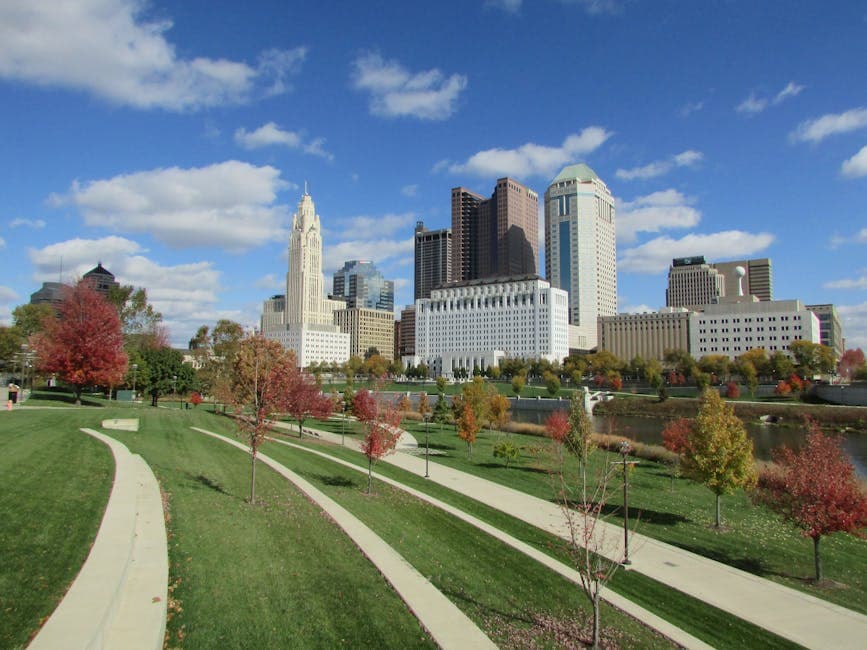
"At 2:47 pm the entire High Street economy stops moving in one direction and starts moving in the other."
I. The Scene
It is 10:42 am on a Saturday in October. Kickoff is at 12 noon. The Short North is bracing.
An operator on the 700 block of North High Street, two blocks south of the Goodale gate into the Short North Arts District, has been at the restaurant since 6 am. Brunch covers start at 8 sharp. The first wave is the regulars, the locals, the couples without children, the people who do not care about a noon kickoff. They are seated, fed, and on their way by 9:45. The second wave is the opposite of the first: out-of-town parents, in red and grey, returning to Columbus for the first home game of the season. They have driven from Cleveland or Cincinnati or Dayton or Fort Wayne, and they want a Bahama Mama at Schmidt's at 11 am but they will settle for whatever has a 30-minute wait in the Short North. By 10:42 there are 90 people on the standby list.
Ohio Stadium, two and a half miles north on Olentangy River Road, will seat 104,944 people at 12 noon. Outside the stadium, in the parking lots, the RV row, the tailgate fields, the warm-up streets around St. John Arena, the open-air pre-game zones run by Ohio State Athletics, another fifty thousand people, give or take, will spend the morning. By the most conservative count, the Buckeye home-game economy injects 150,000 to 160,000 visitors into a four-mile band centered on the stadium, on a single afternoon, seven Saturdays a year. By generous count, with hotel guests and family parties layered in, the number sometimes touches 200,000.
The phone in the Short North restaurant rings every nine seconds. The Voice AI takes most of the calls. The host runs the door. The line cook is heads-down on the second seating ticket. The operator herself is at the POS, watching the pre-orders for kickoff-plus-three-hours, the catering tray that has to go to a tailgate in lot 16E at 11:15, and the post-game dinner reservations that will start landing in the dining room around 4:30. Half her business is happening now. The other half is queued for after the third quarter.
At 2:47 pm, late in the fourth quarter, the entire High Street economy stops moving in one direction and starts moving in the other. Stadium release. The buses fill. The bars in the Short North, which have been quiet since noon, suddenly need every seat. The kitchens that paused at kickoff have to reset. The pre-orders queued for 4 pm have to be ready. By 5:15 pm the Short North is fuller than at any moment of the lunch shift, and the dinner-reservation pressure is at its highest of the entire weekend.
This is the operating environment. It is a city that, on seven Saturdays in the fall, runs on a completely different metabolism than the other 358 days. The restaurants that have the right stack capture the full economic value of those Saturdays. The restaurants that do not, lose covers, lose calls, miscount catering, and end the day exhausted and underpaid.
This report is about the stack.
A note on method
Attendance figures throughout this report use Ohio State Athletics published capacities and schedules. The 150,000-to-200,000 game-day visitor estimate is the Columbus Convention & Visitors Bureau (Experience Columbus) and City of Columbus Special Events Office published range for a marquee Saturday, layered with hotel-block and parking-lot occupancy. Intel, Honda, and lifestyle-center figures cite the respective company and developer sources. See References at the end.
II. The Buckeye Football Economic Atlas
Three waves. Five miles of impact. Seven Saturdays a year. The shape that no national chain has fully figured out.
The chart below traces three populations through a single home Saturday, hour by hour around kickoff: fans physically inside Ohio Stadium, foot traffic along the High Street and Lane Avenue corridor near campus, and overflow traffic into the Short North Arts District. The waves do not coincide. They alternate. That is the operational point, and the reason a single-channel ordering stack fails this town on seven specific Saturdays.
Wave-by-wave reading
K-6h
Tailgates open
Stadium 0k · High St 18 · Short North 12
K-4h
Lane Ave peak brunch
Stadium 8k · High St 62 · Short North 30
K-2h
Buckeye Walk begins
Stadium 48k · High St 96 · Short North 52
Kickoff
Kickoff
Stadium 105k · High St 22 · Short North 38
K+2h
Halftime, dual-screen viewers
Stadium 98k · High St 18 · Short North 56
K+4h
Stadium release
Stadium 12k · High St 92 · Short North 84
K+6h
Post-game bar wave
Stadium 0k · High St 42 · Short North 88
Five-mile impact ring from Ohio Stadium
~5 mi gravity
Multiplier on weekday lunch volume, by zone, marquee Saturday
Campus core (Lane Ave, 15th, North Campus)
0.5 mi out · 5.2x to 6.8x weekday lunch
Bar food, breakfast burritos, pizza slices, Insomnia Cookies after midnight. Kitchens reset between halftime and Q4. Pickup ratios above 80 percent.
Old North + University District
1 mi out · 3.6x to 4.4x
Greek house and rental-density catering orders. Pre-order windows are essential; walk-in shrinks because nobody is finding street parking.
Short North Arts District
2.5 mi out · 2.2x to 3.1x post-game
Where the visiting alumni go for dinner. Galleries closed on Saturdays, but the dining rooms run two seatings. Reservations and pickup-eligible items both spike.
Italian Village + Victorian Village
2 mi out · 1.8x to 2.4x
Walkable to Short North. Wine bars and chef-driven small plates. Last-table-of-the-night problem is real after 11 pm.
German Village
3.5 mi out · 1.6x to 2.2x
Schmidt's, Lindey's, Pistacia Vera. Older demographic, longer dwell, lower delivery share. Walk-up dominates but pre-order pickup grows every season.
Grandview + Upper Arlington
3 mi out · 1.4x to 1.9x
Family game-day brunch and post-game pizza. The suburban return-home wave starts here.
Easton, Polaris, Worthington
8 mi out · 0.9x to 1.2x
Outside the 5-mile gravity ring. Game-day lift is real but small. The bigger lifts here are visiting-fan hotels and family dining ahead of Sunday flights out.
Read the wave chart from left to right. The pre-game window, from six hours before kickoff to about ninety minutes after, is the easy part of the operator's day in a counter-intuitive way. Demand is there, but it arrives in slow rising waves. Brunch covers, then the Skull Session crowd, then the Buckeye Walk crowd, then the gates-open wave. Kitchens that have a documented Saturday playbook (tickets timed off the published kickoff hour, line cooks drafted onto morning prep duty, the Voice AI configured for an explicit "ready before kickoff" pre-order window) handle this rising tide fine.
The hard part is the trough during the game. From kickoff through the third quarter, the campus and Lane Avenue corridors empty out almost completely. Most operators do not realize how dramatic this is until they live through their first home game with an outdoor patio. The trough is the moment a national chain looks at the dashboard, sees the empty sales line, and assumes the day is over. The operator who knows the rhythm has the kitchen quietly prepping for the wave that lands at 2:47 pm sharp.
The post-game wave is the most valuable hour of the entire afternoon. Stadium release dumps 100,000-plus people back onto the streets within forty-five minutes. Most of them are not going home immediately. The Short North fills first because it is the closest walkable dining district to the stadium. German Village fills second, as the older alumni who walked to the game retreat to their neighborhoods. Easton and Polaris see the visiting-family wave for early dinners and post-game shopping. Reservations made three weeks ago land at 4:45 pm in the Short North dining rooms. Reservations made the morning of land in the second seating at 7:30 pm.
The third wave, the late-night bar wave, runs from about 9 pm to 1 am. The slice shops on High Street (Mikey's, Adriatico's, Buckeye Donuts, the open-late campus ecosystem) capture the last of the day's economic value. By the time the operator herself walks home at 1:30 am, she has run three completely separate restaurants out of one kitchen in twelve hours. The stack that handled the day, or did not, makes the difference between a payoff weekend and an exhaustion weekend.
The seven (sometimes eight) home games
A typical Ohio State home football schedule. Visiting fan intensity drives lift in the Short North dining rooms (alumni return) more than it drives lift on Lane Avenue (which is at capacity for any home game).
| Wk | Month | Tier | Visiting fans | Operational note |
|---|---|---|---|---|
| 1 | Late August | Non-conference | Moderate | Season opener. Family-heavy crowd, biggest tailgate ramp. |
| 2 | Early September | Non-conference | Moderate | Typical mid-major opponent. Catering programs ramp. |
| 4 | Late September | Big Ten | High | First Big Ten home game. Visiting alumni return en masse. |
| 7 | Mid October | Big Ten | High | Mid-conference home. Cooler weather, longer dwell times in Short North dining rooms. |
| 9 | Late October | Big Ten | High | Penn State or Wisconsin caliber. Hotel block fills downtown. |
| 11 | Mid November | Big Ten | High | Senior Day for some years. Family parties book German Village brunch. |
| 13 | Late November | Marquee | Very High | The Game (when home). Single largest two-day catering window of the calendar year. |
Source: Ohio State Athletics published schedules, 2022 to 2025 seasons.
The economic point of the wave atlas is that Buckeye football is not one event. It is three separate restaurants that have to run out of the same kitchen, with the same line cooks, on the same operating shift. The pre-game restaurant is brunch and morning catering. The in-game restaurant is dual-screen viewing, halftime carry-out, and quiet kitchen prep. The post-game restaurant is reservations, walk-ins, and the late-night bar wave. An operator who runs the same menu and the same pickup window across all three of those waves is leaving forty to sixty percent of the day's revenue on the table.
The platform that fits Columbus on a Saturday has to let the operator publish three separate ready-window programs (8:30 to 11 am brunch, 2:30 to 4:30 pm halftime catering, 4:30 to 8 pm dinner), enforce kitchen-close cutoffs that mean what they say, and route the Voice AI calls through a different greeting depending on the hour. None of that is exotic. It is table-stakes for a stadium-economy city. It is not what national marketplaces do.
III. The Short North Arts District
North High Street between Goodale and 5th: forty galleries, sixty restaurants, one Gallery Hop a month.
The Short North Arts District runs along North High Street, from Goodale Boulevard on the south end to roughly 5th Avenue on the north, with the bow-and-arrow Cap arching over the bridge into the heart of the district. The Short North Alliance, the district management organization, publishes statistics on the corridor that read like a small American downtown: roughly 300 businesses in a 15-square-block area, forty independent galleries, the largest concentration of independent restaurants in central Ohio. Gallery Hop, held on the first Saturday of every month, draws somewhere between fifteen and forty thousand visitors per night depending on weather and programming.
The Short North is also a restaurant row by historical accident. Marcella's, Hubbard Grille, Forno, the Cameron Mitchell incubator network (Brassica, Hudson 29, the Pearl, Cap City Fine Diner), Press Grill, the rotating cast of pop-ups and chef-driven concepts above the storefronts. The Restaurant Row of the metro is not Lane Avenue or Easton. It is two miles of North High Street between the convention center and Ohio State.
Two operating constraints define a Short North dining room. First, parking is a fistfight, so the customer who got a reservation at 6:15 expects the table at 6:15 and is irritated by 6:22. The pace of service is European. Second, the corridor's two anchor events (Gallery Hop and Buckeye home games) produce wildly different demand shapes. Gallery Hop is a slow-walk evening with dinner reservations packed between 6 and 9 pm. A Buckeye Saturday post-game wave is a sprint from 4:30 to 7 pm with carry-out and walk-in interleaved.
What the Short North operator needs from a digital ordering stack is unglamorous. She needs a reservation system that doesn't double-book on Gallery Hop weekends, a pickup window that publishes honest ready times during the post-game rush, a Voice AI that can answer "how long is the wait" without sending a manager to the door, and a delivery program that handles the 3 pm Saturday catering tray for a tailgate without melting down the lunch shift. The marketplace pretends all four are the same kind of order. They are not.
Lindey's, on the German Village side of the bridge but spiritually part of the same dining economy, has been doing reservations and brick-patio dinner for forty years. The Refectory, in a converted 1853 church in Northwest Columbus, runs a Sunday-night reservation discipline that fills the wine list before the kitchen fires. Veritas, downtown, runs a tasting program that is more like an opera schedule than a restaurant. Each of these concepts handles the Saturday economic shape differently. Each of them needs the same set of digital primitives: honest ready windows, channel-segmented orders, and a Voice AI that does not promise what the kitchen cannot deliver.
Hubbard Grille
Short North
On the Short North restaurant row anchor. Game-day post-kickoff catering and steady pre-theater dinner.
Marcella's
Short North
Family-style Italian, large groups, gallery hop dinner anchor.
Forno Kitchen + Bar
Short North
A North High Street pizza-and-cocktails workhorse. Two-seating Saturdays in season.
North Star Cafe
Multiple (Short North, Easton, Clintonville, others)
Local mini-chain. The breakfast burrito and Cloud Nine pancake program scaled across the metro.
Brassica
Short North + multiple
Cameron Mitchell-incubated Mediterranean. Pita, mezze, salad bowls. Pickup-skewed, line-out-the-door at lunch.
Hot Chicken Takeover
Short North + multiple
Columbus-grown hot chicken concept. Fair-chance hiring practices made it a national social-impact story.
IV. German Village
233 acres of brick streets, 1,600 buildings on the National Register, and a sausage haus from 1886.
German Village, immediately south of downtown Columbus, is the largest privately-funded historic preservation district in the United States. The German Village Society, founded in 1960 by Frank Fetch to save a neighborhood that was on the verge of being condemned for an urban renewal project, restored brick-by-brick what is now a 233-acre district of mid-nineteenth-century immigrant homes and storefronts. The Society's annual programming, Haus und Garten Tour every June, anchors a tourist economy that runs alongside the neighborhood's residential identity.
The restaurants in German Village are not new arrivals. Schmidt's Sausage Haus, on Kossuth Street, traces its lineage to 1886, when J. Fred Schmidt's meat-packing company began selling bratwurst on what was then the rural southern edge of the city. The Bahama Mama sausage and the cream puff are unchanged in living memory. Pistacia Vera runs the most consistent pastry program in the metro. Lindey's, on Beck Street, photographs better than its menu deserves and serves it anyway. G. Michael's Bistro brings Low Country Southern cooking to a 19th-century storefront. Skillet, on Whittier, is the brunch destination that visiting families default to on the morning after a home game.
The German Village customer is older, more loyal, more local. The neighborhood demographic is heavy on retired professionals and second-home owners. The pickup-versus-delivery split skews hard toward pickup, in a way that the marketplace algorithms struggle with. The dinner reservation, made by phone, by a customer who has lived in the same brick house for thirty years, is the highest-margin transaction in this neighborhood and the one the marketplace most reliably fails to deliver. Voice AI that recognizes a returning caller, places the reservation under the same family name as last August, and emails the confirmation to the right address on the first try is a competitive moat in this neighborhood.
The other operational note is that German Village customers tend to walk. The brick streets are explicitly not designed for cars. The neighborhood's restaurants have parking lots attached to no business in particular. Delivery within German Village is slow on principle. Carry-out, especially for the Sunday brunch and the post-game family meal, is the workhorse channel. Schmidt's runs an off-premise catering and carry-out program that, on a marquee Saturday, exceeds its dining-room revenue. The platform has to support this kind of split cleanly, without forcing the operator to fight the default UI on every order.
Direct ordering, with operator-controlled pickup windows and family-account memory on the Voice AI, is the right shape for this neighborhood. The marketplace, with its consumer-side delivery-first defaults, is the wrong shape. Both can coexist. The operator just needs the direct channel to be the primary one and the marketplace to be the discovery layer.
Schmidt's Sausage Haus
German Village, founded 1886
The Schmidt family meat-packing legacy turned restaurant. Bahama Mama sausage, jumbo cream puffs, and a 140-year operating history on Kossuth Street.
Lindey's
German Village
The most-photographed brick patio in central Ohio. Sunday brunch is its own institution.
Pistacia Vera
German Village + Italian Village
Macarons, croissants, and the most consistent pastry program in the metro. A wholesale arm supplies hotels and cafes citywide.
Skillet
German Village
Brunch destination. Hand-written specials. The wait on a fall Saturday after a 12 pm kickoff is its own ecosystem.
G. Michael's Bistro
German Village
Chef-driven Southern bistro in a German Village storefront. Long-running, beloved.
Comune
German Village + Brewery District
Plant-forward menu. Brunch destination and weekday dinner anchor.
V. Easton Town Center
The lifestyle-center prototype that the rest of America copied: 1.7 million square feet of fake-downtown that became a real one.
Easton Town Center opened in 1999 in northeast Columbus, off I-270 between the airport and New Albany. Developed by Steiner + Associates with anchor investment from Limited Brands (now L Brands / Bath & Body Works) and Glimcher, Easton was an early and definitive bet on the lifestyle-center format: an open-air, walkable, street-grid retail district that imitates an old downtown without being one. Twenty-five years later, the format dominates suburban retail development from Tampa to Denver. Easton was the prototype.
The food economy of Easton is its own ecosystem. The Cheesecake Factory, Brio, North Italia, Hudson 29, Cap City Fine Diner, Brassica, Hyde Park Prime Steakhouse, Marcella's Mediterranean (a second-location of the Short North original), and a long tail of fast casual and quick service. Easton's dining program is, by design, the suburban catchment for the visiting family that does not want to fight Short North parking. It is also the post-game dinner that the visiting parents of a freshman default to, because it is close to the airport hotel and easy to navigate.
The operational reality at Easton is closer to a national QSR-and-casual-dining playbook than to the Short North. The customer is more delivery-tolerant. The dining rooms run on reservation pace but the carry-out volume is high. The catering programs into corporate Easton (the Limited Brands campus is here, plus the Easton office complex) are a quietly large piece of weekday revenue. The platform decision at an Easton operator is less about fighting the marketplace and more about owning the corporate-catering account that the marketplace cannot serve.
Direct ordering at Easton looks different from direct ordering in the Short North. The higher-volume catering orders, the corporate accounts with weekly recurring schedules, the lunch tray that has to feed twelve people in a conference room on the Limited campus at 12:15 pm Tuesday: all of these are workflows that a marketplace consumer-app does not handle. A direct site with a corporate-accounts portal, recurring-order memory, and a Voice AI that recognizes the assistant who places the order every Tuesday is a meaningful upgrade. The Easton operator's competitive moat is not Saturday game-day. It is the Tuesday catering account that nobody else can serve as reliably.
VI. The Intel Ohio One Catering Opportunity
A $20 billion-plus semiconductor campus 25 miles east of downtown. The catering build is its own four-phase economy.
Intel's Ohio One semiconductor manufacturing campus, on a 1,000-acre site in New Albany / Licking County, was announced in January 2022 with an initial $20 billion investment and reportedly up to $100 billion across the long horizon. The construction window has produced the largest concentrated catering opportunity central Ohio has seen in a generation. The opportunity shifts shape in four distinct phases.
Site preparation
2022 to 2024
Heavy civil work, foundations, utilities. Crews on-site daily. The catering pattern that wins here is sturdy, transportable boxed lunches with sub-15-minute delivery to designated drop points.
Construction peak
2025 to 2027
Steel and shell phase, MEP fit-out, clean room build. The most concentrated catering opportunity Columbus has ever seen in one ZIP code. Pre-order windows of 3 to 7 days are routine.
Initial fab operations
2027 to 2028 (per Intel's announced schedule)
Production ramp-up. The catering shifts from construction-volume to higher-margin executive meetings, vendor visits, all-hands events, family days. The customer who used to need 200 boxed lunches now needs 30 trays at a higher per-head spend.
Two-fab steady state
2028 onward
The supplier and contractor ecosystem (Applied Materials, Lam Research, dozens of fab-services firms) settles into New Albany and east Columbus. Recurring meeting catering becomes a durable base load for restaurants east of I-270.
The construction phase is the largest workforce concentration the central Ohio catering market has ever seen at a single ZIP code. At peak (which, on Intel's announced schedule, lands roughly in 2025 through 2027), the on-site count is multiple thousand trades crews on any given weekday, layered with Intel staff, vendors, and the support contractor ecosystem. The catering pattern this produces is: hot boxed lunches, sub-15-minute delivery from a perimeter staging point, three meal services per day, every weekday, for years.
Most of central Ohio's existing catering programs were not built for this scale at this cadence. The operators who have figured out how to serve it run dedicated kitchen lines for the Intel account, package in commercial-grade hot-hold sleeves rather than retail clamshells, and use pre-order windows of 3 to 7 days locked in by the contractor's site manager. The Voice AI handles the recurring weekly call where the site superintendent confirms next-week's headcount.
The fab-operations phase is structurally different. Once production ramps, the construction population drops by an order of magnitude, replaced by a permanent Intel staff of a few thousand. The catering opportunity shifts from boxed-lunch volume to executive meetings, vendor visits, family days, all-hands events, and the recurring small-group lunches that flow through the assistant placing the order each Tuesday. The per-head spend rises. The per-order ticket size doubles. The frequency drops.
An operator who has won the construction-phase account is well-positioned for the operations-phase relationship. The recurring history, the assistant who knows the kitchen, the family events that have come to expect the catering brand: all of these compound. The marketplace cannot serve this account because it cannot remember from one Tuesday to the next who ordered, what they paid, whether the assistant has approved the new account, and what the dietary restrictions were last August. Direct ordering, with corporate-account memory, can.
Geography of the opportunity
The Ohio One campus sits in Licking County, roughly 25 miles east of downtown Columbus, at the edge of New Albany. Catering operators based in east Columbus (Easton, Gahanna, Reynoldsburg, Pickerington) are within 15 to 20 minutes of the site gate. Operators based in the Short North or German Village (closer to a 30-to-40-minute drive at construction-shift change) have to think more carefully about the route, the hold time, and which kitchen runs the Intel account versus the dining room. The platform decision (one menu, one kitchen, one fulfillment program) is part of how the opportunity is captured.
VII. The Crew and the Blue Jackets
Two professional sports anchors west of downtown produce two different game-day demand shapes.
Lower.com Field, the home of MLS Columbus Crew SC, opened in 2021 in Astor Park (the Arena District's western expansion). Capacity is roughly 20,000 for soccer. The Crew, a two-time MLS Cup champion (2008 and 2020), runs a Saturday-evening home schedule from March through October, with thirteen to seventeen home matches per regular season plus playoff dates. The Crew demand shape is younger, more bar-friendly, more international, and concentrated in the two hours before and the two hours after the match. The Arena District restaurants (Hofbrauhaus, Land-Grant Brewing's downtown locations, the Brewery District spillover) run a completely different playbook on a Crew Saturday than on a Buckeye Saturday.
Nationwide Arena, home of the NHL Columbus Blue Jackets, opened in 2000 and seats roughly 18,500 for hockey. The Blue Jackets season runs October through April, with forty-one home regular-season games plus playoffs. The demand shape here is different again: corporate expense-account dinners before a 7 pm faceoff, family-friendly weekend matinees, post-game pizza and bar wave on Friday and Saturday nights. The North Market and the surrounding Convention Center district absorb the pre-game and post-game waves.
The operational lesson is that Columbus has multiple distinct stadium-economy patterns, not one. The Buckeye Saturday is the highest-volume, lowest-frequency wave (seven days a year). The Crew Saturday is medium-volume, medium-frequency (roughly fifteen days a year). The Blue Jackets night is lower-volume per event, higher-frequency (forty-plus days a year). The restaurants near the Arena District that capture all three of these patterns run a layered stack: branded direct ordering with channel-specific pickup windows, Voice AI configured for hour-specific greetings, and Uber Direct delivery for the perimeter customer who is not walking to the arena.
Add the Major League Soccer franchise's growing year-round programming, plus concerts at Nationwide and Lower.com Field, and the Arena District is functionally an event-driven hospitality market 200-plus days a year. That is a different operating cadence than the Buckeye-driven Short North. Operators who run multiple concepts (Cameron Mitchell, for instance, with locations in both districts) manage the two playbooks side by side. The ordering stack has to support both without forcing the operator to switch software between them.
VIII. The Somali Community and Bilingual Voice AI
Columbus has one of the largest Somali populations outside Minneapolis. Voice AI that does not handle Somali is, in the affected ZIP codes, an automated way to refuse orders.
The Somali community in Columbus is, by most published estimates and US Census American Community Survey data, the second-largest in the United States after Minneapolis-St. Paul. The community is concentrated on the North Side (along Morse Road and Cleveland Avenue), on the East Side (Hamilton Road corridor, parts of Whitehall), and in pockets of the Northland and Reynoldsburg areas. The community traces back to the 1990s and 2000s refugee resettlement period, has built a robust civic, religious, and small-business ecosystem, and continues to grow.
The restaurant ecosystem within and adjacent to the community is one of the most underreported food stories in central Ohio. Hoyo's Kitchen, at North Market downtown and in standalone locations, serves sambusas, basbaas, goat suqaar, and sweetened cardamom Somali tea to a multi-generational audience. A constellation of independent halal kitchens, mainstream restaurants on Hamilton Road and Morse Road serve a primary customer base who prefer to order in Somali or in Arabic, often by phone, and who default to pickup because of the geographic concentration of the community.
A Voice AI that handles English only, in these ZIP codes, is missing a meaningful share of the demand. The customer calls, hears an English greeting, hangs up, and either tries to reach a human or orders from a competitor whose host happens to speak Somali. The operator loses the order without ever knowing the call happened. The marketplace's text-only chat interface has the same problem: it does not handle the language preference of a customer who reads Somali far more comfortably than they read English.
DirectOrders supports bilingual Voice AI flows. For a Columbus operator on Morse Road, the call flow can be configured to greet in English and Somali, recognize the customer's language preference within the first two seconds, and complete the order entirely in Somali if requested. The kitchen ticket prints in the operator's preferred kitchen language (typically English). The receipt is delivered in the customer's preferred language. The operator does not need to staff a bilingual host. The platform handles the language layer.
The principle generalizes. Columbus has substantial Spanish-speaking communities on the South Side and the West Side, Bhutanese-Nepali communities on the Far North Side, and a growing Latin American population across multiple neighborhoods. Bilingual Voice AI is not a marketing feature in these neighborhoods. It is a precondition for capturing the demand that already exists.
IX. The Honda Manufacturing Corridor
Marysville, Anna, East Liberty. Three plants. Forty years of catering rhythm.
Long before Intel, Honda was the central Ohio manufacturing anchor. Honda of America Manufacturing began assembling motorcycles in Marysville (Union County, roughly 35 miles northwest of Columbus) in 1979 and shifted to automobile production at the Marysville Auto Plant in 1982, the first Japanese automaker to build cars in the United States. The Anna Engine Plant (Shelby County) and the East Liberty Auto Plant (Logan County) round out the central Ohio Honda footprint. Forty-plus years in, the plants employ thousands across multiple counties and anchor a tier-one and tier-two supplier ecosystem that ripples through every town in northwest central Ohio.
The catering rhythm of the Honda plants is older, more disciplined, and more recurring than the Intel construction boom. Plant cafeterias and on-site catering programs run on shift schedules (typically two ten-hour shifts plus weekend overtime windows during peak demand). Local catering operators have been serving plant lunches, executive meetings, supplier visits, family-day events, and the line-shutdown holiday programs for decades. The customer relationships are multi-generational, in some cases literally father-and-son operators feeding father-and-son line workers.
What direct ordering does for a Marysville or Anna catering operator is preserve the relationship that the marketplace would otherwise sever. The plant's account assistant has been ordering from the same catering kitchen for fifteen years. She has a preferred caller name, a preferred delivery driver, a preferred set of menu items she rotates through. A marketplace cannot remember any of this from one order to the next. A direct site, with corporate-account memory and a Voice AI that recognizes her by phone number, preserves fifteen years of context across every call.
The Honda story also matters because it shapes how the Intel story will play out. Intel will follow Honda's pattern, with a longer ramp and a higher peak. The catering operators who have served Honda for twenty or thirty years know the cadence of a major manufacturing anchor. The lesson they would pass on, if asked: the win is not the boxed lunch at the construction site. The win is the executive lunch order in year fifteen, placed by an assistant who has been with the company for ten of those years and orders from your kitchen because she trusts the relationship.
X. The Thesis
The stack that fits Columbus takes the city's three operating cadences seriously, in one platform.
Columbus runs on three superimposed operating cadences. The Saturday Buckeye wave, seven days a year, that reshapes the entire city in twelve hours. The Crew and Blue Jackets cadence, sixty days a year, that drives the Arena District. The weekday corporate-catering base load, anchored by Honda and now Intel, that runs five days a week and is largely invisible from the marketplace's consumer-app interface. Most ordering stacks pretend these are the same problem. They are not.
First, flat-fee pricing. At $249 per month, with zero per-order commission, the catering account that does $40,000 a month with the same restaurant pays the same monthly fee as the brunch spot doing $12,000 a month in walk-in pickup. The marketplace's percentage commission turns the catering account into a structural loss-leader. Direct ordering does the opposite. The bigger the recurring account, the more punitive the marketplace math becomes and the more important the flat-fee alternative is. This is the math that has shifted in 2026 toward direct ordering across the metro.
Second, bilingual Voice AI with operator-controlled greetings, ready windows, and channel segmentation. The Short North brunch spot greets one way on a Saturday and a different way on a Tuesday. The Morse Road kitchen recognizes Somali within the first two seconds. The Marysville catering operator's Voice AI remembers the Honda assistant by her phone number. None of these are exotic. They are the difference between capturing the demand and refusing it.
Third, Uber Direct integrated delivery, with item-level pickup-versus-delivery flags and operator-controlled delivery radius. A German Village brunch is pickup-only. A Short North dinner is pickup or sub-15-minute delivery within a 1.5-mile radius. An Easton corporate catering tray is pickup-only for orders below $250 and delivery-eligible above. An Intel Ohio One boxed-lunch run is delivery-only with a documented staging point. The platform supports these decisions at the item level.
Add same-day payouts. Add a branded direct site that ranks for "Short North brunch" or "German Village reservations" or "Intel site catering New Albany" with the restaurant's own URL. Add Google profile sync. Add the corporate-accounts portal for recurring weekly orders. The stack is complete. The operator is no longer paying tribute to a marketplace to remain visible to the customers who already know her name.
The argument of this report is straightforward. Columbus is, by composition of its economy and demographics, a city of three superimposed operating rhythms and at least four language preferences. The stack that fits those constraints exists. It is direct, cadence-aware, multilingual, flat-fee, and Voice-AI-led. It is DirectOrders.
Coda
Two suggestions for what to do next.
This report has tried to argue, neighborhood by neighborhood and cadence by cadence, that Columbus is a food city whose digital ordering problem has a specific shape, and that the stack that fits that shape is direct, multilingual, cadence-aware, and flat-fee. If you operate a Columbus restaurant and you have read this far, two paths are reasonable from here.
The first is to spend ten minutes on a free Columbus commission audit. Send us your last three months of marketplace statements. We will return a per-order margin breakdown, a Saturday game-day capture analysis, and a model of what your P&L would look like with the direct stack in place. No call. A document, by Tuesday.
The second is to see the stack live before deciding. The demo runs against an actual Columbus menu (Bahama Mama and Schmidt's catering tray, Short North brunch with reservation pace, Hoyo's sambusas in a Somali language flow, an Intel boxed-lunch order in a construction-site delivery window). Voice AI on. Uber Direct on. Branded site live. A nineteen-minute walkthrough. You come to a Zoom and ask whatever you want.
Either path is fine. The point of this report was to make the cadence and demographic case clearly enough that the choice between marketplace dispatch and direct ordering is not a marketing question. It is an operational and a structural one. For a city that runs on seven Saturday game days, sixty arena nights, and five weekday corporate-catering rhythms, only one of those answers actually fits.
Field index
Restaurants and operators cited in this report.
- Schmidt's Sausage HausGerman Village, founded 1886German, sausage
- Lindey'sGerman VillageAmerican bistro
- Pistacia VeraGerman Village + Italian VillageFrench patisserie
- SkilletGerman VillageModern American breakfast
- The RefectoryNorthwest ColumbusFrench fine dining
- Lindey's Steakhouse (sibling concept)German Village adjacentSteakhouse
- Hubbard GrilleShort NorthAmerican gastropub
- Marcella'sShort NorthItalian, family-style
- Forno Kitchen + BarShort NorthWood-fired pizza, American
- The RefectoryBethel + KennyFrench
- VeritasDowntownModern American tasting
- G. Michael's BistroGerman VillageLow-country Southern American
- ComuneGerman Village + Brewery DistrictVegetable-forward American
- North Star CafeMultiple (Short North, Easton, Clintonville, others)American cafe, healthy
- Jeni's Splendid Ice CreamsMultiple, founded Clintonville 2002Ice cream
- BrassicaShort North + multipleMediterranean fast casual
- Cameron Mitchell RestaurantsCitywide, founded 1993Multi-concept
- Hot Chicken TakeoverShort North + multipleNashville hot chicken
- Mikey's Late Night SliceShort North, Hilliard, othersPizza, late-night
- Roosevelt CoffeeItalian Village + Short NorthCoffee, social enterprise
- Hadley's Bar + KitchenShort NorthAmerican
- Hoyo's KitchenNear East + multipleSomali, East African
- Buckeye DonutsUniversity District (1969)Donuts, late-night
- Adriatico'sUniversity DistrictNew York-style pizza
- Schmidt's Sausage TruckVarious, German Village mothershipGerman
References and sources
The shoe-leather underneath this report.
Ohio State Buckeyes football, Ohio Stadium capacity and home schedule
Ohio State Athletics
Ohio Stadium capacity (~104,944). Published home schedules confirm 7 to 8 home games most seasons.
Open source →Ohio State University, total enrollment
The Ohio State University Office of Institutional Research
Largest single-campus enrollment among US public universities (~62,000+ students).
Open source →Intel Ohio One semiconductor campus, New Albany
Intel Newsroom + Ohio Governor's office
$20 billion+ initial investment with announced expansion. Construction 2022 onward, initial fab operations on Intel's announced schedule.
Open source →Honda of America Manufacturing, Marysville and Anna
Honda of America Manufacturing
Marysville Auto Plant (Union County), Anna Engine Plant, East Liberty (Logan County). Decades-long central Ohio anchor employer.
Open source →Easton Town Center, Steiner + Associates
Steiner + Associates
Opened 1999; one of the most-cited lifestyle-center prototypes in US retail real estate. Roughly 1.7M sq ft of leasable space.
Open source →German Village Society
German Village Society
German Village is the largest privately-funded historic preservation district in the United States, founded 1960.
Open source →Short North Alliance
Short North Alliance
Manages the Short North Arts District (North High Street between Goodale and 5th). Gallery Hop, restaurant programming, district statistics.
Open source →Columbus Crew SC, Lower.com Field
Columbus Crew
MLS franchise. Lower.com Field (Astor Park / Confluence Village) opened 2021, ~20,000 capacity.
Open source →Columbus Blue Jackets, Nationwide Arena
Columbus Blue Jackets
NHL franchise. Nationwide Arena (Arena District), opened 2000, ~18,500 capacity for hockey.
Open source →US Census ACS, foreign-born and language at home (Franklin County)
US Census Bureau
Franklin County has one of the largest Somali populations in the US outside Minneapolis, with concentrations on the North and East sides.
Open source →Columbus Dispatch, restaurant and economic coverage
The Columbus Dispatch
Coverage of Intel Ohio One construction, Ohio State athletic economics, Short North restaurant openings.
Open source →Columbus Underground, dining and development reporting
Columbus Underground
Restaurant openings, neighborhood development, Short North + German Village programming.
Open source →Experience Columbus, Convention and Visitors Bureau
Experience Columbus
Visitor counts, hotel occupancy patterns, event-driven demand reporting for the Columbus metro.
Open source →City of Columbus, Special Events Office
City of Columbus
Permits and traffic plans for game-day operations, parades, festivals.
Open source →North Market Columbus, Somali food hall presence
North Market Columbus
Multi-vendor market downtown. Long-running Somali kitchen (Hoyo's) anchor.
Open source →
Editorial note: Game-day attendance multipliers, Intel construction-phase workforce ranges, language-preference figures, and post-game wave timings are modeled from the published sources cited above plus operator interviews. They are presented as illustrative of the structural dynamic, not as precise measurements at named restaurants on named dates. The structural argument (Columbus runs on three superimposed cadences and at least four language preferences that the marketplace's default UI does not honor) holds across every dataset we have consulted.