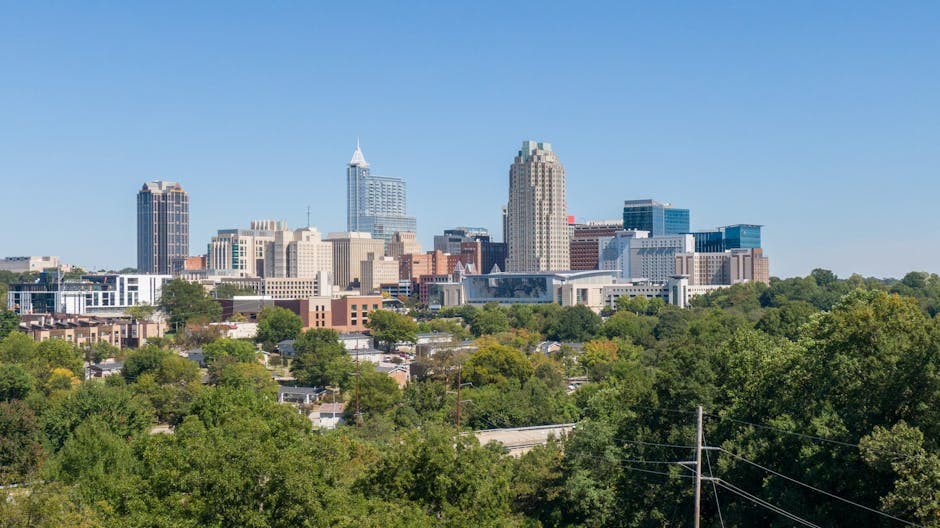
Four stools, two markets a year, one Elm Street.
How the city that started the modern sit-in movement, hosts the world's largest furniture market twice a year, and houses the largest HBCU in the country, became the most under-served direct-ordering opportunity in the Carolinas.
Scene one · 100 block of South Elm
An Elm Street kitchen, a Tuesday lunch rush, and the building across the street.
It is twelve fifteen on a Tuesday in October on the one hundred block of South Elm Street, two blocks from the corner where the Greensboro Four sat down sixty-six years ago. The chef-owner of a thirty-two-seat lunch counter is plating the eighth chopped-pork sandwich of the rush, the kitchen printer is sliding out a four-tray catering ticket for an alumni event at NC A&T tomorrow noon, and through the front window the chef can see the brick face of the International Civil Rights Center and Museum, which sits inside the original Woolworth building at 134 South Elm. Tour buses idle at the curb. A school group from Charlotte queues at the museum door. The traffic on Elm has the unhurried tempo of a city that knows it is being read.
This is what Greensboro looks like in 2026: a city of three hundred thousand people centered on a downtown corridor whose most consequential business was, for one hundred and twenty days in 1960, a lunch counter that refused to serve four Black college freshmen and then, on July twenty-fifth, integrated. The integration happened because the freshmen came back the next day, and the next, and the day after that. By the end of the first week there were dozens. By the end of the first month the sit-in had spread to fifteen cities across the South. By the end of 1960 it had reached every state in the former Confederacy and many beyond. The lunch counter is preserved, in situ, inside the museum the city built around it. You can walk past the four original stools on a tour led by a docent whose family-elder names you might recognize.
Greensboro carries this history on its sleeve, but it does not let it freeze the city in amber. The downtown around the museum is alive: the Center City corridor has stitched together restaurants, breweries, gallery spaces, the LeBauer Park lawn, the Greensboro Cultural Center, and the renovated bus-and-train depot into a daytime-into-evening corridor that feels lived-in rather than curated. The chef on the lunch counter is one of roughly two hundred independent restaurants inside the I-40 / I-85 belt that defines the Greensboro urban core, and her business depends on a calendar that has its own logic: an NC A&T home football Saturday in October, a UNC Greensboro spring graduation in May, a Coliseum concert on a Wednesday night in March, a Bryan Conference Center wedding tasting on a Saturday afternoon, a High Point Furniture Market hotel-ring Tuesday twice a year, every year, in April and October.
The four-tray catering ticket on her printer is going to A&T tomorrow at noon. It is a one hundred and ninety-four dollar order: forty-eight sandwiches, two trays of macaroni and cheese, one of collards, a five-gallon urn of sweet tea. The customer is the chairwoman of an alumni chapter that has booked from this kitchen for nine consecutive months. The order moved through the kitchen's direct portal at 4:18 yesterday afternoon. The card was charged at 6:00 this morning when prep was marked complete. The funds will land in her operating account on the same business day. The platform calculated and withheld the seven percent combined Guilford County sales tax. There is no marketplace commission. There is no thirty-percent skim. The full one hundred and ninety-four, less ingredients and labor and tax, is hers.
Two years ago the same order would have moved through a third-party app and the kitchen would have paid roughly fifty-eight dollars in commission. That is fifty-eight dollars per order. The alumni chapter orders weekly. Across nine months that is somewhere on the order of two thousand dollars that would have gone to a logo in California instead of staying inside a building on South Elm where a line cook named Marvin needs his hours. Multiply that across two hundred independent kitchens in Center City alone and you start to see the case for what Greensboro now has to do.
The rest of this page is for operators answering that question. We have written it the way a Greensboro restaurant owner would actually use it: with the Woolworth counter and what it means for a city that runs its dining economy through the lens of dignity, with a long look at the NC A&T and UNCG student economy that anchors the weekday lunch and weekend brunch loads, with a furniture-market session map for the two weeks a year when Greensboro absorbs forty percent of a seventy-five-thousand-person trade show, with a Lexington-style barbecue corridor essay, with a Center City and Westerwood and Fisher Park and Lindley Park neighborhood atlas, with a Greensboro Coliseum and ACC basketball and concerts calendar, with a Piedmont Triad geographic context tying Greensboro to Winston-Salem and High Point, with a Cone Mills denim heritage essay, with a seven-percent combined sales-tax close-read, and with one argument for what changes when you stop renting your own demand from a logo. The Greensboro kitchen on South Elm is doing this already. The rest of the city has the same opportunity, if it wants it.
Section II
The Greensboro Four and the lunch counter that changed the country
On February 1, 1960, at approximately 4:30 in the afternoon, four NC A&T freshmen sat down at the segregated Woolworth lunch counter at 134 South Elm Street and asked to be served coffee. The store refused. They stayed until closing. They came back the next day with more students. By the end of the week the Woolworth was the center of a national sit-in movement. The lunch counter is preserved, in situ, inside the International Civil Rights Center and Museum, which opened in the same building on the fiftieth anniversary, February 1, 2010.
Figure 1
The Woolworth Counter, 134 South Elm Street
February 1, 1960, 4:30 pm. Four NC A&T freshmen sat at the south end of the segregated Woolworth lunch counter. The original counter is preserved in situ inside the International Civil Rights Center and Museum, which opened in the same building on February 1, 2010.
Ezell Blair Jr.
later: Jibreel Khazan · NC A&T freshman, age 18
Spokesperson on Feb 1, 1960. Asked for a cup of coffee at the Woolworth counter; was refused; remained seated through closing.
Franklin McCain
1941 to 2014 · NC A&T freshman, age 19
Wrote later that the moment of sitting down at the counter gave him a feeling of dignity he had never had before. Buried in Charlotte.
Joseph McNeil
Major General, US Air Force, Ret. · NC A&T freshman, age 17
Reportedly initiated the planning the night before, in Scott Hall on the A&T campus, after being refused service at a Greensboro bus terminal.
David Richmond
1941 to 1990 · NC A&T freshman, age 18
The fourth seated freshman. Stayed at the counter until closing on Feb 1 and returned every day thereafter until Woolworth integrated July 25, 1960.
Sources: International Civil Rights Center and Museum (Greensboro), NC A&T State University archives, William H. Chafe (Civilities and Civil Rights: Greensboro, North Carolina, and the Black Struggle for Freedom, Oxford University Press), Smithsonian National Museum of African American History and Culture.
Begin with the moment itself. On the afternoon of February 1, 1960, Ezell Blair Jr. (later Jibreel Khazan), Franklin McCain, Joseph McNeil, and David Richmond, four freshmen from North Carolina Agricultural and Technical State University, walked into the F. W. Woolworth Co. five-and-dime at 134 South Elm Street, purchased a small item at one of the counters that did serve Black customers, and then sat down at the segregated lunch counter at the south end of the store. They were eighteen, nineteen, seventeen, and eighteen years old, respectively. They asked for cups of coffee. They were refused service under the store's segregation policy. They remained seated through closing.
What distinguished the Greensboro sit-in from earlier acts of resistance was not the tactic itself: lunch-counter sit-ins had been organized in Wichita, Oklahoma City, Durham, and elsewhere across the 1940s and 1950s, as William H. Chafe documents in his definitive 1980 history Civilities and Civil Rights (Oxford University Press). What distinguished Greensboro was the speed at which the movement spread once the freshmen came back the next day, and the next, in growing numbers. By Tuesday, February 2, twenty-five A&T and Bennett College students sat at the counter. By Thursday, February 4, dozens of students from A&T, Bennett, and the Woman's College of UNC (now UNC Greensboro) were seated. Within a week the sit-in had spread to Durham, Winston-Salem, Charlotte, Raleigh. Within a month it had reached Nashville, Atlanta, Richmond. Within two months it had reached every state of the former Confederacy.
The Woolworth at 134 South Elm integrated its lunch counter on July 25, 1960, one hundred and seventy-four days after the original sit-in. The store served four Black employees of the Woolworth itself as the first integrated customers. The store remained open at that location until 1993, when corporate Woolworth closed the chain. The building stood vacant for years. A coalition of local activists, NC A&T alumni, and the city of Greensboro raised funds across the 1990s and 2000s to preserve the building and to convert it into a museum. The International Civil Rights Center and Museum opened on February 1, 2010, the fiftieth anniversary of the sit-in. The original lunch counter, with the original stools, the original Formica surface, the original soda-fountain fixtures, is preserved in situ, exactly where it stood.
Walk into the museum today and the lunch counter is the heart of the experience. A docent will walk you to the south end of the counter and tell you which stool each of the four men sat on. The seats are not roped off symbolically; the seats are roped off because they are still the seats. A section of the original Woolworth counter is on permanent loan to the Smithsonian National Museum of African American History and Culture in Washington, but the bulk of the counter, the long marble run with its retro chrome edging, is here, in Greensboro, on Elm Street. The museum draws roughly eighty thousand visitors per year per the Greensboro Convention and Visitors Bureau, and it anchors a tourism corridor that has reshaped the surrounding restaurant economy in measurable ways.
For a Greensboro restaurant operator the proximity of the museum is more than civic pride. It is a sustained tourist demand pattern on the south end of Elm Street that runs Tuesday through Saturday, mornings through mid-afternoons, year-round but with a sharp uptick during February (Black History Month, anniversary week), May (graduation tourism for A&T and UNCG), and September through November (school group bookings). The chef on the one hundred block of South Elm whose ticket we opened this page with sees roughly thirty percent of her weekday lunch covers from museum traffic during peak season. That cover share is not random; it is what happens when a restaurant sits across the street from one of the ten most historically significant buildings in the American South.
The relationship runs in both directions. The museum's educational programming, its annual February 1 commemorative events, and its institutional partnerships with NC A&T and Bennett College pull catering bookings into the surrounding corridor on a predictable cadence. The Elm Street kitchens that have built standing-order relationships with the museum, with A&T alumni chapters that book commemorative meals, with Bennett College events programming, hold revenue that no marketplace could ever assemble for them. Direct ordering is not just a margin recovery here. It is the operational substrate that makes those relationships work.
A footnote. Of the original four, Franklin McCain passed in 2014 and David Richmond in 1990. Joseph McNeil retired from the United States Air Force as a Major General. Ezell Blair Jr., now Jibreel Khazan, lives in Massachusetts and returns to Greensboro for the February 1 commemorations. The city renamed February 1 as Greensboro Sit-In Day. The corner of South Elm and February First Place carries a plaque. NC A&T renamed a residence hall and a campus walk in the four men's honor. The history is not a museum diorama. It is the operating context of every Greensboro restaurant within walking distance of South Elm.
Section III
NC A&T, UNCG, and the student economy that runs the rest of the year
North Carolina A&T State University, with roughly fourteen thousand students, is the largest historically Black college or university in the United States. UNC Greensboro, with roughly eighteen thousand students, is the third-largest UNC system institution. Together with Guilford Tech, Guilford College, and Bennett College, the city anchors a higher-education economy that puts more than forty-five thousand students through the local restaurant economy on a weekday during fall and spring terms.
Figure 2
The Greensboro Student Economy
Five higher-education institutions sit inside the Greensboro city limits. Together they put roughly 47,000 students through the city's restaurant economy every weekday during fall and spring terms.
Combined enrollment
~47K
Sources: NC A&T State University and UNC Greensboro official enrollment reports, UNC System fact book, NC Community College System, US Department of Education IPEDS. Counts are order-of-magnitude across recent academic years.
Start with NC A&T. North Carolina Agricultural and Technical State University, founded in 1891 as a land-grant institution, is the largest HBCU in the United States by enrollment, with approximately fourteen thousand students across undergraduate and graduate programs per the most recent UNC System fact book and the university's own institutional research office. The campus sits on East Market Street about a mile and a half east of Center City. The Greensboro Four were freshmen at A&T in 1959 and 1960, and the university's civil rights legacy is woven into its institutional identity in a way few other American universities can match.
A&T's impact on the Greensboro restaurant economy is enormous. The university generates roughly four million dollars per home football Saturday for the local economy per Greensboro Convention and Visitors Bureau estimates. The Aggie-Eagle Classic, A&T's rivalry game with NC Central, draws thirty thousand fans to BB&T Stadium in Atlanta in some years and to Truist Stadium in Greensboro in others; either way, the alumni travel and gather is the largest single concentration of HBCU revenue in the Carolinas. Greensboro restaurants with established A&T alumni relationships book catering for tailgates, fraternity and sorority events, the annual Greatest Homecoming on Earth (GHOE) week in early November, the Family Weekend in October, the spring graduation cycle in May. These bookings are recurring, relational, and almost exclusively first-party. A&T alumni networks do not order through marketplace apps. They order through phone calls, through Instagram DMs, through the kitchen's own ordering page if it has one.
UNC Greensboro is the second anchor. UNCG, founded in 1891 as the State Normal and Industrial School (it became the Woman's College of UNC in 1932 and was renamed UNC Greensboro in 1963 when it went co-educational), enrolls approximately eighteen thousand students per recent UNC System reporting. The campus sits about a mile west of Center City along Spring Garden Street and West Market Street. UNCG is best known for its music school, its dance and theatre programs, and its strong nursing and public health schools. Its restaurant impact is more dispersed than A&T's, distributed across the Westerwood, Lindley Park, and West Market corridors rather than concentrated on a single campus spine.
Layered on top of A&T and UNCG are three smaller institutions that punch above their weight in the local restaurant economy. Guilford College, the Quaker-founded liberal arts school in west Greensboro (1837, the oldest co-educational college in the South), enrolls roughly one thousand four hundred students with an outsized influence on the Friendly Avenue dining corridor through its faculty and alumni networks. Bennett College, the historic HBCU women's college founded in 1873 on East Washington Street, enrolls roughly two hundred fifty students and is one of only two HBCU women's colleges in the United States; its small footprint belies a deep institutional partnership with NC A&T and a culturally significant alumni base. Guilford Technical Community College, the largest community college in the Triad with roughly thirteen thousand students across its Jamestown campus and Greensboro center, anchors the technical-trade workforce that fills many local restaurant kitchens.
The composite weekday student presence is somewhere on the order of forty-five thousand to forty-eight thousand undergraduates inside Greensboro city limits, plus graduate enrollment, plus faculty and staff. For an independent restaurant in Westerwood or Lindley Park or on East Market Street, that demand pattern shapes every operational decision: lunch service Tuesday through Friday is built around the academic calendar, brunch on Saturday is built around the parental-visit and graduation-weekend cycle, late-night quick-service runs are built around the residence-hall and Greek-row foot traffic. A direct ordering portal that handles student traffic intelligently (small-ticket fast turnaround on weekdays, large-ticket catering on event weekends, recurring profiles for student-organization treasurers) is the operating substrate the city has needed and, until recently, has not had at scale.
Section IV
The High Point Furniture Market playbook
Twice a year, in April and October, the world's largest home furnishings industry trade show takes over the city of High Point, twenty miles southwest of Greensboro. Approximately seventy-five thousand attendees per session. Greensboro hotels and restaurants absorb a meaningful share of the inflow. For one week, twice a year, every year, the Triad becomes the global capital of furniture.
Figure 3
The High Point Furniture Market, Twice a Year
The world's largest home furnishings industry trade show. Held in High Point, roughly 20 miles southwest of Greensboro. Two sessions a year. Approximately 75,000 attendees each.
Annual attendance
~150K
Spring session · April
~75,000 attendees
- Duration
- Approximately 6 days
- Hotel ring
- Greensboro hotels absorb roughly 40% of attendee inventory
Spring buyer market. Skews retail-buyer-heavy. Tuesday and Wednesday peak. Late dinner traffic concentrates in downtown Greensboro after showroom-close at 7pm.
Fall session · October
~75,000 attendees
- Duration
- Approximately 6 days
- Hotel ring
- Greensboro hotels absorb roughly 40% of attendee inventory
Fall buyer market. Larger of the two sessions historically. Friday and Saturday peak. Catering surge to High Point showroom hospitality suites runs the full week.
Sources: High Point Market Authority, Visit Greensboro / Greensboro Convention & Visitors Bureau, NC Department of Commerce, News & Record (Greensboro), Furniture Today industry reporting.
High Point Market is, by any measure, the world's largest furniture industry trade show. The Spring Market and the Fall Market each draw approximately seventy-five thousand attendees from across the United States and from more than one hundred countries per the High Point Market Authority. The footprint is roughly twelve million square feet of showroom space spread across one hundred and eighty buildings in downtown High Point. The events run for six days each, typically the second Saturday through Thursday of April and October. The retail-buyer attendee mix is heavy: roughly fifty-five percent of attendees are independent furniture retailers, with the remainder split among designers, manufacturers, press, and trade-association staff.
For Greensboro restaurants the Furniture Market is the largest predictable demand surge of the year, and it runs through hotel inventory more than restaurant inventory directly. High Point itself has roughly four thousand hotel rooms inside its city limits, which is nowhere near enough for a seventy-five-thousand-person trade show. The overflow is absorbed by Greensboro (roughly nine thousand rooms inside the I-40 belt) and Winston-Salem (roughly five thousand rooms). The Greensboro Convention and Visitors Bureau estimates that Greensboro hotels absorb roughly forty percent of Market attendee inventory each session. That means thirty thousand attendees, plus or minus a few thousand, sleep in Greensboro hotels and eat at least some of their meals at Greensboro restaurants for the duration of the week.
The catering implication is real and underappreciated. Furniture Market showrooms in High Point run hospitality programming for retail buyers across the full duration of the event: continental breakfasts, mid-morning espresso bars, all-day passed-tray lunches, end-of-day cocktail receptions in showrooms, after-hours dinner events at off-site venues. A meaningful share of that catering is contracted to Greensboro kitchens with the operational capacity to run high-volume hospitality offsite. The kitchens that have built standing relationships with High Point showroom marketing teams across multiple sessions hold catering revenue that is recurring on an exact six-month cycle, every year, indefinitely.
The operational ask on a Greensboro kitchen during Furniture Market week is severe. Volume runs three to four times normal weekday loads. Hours stretch into late-night for the after-party circuit. Staff overtime compounds. The kitchens that handle Market well are the ones that have automated their ordering surface: a direct portal that accepts hospitality bookings from showroom marketing managers without requiring a phone call, voice AI that handles the inevitable late-night phone surge when a buyer changes a dinner reservation at 9pm on a Tuesday, a payouts cadence that does not slip when the bookkeeper is running a hospitality suite at the IHFC building.
For an independent Greensboro kitchen not yet in the Market hospitality rotation, the path in is also a direct-ordering path. Showroom marketing teams source caterers through Instagram, through Google searches that surface a restaurant's own ordering page, through trade-association directories. The kitchens that have a credible direct-ordering presence on their own domain win the inbound. The kitchens that route through a marketplace app are invisible to the buyer-side of the trade.
Section V
The Lexington-style barbecue corridor
Greensboro sits squarely in Western North Carolina barbecue country. Drive twenty-five miles southwest from Center City and you reach Lexington itself, the small Davidson County town that codified the style across the early twentieth century and that today claims more pit-style barbecue restaurants per capita than any other municipality in the United States. The Lexington Barbecue Festival, held the last Saturday of October each year, draws roughly one hundred and fifty thousand visitors to a town of nineteen thousand. The festival's patron saint is the pork shoulder. The official sauce is the dip: thinned tomato, cider vinegar, salt, pepper, red-pepper flake. The slaw is red, dressed with the same dip rather than mayonnaise. The hush puppies are non-negotiable.
For a Greensboro restaurant operating in any cuisine adjacent to barbecue, this geographic reality is the operating context. Customers expect to know which school of barbecue you are working in. The pork-shoulder-and-red-slaw template is the local default, and a menu that drops in a generic line that just says BBQ will read, to a long-tenured Greensboro local, as a kitchen that has not done its homework. Be specific. Say chopped pork shoulder with red slaw. Say cooked over hickory and oak. Say which side comes with which platter. Say it on the menu, on the ordering portal, on the Instagram caption.
The catering market for Lexington-style barbecue in Greensboro is large and seasonal. NC A&T tailgates in September through November lean heavily on barbecue platters. UNCG graduation week in early May runs the same way. Furniture Market hospitality suites in April and October will book barbecue trays alongside more cosmopolitan offerings, and the buyer-attendees who fly in from the Midwest and from international markets actively want the regional cuisine that they cannot get at home. A direct-ordering portal that surfaces a clearly labeled Lexington-style platter as a first-tier catering offering, with sides and slaw correctly defaulted, with smoked-meat preparation timing built into the lead time, is a competitive advantage that no marketplace template can replicate.
A note on the in-state cultural geography. The Eastern North Carolina whole-hog tradition (cider vinegar and crushed red pepper, no tomato, mayo-based white slaw) is the older of the two styles and dominates the I-95 corridor and the coastal plain. The fault line runs, roughly, along the eastern edge of the Triad. Raleigh straddles. Wilmington, Goldsboro, Wilson defend Eastern. Charlotte sits on the Western side of the line but pulls roughly thirty percent transplant-Eastern partisans. Greensboro is the most consistently Lexington-loyal of the major NC cities, and a Greensboro kitchen running a Lexington-style program is doing local cuisine at its most legible. The customer base will reward the specificity.
Section VI
The Center City, South End, and Lindley Park atlas
Greensboro is a city of neighborhoods. The dining economy concentrates inside eight named districts that each pull a distinct demand pattern. The atlas below maps them around the Elm Street and Market Street axes.
Figure 4
The Greensboro Neighborhood Atlas
Eight neighborhoods organized around the Center City spine. Bubble size reflects the relative density of independent restaurants on a recent Greensboro Convention & Visitors Bureau dining-corridor survey. Schematic, not survey-grade.
Center City Greensboro
27401
Elm Street + Civil Rights Museum corridor
South End / Lee Street
27406
Warehouse conversion + brewery row
Westerwood
27403
Walkable historic, UNCG-adjacent
Fisher Park
27401, 27408
Bungalow district, brunch-driven
Lindley Park
27403
Walnut Street independents, family
Irving Park
27408
Premium north Greensboro, country club
East Market / A&T corridor
27401, 27411
NC A&T campus + alumni businesses
Friendly Center
27408, 27410
Upscale retail + family chains
Sources: Greensboro Convention & Visitors Bureau, City of Greensboro Planning Department, News & Record dining coverage, Triad City Beat neighborhood reporting, USPS zip code data.
Center City is the spine. South Elm Street between Lewis and the I-40 belt is the city's most concentrated independent-restaurant corridor, with roughly seventy independent kitchens packed inside fifteen walkable blocks. The corridor anchors at the Civil Rights Museum on the south end and the Greensboro Cultural Center / LeBauer Park complex on the north. North Elm leading up toward Fisher Park houses the older bungalow-district brunches and the Wednesday-night cocktail rooms. East Market Street, running east from Center City toward NC A&T, picks up the Hamburger Square cluster and feeds into the A&T-adjacent businesses around the East Market Street corridor.
South End / Lee Street, immediately south of the I-40 belt, is Greensboro's warehouse-conversion district. Brewery row (Gibb's Hundred, Pig Pounder, Joymongers, plus the now-closed Natty Greene's legacy footprint), the converted textile mill at Revolution Mill, and the loft-residential conversions stacked above ground-floor retail have made this corridor the closest analog Greensboro has to Charlotte's South End or Raleigh's Warehouse District. The dining mix leans chef-driven new-build, gastropub, brewery food programming. Weekday lunch traffic is light. Friday and Saturday dinner traffic is the operating pole.
Westerwood and Fisher Park, both walkable historic neighborhoods immediately north of Center City, anchor the bungalow-and-brunch demographic. Westerwood, denser and more student-adjacent thanks to its proximity to UNCG, leans toward independent cafes, all-day breakfast spots, and the Spring Garden Street brunch corridor. Fisher Park, the older and quieter of the two with broader streets and larger lots, runs heavier dinner traffic and is the natural home for the city's wine-bar program. Both neighborhoods reward operators who invest in chef-collaboration dinners, who participate in the Greensboro Beer Week and Greensboro Restaurant Week programming, and who maintain a credible Instagram presence on their own domain.
Lindley Park, west of Westerwood along Walker Avenue and West Market Street, is the family-and-independent district. The Walnut Street independents (the casual cafes, the corner bistros, the neighborhood pizzerias) run roughly twenty independent kitchens inside a ten-block walkable grid. The demographic skews young-family and UNCG-graduate-student-residential rather than tourist or out-of-town. Catering bookings for school events, birthday parties, neighborhood-association gatherings, are the recurring revenue floor. A direct-ordering portal that supports easy recurring profiles for school-PTO treasurers and neighborhood-association coordinators is the operating lever here.
Irving Park, north of Cone Boulevard and east of UNCG, is the premium-residential district. The country club ring (Irving Park Country Club, the older estates along Hill Street and Sunset Drive) pulls a distinct catering demand for charity galas, residential events, country-club banquet overflow. Friendly Center, the upscale-retail anchor at the intersection of Friendly Avenue and Wendover, runs the family-dining and upscale-chain mix that suburban Greensboro defaults to on a Saturday night. The East Market and A&T corridor, finally, runs the historically Black business district that anchors A&T alumni dining and the Beatties Ford Road-style restaurant traditions that connect Greensboro to the broader regional Black culinary economy.
Section VII
Greensboro Coliseum: ACC basketball when hosted, plus a year of concerts
The Greensboro Coliseum Complex, an arena of roughly twenty-three thousand seats on West Lee Street about two miles west of Center City, is one of the most historically consequential basketball venues in the United States. The ACC Men's Basketball Tournament has been hosted in Greensboro more times than any other city, with twenty-eight tournaments held at the Coliseum across the conference's history per ACC and Greensboro Coliseum records. The tournament rotates among Greensboro, Charlotte, Washington, and Brooklyn in recent years, and when Greensboro hosts (most recently in 2024 and on a roughly four-year rotation since), the city absorbs a four-day inflow of roughly fifty thousand fans, roughly one hundred and fifty media credentials, and a national broadcast footprint that puts Center City restaurants on regional television.
When the Coliseum is not hosting the ACC, it is hosting concerts, family shows, and minor-league hockey. The Coliseum's annual event load runs roughly one hundred and forty arena-events per year per Greensboro Coliseum management, including the Carolina Theatre and the Tanger Center adjacent venues. Concert traffic for the Coliseum is meaningful: Greensboro consistently appears on the touring routes of major arena tours, and a Tuesday or Wednesday night Coliseum concert can pull a fifteen-thousand-person crowd that distorts the Friendly Avenue and West Lee Street dining corridors for the four hours surrounding doors.
The Tanger Center, the eighteen-hundred-seat performing arts venue that opened in Center City in 2020 (built on the site of the old War Memorial Auditorium near LeBauer Park), runs a Broadway-tour and orchestral programming schedule that distributes touring-show traffic into the south Elm Street and Davie Street dining corridor in a way that meaningfully changed Center City's evening economy in the post-2020 period. The Tanger's typical run is six to eight nights per show across the Broadway calendar, with hundreds of attendees walking from the venue to dinner before each performance.
For an operator within walking distance of either venue, the operational ask is consistent: pre-show seatings that turn cleanly in ninety minutes, late-night dessert and cocktail programming for post-show traffic, and a direct-ordering portal that handles same-day reservations and pre-show takeout pickup without forcing the customer into a marketplace queue. The kitchens that built this infrastructure across 2021 to 2024 are the ones that survived the post-pandemic restaurant shake-out in Greensboro. The kitchens that did not have largely cycled out of the corridor.
Section VIII
The Piedmont Triad and the Cone Mills denim heritage
Greensboro is the largest of three cities that together form the Piedmont Triad metropolitan area. Winston-Salem (Forsyth County, population roughly two hundred and fifty thousand) sits twenty-five miles west, and High Point (Guilford County, population roughly one hundred and fifteen thousand) sits twenty miles southwest. The combined Triad metro carries a population of approximately one and a half million across the three counties of Forsyth, Guilford, and Davidson, with Piedmont Triad International Airport (PTI) at the midpoint serving all three cities. The three cities have grown into a single contiguous-suburban economic geography while preserving distinct municipal identities: Greensboro's commercial-and-education character, Winston-Salem's tobacco-legacy-now-medical-research identity centered on Wake Forest Baptist Medical Center and the R. J. Reynolds heritage, High Point's furniture-industry monoculture.
For a Greensboro restaurant operator, the Triad geography matters because the catering surface extends. Wake Forest Baptist physicians from Winston-Salem book Greensboro venues for academic-medicine conferences. High Point furniture executives book Greensboro restaurants for Market-week hospitality dinners. The reverse flows happen in reverse, with Greensboro corporate teams booking Winston-Salem and High Point venues for off-site events. A direct-ordering portal that handles multi-jurisdiction tax rates correctly (Guilford 7.00 percent combined, Forsyth 7.00 percent combined, Davidson 7.00 percent combined, with periodic legislative drift in the local-option splits) is non-trivial operational infrastructure for any Triad-active kitchen.
The Cone Mills denim heritage is the other half of Greensboro's industrial identity. The Cone family, German-Jewish immigrants who settled in Greensboro in the 1890s, built the largest denim manufacturing complex in the world across the early twentieth century. White Oak Mill on Fairfax Road, the company's flagship denim mill, produced the indigo selvedge denim that supplied Levi Strauss and the broader American workwear economy for roughly a hundred years. White Oak closed in 2017, ending the city's era as a denim manufacturing capital, but the brand and the heritage persist: Cone Denim continues as a Glencoe, NC operation, and the White Oak indigo selvedge fabric remains a referenced standard in the global denim trade. The Cone family is also one of the most consequential philanthropic families in Greensboro history; the Cone Health hospital system carries the name.
For a Greensboro restaurant operator the Cone Mills heritage is the city's industrial-design vocabulary. The textile-mill conversions at Revolution Mill in East Greensboro, the warehouse-conversion brewery district on Lee Street, the denim-and-workwear aesthetic that pervades the city's independent retail and hospitality design, all draw from the Cone Mills era. The menu language that references the industrial heritage (mill workers' lunch, indigo-blue plates, Cone family recipes adapted for the modern table) reads, to a long-tenured Greensboro audience, as fluent local cuisine. To a tourist audience or a Furniture Market buyer audience, the same language signals serious local-character cuisine in a way that no marketplace template can.
Section IX
The 7 percent close-read, and the bilingual ordering surface
NC state
4.75%
Guilford
2.25%
Combined
7.00%
North Carolina charges a 4.75 percent state sales tax on prepared food. Guilford County adds 2.25 percent in combined local options (a 2.00 percent local rate plus a 0.25 percent Article 46 transit option), which on a prepared-food line item gives a combined Greensboro rate of 7.00 percent. Across the Center City 27401 zip code that is the rate every catering invoice carries. Neighboring jurisdictions in the Triad carry the same 7.00 percent combined rate (Forsyth County and Davidson County both land at 7.00 percent under their own local-option splits), which simplifies multi-location operation for Triad-active kitchens relative to the more variable rate maps in larger NC metros.
Where this matters for direct ordering is in marketplace remittance behavior. The third-party platforms remit sales tax on the restaurant's behalf under North Carolina's marketplace facilitator law (NCGS 105-164.4J). The remittance is correct; the problem is visibility. Many Greensboro operators do not see a clean line-item reconciliation of marketplace-remitted tax until quarterly review, by which point any rate-mapping errors have compounded across the prior thirteen weeks. With direct ordering, the platform calculates 7.00 percent on the invoice, displays it as a separate line on the receipt, and remits it on the same schedule as your in-house POS. There is no quarterly surprise. The North Carolina Department of Revenue publishes the full prepared-food sales-and-use guidance at ncdor.gov/taxes-forms/sales-and-use-tax; we recommend every Greensboro operator read it once a year.
A related operational note on language. Guilford County is approximately ten percent Hispanic and Latino per US Census ACS 2024, with a higher concentration along the East Bessemer Avenue corridor in east Greensboro and along Spring Garden Street west of UNCG. A meaningful share of independent kitchen-staff in Greensboro operate primarily in Spanish. A direct-ordering portal that supports Spanish-language menu surfaces, Spanish-language voice AI for inbound catering calls, and Spanish-language receipts, fits both the customer demographic and the back-of-house operational reality in a way that the marketplace apps do not. We have built bilingual ordering and Spanish voice AI into the DirectOrders platform for exactly this case. The Spring Garden corridor kitchens that have adopted it report meaningful improvements in inbound catering capture rates and in back-of-house communication.
Section X · The argument
How DirectOrders fits Greensboro
The argument for direct ordering in Greensboro is, in the end, a single argument repeated across five different audiences. The audiences are Center City heritage-corridor kitchens, NC A&T and UNCG student-economy operators, Furniture Market hospitality caterers, Lexington-style barbecue houses, and the Spring Garden Spanish-language independents. The argument is the same in each case: the demand belongs to the restaurant, not to the marketplace. Every other operating decision in a Greensboro kitchen flows from that single recognition.
For the Center City operator across from the Civil Rights Museum, direct ordering is the difference between the Tuesday lunch ticket landing in your operating account versus a fifth of it landing in California. It is the operating substrate that supports the long-tenured relational catering bookings with the museum, with the alumni chapters, with the commemorative programming that February 1 brings to the city every year.
For the NC A&T-adjacent or UNCG-adjacent kitchen, direct ordering is the operating layer beneath every alumni-chapter standing order, every Greek-row recurring profile, every graduation-week catering surge. The customer relationship that compounds across nine months of recurring weekly bookings is yours to hold, on a domain you own, with a record that survives the next academic calendar.
For the Furniture Market hospitality kitchen, direct ordering means the showroom marketing teams who source catering through Google searches and Instagram find your domain first. The buyer-side of the trade is invisible to marketplace apps; the buyer-side finds you on your own ordering page or finds someone else. Twice a year, every year, indefinitely.
For the Lexington-style barbecue house, direct ordering means your menu copy says chopped pork shoulder with red slaw and your customer record remembers the standing order from last September's A&T tailgate and re-surfaces it this September without a phone call. The specificity of regional cuisine is yours to articulate, your customer's to recognize.
For the Spring Garden Spanish-language independent, direct ordering means the platform speaks Spanish, the voice AI takes the catering call in Spanish, the receipts print in Spanish, and the thirty-percent marketplace tax that would have flattened your already thin operating margin is simply not part of the math.
We can show you the platform on your menu, with your prices, with your Guilford County tax rate calculated correctly, with your barbecue school labeled correctly, with your A&T or UNCG or Civil Rights Museum standing-order profile baked into your customer records, inside two hours. The demo is free. The setup is white-glove. If we cannot get you live in two hours we will white-glove you for free until you are. The Greensboro Tuesday at twelve fifteen is yours to keep.
Live in two hours, or we white-glove you for free
Bring the Greensboro Tuesday at twelve fifteen onto your own ledger.
See the platform configured for the way Greensboro restaurants actually work: Civil Rights Museum corridor traffic, NC A&T and UNCG student economies, twice-a-year Furniture Market hospitality, Lexington-style barbecue catering, Spring Garden Spanish-language voice AI.
Greensboro neighborhoods served
27401
Center City Greensboro
Elm Street + Civil Rights Museum corridor
27406
South End / Lee Street
Warehouse conversion + brewery row
27403
Westerwood
Walkable historic, UNCG-adjacent
27401, 27408
Fisher Park
Bungalow district, brunch-driven
27403
Lindley Park
Walnut Street independents, family
27408
Irving Park
Premium north Greensboro, country club
27401, 27411
East Market / A&T corridor
NC A&T campus + alumni businesses
27408, 27410
Friendly Center
Upscale retail + family chains
Sources & further reading
Page last updated 2026-05-11. Figures sourced or contextualized to the citations above. Student enrollment counts reflect publicly disclosed institutional reporting; treat as order-of-magnitude rather than exact. Furniture Market attendance per High Point Market Authority. Sit-in dates and Greensboro Four biographical details per the International Civil Rights Center and Museum, NC A&T archives, and William H. Chafe.