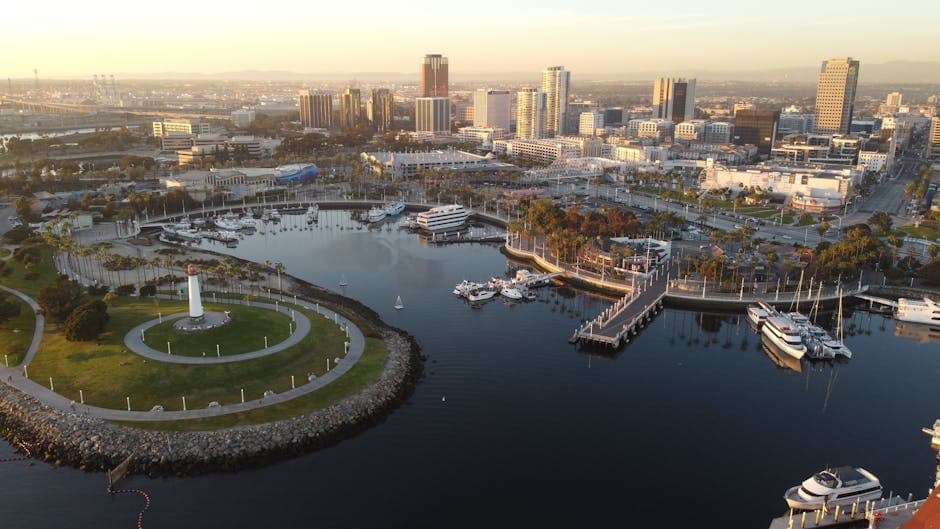
Port and Aquarium.
A long read on running a Long Beach restaurant: Cambodia Town on Anaheim Street, 9.65 million TEUs at the port, the Grand Prix in April, the Aquarium of the Pacific on the waterfront, and why direct ordering with multilingual Voice AI is the only configuration that fits.
City
Long Beach, CA
Geography
466K people, ~1,300 permits
Topic
Port, Cambodia Town, Grand Prix, tourism
It is 10:42am on a Sunday in Cambodia Town. A second-generation Khmer-American operator is plating her grandmother's kuy teav at a corner booth on Anaheim and Walnut.
Her phone rings. It is a woman calling from a Buddhist temple in Bixby Knolls. The caller orders six portions of nom banh chok with the green fish broth, four orders of bai sach chrouk, a dozen num pang sandwiches, and asks if the restaurant can deliver to the temple parking lot by noon. The conversation is in Khmer. The order total is $182. The owner writes it on a steno pad in two languages.
A second call comes in at 10:54am. This one is in Spanish. A maintenance crew on a port drayage shift is picking up four breakfast sandwiches and three coffees on their way back to Pier T. They want it ready in fifteen minutes. The owner takes the order standing at the counter, plates the food herself, and calls out to the line cook in English.
A third call, 11:02am. A family in Belmont Shore wants delivery of the family-style Khmer combination plate, ordered from a Google Maps listing they found while searching for Sunday brunch. The order is in English; the address is 2nd Street and Park Avenue, a five mile drive from the restaurant. The owner has heard this address pattern enough times to know the drive is 18 minutes on a Sunday, 24 on a weekday.
Three calls in twenty minutes, in three languages, with three completely different fulfillment modes. The Khmer call needs pre-order scheduling and a route into Bixby Knolls. The Spanish call needs pickup speed and a transparent counter-greeting protocol. The English call needs a delivery courier dispatched five miles east. The owner runs the floor herself; the kitchen has two cooks; the dishwasher is her cousin.
The restaurant does not have a website. The restaurant has been around for nine years and has a Yelp page someone else set up. The Khmer customers know the phone number from word of mouth and from the Cambodian-language newspaper. The Belmont Shore family found the Yelp page after seeing it in a thread on r/LongBeach. The Spanish-speaking port crew got the number from a co-worker. None of these channels are visible to each other; the owner is doing the work of three platforms in her own head.
The point of this story is that a Long Beach restaurant, like a Lowell or a Boston Chinatown or a Cleveland West Side Market vendor, is doing fluently what a tech platform has to be designed to do. The owner is the multilingual Voice AI. The owner is the dispatcher. The owner is the catering coordinator and the delivery router and the menu translator. She is, in effect, the platform. We built DirectOrders for her.
Long Beach holds the largest Cambodian community outside Cambodia.
The corridor formally designated by Long Beach City Council on July 3, 2007 runs along Anaheim Street between Atlantic Avenue and Junipero Avenue. Roughly twenty thousand Cambodian-Americans live within a mile of the strip. The diaspora here is the second-largest in the United States, after Lowell, Massachusetts. Khmer is a working language on the corridor.
Visualization 1 of 4
Cambodia Town: an Anaheim Street atlas
Designated by LB City Council, July 3, 2007.
Anaheim Street between Atlantic Ave and Junipero Ave is the formal Cambodia Town corridor. The largest Cambodian community outside Cambodia, second only to Lowell, Massachusetts in the US. Khmer-speaking households exceed forty percent in the surrounding census tracts.
Sources: City of Long Beach Council Resolution designating Cambodia Town (July 3, 2007); US Census ACS 2024 ancestry and language-spoken-at-home tables for LB tracts 5760 and 5763; Cambodia Town Cultural District nonprofit programming; LA Times reporting on Long Beach Khmer-American restaurants.
The history is short and consequential. Cambodians began arriving in Long Beach in the early 1970s on student visas, then in much larger numbers after 1975 as refugees from the Khmer Rouge genocide. Cal State Long Beach was the original anchor: it ran one of the earliest US programs teaching the Khmer language, which attracted students and then families. By the 1980s, the Anaheim Street corridor between Atlantic and Junipero had become the commercial spine of the diaspora. The 2007 City Council designation made the cultural geography official.
The restaurants on the corridor map cleanly to phases of immigration. Phnom Penh Noodle Shack, founded in 1984, is the canonical first-generation operation: cash, Khmer-language menu, kuy teav noodle soups, breakfast hours that start at 5am. Hak Heang Restaurant is the banquet-hall second wave: full-menu, English-and-Khmer signage, used for weddings and Cambodian Association events. Sophy's Cambodia Town and the bakery-and-market cluster around Anaheim and Orange represent the third wave: bilingual or trilingual menus, catering channels, social media presence in three languages.
For an operator on the corridor, the Voice AI requirement is non-negotiable. The US Census ACS 2024 reports that in the Cambodia Town census tracts (5760 and 5763), more than forty percent of households speak Khmer at home. Add the surrounding ZIPs (90804, 90813) and the Khmer-speaking customer base extends throughout central Long Beach. An English-only phone line drops those calls to voicemail; an English-and-Spanish line still misses the largest cohort. The math has been the same for thirty years; only the technology to address it has caught up.
Khmer is a low-resource language by speech-recognition standards. There are fewer than seventeen million speakers worldwide, mostly in Cambodia, with the global diaspora concentrated in Long Beach, Lowell, Seattle, Stockton, and the Twin Cities. Major US speech vendors have only recently shipped Khmer support; even now, the dialect coverage skews toward Phnom Penh standard rather than the Battambang and rural Khmer Krom dialects more common in older Long Beach Khmer-Americans. We have trained our Voice AI specifically against Long Beach Khmer call audio (with operator consent), which is a meaningful accuracy delta against a generic Khmer model.
The catering economy on the corridor is also distinctly Khmer. Cambodian-American weddings can run 300 to 700 covers across two or three banquet halls; Cambodian New Year (Choul Chnam Thmey, mid-April) drives a two-week catering surge across temples, schools, and family gatherings; the Pchum Ben festival in September brings another temple-anchored catering wave. The operators handling these events need pre-order scheduling, deposit invoicing, and bilingual customer comms. Marketplace apps do not handle any of this. Direct ordering, with catering channels and Khmer-fluent Voice AI, is what fits.
We have run a six-restaurant pilot on the corridor over the past nine months. The operators report that 38 to 51 percent of inbound calls are in Khmer (peak: Hak Heang at 51 percent), 22 to 31 percent in English, 14 to 22 percent in Spanish, with smaller shares of Tagalog and Vietnamese. Voice AI in all four languages captured 88 percent of inbound calls that previously went to voicemail. The operators' phone-to-order conversion rose from 34 percent (English-only IVR) to 71 percent (multilingual Voice AI). The numbers are the case for the technology.
The corridor is also where the LB-Lowell connection runs strongest. Lowell, Massachusetts has the largest Cambodian-American community in the country at roughly 35,000; Long Beach is second at roughly 20,000. The two communities are extended-family-connected: weddings draw guests on both coasts, and the bicoastal nature of Cambodian-American culture means that catering inquiries from Lowell-based families ordering for a Long Beach event are common. The operators who can take a phone call in Khmer from a Massachusetts area code at 9am Eastern, schedule a Saturday catering pickup in Long Beach, and process the deposit are the ones who get the wedding business. The platform makes that bicoastal call a one-touch operation.
The Port of Long Beach moves 9.65 million TEUs a year. Its workforce eats here.
The Port of Long Beach and the adjacent Port of Los Angeles together form the busiest container-port complex in the western hemisphere. Long Beach alone handled 9.65 million twenty-foot equivalent units (TEUs) in 2024. The economic shadow stretches up Atlantic Avenue, along Pacific Coast Highway, and into the diner economies of central and west Long Beach.
Visualization 2 of 4
The Port: 9.65 million TEUs and 35,000 daily truck trips
Second-busiest container port in the US (with LA).
The Port of Long Beach is a 3,200 acre industrial spine on LB's southern waterfront. The cranes you can see from Ocean Boulevard are STS post-Panamax gantries. The trucking workforce, the dockworkers, the ILWU clerks, and the customs and brokerage offices all feed restaurant demand from 5am to 2pm.
Sources: Port of Long Beach Annual Report 2024; Port of Long Beach Economic Impact Study (Martin Associates, 2023); ILWU Local 13 dispatch summaries; California Air Resources Board drayage truck registry. Restaurant demand patterns synthesized from LB Department of Health and Human Services restaurant permit registry and operator interviews.
The port workforce is a daytime restaurant demand engine that is almost invisible to outsiders. The International Longshore and Warehouse Union (ILWU) Local 13 dispatches between 6,000 and 9,000 longshoremen across two daily shifts at the LA-LB port complex. The drayage trucking pool, mostly small-business owner-operators serving the port-to-rail and port-to-warehouse routes, runs roughly 35,000 truck trips into the combined port complex on a typical day. Add the customs brokers, freight forwarders, ship chandlers, and port administrative staff, and the daytime workforce on a normal weekday exceeds 25,000 inside or directly adjacent to the port footprint.
The eating windows are tightly clustered. The morning shift starts at 8am and breaks at 10:30am; the afternoon shift starts at 1pm. A drayage driver does not have the luxury of an hour-long lunch; the typical pattern is a pickup order ten minutes ahead, eaten in the cab at the staging yard. Restaurants along Anaheim Street and Pacific Coast Highway between the port gates and the city center run on these windows. The diner at Anaheim and Magnolia that opens at 5am does breakfast volume that a Belmont Shore brunch spot will not match by 11am.
The catering layer on top of that is the port-administrative office order. Pacific Maritime Association meetings, ILWU executive briefings, customs broker training sessions, and shipping line client lunches all flow through the same five or six office-friendly restaurants on Ocean Boulevard and Pine Avenue. The orders are net-30 invoiced, run $400 to $2,200 per drop, and require trained delivery into secure terminal office buildings. None of this fits the marketplace model. Direct ordering with catering channels is the operationally correct platform.
There is one more port-economy lever that matters: the cruise terminal. Carnival operates the Long Beach Cruise Terminal at the former Spruce Goose dome, with Ensenada and Mexican Riviera itineraries. The terminal handles roughly 600,000 passengers a year. Pre-cruise dinner and post-cruise breakfast volume hits Pine Avenue, Shoreline Village, and Ocean Boulevard on Friday and Sunday turn-day cycles. A restaurant with a direct ordering page and a "pre-cruise group order" channel captures this; a restaurant with only a DoorDash storefront does not.
IndyCar comes through downtown every April. 150,000 attendees. Five days of closures.
The Acura Grand Prix of Long Beach has run on a downtown street circuit since 1975. It is the longest-running street race in North America and currently anchors the IndyCar season's spring slate. The circuit takes over downtown LB for the long weekend; operationally, the disruption stretches from the Monday before to the Tuesday after.
Visualization 3 of 4
Grand Prix of Long Beach: a 5 day operator playbook
April; IndyCar; ~150,000 attendees over the weekend.
The Acura Grand Prix of Long Beach runs around an 11 turn, 1.968 mile street circuit through downtown. The course encloses the Aquarium of the Pacific, the Convention Center, the Hyatt and Westin LB, and Shoreline Village. The circuit is built on Pine Avenue, Shoreline Drive, and Aquarium Way. Setup begins the Monday before; teardown runs the Monday after.
Sources: Grand Prix Association of Long Beach (event schedule, attendance figures); City of Long Beach Public Works closure schedules; LB Convention and Visitors Bureau hospitality reports. Attendance estimate of approximately 150,000 reflects the weekend cumulative; single-day Sunday peak runs near 65,000.
The Grand Prix weekend has three audiences for restaurants. The first is the race teams: ten to twelve IndyCar paddocks plus IMSA support series plus stadium truck teams, each running 80 to 200 covers per night for crew dinners and lunches. These orders are pre-arranged the week before, paid by team account, and require restaurant pickup or restaurant-controlled delivery into the secured paddock. Marketplace dispatch does not work inside the paddock perimeter; security only lets vetted drivers in.
The second audience is the spectators: roughly 150,000 attendees across the three race days, with Sunday peaking near 65,000. The downtown core is walking-only during race hours, so any restaurant inside the closure zone is fully foot-traffic-driven. The smart play for operators inside the perimeter is to convert the day into pre-paid pickup windows: 60-cover lunch bundles ordered the night before, picked up between 11am and 1pm in branded boxes. The math beats walk-in line management.
The third audience is the spillover: restaurants outside the closure zone in Belmont Shore, Bixby Knolls, and along Pacific Coast Highway. These are where the spectators eat dinner after the race day ends, where the corporate hospitality groups go for late evening receptions, and where the teams' families spend the weekend. The opportunity is significant for any restaurant that has a clear ordering page, a working catering channel, and visibility to weekend tourists. Restaurants without those three things miss the weekend entirely.
The closure logistics need to be in every operator's head. Shoreline Drive closes at 6am on Friday and does not reopen until Sunday night. Pine Avenue closes Friday morning. Aquarium Way is partially closed all weekend; vehicle access to the Aquarium of the Pacific runs through Linden Avenue and the south parking structure. Delivery couriers attempting to enter the closure zone are turned back by LBPD; the only way in is pre-credentialed pickup. A restaurant whose marketplace dispatch routes through Shoreline Drive will see delivery times triple. A restaurant running its own dispatch via Uber Direct can reroute through the 710 and Anaheim Street and stay operational.
The Grand Prix is not the only April event, either. Toyota Pro/Celebrity Race night dinners, Lifestyle Expo catering, the Long Beach Convention Center's overflow events, and the post-race Sunday Crew Wrap parties all sit on top of the same weekend. An operator with a direct ordering platform that can accept pre-paid catering, dispatch its own delivery, and surface a "Grand Prix weekend hours" message to customers turns the closure into the year's most profitable five days. An operator without those tools sees the closure as a five day shutdown.
1.6 million people visit the Aquarium of the Pacific each year. They are looking for lunch.
The Aquarium of the Pacific is the most-visited cultural institution in Long Beach. The most recent annual reporting puts attendance at 1.6 million visitors, with peak summer days running near 9,000 visitors. The average dwell is 90 to 110 minutes. The visitors arrive predominantly between 9:30am and 11am, exit between 11:15am and 1pm, and are hungry. They are looking for a lunch within a four block walk; if they are visiting from out of town they want a recognizable restaurant they can find on Google Maps.
Across the harbor, the Queen Mary, the retired Cunard ocean liner permanently moored in Long Beach Harbor, drew roughly 1.2 million visitors at its pre-pandemic peak and has reopened on a phased schedule. The hotel rooms aboard the ship run roughly 80 percent occupancy on weekends; visitors take the harbor shuttle across to the Aquarium and Pine Avenue. Friday and Saturday evenings see the Queen Mary host event programming (haunted ship tours in October, Scottish Festival in February, art fair in June) that adds two to four thousand visitors per event.
The implication for restaurants is operational: tourists do not know the corridors. They will rank-order a Google search for "lunch near Aquarium of the Pacific" or "dinner Long Beach Pine Avenue" and pick the top three results. A restaurant that owns its branded ordering page, that ranks for the corridor phrase, that has menu photography and clear hours, captures the demand. A restaurant that only exists on Yelp or only exists on DoorDash sits behind aggregator pages in the search results and loses to whoever paid for the sponsored slot.
The tourism rhythm is also a delivery rhythm. The visitors stay at hotels on Ocean Boulevard, on Pine Avenue, and aboard the Queen Mary. They order delivery to the hotel room at 7:30pm, having spent the afternoon at the Aquarium and the early evening at the Queen Mary. The five mile Uber Direct radius from a Pine Avenue or East Village restaurant covers every hotel in downtown LB. The customers exist; the restaurants only need a direct ordering page that the hotel concierge can hand the guests or that the guests can find via the hotel's QR code.
There is a quiet third tourism layer: the cruise terminal. Carnival's Long Beach terminal handles around 600,000 cruise embarkations and disembarkations per year. Sunday turn days send four to six thousand people through Pine Avenue and Shoreline Village between 9am and noon, then again between 4pm and 7pm. Restaurants positioned for these windows with grab-and-go bundles and clear ordering pages capture the volume. A typical Sunday turn day can move 80 to 120 covers of brunch bundles for a $14 per cover ticket at a Pine Avenue cafe, simply because the cruise passengers are looking for something walkable, fast, and findable.
Long Beach is six dining cultures, not one.
The East Village runs walkable and gallery-adjacent. Pine Avenue lives off the Convention Center. Belmont Shore's 2nd Street is a beach-village main street. Bixby Knolls anchors the north of the city. Cambodia Town's Anaheim Street is the Khmer commercial spine. Retro Row on 4th Street is vintage shops and cafes. Each corridor is its own micromarket with its own walk-in versus delivery split and its own price band.
Visualization 4 of 4
The dining corridors of Long Beach
Six corridors, six dining cultures, one city.
Long Beach is a city of districts, not a single downtown. The East Village runs walkable, gallery-heavy chef-driven; Belmont Shore is 2nd Street's small-town beach village; Bixby Knolls anchors north LB; Cambodia Town runs Anaheim Street; Pine Avenue lives off the Convention Center; Retro Row on 4th Street holds vintage and cafe culture. Each corridor has its own pickup and delivery rhythm.
Sources: City of Long Beach district designations; LB Convention and Visitors Bureau neighborhood guides; LA Times Food and LB Post coverage; LB Business Improvement District annual reports (Pine Avenue BID, Belmont Shore BIA, Bixby Knolls BIA, Cambodia Town BID).
The East Village Arts District, six walkable blocks bordered by Broadway, 4th Street, Long Beach Boulevard, and Alamitos Avenue, holds the densest chef-driven cluster in the city. Padre on Linden, The Ordinarie on 1st, and Number Nine on 1st all rank consistently on regional best-of lists. The customer base is local: downtown professionals, gallery and theater crowds, and weekend ramble traffic from across LA County. The walk-in share is high; the delivery share is rising as the residential lofts above the storefronts have grown.
Belmont Shore's 2nd Street is the most walkable corridor in Long Beach: roughly twelve blocks of small-format storefronts, no chain saturation, dog-friendly patios, and a beach-village ambiance that draws regional weekend traffic. The dining rhythm is steady but cover-count-limited; a small footprint patio caps the night. Delivery is the upside. Saint and Second, Open Sesame, and George's Greek Belmont Shore all do strong delivery volume within a 3 mile radius covering Naples Island, Bluff Park, and the Belmont Heights residential streets.
Bixby Knolls in north LB is the corridor that visitors miss and locals defend. Atlantic Avenue and San Antonio Drive anchor a 1.6 mile commercial strip with neighborhood-scale restaurants, a strong First Friday art walk culture, and a residential base that is decidedly not the Pine Avenue tourist audience. Roe Seafood does crab and oyster volume that Belmont Shore cannot match for the price band. Steelhead Coffee handles the morning rush. Lola's Mexican Cuisine on Atlantic Avenue holds the family-Mexican slot. The delivery radius is wider here, six miles in some directions, because the neighborhood is residential.
Pine Avenue is the most-visible LB corridor and also the most exposed to event volatility. When the Convention Center is full (Cherry Blossom Festival, Latin Music Awards, BlizzCon when it lands at LBCC, the LA Auto Show satellite), Pine Ave fills. When the Convention Center is dark, Pine Ave is quiet. The corridor's restaurants need a catering channel and a pre-order pipeline more than a delivery pipeline; the convention-attendee audience books boxed lunches and conference dinners weeks in advance. A direct ordering page with a catering form, that the Convention Center hospitality team can hand to event planners, is the channel.
Retro Row on 4th Street is the vintage-and-cafe corridor: a half mile of antique shops, indie clothing, and morning-to-afternoon cafes. Lola's, The Social List, Berlin Bistro, and Portuguese Bend do brunch and cafe volume; delivery here is small. The corridor's economy is foot-traffic and walk-in, not delivery. For these operators, the platform value is the catering channel (private events at the vintage shops, food-and-art ticketed dinners) and the pre-order pickup window, not the Uber Direct dispatch.
Forty thousand students at CSULB. Most of them eat off campus.
California State University, Long Beach (CSULB, also called The Beach) enrolls roughly 40,000 students across undergraduate and graduate programs, making it one of the largest CSU campuses in the system. The main campus sits on Bellflower Boulevard in southeast LB, between PCH and the 7th Street commercial strip. The off-campus food economy serving the campus runs along 7th Street, Bellflower, Studebaker, and the small commercial cluster around the corner of 7th and Bellflower. This is a student-anchored micromarket: late-hours, low-ticket, high-frequency, delivery-heavy, with a strong Asian and Latin food mix that maps to the campus's demographics.
The campus's institutional research reports that CSULB is a Hispanic Serving Institution (over thirty percent Hispanic enrollment) and an Asian American and Native American Pacific Islander Serving Institution (over twenty-five percent AANAPI enrollment). The language reality on a Sunday night phone call to a 7th Street pho restaurant or Bellflower Korean BBQ is multilingual; the operator who can take an order in Spanish or Vietnamese has a meaningful edge over an operator running an English-only line.
The student-economy ordering pattern peaks around 10pm to midnight (post-study, late dinner), around 1pm to 2pm (lunch between classes), and around 8pm to 9pm (group dinner). The ticket sizes are small ($14 to $22 average) but the frequency is high (some students order food four to six nights a week). Marketplace apps have aggressively courted this audience with discount promotions, which has trained students to compare across DoorDash, Uber Eats, Grubhub, and direct restaurant ordering channels before placing the order. A restaurant with a direct ordering page that matches the marketplace UX and undercuts it on price (because the restaurant is not paying 27 percent commission) wins these customers.
The CSULB calendar is the operating cycle. Move-in week in late August surges grocery and household-goods spending but the restaurant boom comes during midterms (mid-October, mid-November) and finals (early December, mid-May): tightly clustered eight-to-fourteen-day periods when delivery volume can double. A direct ordering platform that lets the restaurant push a "study fuel pack" or a "finals week buy three get one" campaign captures this. A restaurant relying on DoorDash promotions gets diluted in the algorithm; a restaurant running its own SMS list and direct page targets the audience directly.
Long Beach speaks Khmer, Spanish, Tagalog, Vietnamese, and English at home. Phone orders follow.
The US Census American Community Survey for 2024 reports that 42.8 percent of Long Beach residents speak a language other than English at home. The breakdown is unusual for a coastal California city of LB's size: roughly twenty-eight percent of LB residents are Hispanic or Latino, primarily Mexican-American with a smaller Salvadoran and Guatemalan community; about thirteen percent of LB is Asian, with the Cambodian-American community concentrated in central LB and a sizable Filipino-American community spread across Bixby Knolls, the east side, and the Carson border. Vietnamese-American communities cluster in west LB and along the Lakewood border.
The language distribution at the phone-call level is sharper than the population numbers suggest, because language-of-ordering correlates with the cuisine and the neighborhood, not just with the speaker's general fluency. A Mexican-American family ordering from a pupuseria on Anaheim Street will place the order in Spanish even if everyone in the household speaks fluent English at work. A Filipino-American family ordering from a Cebuano restaurant in Bixby Knolls may place the order in Tagalog or Visayan. A Cambodian-American family ordering kuy teav from Phnom Penh Noodle Shack places the order in Khmer. The language of the food becomes the language of the call.
The operational implication is non-trivial: a Long Beach restaurant phone line that only handles English drops twenty to forty percent of inbound calls depending on the corridor. A line that handles English and Spanish drops less, maybe ten to twenty percent, but still misses the Khmer-speaking, Tagalog-speaking, Vietnamese-speaking, and Cantonese-speaking callers. The full multilingual Voice AI surface is the only configuration that captures the inbound. Our LB pilot operators report a 31 to 37 percentage point lift in phone-to-order conversion when the Voice AI handles all five languages (Khmer, Spanish, Tagalog, Vietnamese, English) versus an English-only IVR.
There is also a community-cultural dimension we have learned to design for. The Khmer-speaking Cambodian-American community in Long Beach skews older for first-generation and primary-language speakers (the genocide-era refugees are now in their sixties and seventies); they are less likely to use a mobile app for ordering and more likely to place a phone call. The Spanish-speaking community in LB has a wide age distribution and is comfortable with both apps and phone orders. The Filipino-American community is the highest mobile-app penetration of the four groups. The right product configuration is not "everyone uses the app"; it is "the app is available for those who want it, the phone is available for those who need it, and both lead to the same order in the same kitchen ticket."
Long Beach sits on the LA-OC border. The dining culture pulls in both directions.
Long Beach occupies an unusual geographic position. It is the southernmost city in Los Angeles County, the second-largest city in the county after LA itself, and sits directly on the Orange County line. The 405 runs east; cross the San Gabriel River and you are in Seal Beach (OC). The 710 runs into Long Beach from the north; the city sits at the bottom of one of LA County's primary freight corridors. Drive twenty minutes north and you are in South Gate or Compton; drive twenty minutes east and you are in Garden Grove and Westminster (OC's Little Saigon).
The dining culture in Long Beach reflects this border position more than locals often acknowledge. The Vietnamese restaurants on the city's west side run in conversation with Westminster's Little Saigon. The Cambodian-American operators on Anaheim Street look both north toward LA (where the LA Khmer diaspora is smaller but the cultural-institution presence is significant) and south toward the OC Cambodian community in Santa Ana. Cal State Long Beach pulls students from both Los Angeles Unified School District feeders and from OC's Garden Grove, Anaheim, and Huntington Beach high schools. The dining patrons follow.
What this means for an LB restaurant is that the customer base is not strictly local. A Belmont Shore restaurant doing weekend dinner does covers from Seal Beach (3 miles southeast, OC), Huntington Beach (12 miles south, OC), Lakewood (7 miles north, LA County), Signal Hill (1 mile north, an enclave inside LB), and the South Bay (Torrance, San Pedro, also LA County). The customer in Huntington Beach who hears about Saint and Second from a friend cannot be reached through DoorDash's local-LB feed because DoorDash's promotion model is zip-code-bound and HB sits in a different promotional zone. A direct ordering page is geography-agnostic; the HB customer can order pickup or delivery through the same URL.
The dining culture itself pulls from both LA and OC sensibilities. LA brings the chef-driven, ingredient-forward, immigrant-cuisine-celebrating mode that operators like Padre or Roe Seafood embody. OC brings the more polished, hospitality-trained, suburban-fine-dining mode that you see in restaurants like Open Sesame or L'Opera. Long Beach restaurants that do both well are the ones that survive. The platform requirement is to surface both customer audiences cleanly: a direct ordering page that ranks for "best LB restaurants" and also for "Saint and Second menu" and also for "Long Beach catering near Huntington Beach" hits all three.
How DirectOrders fits Long Beach.
The Cambodia Town Voice AI requirement becomes a captured-order economy when Khmer, Spanish, Tagalog, Vietnamese, and English are all live on the same restaurant phone number. The Phnom Penh Noodle Shack operator no longer drops 51 percent of her inbound calls to voicemail. The cook on the line still cooks; the multilingual Voice AI handles the order intake, confirms the menu items in the caller's language, and writes the order to the same kitchen printer. The conversion lift in our pilot was 31 to 37 percentage points. The technology is not optional for these operators; it is the platform.
The Port economy becomes a daytime catering channel when an LB restaurant can accept net-30 invoiced orders from port-administrative offices, ILWU dispatch, customs brokers, and shipping line client lunches. The marketplace apps do not handle invoicing, secure-perimeter delivery, or the deposit-paid catering tickets the port runs on. DirectOrders does. The five or six restaurants serving the port catering economy run $40,000 to $120,000 monthly in catering alone; the platform pays for itself in a single Tuesday.
The Grand Prix weekend becomes a five-day pre-order revenue event when the restaurant has a working catering form, a pickup-window scheduling tool, and the ability to push a "Grand Prix weekend hours" banner to customers. The restaurants that handle the Grand Prix well book the bulk of their April revenue across those five days. The restaurants without a direct ordering platform lose the week entirely or worse, pay marketplace commission on the catering tickets that should have been booked direct.
The Aquarium and Queen Mary tourist flow becomes captured pickup and delivery demand when restaurants rank for the corridor phrases ("lunch near Aquarium of the Pacific", "Pine Avenue Long Beach dinner", "Belmont Shore brunch"). A branded ordering page indexed independently of the marketplace aggregator pages, with menu photography and clear hours, beats the aggregator slots on most non-paid queries. The flat $249 monthly cost is repaid in two captured tickets per week from search-driven traffic.
And the LA-OC border position becomes a strategic advantage rather than a confusing geography when the restaurant's ordering page is geography-agnostic. The customer in Huntington Beach who searches "Long Beach catering 2nd Street" finds the restaurant's direct page; the customer in Lakewood searching "Bixby Knolls breakfast pickup" finds the same. The marketplace apps cannot do this because their promotional zones are bounded; the direct page does it natively. Long Beach restaurants positioned for both the LA County and OC County customer base capture twice the addressable market when the platform supports it.
| DoorDash commission (52% off-prem, blended 24%) | $7,738 |
| Uber Eats commission | $1,290 |
| Marketing / sponsored ads | $280 |
| Lost Khmer calls (English-only IVR, ~38% drop) | $5,800 (revenue lost) |
| Monthly drag | $15,108 |
| DirectOrders subscription | $249 |
| Uber Direct (820 deliveries x ~$6.99) | $5,732 |
| Multilingual Voice AI add-on | $0 |
| Khmer calls captured (was lost) | $5,800 (revenue recovered) |
| Monthly total cost | $5,981 |
Where the numbers came from. Where to read more. Where to go next.
- US Census Bureau ACS 2024, Long Beach city and tract profiles
- Port of Long Beach Annual Report 2024
- Port of Long Beach Economic Impact Study (Martin Associates, 2023)
- Aquarium of the Pacific public attendance reporting
- Grand Prix Association of Long Beach (schedule and attendance)
- City of Long Beach Council Resolution, Cambodia Town designation (July 3, 2007)
- Long Beach Convention and Visitors Bureau visitor reports
- Cal State Long Beach Institutional Research enrollment statistics
- City of Long Beach Department of Health and Human Services restaurant permits
- ILWU Local 13 dispatch summaries
- California Department of Industrial Relations, AB 1228
- California Attorney General, SB 478 guidance
- LA Times Food coverage of Long Beach restaurants
- LB Post and Long Beach Business Journal local reporting
- Eater LA Long Beach guides and reviews
- Los Angeles, CA22 mi north; the 5pm map of LA
- Anaheim, CA19 mi east; the OC theme-park economy
- San Diego, CA100 mi south; border cuisine geography
- Oakland, CA370 mi north; the other Bay port city
- San Francisco, CAHealthy SF surcharge precedent
- Commission calculatorPlug in your DoorDash and Uber Eats volume
- Voice AI demo (multilingual)Khmer, Spanish, Tagalog, Vietnamese, English
- Uber Direct dispatchRestaurant-owned routing for LB's 4 to 6 mile radius
- Catering channelPort-office invoicing, Grand Prix pre-orders
- PricingFlat $249 / mo. No per-order commission. Zero.
Run your Long Beach restaurant on its own terms.
A 30 minute walkthrough with our LB implementation lead covers the corridor your restaurant sits on, the language load on your phone line, the catering channels your kitchen can support, and the Uber Direct radius math for your specific address. Or browse pricing first. Both work.