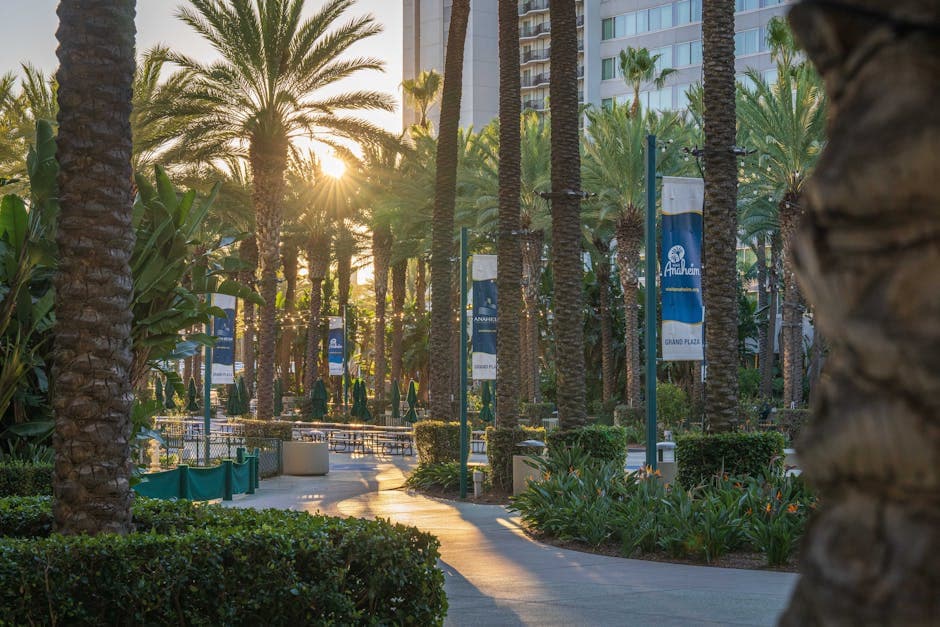
The Disney Resort Capture.
A long read on Anaheim: the off-park hotel ring around Disneyland, the Little Arabia atlas on Brookhurst Street, the Packing District, and the Honda Center event nights. And the multilingual ordering reality that ties them together.
City
Anaheim, CA
Geography
~17M park visits, ~26K hotel rooms
Topic
Off-park capture, Little Arabia, events
It is 1:14pm on a Saturday in May, and Layla Awad is finishing the noon mansaf orders at her family's Olive Tree Restaurant on Brookhurst Street, three miles west of Disneyland.
The Friday-into-Saturday rush is the rhythm of Little Arabia. Friday is jummah and the takeout boom that follows; Saturday is family weekend lunch, baby showers, engagement gatherings, and the steady drip of Disney park guests who have figured out that the family-sized mansaf platter at Olive Tree feeds a party of eight for less than two adult Disneyland tickets. The phone has rung seventeen times today already, eight of them in Arabic, six in English, two in Spanish, and one from a tour operator at a Harbor Boulevard hotel inquiring about a wedding rehearsal dinner.
Layla speaks four languages and the phone line, which is how she sees the world. The hotel concierges sometimes ask in halting English; the tour bus drivers calling from the Anaheim Resort Transit drop-off ask in Spanish; the Egyptian families calling for the koshary platter ask in Egyptian-dialect Arabic; the Lebanese aunts calling for kibbeh ask in Levantine. The Iraqi family that just rolled into the Hyatt House on Harbor will be calling at 2pm to ask whether the kitchen does samoon and dolma, and they will ask in Iraqi-accented Arabic that sounds quite different from anything in Beirut.
Layla has, until now, been the multilingual phone line. There is no IVR. There is no Voice AI. There is the cordless handset behind the cashier, and there is Layla, and there is her cousin Hussein on the days when the manakish oven is too busy for her to answer. The marketplace apps, DoorDash and Uber Eats, are turned on as a backstop for the lunch surge, but the apps cannot describe to a customer what mansaf is or how many it feeds or whether the lamb is halal. The phone does that work, and the phone is Layla.
A family from a Good Neighbor hotel on Harbor walks in at 1:32pm, fresh off the Anaheim Resort Transit bus, asking whether anything on the menu is suitable for two adults plus three children who have to be back in line at Pirates of the Caribbean by 3:15. Layla puts them on the patio with shawarma plates and three bowls of hummus, runs the card on the iPad point-of-sale, and pushes the order through to the line cook in 90 seconds. The party of four at the next table is a wedding-planning client, a wedding-rehearsal-dinner inquiry from a couple staying at the Sheraton Park, and Layla excuses herself to take a phone call from a concierge in Egyptian Arabic.
None of this scales. Layla is one person, the phone line is one phone line, and on a 230 cover Saturday with a hotel concierge demanding a return call about a 40 person rehearsal dinner, the math snaps. The marketplace apps are the cheap convenient answer; they take 28 percent of the ticket and the lamb still has to come from the kitchen and the language barrier is still there, just absorbed by the customer's frustration with a robot. The Anaheim restaurant scene, all of it, is built on the back of operators like Layla. This piece is about how to stop asking those operators to be the multilingual phone line themselves.
Anaheim is not Orange County's restaurant capital because of Disneyland. It is the restaurant capital because eight blocks west of the Resort runs a Brookhurst Street that holds the largest Arab restaurant district in the western United States, because a 1919 Sunkist citrus packing house has been converted into a 30 vendor food hall, because 41 nights a year the Honda Center fills with 17,000 fans who want pickup food in the 75 minutes after the buzzer. None of these audiences belong to Disney. All of them are off-park capture.
Disney owns the parks. Everyone else owns the perimeter.
Walt Disney opened Disneyland on a 160 acre orange grove in 1955; the park drew 50,000 visitors on opening day. Today the Disneyland Resort spans roughly 500 acres of gated park, hotels, and Downtown Disney, and pulls 17 million visits a year between Disneyland Park and Disney California Adventure. None of that food revenue is accessible to an outside restaurant. The capture happens at the perimeter: Harbor Boulevard, Katella Avenue, the Packing District, the Platinum Triangle.
Visualization 1 of 3
The Disney Resort capture map
Disneyland 1955 + DCA 2001. ~17M park visits/yr. ~26K hotel rooms in the resort ring.
Disney owns the parks plus Downtown Disney. Outside restaurants do not get tenancy inside the gates. The capture zone is the perimeter: Harbor Boulevard hotels to the east, Katella Avenue to the south, the Packing District to the northeast, and the Platinum Triangle at the Honda Center and Angel Stadium ring.
Sources: City of Anaheim Planning + Building Department; Visit Anaheim 2024 Annual Report; AECOM and TEA Theme Index 2023 (Disneyland ranked 2nd most-visited theme park in the world); Disneyland Resort historical archives; Anaheim Convention Center fact sheet. Geometry stylized for legibility, not surveyed precision.
Disneyland Park ranks as the second most-visited theme park in the world per AECOM and TEA's Theme Index 2023, behind only Magic Kingdom in Orlando. Disney California Adventure, opened in 2001, draws another roughly 9 million visits a year. The Resort holds three Disney-owned hotels (Grand Californian, Disneyland Hotel, Pixar Place) with roughly 2,400 rooms. The Good Neighbor hotel program adds another 40 plus partner hotels along Harbor and Katella, with the City of Anaheim's tourism office reporting roughly 26,000 total hotel rooms in the Anaheim Resort district as of 2024.
The interior of the Resort is closed economic territory. Outside restaurants do not get tenancy inside Downtown Disney; the leases are Disney-controlled, and the curation is consistent with the Disney brand portfolio. Earl of Sandwich, Wetzel's Pretzels, Tortilla Joe's, and the Napa Rose are inside; the Anaheim chef-driven independents are not. This is the same dynamic that shapes Orlando, with two large operational consequences for Anaheim restaurants on the perimeter: the demand is enormous, and none of it walks into your dining room without crossing a street.
The first capture zone is the Harbor Boulevard hotel strip. The Good Neighbor hotels (Hilton, Sheraton, Marriott, Hyatt House, Hampton Inn, Hojo, and the long tail of Best Western and Howard Johnson conversions) push roughly 9,500 rooms within a 12 minute walk of the Resort. Park guests get back to their rooms at 11:15pm with hungry children, having spent eight hours in the parks where the Disney churro and corn dog are the only options, and they order delivery. The order goes to whatever is open and ranked. The marketplace app rolls up the top four (whichever paid the highest sponsored placement that week); the direct ordering page, if the restaurant has one, wins on brand searches and on language-of-ordering specificity.
The second is the Anaheim Convention Center on Katella, which the City of Anaheim reports draws roughly 1 million conventioneers annually across about 200 events. A January show like the NAMM music products convention or a June show like Anime Expo will fill 1.4 million square feet of exhibit space and push catering demand to a half mile radius of operators who can write a corporate catering quote, accept a purchase order, and deliver to a hotel ballroom on a 36 hour lead time. Marketplace apps cannot do that. Direct ordering with a catering channel can.
The third is the GardenWalk open-air retail and dining center on Clementine Street, which has had a difficult tenancy history (House of Blues moved out in 2017, several brand-name restaurants have come and gone) but remains the closest open-air mall to the Resort's east flank. The fourth is the Anaheim Packing District, two miles northeast of the Resort on South Anaheim Boulevard, which is a 30 plus vendor food hall in a 1919 Sunkist citrus packing house. Each requires its own perimeter capture strategy.
The fifth and largest is the Platinum Triangle, the City of Anaheim's high-density rebuild zone east of the Resort, anchored by the Honda Center (NHL Anaheim Ducks plus arena concerts) and Angel Stadium (MLB LA Angels). Together those two venues run roughly 140 home dates plus 75 concerts a year, drawing crowds that route through the I-5, the 57, and Katella Avenue in patterns that demand pickup ordering and pre-game catering windows. The marketplace apps were not built for stadium pre-game ordering. The phone is the original stadium ordering channel, and the phone with a Voice AI is the upgrade.
The perimeter is the asset. Disney owns the gates. The Anaheim independent owns Brookhurst, the Packing District, the Honda Center halo, and the Saturday morning hotel lobby phone call from a Lebanese family staying at the Sheraton.
Brookhurst Street is the largest Arab restaurant district in the western United States.
The City of Anaheim formally designated Little Arabia in 2022, recognizing roughly two miles of Brookhurst Street between Lincoln Avenue and Katella as the cultural and commercial spine of the Arab community in Southern California. Within those two miles sit Lebanese bakeries, Egyptian falafel counters, Syrian kebab houses, Palestinian mansaf kitchens, Iraqi sweets shops, and Jordanian family restaurants.
Visualization 2 of 3
The Little Arabia atlas
Brookhurst Street, Anaheim 92804. Officially recognized by the City of Anaheim in 2022.
Brookhurst Street runs roughly two miles from Lincoln Avenue down to Katella, on the west side of Anaheim. It anchors the largest Arab community in Southern California, with restaurants representing Lebanese, Egyptian, Syrian, Palestinian, Jordanian, and Iraqi traditions. Each kitchen serves a distinct regional Arabic palate; lumping them as "Mediterranean" misses the entire point.
Sources: City of Anaheim ordinance designating Little Arabia (2022); Arab American Civic Council; LA Times Food, "Inside Little Arabia, the heart of Arab America" (2023); Voice of OC reporting; Eater LA Little Arabia guide. Restaurant addresses verified from public listings as of 2026-05-11.
The Arab American Civic Council, headquartered in Anaheim, has put the regional Arab population at roughly 300,000 across Orange County and the southern Inland Empire, with Brookhurst as the everyday food and grocery axis. Halal markets, Arabic bookstores, hijab shops, and travel agencies line the corridor; the restaurants are anchored among them. The customer is not solely Arab: Brookhurst draws Latino, Iranian, South Asian, and Disney tourist visitors with growing volume year over year. But the language of ordering on the phone, on a Friday at 12:45pm, is overwhelmingly Arabic.
Within Arabic there are mutually intelligible but distinctly different dialects. A Levantine ordering call (Lebanese, Syrian, Palestinian, Jordanian) sounds different from an Egyptian ordering call sounds different from a Khaleeji Gulf ordering call sounds different from a Maghrebi (Moroccan, Algerian) ordering call. The vocabulary of food differs too: an Iraqi customer ordering samoon does not call it the same thing a Lebanese customer would call pita; an Egyptian customer ordering koshary does not call it the same thing a Lebanese customer would call mujadara. A Voice AI that handles Modern Standard Arabic but no dialect coverage drops every dialect call to voicemail.
The food itself is regionally distinct. Aleppine kebab (Aleppo, Syria) is sweetened with sour cherry; Lebanese kafta is parsley plus onion; Egyptian taameya is fava bean rather than chickpea. Mansaf (Jordanian and Palestinian) is fermented yogurt lamb over rice and is the centerpiece of weekend family dining. Manakish (Lebanese, Palestinian) is the morning flatbread, baked across breakfast hours. Knafeh (Palestinian, Syrian) is the Eid and wedding dessert that any Little Arabia bakery makes in volume on holiday weekends. Treating all of this as "Mediterranean" on a menu page erases the entire point.
The direct ordering implication: a Brookhurst restaurant needs a branded ordering page that ranks for the dialect-specific cuisine search (mansaf Anaheim, kibbeh Brookhurst, knafeh near me, halal lamb Anaheim) plus a Voice AI that handles at minimum Modern Standard Arabic, Levantine, and Egyptian dialect, plus a delivery dispatch sized for the corridor (the Brookhurst delivery radius is roughly 2 miles to the Resort east, 2.5 miles to Garden Grove south). DirectOrders builds that stack natively.
The customer base extends beyond the local Arab community. Disney park guests staying on Harbor Boulevard increasingly order halal because halal travel is one of the fastest-growing segments in US family tourism, according to the 2024 Global Muslim Travel Index. A Lebanese-American family staying at the Hyatt House and going to Disneyland for three days will order from Brookhurst for two of the four dinners. A Saudi Arabian or Emirati tourist family staying at the Disneyland Hotel will routinely order from Olive Tree, Kareem's, or Aleppo's Kitchen on the second night of their trip. None of those orders are visible to Disney's in-park dining program; all of them are accessible to a Brookhurst restaurant with a direct ordering page in English and Arabic and a delivery dispatch that hits the Harbor Boulevard hotel strip in 14 minutes.
A 1919 Sunkist citrus packing house, now a 30 vendor food hall.
The Anaheim Packing House opened in 1919 as one of the earliest Sunkist Growers citrus packing facilities in Orange County, a region whose name was earned by the literal volume of oranges shipped east on the Santa Fe Railway from facilities exactly like this one. Anaheim was founded in 1857 by German immigrants who planted Concord grapes; phylloxera wiped out the vines in the 1880s and the city pivoted to oranges. By 1920, Orange County packed and shipped more citrus than any county in California. The Sunkist label on a 90 pound wooden crate of Anaheim Valencias was the marker of the modern produce trade.
The Packing House closed as a working facility in the 1950s, the same decade Walt Disney bought 160 acres of orange grove a few miles west and began clearing the land for Disneyland. The building sat vacant or under-used for fifty years, then was acquired by Anaheim developer Shaheen Sadeghi and reopened in 2014 as the Anaheim Packing District, a 30 plus vendor food hall in a restored Mission-Revival concrete building with the original packing-house bones intact. The Packing House anchors a three-building campus that includes Farmers Park and the Packard, a 1925 Packard auto showroom now converted to a coworking and event space.
The vendor mix is chef-driven. Iron Press makes Belgian liege waffles and sandwiches; Adya runs the Indian street food counter; Black Sheep GCB does grilled cheese; Hans' Homemade does ice cream; The Iron Press does the sit-down upstairs. There are bao counters, ramen counters, Korean fried chicken counters, a craft beer hall, and a tequila bar. The food hall model is the operational efficiency that lets a chef-driven concept rent a 200 square foot counter, run a 9-item menu, and break even at $1,800 in daily sales rather than the $7,500 a brick-and-mortar would require.
For DirectOrders, the Packing District is two operational realities at once: each individual vendor needs its own branded direct ordering page, ranking for its own name, indexed for delivery within roughly 1.5 miles. And the Packing House as a whole benefits from a unified pickup channel where a customer at the Resort can place orders against three vendors in the same checkout, with a single pickup window scheduled into the kitchen rhythm of all three. This is what direct ordering can do that marketplaces cannot. Marketplaces split each vendor into a separate transaction; direct ordering on a multi-vendor checkout lets the food hall function as one customer surface.
The Packing District also runs catering. Weekend wedding orders, corporate offsite orders from the Convention Center, and "park guest left their hotel without lunch" pickup orders all route through the same kitchen capacity. A vendor on a marketplace app cannot do a 40 person purchase-order catering quote; a vendor on a direct ordering catering channel with 36 hour lead time and a quote-to-PO flow can. The Packing District is the canonical example of why a chef-driven concept needs both retail ordering and catering ordering on the same platform.
The Honda Center plus Angel Stadium runs more event nights than any other city block in Orange County.
Honda Center seats 17,174 for hockey and up to 18,900 for concerts. Angel Stadium seats 45,517. Between them, they put roughly 140 NHL plus MLB nights on the calendar, plus 75 plus concerts and other events. The Platinum Triangle, the high-density rebuild zone wrapped around both venues, is the largest pre-game pickup ordering surface between Los Angeles and San Diego.
Visualization 3 of 3
Event nights at Honda Center + Angel Stadium
~140 NHL + MLB nights per year, plus ~75 concerts and other events.
Honda Center is a 7-minute drive east of the Resort along Katella. Angel Stadium is a 5-minute drive south of the Honda Center on the other side of the 57. Anaheim runs a near-year-round stadium event calendar, with summer doubled up by Angels weeknight games plus concert tour stops at the Honda Center.
Sources: NHL Anaheim Ducks 2024 to 2025 season schedule (41 regular-season home games); MLB LA Angels 2024 home schedule (81 regular-season home games at Angel Stadium); Honda Center concert calendar (Ticketmaster + Pollstar public listings); OC Register events coverage. Bar values are typical, not actual to-the-night, and include playoffs in NHL months.
The pre-game pickup window starts roughly 90 minutes before puck drop or first pitch. A 7pm Anaheim Ducks home game on a Tuesday pushes its order peak between 5:00pm and 6:15pm; the customer drops off the food at the parking lot tailgate or walks it into the arena seat. A 1:07pm Angels Sunday day game has a peak that starts at 11:30am for the families who get to the lot early. A concert on a Saturday at the Honda Center, where the doors open at 6:30pm for an 8pm show, peaks at 5:00pm for the upscale dinner pickup orders.
A restaurant within a 1.5 mile radius of either venue (and the Platinum Triangle holds dozens) is structurally positioned to capture the pre-game pickup window if it has a direct ordering page with reliable pickup time scheduling. The marketplace apps surface the same restaurants but route the order through a third-party delivery driver who is themselves trying to navigate the same pre-game traffic. Direct ordering with on-site pickup wins on event nights; direct ordering with Uber Direct dispatch wins on the post-event delivery window.
The post-event window is its own pattern. Hockey at 9:45pm, baseball at roughly 10:00pm on weeknights or 10:30pm on weekends, and concerts ending anywhere from 10:00pm to 11:45pm. The fans leaving the parking lots are often hungrier than they were before the game started; the post-game beer is already cracked, the kids want food, the restaurants on Lincoln Avenue and Katella east of the Resort run an extended dinner rush. Direct ordering, with longer operating hours communicated transparently on the ordering page and Uber Direct dispatch through 11:30pm, captures that demand. The kitchen that closes at 10:00pm because the marketplace was the only ordering channel and was not surfacing those late orders does not.
The concert calendar has been the operational growth surface for the Honda Center. The Ducks ownership group (Anaheim Arena Management) hosts roughly 60 concerts and arena events a year, with the summer months pushing concert volume up significantly. May through August is the highest aggregate event density (Angels at home five nights a week plus Honda Center concerts on the others). May is the densest month on the calendar; Anaheim restaurants who built around the event calendar do roughly 25 to 35 percent more revenue in May than in February.
~1 million conventioneers a year. A separate restaurant audience entirely.
The Anaheim Convention Center occupies 1.4 million square feet of exhibit space on Katella, immediately south of the Disneyland Resort, and is the largest convention center on the West Coast. Visit Anaheim's economic impact reporting puts annual conventioneer volume at roughly 1 million attendees across approximately 200 events. The largest are NAMM (National Association of Music Merchants) in January, drawing 100,000+ music industry attendees, and Anime Expo in July, drawing 350,000+ over four days, plus DCon (DesignerCon), VidCon, WonderCon, and the long tail of pharmaceutical, automotive, and dental industry trade shows.
Conventioneers eat differently from Disney park guests. They have per-diem budgets, they want quiet sit-down meals at lunch, they want catering delivered to a hospitality suite at 9:30pm, and they want a vendor that can write a corporate purchase order and accept net-30 invoicing. Marketplace apps cannot do any of that. A conventioneer ordering for a 60 person hospitality suite at the Hilton Anaheim is a business-to-business catering transaction with a purchase order number, a billing department, a tax-exempt certificate, and a 48 hour lead time. The marketplace app surfaces a delivery option to one room number; the catering channel surfaces a quote, a contract, a tax form, and an invoice.
Direct ordering with a catering channel turns the Convention Center into a recurring revenue line for any restaurant within roughly a 3 mile radius. The repeat business is annual: the same trade show is back next year, the same hospitality manager is making the same call, and the operator who handled the 2024 NAMM hospitality suite catering well is on the shortlist for 2025. The marketplace app surfaces no operational memory of the prior year's order. The direct ordering platform's customer database does. The catering channel turns a one-time hospitality suite order into a five-year repeat revenue stream.
A typical large convention generates 80 to 200 catering inquiries among Anaheim restaurants in the week of the show. The ones with a catering page get the orders; the ones without it lose them. Voice of OC's reporting on the Convention Center economy estimates that roughly 60 percent of off-property convention catering goes to a small set of operators who have built repeat relationships with hospitality managers at the Good Neighbor hotels. The bar to entry is the catering channel and a fast quoting flow. The reward is a six-figure annual revenue line.
Little Saigon is in Westminster. The pho is everywhere west of the 5.
Westminster's Little Saigon, anchored on Bolsa Avenue four miles southwest of Anaheim, is the largest Vietnamese community outside Vietnam. The 2020 US Census put the Vietnamese-American population of Orange County at over 200,000, with concentrations in Westminster, Garden Grove, Fountain Valley, and the western Anaheim neighborhoods that abut Garden Grove. The Vietnamese restaurant geography of Bolsa Avenue spills naturally north onto Brookhurst (which crosses both Garden Grove and west Anaheim) and east into central Anaheim.
West Anaheim, particularly the area south of Lincoln and west of Euclid, has a substantial Vietnamese restaurant presence anchored on Magnolia Avenue and the western stretch of Lincoln. Pho counters, bun bo Hue specialists, banh mi delis, and Vietnamese coffee shops sit interspersed with the Korean BBQ houses, the Mexican panaderias, and the Little Arabia spine. Customers crossing from Westminster to Anaheim for work, school, or the Disneyland Resort routinely order Vietnamese for dinner; a restaurant in Anaheim that ranks for "pho Anaheim" and "banh mi delivery 92804" captures a flow that the marketplace apps aggregate but do not localize.
A Vietnamese-language phone line, with a Voice AI that handles Vietnamese (Northern, Central, and Southern dialect variation included), captures the older customer base that still places orders by phone. Pew Research's 2024 work on language use among Asian American immigrant communities found that 51 percent of Vietnamese Americans speak Vietnamese at home, with the older generation (60+) placing roughly 70 percent of restaurant phone calls in Vietnamese. A monolingual English IVR drops those calls. A multilingual Voice AI captures them.
The same operational logic that applies to Brookhurst Little Arabia applies to the west Anaheim Vietnamese corridor: distinct cuisine, distinct language reality, distinct customer base, distinct ordering surface. A platform built for one shape of restaurant in one language is a platform that loses both. DirectOrders supports Vietnamese, Arabic, Spanish, Korean, and English on the same Voice AI, the same menu pages, the same ordering flow. The phone line becomes the multilingual asset it has always implicitly been.
AB 1228 set the QSR floor at $20 in 2024. The independents felt it next.
California Assembly Bill 1228, signed by Governor Newsom in September 2023 and effective April 1, 2024, set the hourly minimum wage at $20 for limited-service restaurant chains with 60 or more US locations. The law applies to the typical QSR chain (McDonald's, Chipotle, Starbucks, Panera, In-N-Out, Taco Bell) but exempts most independents and full-service operators. In Anaheim, the chain QSRs along Harbor Boulevard and Katella absorbed the wage step in the first month; the LA Times reported price increases of 8 to 14 percent at Anaheim-area chain QSRs during the second quarter of 2024.
Independents are not directly subject to the chain rate, but they hit it indirectly through labor competition. A line cook who can earn $20 at the McDonald's on Harbor will not stay at the Brookhurst falafel counter for $17. The pressure flows up the wage curve. Many Anaheim independents raised wages within the first six months of AB 1228 to retain staff, with operator surveys from the California Restaurant Association reporting mid-single-digit percentage labor cost increases across the independent segment. For a Brookhurst restaurant running 30 percent labor on $900,000 annual revenue, a 5 percent labor step is $13,500 in new annual cost.
The Resort district adds a separate layer. Disneyland Resort cast members, organized under several unions including Workers United Local 50 and the Master Services Council, negotiated wage step agreements with Disney that put Resort-area service workers above the QSR floor by 2025. Anaheim hospitality wages tracked Disney's lead, which pulled the full hospitality labor market in the city upward. The Convention Center catering wage, the Honda Center event-staff wage, and the Good Neighbor hotel restaurant wage all moved up in tandem.
The implication for direct ordering is straightforward: the labor cost step has to be recovered, and the marketplace commission line is the most controllable margin a restaurant has. The Brookhurst restaurant doing $900K with $13,500 in new annual labor cost recovers roughly 90 percent of that step by moving from a 28 percent blended marketplace commission to a $249 monthly DirectOrders subscription plus Uber Direct on a per-delivery basis. The same math at the Packing District vendor, the Honda Center halo restaurant, the Convention Center catering operator. AB 1228 makes the commission line untenable; direct ordering replaces the savings.
Five languages on a single Voice AI: Spanish, Arabic, Vietnamese, Korean, and English.
The US Census American Community Survey 2024 puts the share of Anaheim residents speaking a language other than English at home at roughly 56 percent, with Spanish first (about 39 percent of residents), followed by Vietnamese, Arabic, Korean, Tagalog, and Mandarin. The City of Anaheim's own demographic profile shows a Latino population of roughly 53 percent, Asian-American population of roughly 17 percent, and a smaller but growing Arab and North African community concentrated around Brookhurst. Anaheim is not an English-only restaurant audience by any measure.
Tourist traffic adds a separate multilingual layer. The Disneyland Resort's international visitor share has rebounded post-pandemic with strong inbound flows from Mexico (Spanish), South Korea (Korean), Brazil (Portuguese), Japan (Japanese), Australia, the United Kingdom, and the Gulf states (Arabic). A Saudi family staying at the Disneyland Hotel and ordering halal from Brookhurst will be the third Arabic call that restaurant takes in a given hour on a Saturday afternoon. A Korean family staying at the Hilton Anaheim and ordering Korean BBQ delivery from a Magnolia Avenue restaurant will place that order in Korean.
A Voice AI that genuinely handles five languages on a single phone number is rare. Most restaurant IVR systems route to a static menu in English; the customer who does not speak English hangs up. DirectOrders' Voice AI is built on a multilingual LLM stack that routes the caller to the appropriate language automatically, recognizes the dialect variation within Arabic and Spanish and Vietnamese, and places the order natively. The order goes into the same kitchen ticket system that the English orders go to. The line cook sees a single English-language ticket regardless of which language the customer ordered in.
Multilingual menu pages matter too. The ordering page rendered to a customer whose browser locale is set to Arabic should display the Arabic menu, right-to-left, with Arabic-language item descriptions and dietary tags (halal, vegetarian, dairy-free) rendered in Arabic. The same logic applies to Spanish, Vietnamese, Korean. A monolingual ordering page loses the international tourist visitor flow that the Disneyland Resort drives into Anaheim every weekend.
Why DirectOrders fits Anaheim.
The off-park capture geography becomes a ranked ordering surface when each restaurant has its own branded direct ordering page anchored to its corridor (Brookhurst, Lincoln, Katella, Magnolia, Anaheim Boulevard) and its own customer-base language. A Lebanese restaurant on Brookhurst ranks for mansaf Anaheim and halal lamb Brookhurst, not just "Mediterranean food near Disneyland". The Packing District vendor ranks for the specific concept (Iron Press waffles, Adya street food, Hans' homemade ice cream) plus the food hall reference. The Platinum Triangle pre-game pickup operator ranks for pre-Ducks game pickup, pre-Angels pickup, Honda Center catering. Each is a separate search surface, each indexed independently, each accessible to the customer who is one Google query away from finding it.
The Disney perimeter demand becomes a captured demand when the restaurant owns the ordering channel. Park guests staying on Harbor will order delivery to their room at 9:30pm; the restaurant with a direct ordering page that supports a 1.4 mile delivery radius and English plus Spanish plus Arabic on the phone captures that order. The marketplace app captures the same order but takes 22 to 30 percent of the ticket. At Anaheim Resort volume (the average Good Neighbor hotel reports 35 to 50 percent of guests ordering at least one meal off-property during their stay), the commission delta is the difference between a 6 percent margin and a 2 percent margin for a Harbor-adjacent restaurant.
The multilingual phone line becomes a Voice AI handling Spanish, Arabic, Vietnamese, Korean, and English on a single number with native dialect recognition. The owner gets back the 1.5 to 2 hours a day they were spending answering the phone in five languages. The line cook keeps cooking. The kitchen ticket system surfaces the orders in English regardless of input language. The customer in their preferred language gets the order placed accurately the first time. None of this is hypothetical; it is the existing product, available today on the standard DirectOrders subscription with no language add-on fees.
The event night surge becomes a manageable pickup window when the restaurant controls the dispatch logic. Pre-Ducks pickup at 6:00pm on a Tuesday gets dispatched on the kitchen's timing, with scheduled pickup windows on the ordering page so the customer knows the order will be ready at 6:15pm, not 5:45pm or 6:35pm. Post-Angels delivery at 10:15pm gets dispatched via Uber Direct as soon as the kitchen has the bag ready. The Convention Center hospitality suite catering at 9:30pm gets scheduled four days in advance with a corporate purchase order and a tax-exempt certificate uploaded to the catering quoting page. Each of these is a separate operational mode the marketplace apps do not support; each is native to DirectOrders.
The flat $249 monthly subscription aligns with the operator economics of the Brookhurst falafel counter, the Packing District chef-driven vendor, the Magnolia Avenue pho specialist, and the Platinum Triangle pre-game burger shop. None of these are operationally sized to pay 28 percent of revenue to a marketplace. All of them are sized to pay $249 a month for the ordering page plus the Voice AI plus the catering channel plus Uber Direct on a per-delivery basis. The math is the entire argument.
| DoorDash commission (40% off-premise, blended 22%) | $6,600 |
| Uber Eats commission | $1,440 |
| Stacked marketing / sponsored ads | $310 |
| Monthly total | $8,350 |
| DirectOrders subscription | $249 |
| Uber Direct (850 deliveries × ~$7.49) | $6,367 |
| Multilingual Voice AI (Arabic + Spanish + English) | $0 |
| Monthly total | $6,616 |
Where the numbers came from. Where to read more.
- City of Anaheim Planning + Building Department, demographic profile
- US Census Bureau ACS 2024, Anaheim and Orange County profile
- Visit Anaheim Annual Report 2024 (convention and tourism volume)
- AECOM and TEA Theme Index 2023 (Disneyland Park attendance ranking)
- Disneyland Resort historical archives and operations communications
- Anaheim Convention Center facility fact sheet and event calendar
- Arab American Civic Council (Anaheim), Little Arabia designation
- City of Anaheim Council ordinance, Little Arabia designation (2022)
- LA Times Food, "Inside Little Arabia" feature (2023)
- Eater LA, Little Arabia Brookhurst Street guide
- Voice of OC reporting on the Convention Center economy
- NHL Anaheim Ducks 2024 to 2025 season schedule
- MLB LA Angels 2024 home schedule (Angel Stadium)
- Honda Center event calendar (Ticketmaster + Pollstar listings)
- California Department of Industrial Relations, AB 1228 ($20 QSR wage)
- California Restaurant Association operator surveys (2024)
- Pew Research Center, Asian American immigrant language use (2024)
- OC Register coverage of the Platinum Triangle and Packing District
- Los Angeles, CA27 mi north; the 5pm map of LA
- San Diego, CA95 mi south; the border cuisine geography
- Orlando, FLThe other theme-park off-park capture story
- Oakland, CASame CA legal stack, different geography
- San Francisco, CAHealthy SF surcharge precedent
- Commission calculatorPlug in DoorDash volume, see the resort-district drag
- Voice AI (multilingual)Arabic, Spanish, Vietnamese, Korean, English
- Uber Direct dispatchRestaurant-owned dispatch for the Harbor strip
- Catering channelConvention Center net-30 invoicing, PO upload
- PricingFlat $249/mo. No per-order commission. Zero.
Own the perimeter. Own the phone line. Own the catering.
A 30 minute walkthrough with our Anaheim implementation lead covers the corridor your restaurant sits on (Brookhurst, Harbor, Katella, Magnolia, Lincoln, Anaheim Blvd, the Packing District), the Voice AI languages your customer base needs, and the Uber Direct radius math for your specific kitchen address. Or browse the pricing page directly. Both work.