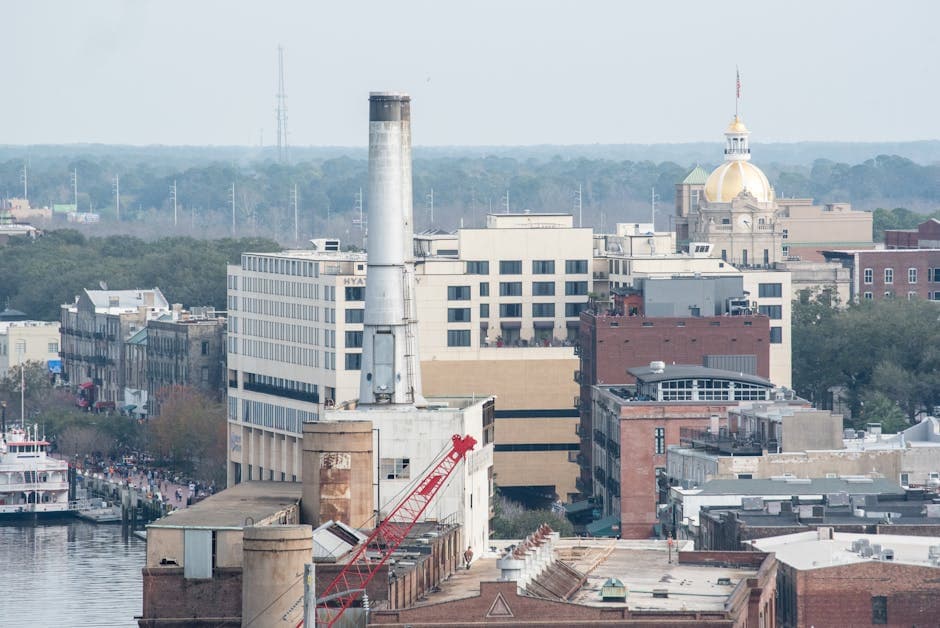
Savannah, Georgia / Dispatch
Historic District and Southern Charm
Twenty-two squares, fourteen million annual visitors, the second-largest St. Patrick's Day parade in the United States, sixteen thousand art-school students, and a baseball team that turned barnstorming into a national obsession. This is a dispatch about how Savannah's spine actually works.
Dispatch one / Opening scene
A Saturday on River Street during St. Patrick's weekend
Five in the morning. The kitchen lights on the second floor of a Bay Street restaurant we will call (because the operator is composite, not singular, though every detail of his morning is drawn from real operator interviews) Eamon's are already on. Eamon stands at his pass going through the day's prep with his sous chef. Corned beef for sixty pounds of sandwich service. Cabbage for what will become eight separate eight-hour holds at warming wells. Soda bread for two hundred and forty individual loaves stacked by the back door because the front of house cannot store them. He has been doing this Saturday for fourteen years.
The parade steps off at Abercorn and Gwinnett at ten in the morning. It is the second-largest St. Patrick's Day parade in the United States by attendance, smaller only than New York's. The Savannah parade has been running since 1824, two hundred and two consecutive years counting through pandemic cancellation pauses and back. The crowd estimates run between two hundred and fifty thousand and four hundred thousand attendees depending on the year. Visit Savannah's official statement settles on approximately three hundred thousand. The math, for a city whose year-round population is one hundred and forty-seven thousand, is that the parade nearly triples the population of the city for a single day.
By eleven the parade route along Abercorn and east on Broughton is six deep at every curb. Lead floats reach Bay Street by twelve. By that hour Eamon's kitchen is producing a sandwich every twenty-seven seconds. The bar is pouring sixteen ounce compostable cups of green beer at a rate that the bar manager reports to him every fifteen minutes via radio. The open container ordinance is the reason any of this works at scale. The City of Savannah Municipal Code permits adults to carry open containers of alcohol up to sixteen ounces within the Historic District. The district turns into a single distributed outdoor bar.
That ordinance is the operational tailwind underneath every Savannah restaurant on the holiday weekend. The bottleneck is not the bar. The bottleneck is the host stand. With no place to seat the surge, every restaurant on Bay Street and along the squares turns into a takeout window for the duration. The phone rings ninety-three times an hour during peak. Eamon's twenty-two-year-old hostess fields the inbound while answering questions about restrooms, lost children, route closures, and the location of the nearest cash machine.
Now consider the counterfactual. If even a third of the to-go orders on St. Patrick's weekend ran through a marketplace platform at the conventional thirty-percent take, Eamon's single-largest revenue weekend of the year would lose somewhere between eighteen and twenty-six thousand dollars in margin. He has done this math too. The same math has been done on Bay Street for forty years, ever since the open container ordinance turned the district into a continuous outdoor festival. The Savannah operators who survive the calendar are the ones who refused, very early, to hand the big weekend over to a percentage commission.
This dispatch is for Eamon, and for every operator inside the Historic District, on Tybee Island, at the SCAD-facing corners of Madison and Pulaski Squares, in the Bonaventure tour-route storefronts, and at the small cluster of restaurants near Grayson Stadium that absorb the Savannah Bananas pre-game crowd. The spine of all of it is the Oglethorpe grid, the twenty-two squares laid out beginning in 1733, the streets that the National Park Service calls the largest urban National Historic Landmark District in the United States. Every other layer (SCAD, the Bananas, the parade, the cemetery tours, the food canon) sits on top of that grid.
On the biggest revenue weekend of the year, the last thing I want is a thirty percent silent partner I never agreed to. The parade is mine. The corned beef is mine. The phone call is mine.
Dispatch two / The grid
The 22 squares of the Oglethorpe Plan
General James Edward Oglethorpe stepped off the ship Anne onto Yamacraw Bluff in February 1733 and laid out the first four squares of his new colony. The grid he platted is now the largest urban National Historic Landmark District in the United States. Every Savannah restaurant operates inside, around, or in relation to that grid.
The Oglethorpe grid
The 22 squares of the Historic District
General James Edward Oglethorpe laid out the first four squares in 1733 as the spine of the new colony's main town. Twenty-four squares were ultimately platted across the eighteenth and nineteenth centuries. Twenty-two survive today, anchoring the largest urban National Historic Landmark District in the United States.
First square laid out by Oglethorpe. Financial district anchor today.
Weekday lunch corridor for banking and law offices on Bryan Street.
Site of the Tomochichi monument. Government and federal building cluster.
Federal courthouse staff lunches. Catering for government meetings.
Reopened 2010 after the city demolished the 1954 parking garage that erased it.
Adjacent City Market food hall. Tourist density peaks April through October.
Anchored by the Telfair Academy art museum, founded 1886.
Museum visitor lunch traffic. Catering for Telfair gallery openings.
Statue of John Wesley, who preached in Savannah in 1736.
The Olde Pink House on the northeast corner, anchor of formal Southern dining.
Owens-Thomas House and Slave Quarters on the east side.
Historic house museum walking tour traffic. Mid-day visitor pickup.
Davenport House Museum, the building that catalyzed the historic preservation movement here in 1955.
Slow weekday traffic. Wedding photography location, weekend brunch overflow.
Named for General Nathanael Greene. Second African Baptist Church on the east side, where General Sherman read the Emancipation Proclamation locally in 1865.
East end residential, lighter tourist density.
Named for Joseph Warren, killed at Bunker Hill 1775.
Quieter east-end residential pocket, B and B catering corridor.
One of the smaller squares. Historic frame houses around the perimeter.
Walking-tour pause point. Light retail catering for square-front shops.
Western anchor of River Street trail. First African Baptist Church (founded 1773, building 1859) on the west side.
River Street tourist gateway. Pre-dinner pickup before Savannah Riverboat cruises.
Half-square, partly absorbed by Montgomery Street and the federal courthouse complex.
Closed by courthouse traffic. Limited public-facing programming.
Reduced to a small remnant by the Civic Center construction in the 1960s.
Civic Center event traffic when programming is active.
Named for the Battle of New Orleans 1815. German memorial fountain.
Civic Center adjacent. Weeknight programming spillover.
Statue of Oglethorpe. The Forrest Gump bench scene was filmed here on a temporary movable prop in 1993.
Heaviest tourist-foot-traffic square. Lucas Theatre and Savannah Theatre.
One of two squares with a basketball court, traditionally a Black neighborhood social anchor.
Local residential. Community catering and family events.
Cathedral Basilica of St John the Baptist on the east side. Flannery O'Connor childhood home on the south.
Cathedral wedding and funeral catering. Mary Flannery O'Connor tour stop.
Armillary sphere monument. Unitarian Universalist Church on the west side.
Quieter residential, dog-walking circuit. Small B and B clusters.
SCAD's Poetter Hall and Jen Library face this square. Sergeant William Jasper monument.
SCAD student day-traffic anchor. Coffee shops and grab-and-go pickup heavy.
Named for Casimir Pulaski, killed at the Siege of Savannah 1779.
Residential, lighter tourist foot. SCAD student housing adjacent.
Quiet residential square in the southwest corner. Federal-period townhouses on the perimeter.
Quietest square in the district. Limited retail. Local-only.
Gazebo center. Named for the Reverend George Whitefield, who founded the Bethesda Home for Boys 1740.
Wedding photography. Forsyth Park spillover for ceremonies.
Oglethorpe arrived with a charter from King George II to establish a thirteenth British colony as a buffer between Spanish Florida and the Carolinas. The plan he laid down at Yamacraw Bluff was not a frontier improvisation. It was a deliberate civic geometry. Each ward was anchored by a central square. Around the square the ward contained four trustee lots (intended for public buildings) and forty tithing lots (intended for residential and commercial use). The repeating unit was a self-contained neighborhood centered on a green public space.
Four squares went down in 1733: Johnson, Wright, Ellis, and Telfair. By 1733's end the population was four hundred. The town doubled in the next decade and the grid extended south. Reynolds and Oglethorpe Squares went in by 1742. Columbia and Greene Squares followed at the close of the eighteenth century as the city expanded further south. Through the nineteenth century the grid pushed steadily toward what is now Forsyth Park, with Madison, Lafayette, and Whitefield among the latest additions in the 1837 to 1851 window. The final square in the original twenty-four count was platted in 1851.
Twenty-two of the original twenty-four squares remain today. Two were lost. Liberty Square was reduced to a fragment when the federal courthouse complex pushed into Montgomery Street. Elbert Square was diminished to a small remnant by the Civic Center construction in the 1960s. Ellis Square was nearly lost entirely, paved over with a parking garage in 1954, then restored to its original geometry when the city demolished the garage and rebuilt the square in 2010. The lost squares are themselves a piece of the district's history. The preservation-versus-development tension is part of the same story.
The operational geography for a Savannah restaurant follows the grid almost exactly. River Street and Bay Street to the north feed the cruise ship and riverboat trade. The east-west axis along Broughton (originally a primary commercial street) and along Bay carries the tourist daytime walking circuit. The Bull Street north-south axis is the ceremonial spine, running from City Hall at the north end through Johnson, Wright, Chippewa, and Madison Squares before crossing into Forsyth Park. The squares themselves are both rest-stop and orientation. A guidebook tells a visitor to walk Bull Street through the squares. A restaurant on a square gets the foot traffic. A restaurant a block east of a square does not.
The implication for online ordering is that the squares concentrate demand. A restaurant on Reynolds Square (Olde Pink House on the northeast corner being the most famous example) draws from the full tourist walking circuit. A restaurant on Madison Square draws from the SCAD foot traffic that bookends class days at Poetter Hall and the Jen Library. A restaurant on Lafayette Square pulls from cathedral wedding and funeral catering at the Basilica of St John the Baptist. The squares are not interchangeable. Each one anchors a specific economy.
The Historic District as a whole sits inside a four-square-mile footprint. Every square is within a fifteen minute walk of every other square. A delivery driver routing through the district will pass within a block of a half dozen squares on any given run. An online ordering platform that respects the grid (that maps pickup windows to the operator's nearest square rather than to a faceless street address) is substantially more legible to the visitor experience than one that does not. That is the small product detail that matters in this market.
The grid is also why Savannah ranks consistently among the most walkable historic downtowns in the country. The squares break the linear march of the street grid into a sequence of pause-points. A visitor stops at Johnson, then walks to Wright, then Chippewa, then Madison. Restaurants that calibrate their pickup signage to that rhythm capture the walker. Restaurants that do not, do not.
Dispatch three / The parade
The St. Patrick's Day Parade playbook
Approximately 300,000 attendees. Two hundred years of continuous procession (since 1824, excluding pandemic pauses). The second-largest St. Patrick's Day parade in the United States after New York City. The single largest revenue day of the year for most Historic District restaurants.
One day, hour by hour
The St. Patrick's Day Parade playbook
Savannah's parade dates to 1824 and is, by attendance, the second-largest St. Patrick's Day parade in the United States after New York. Approximately 300,000 attendees descend on the Historic District. The open-container law inside the district turns every adult into a potential drinks-to-go customer for the duration.
Setup. Greening of the fountain at Forsyth.
Kitchens prepping all-day to-go service. Bar staff arriving for the long shift.
First crowds claim curb space along the route.
Breakfast pickup and to-go coffee surges from Bay Street to Forsyth.
Parade steps off at Abercorn and Gwinnett.
Two-mile route lined four to six deep. Pickup windows shrink to street-side handoff only.
Lead floats reach Bay Street. Crowd at peak density.
Open-container Historic District law activates the to-go drink economy in full.
Tail of parade clears. Crowd disperses toward squares.
Squares fill with picnic crowds. Pickup volume rolls from route-side to square-adjacent.
Post-parade Irish food rush.
Corned beef and cabbage tickets stack. Wait times push 90 minutes at anchor restaurants.
Dinner service overlaps lingering crowd.
Reservations layered with walk-ins. To-go orders for hotel-room dinners surge.
Late-night River Street. Bars at capacity.
Pizza, late-night to-go food, drink-to-go from Historic District operators.
Recovery. Last orders clearing.
Wind-down. Closing-time pickup for the morning-after staff catering.
Savannah's St. Patrick's Day Parade was first held in 1824, organized by the Hibernian Society of Savannah and rooted in the city's Irish immigrant Catholic communities. The procession has run nearly every year since, with pauses for the Civil War, World War One, World War Two, and the 2020 and 2021 pandemic cancellations. It is the second-oldest St. Patrick's Day parade in the United States, and by modern attendance it is the second-largest after the New York parade. Visit Savannah and the Savannah St. Patrick's Day Parade Committee place attendance at approximately three hundred thousand on the day, with the wider holiday weekend drawing crowds that some years touch four hundred thousand.
The parade route runs roughly two miles, beginning at Abercorn and Gwinnett near Forsyth Park, working north through the Historic District along Abercorn, turning east at Broughton, and concluding near Lafayette Square. The route closes streets from before dawn until late afternoon. Inside the district, the open-container ordinance permits adults to carry sixteen ounce containers of alcohol on the streets and in the squares. Outside the district, conventional public-consumption rules apply.
The hourly intensity profile is asymmetric. Crowd density builds from eight in the morning, peaks between noon and two when the parade body passes Bay Street and the squares fill with picnic crowds, and stays elevated through dinner service as visitors transition from parade-day mode to restaurant mode. The post-parade Irish-food rush between four and seven in the evening is the single highest-margin ticket window of the year for the dozen restaurants on Bay Street, River Street, and the squares closest to the route. The late-night economy on River Street keeps running until two or three in the morning.
The operator math is sharp. A Bay Street restaurant that services six hundred guests on a normal Saturday will service eighteen hundred or more on St. Patrick's Saturday, with ticket sizes inflated by group ordering, by drink-to-go volume, and by the simple fact that a hungry tourist a mile from anywhere else is a paying customer. The single biggest risk to that revenue is the throughput at the host stand and the phone. A marketplace platform that takes thirty percent of a single-largest-day-of-the-year ticket is removing somewhere between fifteen and forty thousand dollars from a single restaurant's annual margin, depending on size. Most Savannah operators figured that math out two decades ago.
What the operator needs on parade day is operational throughput, not delivery. Direct ordering with pre-printed pickup windows. Voice AI to handle the phone when the hostess is on hold with the bar manager. Same-day Stripe payouts on Monday morning so that the operator can pay overtime for parade-day staffing before Tuesday's payroll cycle. The platform that fits parade day is the same platform that fits every other busy day in Savannah. The shape is the same. The volume is just five times larger.
Dispatch four / The art school
The SCAD student economy
Savannah College of Art and Design enrolls approximately 16,000 students across Savannah, Atlanta, and online campuses. The Savannah campus, founded 1978, is the original and largest. SCAD has restored more than 75 historic buildings across the district. The student economy is the structural counterweight to the tourist economy.
Sixteen thousand students
The SCAD footprint
Savannah College of Art and Design enrolls approximately 16,000 students across its Savannah, Atlanta, and online campuses, with the Savannah campus the oldest and largest. The school occupies more than 75 restored buildings across the Historic District. The student economy is the second most consequential force on Savannah restaurants after tourism itself.
One of the largest art and design schools in the United States.
SCAD has restored and repurposed over 75 historic buildings across the district.
By Richard Rowan and Paula Wallace in an abandoned Savannah armory.
Degrees across design, film, fashion, animation, architecture, fine arts.
Pixar, Marvel, Disney, fashion houses, advertising agencies.
Brings filmmakers and industry guests to Savannah for a week of screenings.
Industry-attended fashion show with national press coverage.
Anchored in a restored 1853 Central of Georgia Railway depot.
Richard Rowan and Paula Wallace founded the Savannah College of Art and Design in 1978 in a former Savannah Volunteer Guard Armory on Madison Square. The first cohort was seventy-one students. By the mid-1990s SCAD had restored a dozen historic buildings across the district. By the time of this dispatch the school occupies more than seventy-five restored buildings across the Savannah campus alone, with additional campuses in Atlanta and a robust online program. Total enrollment across all campuses sits at approximately sixteen thousand students, making SCAD one of the largest dedicated art and design schools in the United States.
The student footprint shapes Historic District restaurants in ways that are not immediately obvious to a visitor. SCAD does not run a conventional residential campus. Students live in renovated historic buildings across the district. Their walk to class crosses three or four squares. The grab-and-go breakfast and lunch economies on Bull Street between Forsyth Park and Chippewa Square are oriented around their schedule, not the tourist schedule. A coffee shop on Madison Square fills at nine-fifty in the morning before the ten o'clock class change, then again at ten-fifty before the eleven, and again at one-twenty before the one-thirty. The pattern is regular and weekly. The student is not a tourist.
The SCAD calendar adds two additional rhythms on top of the ordinary class week. The fall and spring move-in weekends each September and March bring families into the district for parent-staying-overnight stays. The SCAD Film Festival in October and the SCAD Fashion Show in late spring bring filmmakers, fashion editors, and industry guests for concentrated week-long programming, with elevated catering and reception traffic across the district. Graduation in June concentrates parent-and-family dinners across the upper end of the Historic District's restaurant tier.
The implication for online ordering is that a restaurant within four blocks of an SCAD building needs to serve at least two distinct demand patterns. The tourist asks for the full experience. The student asks for a clean mobile pickup and a reliable schedule. The platform that handles both is the platform with a fast mobile-first ordering site and a scheduled-pickup flow that a student can pin to a class schedule. That is one specific product detail. Together with Voice AI for the family-week and festival-week inbound, it covers most of the SCAD-adjacent operator's calendar.
The broader cultural argument is also worth stating directly. SCAD is the reason the Historic District is preserved at the level it is today. Hundreds of buildings that would otherwise have been demolished or left to decay through the 1970s and 1980s were instead restored as classrooms, dormitories, libraries, and gallery spaces. The film industry presence in Savannah (which has grown alongside Georgia's film tax credit) flows through SCAD graduates. The fashion industry presence flows through the same channel. The restaurant operator who serves SCAD parents in May and June is, on the margin, also serving the people who built the modern Savannah skyline.
Dispatch five / The Bananas
The Savannah Bananas, or how a city's baseball team became a national obsession
The Savannah Bananas began as a collegiate summer league team in 2016, playing at Grayson Stadium near Daffin Park. The stadium itself has a longer story. Originally built in 1926 and rebuilt in 1941, it is one of the oldest continuously operated minor league ballparks in the United States. Babe Ruth and Hank Aaron both played there during barnstorming visits in their respective eras. Grayson holds approximately four thousand spectators. By the standards of modern professional baseball it is tiny. By the standards of Banana Ball, it is full to capacity at every home game.
The Banana Ball format, the team's invented variant on baseball, removed nearly everything that historically slowed the game down. A two-hour time limit. No bunts. No mound visits. No walking the batter. Every inning a team scores awards one point. Catching a foul ball gets the fan an out for the fielding team. The format is calibrated to retain attention in a TikTok-era audience. The Bananas themselves wear yellow, dance between innings, perform choreographed routines on the field, and have become, in the past few years, a national phenomenon. A Bananas-game viral video routinely clears tens of millions of views. Their tickets sell out instantly when they go on sale. They now play barnstorming road games at MLB stadiums in front of forty-thousand-plus crowds.
The home-game economy in Savannah is concentrated. Grayson Stadium is on East Victory Drive in the Daffin Park neighborhood, about fifteen minutes by car from the Historic District. The pre-game and post-game traffic stacks at the cluster of restaurants and bars along Bull Street between Forsyth Park and the stadium, and along Victory Drive itself. Tickets to a Bananas home game are nearly impossible to acquire in the secondary market. Once a fan has a ticket, the fan has planned the trip for weeks. They have already booked the dinner reservation. They have decided which restaurant gets the pre-game crowd. Reservations book up.
The operator implication is straightforward and similar in shape to the parade economy. The Bananas season packs concentrated demand into discrete home-game evenings. The restaurants that capture the surge are the ones that pre-schedule pickup windows tied to the game calendar, that answer the phone on game nights with Voice AI rather than voicemail, and that print kitchen tickets in scheduled order rather than as they happen to come in. Direct ordering with a calendar-aware schedule of pickup windows is the architectural fit. A marketplace platform that treats the Bananas game like any other Tuesday is not.
The Bananas are also a useful object lesson in how a brand built on direct relationships outperforms a brand mediated by platforms. The team does not rely on a television rights deal. They do not rely on a corporate stadium partner. They sell tickets direct, they distribute content direct, they broadcast on YouTube and the team's own channels direct. The shape of their business is the shape of a Savannah restaurant that has chosen, deliberately, to keep the customer relationship in-house. They are the local cultural anchor for an argument we have been making across this dispatch. The percentage middleman is optional.
Dispatch six / The canon
The Savannah Southern food canon
Mrs. Wilkes Dining Room. The Olde Pink House. The Grey. Paula Deen and The Lady & Sons. Husk Savannah. The food canon in Savannah is anchored by three institutions across three eras: boarding-house Southern from 1943, formal Southern from a 1771 building, and Geechee-Southern reframed by Mashama Bailey in a restored 1938 Greyhound bus terminal.
Canonical dish 1
Fried chicken (Mrs. Wilkes style)
Sema Wilkes opened the boarding-house dining room in 1943 and never took reservations.
Family-style platters served at communal tables. Line wraps around the block by 11 AM. Cash only for most of its history.
Signature: Mrs. Wilkes Dining Room (107 W Jones St, since 1943)
Canonical dish 2
She-crab soup
Lowcountry classic, served formally at Reynolds Square and along Bay Street.
Cream, blue crab, roe, sherry. The Pink House version is the formal dining benchmark in the district.
Signature: The Olde Pink House, Garibaldi's, Vic's on the River
Canonical dish 3
Shrimp and grits
Georgia and South Carolina coastal tradition, dating to the shrimping economy of Thunderbolt.
Mashama Bailey's interpretation at The Grey reframed the dish through her Bronx upbringing and Geechee heritage.
Signature: The Grey, Husk Savannah, Vic's on the River
Canonical dish 4
Country captain chicken
British-Indian colonial trade dish that became a Lowcountry staple via the port at Savannah.
Curry-spiced chicken stew with currants and almonds. Served by FDR at his Warm Springs retreat.
Signature: Olde Pink House, historic Savannah cookbooks
Canonical dish 5
Pecan pie
Georgia pecan tradition. The state's pecan orchards anchor the back-end of every Savannah dessert menu.
Praline economy peaks in October and November. River Street candy shops sample on the sidewalk.
Signature: Savannah's Candy Kitchen, Mrs. Wilkes, Back in the Day Bakery
Canonical dish 6
Fried green tomatoes
Southern garden tradition, refracted through Fannie Flagg's novel and the 1991 film shot partly in Georgia.
Cornmeal-crusted unripe tomatoes, served with remoulade or pimento cheese spread.
Signature: Lady & Sons, Pink House, Mrs. Wilkes
Canonical dish 7
Hoecakes (cornmeal griddle cakes)
Geechee Gullah tradition. Field hands and enslaved cooks made these on hoe blades over open fires.
Cornmeal, salt, water, fat. The simplest expression of Lowcountry corn culture.
Signature: The Grey, Husk Savannah, Mrs. Wilkes
Canonical dish 8
Lowcountry boil
Frogmore stew tradition from St Helena Island, spread north along the Georgia coast.
Shrimp, sausage, corn, red potato, Old Bay. The Tybee Island default for July weekend catering.
Signature: The Crab Shack on Tybee, Coach's Corner, weekend cookouts
Sema Wilkes opened a boarding-house dining room at 107 West Jones Street in 1943. She never took a reservation. The room served family-style: fried chicken, greens, sweet potatoes, beef stew, butter beans, biscuits, banana pudding, on communal tables. The line wrapped around the block by eleven in the morning. The dining room is still open. The Wilkes family still runs it. The format has not changed in over eight decades. Mrs. Wilkes Dining Room is the Savannah benchmark for boarding-house Southern: the food that feeds a working city, served the way it was served at the kitchen table.
The Olde Pink House occupies an eighteenth-century mansion on Reynolds Square, originally built in 1771 for James Habersham Jr. and named for the color the building's bricks bled through the plaster over time. The kitchen has run formal Southern fine dining out of that building for decades. She crab soup. Country captain chicken. Pecan-crusted snapper. Fried green tomatoes with pimento cheese. The dining rooms spread across multiple floors of the historic building, each with its own fireplace and antique candlelight. The Pink House is the formal-dining anchor of the district. It is the Reynolds Square economy on a single corner.
Mashama Bailey opened The Grey in 2014 in a restored 1938 Greyhound bus terminal at 109 Martin Luther King Junior Boulevard. Bailey, raised in the Bronx and trained in New York kitchens, brought a Geechee-Southern point of view back to the Savannah city of her grandmother's birth. She won the James Beard Outstanding Chef award in 2022. Her menu rotates between Geechee tradition (rice middlins, country captain, field peas) and a New York kitchen sensibility. The Grey became, by 2018, the new benchmark for what serious modern Southern dining looks like in Savannah. The room itself, with its preserved art-deco terminal interior, is the most architecturally consequential restaurant interior in the district.
Paula Deen and her sons opened The Lady & Sons on Whitaker Street in 1989, moving to its current Congress Street location in 2003. Deen's national television presence on Food Network through the 2000s turned the restaurant into a destination line that wrapped around the block. The Deen brand has cycled through controversy and rehabilitation. The line has not gone away. The Lady & Sons remains one of the highest-volume individual restaurants in the district, serving large tourist parties at family-style price points. It is, alongside Mrs. Wilkes, the boarding-house Southern of the modern era.
The canon includes other rooms worth naming: Husk Savannah (sister restaurant to the Charleston flagship, on Telfair Square, opened 2018). Vic's on the River and Garibaldi's, the River Street institutions. The Pirates' House dating back to 1753 and the original mariners' tavern. Each of these rooms operates inside the same canon but at different price points, for different visitor segments, on different blocks of the same Historic District grid. The thread is the same. The dishes are the same. The platform behind the ordering does not need to differ between them.
Dispatch seven / The ordinance
The open-container Historic District and the drink-to-go economy
Savannah is one of a small handful of American cities where adults may legally carry an open container of alcohol on public streets and sidewalks. The City of Savannah Municipal Code permits a single open container of up to sixteen ounces of beer, wine, or mixed drink within a specified portion of the Historic District, provided the container is plastic, cup, or other non-glass vessel. The boundary follows roughly the original Oglethorpe district plus the River Street and Bay Street corridors. New Orleans is the most famous comparison case in the United States; Las Vegas's Fremont Street Experience is another, narrower one. Savannah's version is older than both and is geographically the most extensive of any East Coast city.
The operational effect on the restaurant economy is direct. Every restaurant in the boundary is, in effect, a drinks-to-go vendor on top of its food menu. A two-hour dinner reservation does not need to end at the front door. A guest can leave with a sixteen ounce cup of wine and walk the squares. A bachelorette party that comes through River Street can move continuously from one establishment to the next without breaking pace. The economy that runs on top of that ordinance is unlike any other American city's. Bars compete on the cup itself. Restaurants compete on whether the dessert and the after-dinner cocktail can come in a cup that travels.
The to-go drink format also reshapes how restaurants think about online ordering. A Savannah restaurant building a direct ordering site has to support a category that does not exist in most American cities: the takeaway alcoholic drink, sold legally for outdoor consumption, served in a compostable cup with a lid. State and county alcohol licensing imposes the usual constraints (proof of age, hours, server training). The platform has to handle the receipt, the timing, and the legal age verification flow for the alcohol category. DirectOrders supports the to-go cup category as a first-class menu type, with age-verification capture at the pickup window. This is a small detail. In Savannah, the small detail is the year.
The ordinance is also part of why Savannah's tourist economy has been resilient through cycles that hurt other cities. When weather is poor in the cruise ship trade off River Street, the Historic District remains attractive because the walking experience itself is the destination. When the national restaurant industry retracts (during the 2008 to 2010 recession, during the 2020 pandemic), Savannah's outdoor-friendly drink-to-go architecture meant that operators could shift more of their revenue outside the building. That structural advantage is not available to most East Coast cities. It is one of the underwriters of why a flat-fee platform makes sense here: the operator's revenue comes through multiple legal sale channels, and they all deserve the same flat-fee treatment.
Dispatch eight / The outer ring
Wormsloe, Bonaventure, and Tybee Island
The Historic District is the dense core, but Savannah's tourism economy depends on an outer ring of destinations that pull visitors out of the district and into Chatham County's broader geography. Wormsloe State Historic Site, south of the city, preserves the eighteenth-century tabby ruins of Noble Jones's colonial estate and is reached through the most-photographed entrance allee in the American South, a one-and-a-half-mile drive under nearly four hundred live oaks draped in Spanish moss. The Wormsloe allee appears in every postcard, every Instagram travel story, every Hallmark Channel Christmas movie filmed in Savannah. The site itself draws roughly one hundred and forty thousand annual visitors.
Bonaventure Cemetery, east of the city along the Wilmington River, was made famous internationally by John Berendt's 1994 nonfiction novel Midnight in the Garden of Good and Evil and the 1997 Clint Eastwood film adaptation. The cemetery is a one-hundred-acre Victorian-era memorial park filled with marble statuary, ironwork, and live oaks. Tour operators run morning and afternoon trolley loops from the Historic District out to the cemetery and back. Bonaventure is the second-most-visited destination in Savannah behind the Historic District itself.
Tybee Island sits eighteen miles east of downtown Savannah, accessed via Highway 80 across a series of low-country causeways. Tybee is the small barrier-island beach town that serves as Savannah's Atlantic-front summer extension. Roughly three thousand permanent residents, between twenty and thirty thousand on a peak summer weekend. The Crab Shack, the Lighthouse, the pier and pavilion, and a strip of beach houses along Butler Avenue make up the operator economy. A Tybee restaurant operates on a sharply seasonal calendar. Memorial Day to Labor Day is the working year. October through March is the local-only economy plus winter holiday spillover.
The operator implication is that the Savannah restaurant market is not a single concentrated district. It is a hub and spoke. The Historic District is the hub. Wormsloe, Bonaventure, and Tybee are the spokes. A B and B in the district feeds a Tybee day-trip. A Bonaventure tour stops at a Wormsloe gift shop on the same morning. A Tybee weekend visitor drives back to the Historic District for Saturday dinner. The catering kitchen that supplies a Bonaventure tour bus also supplies the breakfast service at a Bay Street B and B. The platform that fits Savannah has to support pickup windows for the trolley stops, delivery routing to Tybee Island over the causeway, and an integrated catering inquiry desk for the multi-stop tour operator clients. One platform, four geographies.
The argument we make to operators on the outer ring is specific. Marketplace delivery platforms underperform on Tybee because the driver pool is thin and the eighteen mile one-way distance over the causeway makes the economics work poorly. Our integration with Uber Direct routes the operator's own delivery layer, on the operator's own terms, and the operator's flat monthly fee does not change whether the kitchen ships ten miles or forty. The outer ring becomes a margin equal to the inner district, not a margin degraded by distance.
Dispatch nine / The storms
Hurricane operational continuity
Atlantic hurricane season runs June 1 to November 30. Savannah's coastline is slightly more sheltered than Charleston's, but tropical system risk is material from August through October. The 1898 Georgia Hurricane is the historical floor; Matthew (2016), Irma (2017), and Dorian (2019) are the modern reference points.
Direct hit on the Georgia coast. Major historical reference storm for the region.
Savannah Historic District sustained heavy damage. The storm shaped two generations of municipal preparedness.
Heavy rain and flooding. Tybee Island evacuation.
Tybee restaurants closed for several days. River Street trade paused mid-September.
Mandatory evacuation for Chatham County coastal zones. October.
Three days of closures across the Historic District. SCAD fall quarter classes delayed.
Storm surge into River Street. September flooding on the lower riverwalk.
River Street businesses suffered direct water damage. Cleanup pushed reopenings into early October.
Mandatory evacuation early September. Storm shifted further offshore than feared.
Two evacuation weekends lost for hotel and restaurant trade. SCAD orientation week disrupted.
Savannah sits on a stretch of the Georgia coast that has been historically less exposed to direct hurricane hits than the Carolinas, but the risk is material and the cost of complacency is large. The 1898 Georgia Hurricane made landfall as a Category 4 near Brunswick and produced storm surge that overwhelmed the lower Historic District. The shape of municipal preparedness in Chatham County still references the 1898 event when planners argue for evacuation routes and shelter capacity.
The modern era has produced a string of near-miss storms. Matthew (October 2016) triggered a mandatory evacuation for coastal Chatham County and closed the Historic District for three days. Irma (September 2017) pushed storm surge up the Savannah River into River Street itself, causing direct water damage to the lower riverwalk businesses. Dorian (September 2019) prompted two evacuation weekends for what ultimately turned into an offshore pass, costing the lodging and restaurant economy roughly forty million dollars across the two lost weekends.
The operator implication is structural. Savannah restaurants need software that handles cancellation cycles cleanly, that supports an emergency-banner mode on the ordering site for evacuation announcements, that lets a Voice AI inbound desk absorb a fivefold call volume spike when a storm watch goes up. A flat monthly fee is a fixed cost in storm week, when revenue collapses, and a fixed cost in recovery week, when revenue rebuilds. A percentage commission tax extracts nothing during the closure and disproportionately extracts during the recovery. The flat-rate shape is correct for the coastal calendar.
Dispatch ten / The tax
A close read of Georgia sales tax for Savannah operators
Georgia state sales tax is four percent. Chatham County (the county that contains Savannah and most of the metro area) layers on county-level local option sales taxes that bring the combined rate inside Savannah to approximately seven percent, with some specific districts pushing slightly higher depending on Special Purpose Local Option Sales Tax (SPLOST) status and education tax (ELOST) additions in effect for any given fiscal year. The Department of Revenue and the Chatham County Tax Commissioner publish the exact rate by zip code; operators should refer to those sources for the rate that applies to their location at the time of any transaction. A typical Savannah combined sales tax for restaurant food and drink service sits around seven and a half percent on most tickets.
Alcohol sales for on-premise consumption are subject to Georgia's separate alcohol excise tax in addition to sales tax. Off-premise alcohol sales (the to-go drink category that the open container ordinance enables) are also taxed, though the tax handling differs depending on whether the container is a sealed package or an open-cup ready-to-drink format. The to-go drink format inside the Historic District boundary is treated, for tax purposes, as on-premise sale at the time of purchase, with the consumer permitted to carry the open container into the public way for consumption.
The platform-level implication is that the Savannah restaurant ordering platform has to support multiple tax configurations on the same menu. Food items at the standard combined rate. Alcohol items at the alcohol-specific treatment. Catering deliveries handled per the county's destination-based rule. A direct ordering site that does not get this right exposes the operator to back-tax liability. DirectOrders handles Georgia state and Chatham County local option taxes via the Stripe Tax integration, with rates auto-updated as the county adjusts SPLOST and ELOST schedules. The detail is invisible to the operator on a normal day. It is the reason the platform is still working on the day after a county tax adjustment.
Dispatch eleven / The thesis
How DirectOrders fits Savannah
The Oglethorpe grid runs the city. The parade economy lands fourteen million visitors a year on top of it. SCAD anchors a counterweight student economy that runs on a weekly class-schedule rhythm. The Bananas concentrate spillover demand at Grayson Stadium evenings. The Southern food canon stretches from Mrs. Wilkes's boarding-house tradition through The Olde Pink House's formal dining tradition to The Grey's modern Geechee-Southern reframing. The open-container ordinance turns the Historic District into a continuous outdoor festival. Wormsloe and Bonaventure and Tybee Island make up an outer ring of destinations. Hurricane season overlaps the late summer and fall. That is the shape of the market.
DirectOrders is the platform we would have built if we had started in Savannah. The flat two-hundred-forty-nine dollar monthly fee replaces percentage-of-revenue commission across the entire order book, including drink-to-go and catering. The catering inquiry desk captures the wedding, B and B, and tour-bus inquiries that the host stand cannot answer in real time. The Voice AI handles the phone when the bar manager is mid-pour and the kitchen is plating tasting menu course four. The Uber Direct integration handles the Tybee Island delivery that the marketplace driver pool will not route. The same-day Stripe payouts hand the operator the cash on Monday morning that the parade-weekend overtime payroll cycle requires.
And critically, the platform is a flat cost on St. Patrick's Saturday when the revenue peaks at five times normal, and a flat cost in February when the kitchen is finally quiet. The economic relationship to the calendar is correct in a way that a percentage commission on the year's single-largest revenue weekend cannot be. That is the structural fit.
The argument we have not yet made is the local one. Savannah operators have built their businesses on direct relationships with regulars, with tour operators, with wedding planners, with the SCAD parent network, with the B and B owners up and down the squares, with the cathedral wedding coordinator, with the Bananas pre-game ticket-holder who has been to fifteen home games in three seasons. None of these relationships need a marketplace to introduce them. What they need is software that captures them when they arrive and routes them cleanly to the kitchen. That is the platform shape that fits. That is what we built.
We did not build Savannah software because we were trying to win Savannah. We built software that respects the way Savannah restaurants already operate, and Savannah is the market that revealed several of the most consequential product details (the to-go drink category, the schedule-aware pickup window, the multi-tax Stripe configuration). If your kitchen is on Bay Street, on Bull Street between Forsyth and Chippewa, on Tybee, near Grayson Stadium, on one of the quieter east-end squares, or in the Bonaventure tour corridor, the platform fits. The grid will keep doing what the grid does. We will be the layer underneath.
At a glance
- $249 / month flat. No percentage cut. No per-order tax. Parade-weekend revenue stays whole.
- Schedule-aware pickup windows. Tie pickup slots to class change, Bananas home games, and Bonaventure tour stops.
- Voice AI inbound desk. Handles the phone when the bar manager is mid-pour and the kitchen is plating.
- Uber Direct delivery. Routes Tybee Island, the outer Historic District, and Bonaventure tour-route addresses.
- Drink-to-go category. First-class support for the open container ordinance, with age-verification capture at the pickup window.
- Same-day Stripe payouts. Monday morning cash for parade-weekend overtime payroll.
Six operators
Savannah operators, six ways
ICP voice from composite operators across the district and the outer ring. The River Street parade anchor. The Historic District fine-dining wedding catering operator. The SCAD-adjacent grab-and-go. The Tybee seafood operator. The B and B catering kitchen. The Grayson Stadium pre-game restaurant.
Profile 1
River Street Saturday-anchor operator
Single location on Bay or River Street, 140 covers, $36 average ticket. Heavy walk-up plus to-go.
St. Patrick's weekend Saturday. Open-container Historic District law means every adult in the crowd of three hundred thousand is a potential drinks-to-go customer. The kitchen plates corned beef. The bar pours green beer in compostable cups. The host stand is buried.
Losing on marketplaces
Marketplace platforms cannot route delivery during the parade because the route is closed. To-go pickup pushed through a marketplace tablet stack adds a layer of friction the host stand cannot afford during a 90-minute wait.
Winning on DirectOrders
Direct ordering with curb-side pickup windows printed direct to the kitchen. Voice AI handles the inbound on the moments the line phone rings. A flat-rate platform replaces percentage commissions that would otherwise hit the year's single-largest revenue day.
Profile 2
Historic District fine-dining operator (Reynolds or Madison Square)
Single location, 90 covers, $84 average ticket. Wedding and corporate catering anchor.
Cathedral wedding at the Basilica of St John the Baptist on Lafayette Square. Reception of one hundred and twenty in the operator's private dining room. SCAD parent dinners alongside on a graduation weekend.
Losing on marketplaces
Marketplace catering commissions on a $12,000 wedding ticket would have removed $3,600 in margin. SCAD parent dinners booked via marketplace would have lost another $9 per cover.
Winning on DirectOrders
Direct catering inquiry captured by Voice AI on a Tuesday afternoon when the host stand was on hold with a vendor. Structured handoff to the catering manager. Same-day Stripe payouts for the deposit.
Profile 3
SCAD-adjacent coffee and grab-and-go (Madison or Pulaski Square)
Single location, 40 seats, $11 average ticket. Student day-traffic anchor.
Class change at SCAD pushes a thirty-person line at 9:50 AM and again at 10:50 AM. Mobile-order pickup is the difference between making the next class and not.
Losing on marketplaces
Marketplace pickup apps charge $2.99 in fees on an $11 ticket. Students reroute to lower-friction pickup elsewhere. Loyalty erodes.
Winning on DirectOrders
Direct ordering site with mobile pickup pinned to class schedule. QR code on the door, students order from the curb. Stripe payouts on Monday after the weekend study cycle.
Profile 4
Tybee Island seafood operator
Single location on Tybee, 110 covers, $32 average ticket. Memorial Day to Labor Day peak.
Beach houses along Butler Avenue want delivery to the doorstep. The bridge from Savannah is a 35-minute drive each way. Tourists arriving Friday night need food before they unpack.
Losing on marketplaces
Marketplace driver pool on Tybee is thin. Orders sit unaccepted. Operator gets blamed when the marketplace fails to dispatch.
Winning on DirectOrders
Direct ordering with Uber Direct as primary delivery layer. Curb-side pickup for the Friday-evening arrival surge. Operator owns the customer relationship for the Saturday-night repeat.
Profile 5
Bonaventure tour and B and B catering operator
Catering kitchen plus retail storefront. Six staff. $480 average catered breakfast for a B and B.
Forty Historic District bed-and-breakfasts schedule breakfast service through a small set of central catering kitchens. Bonaventure Cemetery and Wormsloe trolley tours route past the same kitchens midday.
Losing on marketplaces
Marketplace catering platforms treat each B and B as a separate retail account. Operator runs forty separate logins. Schedules clash.
Winning on DirectOrders
Direct catering desk with B and B accounts as a structured cohort. Voice AI handles the morning intake. Tour-bus midday lunch baskets shipped from the same kitchen on a single schedule.
Profile 6
Bananas-night operator (Grayson Stadium adjacent)
Single location near Daffin Park, 80 covers, $24 average ticket. Bananas home game evenings.
Grayson Stadium capacity is about four thousand for Savannah Bananas home games. Tickets sell out the moment they go on sale. Pre-game and post-game traffic stacks at adjacent restaurants in the Daffin Park area.
Losing on marketplaces
Marketplace tablet sits unattended during the pre-game rush. Phone rings ninety times before tip-off. Most calls go to voicemail.
Winning on DirectOrders
Direct ordering with pre-set pickup windows tied to Bananas game schedule. Voice AI handles the phone on game nights. Tickets stack in the kitchen printer in scheduled order.
Reading list
If you want to go deeper
Internal references for Savannah operators researching the platform, the categories above, and the comparison economics.
Resource
Direct ordering site
The architecture of the customer-facing ordering page and the operator-side dashboard.
Resource
Voice AI
How the phone-answering AI handles the host-stand overflow on a parade weekend.
Resource
Uber Direct delivery
Why operator-controlled delivery economics matter more than a marketplace badge on the Tybee causeway.
Resource
Menu Brain
How the menu is parsed, embedded, and made conversational for both customer and Voice AI.
Resource
Restaurant website
Performance-tuned ordering websites that load under a second on mobile data.
Resource
Charleston, SC
Sister Lowcountry city, the wedding capital. Shared cuisine canon, different calendar.
Resource
Atlanta, GA
Same state, four hours up I-16. Buford Highway, the BeltLine, and the Black-led culinary renaissance.
Resource
DirectOrders vs DoorDash
What a 30% commission actually costs on a Savannah parade-weekend ticket.
Resource
Pricing
$249 / month flat. Everything in this dispatch is included.
Coda
What we owe Savannah
Software built for restaurants in Savannah has to start with the Savannah that exists. The Savannah that exists is a city of twenty-two squares laid down by General Oglethorpe beginning in 1733, the largest urban National Historic Landmark District in the United States, fourteen million annual visitors, three hundred thousand of them on a single March Saturday, sixteen thousand art-school students, a barnstorming baseball team that sells out a four-thousand-seat ballpark instantly, an open container ordinance that turns the district into a continuous outdoor festival, a Wormsloe allee that lives on every postcard, a Bonaventure Cemetery that Berendt and Eastwood put into the American memory, a Tybee beach economy that runs every summer weekend, and a Southern food canon that runs from Mrs. Wilkes through The Olde Pink House through The Grey.
The platform we built tries to meet that Savannah on its terms. Flat monthly fee. Schedule-aware pickup windows. Voice AI inbound. Uber Direct delivery. Drink-to-go category support. Same-day Stripe payouts. The grid told us what to build. We built it.
If you operate a restaurant in metropolitan Savannah and you want to walk through how the platform fits your kitchen, the next step is a twenty-five-minute conversation, on Zoom or in person on Bay Street, on a Madison Square corner, on Tybee, or wherever your kitchen happens to live. We will bring the grid. You bring the questions.
References
Sources used in this dispatch
- 01Savannah Historic District National Historic Landmark designation; the largest urban NHL District in the United States. National Park Service
- 02Oglethorpe Plan: founding 1733, original ward and square layout, 22 surviving squares. Historic Savannah Foundation
- 03Savannah tourism statistics and visitor mix. Visit Savannah
- 04Savannah St. Patrick's Day Parade history (since 1824) and crowd estimates. Savannah St. Patrick's Day Parade Committee
- 05Savannah College of Art and Design enrollment, programs, history. SCAD Office of Institutional Effectiveness
- 06Savannah Bananas barnstorming baseball and Grayson Stadium operations. Savannah Bananas
- 07City of Savannah open-container ordinance, Historic District boundaries. City of Savannah Municipal Code
- 08Bonaventure Cemetery history and visitor information. Bonaventure Historical Society
- 09Wormsloe State Historic Site. Georgia State Parks
- 10Tybee Island visitor information and beach economy. Visit Tybee
- 11Mrs. Wilkes Dining Room history (since 1943). Mrs. Wilkes Dining Room
- 12The Grey, Mashama Bailey, James Beard Award context. James Beard Foundation
- 13Hurricane history: 1898 Georgia Hurricane, Matthew (2016), Irma (2017), Dorian (2019). National Oceanic and Atmospheric Administration
- 14Georgia state and local sales tax rates. Georgia Department of Revenue
- 15Chatham County sales tax composition. Chatham County Tax Commissioner
- 16Eater Carolinas + Atlanta on Savannah dining. Eater
- 17Garden and Gun magazine on Southern food. Garden and Gun
- 18Forsyth Park and the Savannah park system. City of Savannah Department of Parks
Last updated 2026-05-11. Statistics are presented in good faith and drawn from the sources listed; St. Patrick's Day parade attendance figures are presented as approximately 300,000 based on Visit Savannah and Savannah St. Patrick's Day Parade Committee estimates, and should be treated as directional rather than precise counts. Hurricane history references the National Hurricane Center storm archive. SCAD enrollment reflects approximate totals across all campuses per the school's published Institutional Effectiveness reports.