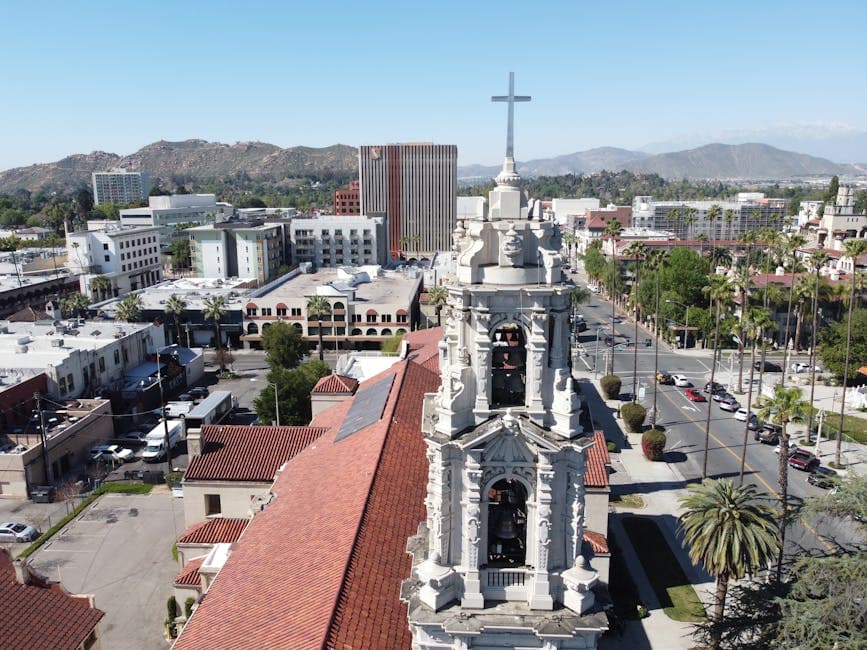
The Inland Empire capital, planted in 1873.
A long read on Riverside: the city of the parent navel orange, the Mission Inn, UC Riverside, March Air Reserve Base, a Hispanic majority, and an ordering stack built for all of it.
City
Riverside, CA
~331,000 (Census 2024)
Metro
Inland Empire
~4.7M residents
Hispanic share
~53%
Census ACS 2024
Combined sales tax
8.75%
CDTFA, current
It is 9:48 on a Sunday in March. The citrus blossoms over the Mission Inn courtyard smell like a perfumery. The Sunday brunch line is three deep.
Citrus blossom bloom in the Riverside basin runs roughly from late February through April. The fragrance is impossible to miss. Drive Magnolia Avenue with the windows down on a Sunday morning in March and you can smell the eastern orange groves of the city, eighty miles inland from the Pacific, from the I-91 off-ramp to the Mission Inn entrance.
At the Mission Inn Hotel and Spa, the bell tower is visible from blocks away. Frank Miller rebuilt the property over four campaigns between 1902 and 1932, but its bones go back to a 12-room adobe boarding house his father opened in 1876. The Sunday brunch is a Riverside ritual. The Festival of Lights is the high holiday. Theodore Roosevelt planted a parent navel orange tree at the entrance on May 7, 1903, after a transcontinental tour.
Four blocks south, on Magnolia Avenue, a family in the Wood Streets neighborhood opens a Riverside cafe's direct ordering page. Two breakfast burritos, an horchata, a cafe de olla, pickup at 10:25. They pay $24.40, all-in, no marketplace markup, no driver tip on top of a tip. The order is in Spanish on the customer side because the menu page is bilingual; the kitchen ticket prints in English.
Two miles east, at Canyon Crest Town Center next to UC Riverside, a graduate student picks up bandaged pandesal from a Filipino bakery. The order was placed in Tagalog at 9:48 through a Voice AI on the bakery's phone line. The customer is a returning patron; the AI recognized the number, retrieved the last three orders, and confirmed the same set in roughly forty seconds.
Twelve miles south, at March Air Reserve Base, a squadron command coordinator places a catering order with a downtown Riverside taqueria for a Wednesday change-of-command lunch. Thirty plates of carne asada, rice, beans, salsa roja, and a tray of guacamole. The order is on a net-15 invoice, paid by squadron MWR fund, dispatched on the catering channel of the restaurant's direct ordering platform.
Each of these is a different customer, a different language, a different geography, and a different payment model. They share two things. The Mission Inn is visible from each of their windows or off-ramps. And none of them is paying a 30 percent marketplace commission to a third party. This is what an ordering platform built for Riverside has to do.
Citrus blossoms scent the bell-tower arches. The Sunday brunch buffet at Mission Inn Restaurant is already three deep at the omelette station. A server folds linen napkins into the shape of an orange.
A family in the historic Wood Streets neighborhood opens the direct ordering page for a downtown cafe. Two breakfast burritos, an horchata, a cafe de olla. Pickup at 10:25. Pay $24.40 all-in, no marketplace markup.
A UC Riverside graduate student walks into a Filipino bakery next to a Vietnamese pho shop. The order ahead was placed in Tagalog through a Voice AI line. The pandesal is bagged warm.
A squadron command coordinator places a catering order for a Wednesday change-of-command lunch. Thirty plates of carne asada, rice, beans, salsa roja. Net-15 invoice, Riverside restaurant accepts.
Almost every California navel orange descends from one Riverside tree.
The Tibbets parent tree is not a metaphor. It is a literal living plant at the corner of Magnolia and Arlington Avenues, designated California Historical Landmark No. 20, still bearing fruit in its 150th year. The diagram below is a family tree, branching from a 1873 cutting that arrived from Bahia, Brazil via the USDA in Washington DC.
Visualization 1 of 5
The 1873 navel orange family tree.
From a Bahia, Brazil cutting to nearly every Washington navel in California.
Eliza Tibbets received three USDA-imported budded trees in 1873. Two survived at her Magnolia Avenue homestead. From those two trees, the entire California Washington navel orange industry was propagated. Almost every commercial navel orange grown in California today is a clonal descendant of the surviving Riverside parent tree.
Sources: USDA Agricultural Research Service, William Saunders correspondence; UC Agriculture and Natural Resources Citrus Variety Collection; California State Parks (Citrus SHP); California Office of Historic Preservation, Landmark No. 20; Mission Inn Foundation. Tibbets parent tree continues to bear fruit at Magnolia and Arlington Avenues in Riverside.
Eliza and Luther Tibbets receive three Washington navel orange trees from the US Department of Agriculture via William Saunders in Washington DC. The cuttings traced to Bahia, Brazil. Two of the three trees survive at the Tibbets homestead at Magnolia and Arlington Avenues in Riverside. One bears its first fruit in 1879.
Source: USDA Agricultural Research Service; California Citrus State Historic Park
Buds from the Tibbets parent tree are grafted onto thousands of seedling rootstocks across San Bernardino and Riverside counties. By 1882 Riverside is the center of California's first commercial citrus economy.
Source: University of California Agriculture and Natural Resources, Citrus Variety Collection
By the early 1890s, Riverside's per-capita income from citrus exceeds every other US city. The navel orange has transformed inland Southern California into the country's first specialty agriculture region.
Source: Press-Enterprise historical reporting; California State Parks heritage records
On May 7 1903, Theodore Roosevelt plants a second-generation parent navel orange tree at the entrance of the Mission Inn. The tree itself does not survive the century, but the ceremony fixes Riverside as the official birthplace of the California citrus industry.
Source: Mission Inn Foundation; National Register of Historic Places nomination
The University of California Citrus Experiment Station opens on the slopes of the Box Springs Mountains in eastern Riverside. The station becomes the global center for citrus science. By 1954 it is the founding department of what becomes the University of California, Riverside.
Source: UC Riverside Office of the Chancellor historical records; UC ANR
The one surviving 1873 Tibbets tree is moved to its current location at the corner of Magnolia and Arlington Avenues in 1903 and remains there today, now in its 150th year. It is designated California Historical Landmark No. 20 and continues to bear fruit annually.
Source: California Office of Historic Preservation, Landmark No. 20
Just south of the city, California Citrus State Historic Park preserves a working 248-acre citrus grove from the 1900s. The park, operated by California State Parks, is the only state park in the country dedicated to a single fruit and a single agricultural moment.
Source: California State Parks, California Citrus SHP
The orange is not a side fact for Riverside. The orange built the city. By the early 1890s the per-capita income in Riverside was the highest of any city in the country, the entire wealth pulled out of a single fruit propagated from two trees in a homestead garden. The mansions on Magnolia Avenue, the Mission Inn's expansion under Frank Miller, the founding of the UC Citrus Experiment Station in 1907, the rail lines pushed inland to ship fruit east; all of it traces to the same Tibbets garden.
That history shapes how the city eats now. Magnolia Avenue, the longest commercial spine in Riverside, is named for the trees its 19th-century planners imported from the American South to line the boulevard. Mission Inn Avenue is named for the hotel that displays Roosevelt's planting ceremony as the moment the citrus industry came of age. The neighborhoods (Wood Streets, Magnolia Center, Casa Blanca) all carry through the citrus-era street grid. Restaurants on those streets are sitting on what was originally an agricultural address.
What that means for direct ordering: Riverside identity is local, granular, and deeply place-attached. A taqueria on Casa Blanca Boulevard or a brunch concept in the Wood Streets gets brand equity from its neighborhood the way a generic suburban strip mall does not. A direct ordering page that anchors to the specific corridor (street, zip, character) outperforms a generic city-level page in both Google search and the customer's mental map.
The other consequence: when you operate a restaurant in Riverside, your customer's relationship to citrus is everyday. Cafes serve cara cara navel juice. Mexican restaurants prepare aguachile with finger limes and Riverside-grown oranges. The Mission Inn's signature Festival of Lights cocktails lean into citrus. A direct ordering menu that does not nod to that local heritage is a menu that has not done its homework.
The seventh and last line of citrus history is the most operational one: the California Citrus State Historic Park, just south of the city, preserves a 248-acre working grove from the 1900s. The park is operated by California State Parks. It is the only state park in the country dedicated to a single fruit. School groups, agritourism, and the Citrus Heritage Run weekend all bring visitors into Riverside's restaurants on a predictable annual cadence. The orange still pays the city's bills.
The largest Mission Revival hotel in the United States anchors a 12-block downtown.
The Mission Inn occupies a full city block downtown. National Historic Landmark since 1977. Christopher Columbus Miller's 1876 adobe boarding house, expanded over thirty years by his son Frank into the building you see today. Three presidents have stayed; two have planted trees. One has gotten married.
Visualization 2 of 5
Elevation: Mission Inn, downtown block.
Largest Mission Revival-style hotel in the United States.
The Mission Inn occupies a full downtown city block bounded by Mission Inn Avenue, Main Street, Orange Street, and 6th Street. Frank Miller rebuilt the property over thirty years in four campaigns, layering Mission Revival, Spanish Colonial, Moorish, and a deliberate Romantic eclecticism. It carries National Historic Landmark designation since 1977.
Sources: Mission Inn Foundation; National Register of Historic Places listing 77000346; National Park Service NHL summary; Riverside Press-Enterprise archives. Diagrammatic elevation, not to scale.
Christopher Columbus Miller opens the Glenwood Tavern, a 12-room adobe boarding house on the corner of 7th and Main streets in then-fledgling Riverside.
Source: Mission Inn Foundation
Frank Miller, son of the founder, rebuilds the property in four major construction campaigns into a Mission Revival hotel modeled on the Spanish missions of Alta California. Today's footprint occupies an entire downtown city block.
Source: National Register of Historic Places, NRHP listing 77000346
Theodore Roosevelt stays at the Mission Inn during a transcontinental tour and plants a parent navel orange tree at the entrance. The hotel becomes a presidential way station. Ronald and Nancy Reagan honeymoon here in 1952. Richard and Pat Nixon are married in the property's Saint Francis of Assisi Chapel in 1940.
Source: Mission Inn Foundation; Riverside Press-Enterprise archives
The Mission Inn is listed on the National Register of Historic Places and designated a National Historic Landmark. It is the largest Mission Revival-style hotel structure in the United States and the most architecturally significant building in the Inland Empire.
Source: National Park Service NHL summary
The Festival of Lights, the hotel's holiday tradition that begins on the Friday after Thanksgiving and runs through the first weekend of January, draws over 750,000 visitors annually and is the largest holiday lights display in the Western US. The downtown F&B economy for that six-week window does its highest revenue of the year.
Source: Riverside Convention and Visitors Bureau; Press-Enterprise reporting
The Mission Inn's role in downtown Riverside's restaurant economy is structural. Wedding season runs from April through October. The Saint Francis of Assisi Chapel inside the property hosts roughly 200 weddings annually. Each ceremony brings out-of-town guests filling the downtown F&B economy from Friday afternoon through Sunday brunch. The on-property restaurants (Mission Inn Restaurant, Las Campanas, Bella Trattoria) handle a slice of that demand; the rest spills onto Mission Inn Avenue, Main Street, and the Market Street corridor.
The Festival of Lights is the city's largest annual event. From the Friday after Thanksgiving through the first weekend of January, the hotel turns on roughly 5 million holiday lights across its block-long facade. The Riverside Convention and Visitors Bureau and Press-Enterprise both report annual attendance figures above 750,000 visitors. For six weeks, the downtown restaurants do their highest-revenue stretch of the year. Pickup and direct-order takeout becomes the limiting capacity factor; the sit-down rooms cannot accept all the inbound volume.
What that means for direct ordering: Riverside's downtown ring has a sharp seasonal calendar built around the Mission Inn's event flywheel. Restaurants that build a pre-order pickup channel, a wedding-week catering form, and a Festival of Lights surge plan capture a meaningfully larger share of the inbound demand than restaurants that funnel everything through DoorDash. The marketplace cuts on Festival of Lights week alone (six weeks at roughly 27 percent blended commission across the downtown ring) reach the low six figures for a serious operator.
The Riverside Convention Center, two blocks east of the Mission Inn, hosts a steady year-round calendar of conferences, expos, and reunions. Catering inquiries from CVC events arrive via the convention center's preferred-vendor list. Direct ordering's catering channel, with corporate net-30 invoicing and lead-time rules, is the channel through which those inquiries get fulfilled. A restaurant without that channel forwards the inquiry to email and loses it.
The Mission Inn is the anchor. The block-long facade, the National Historic Landmark plaque, the bell tower visible from blocks away, all of it underwrites a downtown experience that competes with anywhere in Southern California for civic pride. The restaurants that operate alongside the Mission Inn benefit from that proximity. The platform that handles their direct orders needs to understand that the Mission Inn's calendar is the single largest external demand driver downtown.
The most diverse UC, the only HSI + AANAPISI in the system, the descendant of the 1907 Citrus Experiment Station.
UCR enrolls roughly 26,400 students. Its lineage runs from the 1907 UC Citrus Experiment Station, which sat on the slopes of the Box Springs Mountains decades before Riverside had a four-year campus. The university was elevated to a general campus in 1954, and today the College of Natural and Agricultural Sciences still hosts the world's most cited citrus research program.
Visualization 3 of 5
UCR: 26,400 students, the most diverse UC.
Hispanic-Serving Institution + AANAPISI dual designation.
UC Riverside is the only University of California campus holding both federal Hispanic-Serving Institution (HSI) and Asian American Native American Pacific Islander-Serving Institution (AANAPISI) designations. Its undergraduate population is roughly 40 percent Hispanic / Latino, 36 percent Asian American, 7 percent African American, and 13 percent white / other (US Department of Education IPEDS, Fall 2024).
Sources: UC Riverside Office of Institutional Research, Fall 2024 census; US Department of Education IPEDS Fall 2024; US Department of Education HSI and AANAPISI eligibility lists. Demographic percentages rounded for visual clarity.
UC Riverside enrolls roughly 26,400 students across undergraduate, graduate, and professional programs as of fall 2024. About 23,000 are undergraduates.
Source: UC Riverside Office of Institutional Research, Fall 2024 census
UCR is the most diverse research university in the University of California system. It is federally designated as both a Hispanic-Serving Institution (HSI) and an Asian American, Native American, Pacific Islander-Serving Institution (AANAPISI).
Source: US Department of Education, HSI and AANAPISI eligible institutions list
UCR's lineage begins with the 1907 UC Citrus Experiment Station. The campus was elevated to a general UC campus in 1954. The College of Natural and Agricultural Sciences still hosts the world's most cited citrus research program.
Source: UC Riverside historical records; UC ANR
UCR's most recent independent economic impact study estimates the campus contributes roughly $2.4 billion in annual economic activity to the Inland Empire, including direct payroll, student spending, and supplier purchases. Off-campus dining is one of the larger student spending categories.
Source: UC Riverside Economic Impact Report 2024
The student economy is the single largest demand driver on University Avenue and Canyon Crest. Students order online; faculty and staff order pickup; graduate students order both. The mix of cuisines that thrives along these corridors is the mix of cuisines that the student body's demographic actually wants. Korean fried chicken, Vietnamese pho, Mexican taquerias, halal Mediterranean wraps, Filipino bakeries, boba shops, and chef-driven brunch concepts all coexist in a six-block stretch.
Direct ordering matters at UCR for an unusual reason: the marketplace commission burden falls most heavily on the highest-volume student-targeted operators, the same operators with the thinnest margins. A boba shop running 800 monthly drink orders at $7.50 average ticket and a 25 percent marketplace commission pays roughly $1,500 a month to DoorDash. A flat $249 a month direct ordering subscription with Uber Direct dispatch costs roughly 80 percent less for the same order volume. The student-targeted operator is the operator who cannot afford the marketplace at all and yet is the one paying the most.
The HSI + AANAPISI demographic also has a Voice AI implication. Roughly 40 percent of UCR undergraduates are Hispanic / Latino and 36 percent are Asian American. A meaningful share of phone orders come from students whose first language is not English, particularly Spanish, Tagalog, Vietnamese, Mandarin, or Korean. A multilingual Voice AI on the restaurant's phone line captures those orders. An English-only IVR drops them to voicemail.
The academic calendar drives the demand curve. Riverside's UCR-adjacent restaurants do their highest revenue weeks during the first three weeks of fall quarter (late September), Family Weekend in October, finals week in December, and the equivalent windows in winter and spring quarters. Summer (June 15 through September 20) is the lean season, with enrollment in summer sessions running roughly a fifth of fall numbers. A direct ordering platform that lets the operator schedule menu seasonality, promotional pushes, and email blasts to that calendar makes more sense than a generic year-round platform.
Twelve miles south of downtown sits the largest air mobility wing in the Air Force Reserve.
March Air Reserve Base is a joint installation hosting the 452d Air Mobility Wing (USAF Reserve), the California Air National Guard's 163rd Attack Wing, a Navy Operational Support Center, and Marine Forces Reserve. The base's catering BD calendar is one of the more predictable surges in the Riverside metro.
Combined Air Force Reserve Command, California Air National Guard 163rd Attack Wing, Navy Operational Support Center, and DoD civilian workforce.
Located 12 miles south of downtown Riverside, straddling Riverside and Moreno Valley jurisdictions.
The 452d Air Mobility Wing is the largest air mobility wing in the Air Force Reserve. C-17 Globemaster III and KC-135 Stratotanker operations.
When held, draws 200,000+ visitors over a single weekend. The largest one-weekend catering and food-vendor event in the Inland Empire calendar.
The catering pattern is regular. Squadron and command lunches Tuesday through Thursday. Change-of-command ceremonies on Friday afternoons. Retirement luncheons, promotion ceremonies, family days, and unit picnics on the predictable cadence the Air Force Reserve sets through its annual training calendar. C-17 and KC-135 crews bring family week catering when they return from deployment cycles. A Riverside restaurant that builds the catering channel on its direct ordering platform, with a net-15 or net-30 invoice option and a tax-exempt government billing form, catches the inbound inquiries the base's MWR coordinators are already sending out.
The largest single-weekend event is Thunder Over the Empire, March ARB's biennial air show. When it runs, attendance is reliably in the 200,000-plus range over a single weekend. The food vendor lottery is its own ecosystem (qualified vendors only), but the perimeter restaurants in Moreno Valley and southern Riverside (Mission Grove, Canyon Springs) absorb the spillover dinner and breakfast demand from the out-of-town crowd. A direct ordering page with a clear "no badge needed, no line" message converts the air show crowd at scale.
Direct ordering's catering channel is the operational layer that makes the base business work. Marketplace catering products from DoorDash for Business and Uber for Business exist but charge restaurants the same commission stack as consumer delivery, with a sales-led layer on top. A restaurant operator who builds the direct catering channel and the corporate billing form on the DirectOrders platform captures the base business on its own terms.
The other layer is the family ring. Active duty personnel at March ARB live broadly across Moreno Valley, Perris, Menifee, and southern Riverside city limits. Family dinner orders from those addresses are a meaningful share of any Riverside QSR or fast-casual restaurant's evening volume. Uber Direct dispatch sized for a ten-mile delivery radius covers most of the family ring without venturing into the surge-priced freeway corridors. The restaurant chooses the dispatch; the marketplace does not.
One operational note. Base access requires either a CAC card or a sponsored visitor pass; restaurants cannot drive themselves onto the installation. Catering orders are picked up at the Visitor Control Center, dropped to a base-coordinator's vehicle, or handed off at a gate. Building those handoff details into the catering form (gate location, sponsor name, contact phone) is a small surface that pays off in fewer cancellations.
Riverside crossed the Latino-majority threshold in the 2020s. Ordering tech has not caught up.
Hispanic and Latino residents are roughly 53 percent of Riverside, with Spanish at home reaching 38 percent (US Census ACS 2024). The Filipino, Vietnamese, and Korean communities sit in tight corridor pockets. A Voice AI that handles Spanish, English, Tagalog, Vietnamese, and Korean covers nearly the entire phone-order surface for the city.
Visualization 4 of 5
Riverside is a Hispanic-majority city.
100 residents, by race and ethnicity.
Per US Census Bureau ACS 2024, Hispanic and Latino residents make up roughly 53 percent of Riverside. Spanish at home reaches 38 percent. The Filipino, Vietnamese, and Korean communities concentrate in La Sierra and the UCR ring. Each dot below represents one of one hundred Riverside residents.
Sources: US Census Bureau ACS 2024, Riverside city profile and language-spoken-at-home tables. Filipino-American residents are counted within the Asian American bar; their share alone is roughly 3.5 percent of the city.
Per US Census Bureau ACS 2024 (Riverside city). Compares to ~33 percent statewide and ~19 percent nationally. Riverside is among the larger US cities to cross the Latino-majority threshold in the 2020s.
Per US Census Bureau ACS 2024 language-spoken-at-home tables. The single largest non-English home-language population in the city.
Concentrated in La Sierra, Pierce Street, and the Tyler Mall ring. Loma Linda Adventist Filipino-American community spillover from neighboring San Bernardino County.
Vietnamese cluster around University Avenue and Canyon Crest pho shops. Korean cluster sits in the UC Riverside graduate-student ring and the small but durable downtown Korean BBQ corridor.
The Hispanic-majority threshold matters for how restaurants market and how they take orders. Casa Blanca, Arlanza, and the Magnolia South corridor are anchored by Mexican bakeries, birrierias, and taquerias whose customer base is bilingual but defaults to Spanish for ordering. A direct ordering page in Spanish, with the same checkout flow as the English page, is not a translation project. It is a primary-language design problem that the marketplace apps handle inconsistently.
The phone-order surface is where the language layer becomes most operationally critical. A taqueria on Arlington Avenue takes a high share of its non-pickup orders via the phone. A Voice AI that understands Spanish (Mexican Spanish, not the Spain-Spanish accents that most off-the-shelf IVRs default to), pronounces birria and aguachile and chilaquiles correctly, and routes the order into the kitchen without dropping to voicemail recovers a meaningful share of phone calls that English-only IVRs lose.
The Filipino-American share, concentrated on La Sierra and Pierce Street, anchors Filipino bakeries (pandesal, ensaymada, ube halaya), Adventist-friendly vegetarian and pescatarian menus, and a tight Vietnamese pho corridor. The Tagalog phone-order surface is genuinely rare on the marketplace apps. A Voice AI that handles Tagalog ordering is a measurable competitive moat for any restaurant in this corridor.
The Vietnamese and Korean clusters around UC Riverside and Canyon Crest sit adjacent to but distinct from the student demand layer. Vietnamese pho shops on University Avenue, Korean fried chicken concepts on Canyon Crest, and the occasional Korean BBQ on Magnolia all draw a mixed customer base. A multilingual ordering surface (English, Vietnamese, Korean, Mandarin) on the same restaurant's direct page captures the variance.
There is no city in the IE for whom multilingual Voice AI matters more than Riverside, and there is no off-the-shelf marketplace product that handles the language load at the granularity the city's neighborhoods actually need. The direct ordering platform's Voice AI is the answer to a problem the marketplace cannot solve and will not invest to solve, because the city is not large enough on its own to merit a dedicated language model.
Downtown, UCR, Canyon Crest, Magnolia, La Sierra, Arlanza, Casa Blanca.
Riverside's food geography is street-coded. Each corridor has its own character, demographic, dominant cuisines, and customer-base language. A direct ordering page that anchors to the corridor outranks a generic city-level page in Google search and in the customer's mental map of where to order from.
Visualization 5 of 5
Seven corridors of Riverside.
Downtown, UCR, Canyon Crest, Magnolia, La Sierra, Arlanza, Casa Blanca.
The Riverside food atlas is street-coded. Downtown wraps the Mission Inn. The University Avenue corridor runs east from the I-215 freeway up to the UCR Bell Tower. Magnolia Avenue is the longest commercial spine in the city. La Sierra carries the Filipino-American and Vietnamese clusters. Casa Blanca is Hispanic-majority and one of the IE's oldest continuously Latino neighborhoods.
Sources: City of Riverside General Plan; Census Bureau ACS 2024 (by zip code); Riverside Convention and Visitors Bureau neighborhood directory. Diagrammatic, not to scale.
The Mission Inn anchors the pedestrian downtown. Festival of Lights traffic from late November through early January is the highest revenue window of the year for the F&B operators on Main and University.
Historic 1910s to 1940s craftsman bungalows. Magnolia Avenue is the city's longest commercial spine and one of the country's longest continuous magnolia tree plantings. Walkable boutique cafes and brunch concepts.
The student spine from the freeway off-ramp at I-215 to the UCR Bell Tower. Late-night, fast-casual, boba, Korean fried chicken, Vietnamese pho, halal Mediterranean. Every Hispanic-Serving Institution-friendly menu format converges here.
Canyon Crest Town Center anchors the eastern side of campus. Faculty and grad-student residential ring. Higher disposable income than University Avenue. Brunch and weekend pickup volume is the highest of any non-downtown corridor.
Riverside Plaza and the Galleria at Tyler are the city's two largest retail destinations. Mall and big-box anchored. Family dining, mid-priced QSR, and the Hispanic-majority customer base for the western corridor.
La Sierra University adjacent. Adventist community plus Filipino-American concentration. Vegetarian, vegan, and pescatarian menus play here as nowhere else in the IE. Filipino bakeries and Vietnamese soup shops are anchor formats.
Historic Hispanic-majority west and southwest Riverside neighborhoods. Taquerias, Mexican bakeries, and birrierias define the corridor. Casa Blanca is one of the oldest continuously Hispanic neighborhoods in the Inland Empire.
The corridor anchoring is real. A Mexican taqueria on Arlington Avenue in Casa Blanca ranks for tacos casa blanca, tacos arlington riverside, birria casa blanca riverside, and a long tail of Spanish-language searches that map cleanly to that customer base. It does not rank for mexican food riverside, a generic surface dominated by aggregators. The way to win is the corridor-anchored direct ordering page, indexed independently, optimized for the queries the customer actually types.
Canyon Crest is the cleanest example of why corridor anchoring matters for direct ordering. Canyon Crest Town Center is a single retail node anchoring the Canyon Crest residential ring; restaurants here serve a higher-income customer base than University Avenue, with a tighter delivery radius (most orders are within two miles), and a brunch and weekend takeout pattern that does not exist on the University Avenue student corridor a mile away. A restaurant on Canyon Crest with a direct ordering page anchored to its corridor competes on the local-pickup query in a way that a marketplace listing cannot.
The Magnolia Avenue spine, which runs roughly 12 miles from the southwest corner of the city through Magnolia Center to Arlington and out toward the 215 freeway, is the connective tissue. Direct ordering pages anchored to specific Magnolia segments (Magnolia Center versus Magnolia South versus the Riverside Plaza ring) outperform the generic Magnolia listing. The Tyler Mall ring catches the regional retail demand; the Wood Streets segment catches the residential brunch demand. They are not the same market.
Operationally, the corridor anchoring also drives delivery economics. Uber Direct dispatch is most efficient when the restaurant's typical delivery radius is well-defined. A Casa Blanca taqueria's delivery radius is roughly 3 miles. A Canyon Crest restaurant's is roughly 2.5 miles. A downtown concept's is roughly 4 miles plus the Mission Inn corridor pickup volume. Sizing the dispatch fee to each restaurant's actual radius, rather than a citywide blended average, is a meaningful margin improvement over the marketplace flat-rate structure.
Riverside is the capital of a metro of 4.7 million.
US Census Bureau ACS 2024, Riverside-San Bernardino-Ontario MSA
US Census Bureau ACS 2024, Riverside city
California Department of Finance, E-1 estimates
US Census Bureau ACS 2024
The Inland Empire (the Riverside-San Bernardino-Ontario MSA, comprising all of Riverside and San Bernardino counties) is one of the country's larger metro economies and the fastest-growing major metro in California through the 2010s and 2020s. Riverside is the largest city in the metro, with San Bernardino and Fontana following. The metro's median household income is below Orange County's and above the California state median.
The metro context matters because Riverside operators frequently serve customers from across the IE. A wedding at the Mission Inn brings out-of-town guests from San Bernardino, Redlands, Moreno Valley, Corona, and Temecula. A UCR graduation pulls families from Fontana, Rancho Cucamonga, and Ontario. The catering jobs from March Air Reserve flow to restaurants in Moreno Valley and Perris as much as in Riverside city proper.
What that means for direct ordering: a Riverside restaurant's customer base is not just the 331,000 residents of the city. It is a slice of the 4.7 million-person IE metro that travels into Riverside for events, university affairs, military proceedings, and citrus heritage tourism. A direct ordering page indexed for both city-level and metro-level queries (riverside ca restaurant + inland empire restaurant) outranks a marketplace listing on most of those queries.
The IE's spatial layout matters too. The metro is connected by the I-10, I-15, I-91, I-215, and SR 60 freeways. From Riverside, every IE city is reachable in 30 to 60 minutes of drive time. Catering operations to the broader IE are operationally feasible for a Riverside-based restaurant in a way they would not be for a more concentrated urban core. Uber Direct dispatch sized for that geometry, with the restaurant choosing when to dispatch, is the operational layer.
AB 1228, SB 478, Prop 22, and a 8.75 percent combined sales tax.
The three California laws that reshape the Riverside P&L since 2020, plus the combined sales tax stack restaurants charge customers at checkout. State 7.25 percent base + Riverside County 0.50 percent district tax + City of Riverside 1.00 percent local tax = 8.75 percent combined.
Sets the hourly minimum at $20 for limited-service chains with 60 or more US locations. Independent Riverside restaurants follow the California state minimum (currently $16.50 statewide for most employers in 2026, indexed annually). The state Fast Food Council can index the chain rate annually.
Prohibits advertising a price that does not include all mandatory fees, except taxes and government fees. Restaurants must disclose service fees, packing fees, kitchen surcharges, and any other mandatory line item in the price shown at the time of ordering.
Allows Uber, DoorDash, and similar platform drivers to remain classified as independent contractors with a curated benefits floor. Sustains the Uber Direct driver pool the rest of this page depends on.
Effective rate, current per CDTFA
California state sales and use tax California Department of Tax and Fee Administration (CDTFA), statewide base | 7.25% |
Riverside County district transactions tax Riverside County Transportation Commission (Measure A), administered via CDTFA | 0.50% |
City of Riverside local district tax City of Riverside Measure Z transactions and use tax | 1.00% |
| Combined | 8.75% |
Source: California CDTFA district tax rate finder; City of Riverside Measure Z. Combined rate effective for Riverside addresses; surrounding IE cities and unincorporated Riverside County addresses may differ.
Sources: California Department of Industrial Relations, Fast Food Minimum Wage Order; California Attorney General, SB 478 implementation guidance, June 2024; California Supreme Court, Castellanos v. State, S279622, July 25, 2024; California Department of Tax and Fee Administration district tax rate finder; City of Riverside Measure Z transactions and use tax.
How DirectOrders fits Riverside.
The citrus history is a brand asset. A direct ordering page anchored to Riverside's specific corridor (Magnolia, Wood Streets, downtown, Canyon Crest, La Sierra, Casa Blanca) carries identity that the marketplace listing strips out. The customer who orders from a downtown Riverside restaurant wants to feel proximate to the Mission Inn; the customer who orders from Casa Blanca wants to feel proximate to one of the IE's oldest Latino neighborhoods. The direct page surfaces that. The DoorDash listing does not.
The Hispanic-majority demographic is a Voice AI requirement, not a feature. A multilingual Voice AI that handles Spanish, Tagalog, Vietnamese, Korean, and Mandarin on the restaurant's phone line captures phone-order volume that English-only IVRs lose to voicemail. The taqueria on Arlington Avenue. The Filipino bakery on La Sierra. The pho shop on Canyon Crest. The boba shop on University Avenue. Each operates on a non-English first-language customer base, and each loses orders when the phone line cannot handle it.
The Mission Inn Festival of Lights window (late November through early January) is the highest-revenue six weeks of the year for downtown operators. A direct ordering platform with a pre-order pickup queue, a catering channel, and Uber Direct dispatch the restaurant controls captures that demand without the marketplace's commission overhead. A six-week stretch at marketplace blended commissions can leave $20,000 to $80,000 on the table for a serious downtown operator. The DirectOrders subscription at $249 a month plus Uber Direct's per-delivery fee captures that same revenue at a flat predictable cost.
The UC Riverside academic calendar drives demand peaks the restaurant operator can plan against. Direct ordering with email lists, scheduled promotions, and seasonal menu changes built into the platform lets the restaurant work that calendar. The marketplace flattens the calendar into a single year-round funnel and skims a flat 27 percent off the top.
The March Air Reserve catering channel is genuinely unmatched on consumer-facing marketplaces. Net-15 or net-30 invoicing, tax-exempt billing, base-access handoff details, gate location, sponsor name: a direct ordering platform's catering channel handles all of those fields natively. The marketplace's catering products charge restaurant-side commissions on top of consumer-side delivery fees and do not handle base-access logistics at all.
The combined 8.75 percent sales tax stack is competitive within California (lower than Los Angeles, comparable to Anaheim, higher than San Diego). The pricing impact on consumer orders is real but predictable. A direct ordering platform with SB 478-compliant all-in pricing displayed at checkout is the customer experience layer that respects the law and the customer. The marketplace apps are inconsistent at this; the direct page is not.
A 1873 navel orange tree, a 1876 Mission Inn, a 1907 Citrus Experiment Station, a 53 percent Hispanic majority, a 26,400-student campus, and the largest air mobility wing in the Reserve. Riverside has a stack. The platform that takes its orders should match it.
Where the numbers came from. Where to read more.
- US Census Bureau, ACS 2024 (Riverside city and IE MSA)Population, Hispanic and Latino share, language at home, median income.
- California Department of Tax and Fee Administration (CDTFA)Combined sales tax (state 7.25% + Riverside County 0.5% + City 1% = 8.75%).
- California Department of Industrial Relations (AB 1228)Fast Food Minimum Wage Order, effective April 1, 2024.
- California Attorney General (SB 478)Junk fee transparency law implementation guidance.
- California Supreme Court, Castellanos v. State (Prop 22)Prop 22 upheld unanimously, July 25, 2024.
- USDA Agricultural Research ServiceParent Washington navel orange tree, Bahia Brazil origin, 1873 Riverside introduction.
- California State Parks, California Citrus SHPCalifornia Citrus State Historic Park, 248-acre working grove preservation.
- California Office of Historic Preservation, Landmark No. 20Parent Washington Navel Orange Tree designation.
- National Park Service, NHL summary (Mission Inn)Mission Inn National Historic Landmark designation, 1977.
- Mission Inn FoundationHotel construction history, presidential visits, Festival of Lights heritage.
- UC Riverside Office of Institutional ResearchFall 2024 enrollment, demographic breakdown, Hispanic-Serving Institution designation.
- UC ANR Citrus Variety CollectionCitrus Experiment Station history (1907 founding), variety lineage records.
- March Air Reserve Base public affairs452d Air Mobility Wing personnel and mission summary.
- Riverside Press-EnterpriseLocal daily reporting; Festival of Lights and downtown F&B coverage.
- Riverside Convention and Visitors BureauFestival of Lights visitor numbers, downtown event calendar.
- City of Riverside, Measure Z transactions and use tax1.0 percent city-level local tax.
- Los Angeles, CA60 mi west; the 5pm drive-time tax
- San Diego, CA95 mi south; border cuisine geography
- Anaheim, CA40 mi west; Orange County resort corridor
- Irvine, CA50 mi west; planned-city restaurant economy
- Long Beach, CA65 mi west; port-adjacent restaurant geography
- Fresno, CA240 mi north; Central Valley citrus belt
- Commission calculatorPlug in your DoorDash volume, see the Riverside dollar drag
- Voice AI demo (multilingual)Hear Spanish, Tagalog, and Vietnamese orders
- Uber Direct dispatchHow restaurant-owned dispatch beats marketplace
- Catering channelNet-15 / net-30 invoicing for March ARB and CVC
- PricingFlat $249 / mo. No per-order commission. Zero.
Plant your own tree.
A 30 minute walkthrough with our Riverside implementation lead covers the corridor your restaurant sits on, the Voice AI languages your customer base needs, the Mission Inn or UCR or March ARB calendar effects to plan against, and the Uber Direct radius math for your specific kitchen address.