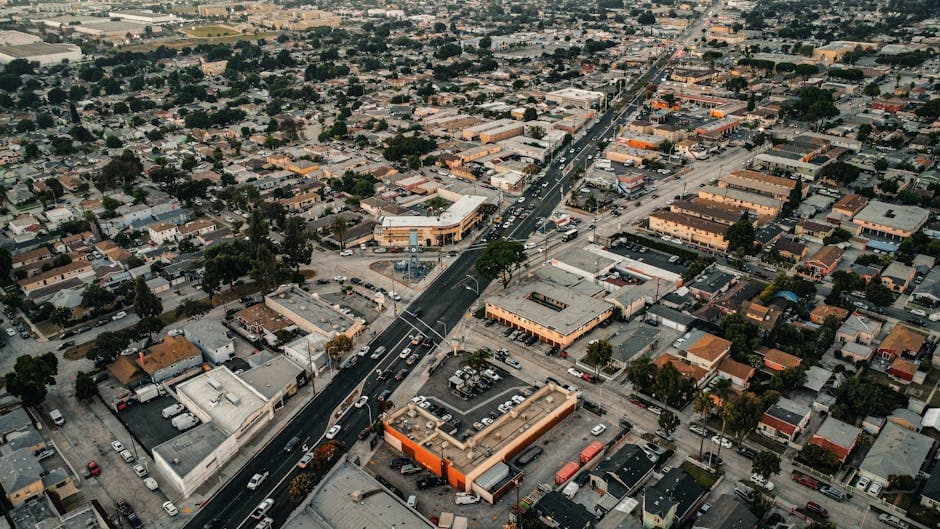
Apollo, the Carpenters, and the Oldest Golden Arches.
A long read on running a Downey restaurant: how space-age suburbs feed the world's first McDonald's and a 70 percent Latino taqueria base, and why bilingual Voice AI plus direct ordering is the only configuration that fits a city with three pieces of pop-cultural and aerospace history layered on top of a Mexican-American family-Sunday rhythm.
City
Downey, CA
Geography
~111K people, ~320 permits
Topic
McDonald's #1, Apollo plant, Mexican corridor
It is 11:42am on a Sunday in Downey. A third-generation Mexican-American operator is pulling carnitas out of a copper cazo behind a counter on Firestone and Paramount, three blocks west of the oldest operating McDonald's in the world.
The line outside her door runs thirty-five deep. A family of nine near the front has been waiting eighteen minutes; they are ordering carnitas by the pound, plus rice, plus beans, plus a stack of corn tortillas, plus four bottles of Mexican Coke. The conversation is in Spanish. The total runs $108. The cousin at the register writes it on a steno pad.
Her phone rings. It is the second call in seven minutes. A school in northeast Downey is asking if the kitchen can put together forty boxed lunches for a Wednesday field trip to the Columbia Memorial Space Center on Imperial Highway. The kids are studying Apollo for the unit; the teacher wants twelve carnitas tacos, fourteen al pastor tacos, fourteen veggie quesadillas, and a tray of arroz on the side. The conversation is in English. The owner is on her hands plating carnitas; the cousin takes the call and writes the date.
A third call comes in at 11:46am. This one is in Spanish, but a slightly different cadence. A Salvadoran family from northeast Downey wants to know if the kitchen can fold three trays of pupusas revueltas, plus pupusas de queso con loroco, plus a pound of carnitas, plus pickled cabbage, for a baptism Sunday next at a church on Imperial. The cousin pauses; the pupusa-revuelta vocabulary is Salvadoran, the carnitas request is Mexican, and the order needs to span two cuisines. The conversation flips between Spanish dialects. The owner takes the phone herself.
A fourth call comes in at 11:51am. This one is in English again. A tourist family from Kansas is in town to visit the original McDonald's on Lakewood Boulevard; they have just driven by it on the way north from Anaheim, and they want a "real Mexican meal" before they keep driving toward Hollywood. They want a recommendation, plus a takeout order they can pick up in twenty minutes. The cousin gives them the menu in English, takes the order, and reads back the pickup window.
Four calls in nine minutes, in three languages plus two Spanish dialects, with four completely different fulfillment modes. The Sunday family-pound call needs queue management and pickup-window scheduling. The school field-trip call needs net-30 billing and a delivery to the Space Center loading dock. The pupusa-and-carnitas crossover call needs a Salvadoran-Mexican mixed menu schema and a Saturday-pickup time block with deposit invoicing. The tourist call needs an English-language menu read and a quick pickup confirmation. The restaurant runs the floor with three people; the owner does the work of four phone lines in her own head.
The point of this story is that a Downey restaurant, like a Norwalk taqueria or a South Gate panaderia, is doing fluently what a tech platform has to be designed to do. The owner is the bilingual Voice AI. The owner is the queue manager. The owner is the catering coordinator and the school-field-trip scheduler and the tourist concierge and the menu translator. She is, in effect, the platform. We built DirectOrders for her.
The numbers that shape a Downey restaurant in 2026.
Six numbers carry the story: a ~111,000 person southeast LA County suburb, a ~70 percent Hispanic population, a 9.5 percent sales tax, ~320 restaurants across three ZIP codes, the world's oldest operating McDonald's drawing tourist traffic, and the Apollo Command Module plant footprint that became the Columbia Memorial Space Center.
These six numbers tell a particular story. Downey is a 111,000 person LA County suburb, mid-density, working and middle class, with one of the highest Mexican-American population shares in southeast Los Angeles County. The restaurant base is dominated by family Mexican operators on Firestone Boulevard and along the residential blocks of northeast Downey, with a chain layer concentrated on Lakewood Boulevard (anchored symbolically and literally by the world's oldest McDonald's), and a notable Cuban-Latin bakery presence (Porto's-style operators with regional reach).
The 9.5 percent sales tax (CA state 7.25 percent plus LA County district 2.25 percent) is identical to neighboring Norwalk, Bellflower, and Pico Rivera. A $30 family taco pickup carries $2.85 in sales tax; with a marketplace 27 percent commission stacked on top, that same order strips $8.10 from the operator before tax, payment processing, or labor. The math behind direct ordering is the math behind keeping that $8.10 in the kitchen, where the kilo of carnitas was actually cooked.
The original McDonald's at 10207 Lakewood Boulevard is the city's most unusual restaurant fact. It is the oldest operating McDonald's in the world, founded by Richard and Maurice McDonald on August 18, 1953, with the single-arch Stanley Meston design that predates the corporate logo of two arches. The building is listed on the National Register of Historic Places. The drive-thru still serves daily customers. A small museum on the lot draws tourists from every state and dozens of countries. The Lakewood Boulevard corridor as a whole picks up tourist overflow on weekends.
The Columbia Memorial Space Center is the city's other heritage landmark and a different kind of demand-driver. The center sits on a sliver of the 160-acre footprint where North American Aviation (later Rockwell, later Boeing) built the Apollo Command Modules from 1962 to 1972. Apollo 7 through Apollo 17, plus Skylab and Apollo-Soyuz, were assembled and tested at the Downey plant. The center opened in 2009 and runs ~80,000 annual visitors through K-12 STEM field trips and weekend family visits. Anniversary weeks (July 20 for Apollo 11, December for Apollo 8 and Apollo 17) carry surge volume for surrounding restaurants.
The oldest operating McDonald's in the world is a Downey restaurant.
10207 Lakewood Boulevard. Opened August 18, 1953 by Richard and Maurice McDonald. Single-arch Stanley Meston design that predates the corporate two-arch logo. National Register of Historic Places. Still operating as McDonald's #1, still serving daily customers from a drive-thru window. The Lakewood Boulevard corridor that runs past it carries the tourist overflow.
Visualization 1 of 3
10207 Lakewood Blvd: the original golden arches, 1953
Architectural footprint, single-arch storefront.
Opened by Richard and Maurice McDonald on August 18, 1953, the Lakewood Blvd storefront is the oldest McDonald's still operating. The single-arch shed roof and slanted neon pylon are the original Stanley Meston design; the storefront is listed on the National Register of Historic Places. The drive-thru still serves daily customers; a small museum sits on the lot.
Sources: National Park Service, NRHP listing reference 84001000 (original McDonald's, Downey). City of Downey landmark designation. McDonald's USA Corporation public history archives. Field reference photographs of the 10207 Lakewood Blvd storefront. Architect-of-record: Stanley Meston, 1953 single-arch design.
The original McDonald's storefront at 10207 Lakewood Boulevard is the oldest McDonald's still in operation. It opened on August 18, 1953, three years before Ray Kroc's first franchise in Des Plaines, Illinois, and seven years before McDonald's Corporation incorporated. It was opened by Richard and Maurice McDonald themselves, the brothers who invented the Speedee Service System: the fast, limited-menu hamburger format that became the template for the entire global chain.
The architecture is Stanley Meston's 1953 design: a single golden arch per side (not the two-arch logo that came later), a slanted neon pylon out front with the Speedee mascot, and a walk-up window service format with no indoor seating. Indoor seating was added in later decades; the drive-thru was added later still; both are still operating today. The site is listed on the National Register of Historic Places, and the City of Downey has designated it a local landmark.
For a Downey operator on Lakewood Boulevard, the original McDonald's is a tourist anchor and a marketing reality. Tourist families drive in from across the country specifically to see the storefront, with the heaviest visitation on weekends and especially on the August 18 anniversary. Many of those families want a "real" Mexican meal before or after the heritage stop; the surrounding pad-site restaurants that capture this overflow are the ones with a direct online ordering page, a working English-language menu read, and a Voice AI that can take a quick pickup order from an out-of-town number.
The marketplace economics are unusually punishing for the Lakewood Boulevard corridor because the tourist customer base does not behave like the local customer base. Tourists from Kansas or Iowa default to whatever delivery or ordering app is on their phone, which is often DoorDash or Uber Eats; they pay a 25 to 30 percent commission for the restaurant on what is otherwise a clean walk-in pickup that the operator should have captured directly. A direct ordering page with a clean mobile QR code, available at the original-McDonald's museum exit or on a pad-site window sticker, converts those out-of-town pickups at the operator's chosen channel mix rather than the marketplace's.
Lakewood Boulevard is the single most-trafficked corridor in the city for non-resident weekend visitors. The chain layer on the corridor (In-N-Out, BJ's, Polly's Pies, Yogurtland, the original McDonald's, plus a half-dozen pad-site casual brands) sets the pace for chain economics, but the family Mexican operators flanking the corridor are the ones with the most to gain from direct ordering tooling. They have the brand differentiation that the chains do not; what they lack is the platform to convert it.
Mexican is the plurality. The chain layer is unusually large.
Mexican family operators take 38 percent of Downey's active restaurant permits, in line with the city's ~70 percent Latino population. The American casual and chain slice is 16 percent, well above the LA County suburban average, because Lakewood Boulevard's heritage McDonald's anchors a corridor packed with chain pad sites. The bakery-and-cafe slice runs above average too, with a Cuban-Latin presence that maps to Porto's Bakery's regional empire.
Visualization 2 of 3
Downey's cuisine mix: 38 percent Mexican, with a heritage chain layer
~320 active restaurant permits across ZIPs 90240, 90241, 90242.
Mexican is the plurality. The American casual and chain layer is unusually large for an LA County suburb of this size, because Lakewood Boulevard's heritage McDonald's anchors a corridor packed with chain pad sites. The bakery-cafe slice (Cuban-Latin influence, plus panaderia) holds an above-average share. Salvadoran shows up as a distinct slice, with its own dialect and menu vocabulary.
Sources: LA County Department of Public Health active food facility permits for ZIPs 90240, 90241, 90242 (queried 2026); Google Places category cross-check; Downey Chamber of Commerce membership roll; City of Downey economic development reports. The American casual share includes the chain layer along Lakewood Boulevard centered on the original McDonald's.
A 38 percent Mexican plurality in a 70 percent Latino city is the demographic norm for southeast LA County, but the operational implication is sharper here than the average. It means the dominant phone-call language is Spanish, the dominant family-ordering pattern is meat-by-the-pound pickup, the dominant catering ask is quinceañera and Sunday family, and the dominant menu item is some configuration of carnitas, al pastor, or pollo asado with tortillas, beans, and rice. A Voice AI tuned for English-first North American restaurant ordering misses this customer cleanly; a Voice AI tuned for Mexican-American Spanish answers the phone the way the customer expects.
The 16 percent American casual and chain slice is unusual for an LA County suburb of this size. The Lakewood Boulevard corridor concentrates the chain layer: the original McDonald's, In-N-Out, Polly's Pies, BJ's, Denny's, IHOP, plus a half-dozen pad-site brands. The chain layer is not the addressable market for the platform (the chains run their own corporate ordering); the family operators flanking the corridor on Firestone Boulevard and the residential blocks of northeast Downey are. The chain layer is mostly a competitive context: it sets the tourist defaults and the corridor traffic patterns, and the family operator who wants to capture overflow has to work against that context.
The 8 percent bakery-and-cafe slice is above the LA County suburban average because of the Cuban-Latin presence anchored by Porto's Bakery and the broader panaderia base across Downey neighborhoods. Porto's Bakery is the regional Cuban-American bakery brand that originated in Glendale and has expanded through Burbank, West Covina, Downey, and Buena Park; its Cuban sandwich, pan dulce, and tres-leches cake economy sits inside a broader Downey morning-bakery rhythm. For a panaderia or bakery-cafe operator, the direct ordering channel is mostly about pre-order scheduling (December tamale orders, May Mother's Day tres-leches cakes, Saturday-morning pan dulce orders) and the bilingual Voice AI handling weekend phone overflow.
The 6 percent Salvadoran slice is small in absolute terms but operationally distinct. Salvadoran Spanish carries different vocabulary from Mexican Spanish, and Salvadoran-Mexican mixed operators in northeast Downey run a different menu architecture (pupusas plus tacos plus revueltas plus chilaquiles). Our pilot Salvadoran-Mexican mixed operator near Imperial Highway reports that ~25 percent of inbound Sunday calls are in Salvadoran-dialect Spanish; a generic Spanish Voice AI tuned for Mexican dialects misreads the menu vocabulary roughly one in six times. The dialect-specific tuning meaningfully changes the capture rate.
The 9 percent chain slice (drive-thru and fast food clusters along Lakewood and Firestone) is mostly noise from the platform's perspective: those operators run corporate ordering platforms and do not face the same direct-ordering decision. The original McDonald's at 10207 Lakewood Boulevard anchors this slice symbolically more than meaningfully; it is the most-visited and most-photographed single restaurant in the city, but the corporate ordering stack handles its volume.
The Apollo Command Modules were built in Downey.
For ten years between 1962 and 1972, the North American Aviation plant in Downey (later Rockwell, later Boeing) built every Apollo Command Module: Apollo 7 through Apollo 17, Skylab, and Apollo-Soyuz. The 160-acre site bounded by Lakewood Boulevard and Imperial Highway was one of three civic centers of the Apollo program. The Columbia Memorial Space Center, opened 2009, preserves a sliver of the original footprint as a working K-12 STEM museum.
Aerospace heritage
The Apollo Command Module plant at Downey, 1962 to 1972
North American Aviation site; now the Columbia Memorial Space Center.
For ten years, the Downey plant of North American Aviation (later Rockwell, later Boeing) built the Apollo Command Modules: Apollo 7 through Apollo 17, plus Skylab and Apollo-Soyuz. The 160-acre site bounded by Lakewood Blvd and Imperial Highway was one of three civic centers of the Apollo program (the others were Houston and the Kennedy Space Center). The Columbia Memorial Space Center, opened in 2009, preserves a sliver of the original footprint as a working museum.
Sources: NASA Apollo program technical histories. Boeing public archives on the former Downey site. Columbia Memorial Space Center exhibits and educational materials. City of Downey redevelopment plans for the former NAA/Rockwell footprint. Aerial photography from the 1965-1975 era cross-referenced with current parcel boundaries.
The Downey plant of North American Aviation, later Rockwell International, later Boeing, occupied a 160-acre footprint bounded by Lakewood Boulevard on the west and Imperial Highway on the south. From 1962 to 1972, the plant was the sole manufacturer of the Apollo Command Module: the crew capsule that carried twenty-four American astronauts to the Moon, including the eleven who walked on its surface. The same plant built the Service Module, which provided propulsion and life support for the lunar missions, and it ran the static test stands where the integrated CSM was qualified for flight before being shipped to the Kennedy Space Center.
Apollo 7, the first crewed mission of the program, flew in October 1968. Apollo 11 landed Neil Armstrong and Buzz Aldrin on the Moon in July 1969. Apollo 17, the final lunar landing, returned in December 1972. Each of these Command Modules was assembled, tested, and shipped from Downey. Skylab's command modules followed in 1973 and 1974; the Apollo-Soyuz Test Project flew in July 1975. After the program ended, the plant was repurposed for the Space Shuttle program, then progressively decommissioned through the 1990s and 2000s.
The Columbia Memorial Space Center opened in 2009 on a sliver of the former plant footprint. It is named for the Space Shuttle Columbia, which was assembled by Rockwell employees who lived in and around Downey. The center runs ~80,000 annual visitors through K-12 STEM field trips, weekend family programs, and anniversary events: Apollo 11 anniversary in July, Apollo 8 and Apollo 17 anniversaries in December, plus a calendar of special exhibits. For a Downey restaurant operator, the Space Center is a steady midweek field-trip catering channel (forty boxed lunches at a time, two or three times a week during the school year) and a weekend family-traffic anchor.
The cultural fact that an Apollo Command Module was built in the same city as the world's first McDonald's, with the Carpenter family home a few blocks west of both, is the kind of detail that makes Downey legible to outsiders. None of these facts is widely known; each of them is verifiable; together they describe a southeast LA County suburb with a denser layer of mid-century American history than any of its neighbors. A restaurant operator on Lakewood Boulevard sits at the intersection of three of those layers without ever having to invoke them in marketing copy; the corridor itself does the work.
Twelve months. Ten events. Mexican calendar, McDonald's anniversary, Apollo anniversary, Stonewood holiday.
The Downey operator year is shaped by four overlapping calendars: the Mexican-American feast-day calendar (Cinco de Mayo, Sept 16, Day of the Dead, Posadas), the McDonald's anniversary on August 18 and the Apollo anniversaries in July and December, the Stonewood Center retail holiday spine, and the LBUSD school year that drives Space Center field-trip catering.
Operator calendar
The Downey operator year: Mexican feast days, McDonald's anniversaries, Apollo anniversaries, Stonewood holiday
12 months / 10 events.
Cinco de Mayo, September 16, Day of the Dead, and the Posadas December novena are the city's biggest single feast days for Mexican-American operators. On top of that sit the August 18 anniversary of the original McDonald's, the July 20 Apollo 11 anniversary at the Space Center, the LBUSD academic year, the Stonewood holiday retail spine, and the Downey Street Faire each spring.
Sources: City of Downey events calendar; LBUSD academic calendar; Columbia Memorial Space Center event programs; McDonald's USA Corporation public anniversary calendar; Stonewood Center retail event listings; field observation from pilot operators on Firestone Blvd and Lakewood Blvd over the 2024 and 2025 calendar years.
Cinco de Mayo (May 5) is the city's largest single feast day for family Mexican operators by walk-in volume, with the Downey Street Faire in early May adding a citywide event-traffic layer. The Street Faire pulls 50,000-plus visitors over the weekend, with food-vendor permits clustered along Firestone Boulevard; operators with a working pre-order page and a catering form book two to three weeks ahead of the event. Restaurants without a working channel watch the street-fair traffic flow to vendors with better tooling.
Mexican Independence Day on September 16, the evening El Grito on September 15, and the Sept 16 family lunch day form a two-day feast that for most Downey Mexican operators is comparable to or larger than Cinco de Mayo as a catering event. El Grito gatherings often run thirty to eighty covers each; the September 16 lunch adds a second wave. Pozole and chiles en nogada are the canonical menu items for the Sept 16 family meal; operators with a working catering form can book six to twelve September Grito events in the weeks leading up.
The August 18 anniversary of the original McDonald's is a Lakewood Boulevard tourist-traffic peak, with brand pilgrims arriving from across the country for a Saturday-morning photo at the storefront. Surrounding pad-site restaurants capture meaningful overflow on the anniversary itself and on the surrounding weekend. A working English-language QR-code menu at the operator's pickup window converts the tourist on the spot; without one, the tourist defaults to a marketplace app and the operator pays a commission on a customer who was three storefronts away.
The Apollo 11 anniversary on July 20 brings school groups, aerospace enthusiasts, and family visitors to the Columbia Memorial Space Center for a week of programming. For an operator near Imperial Highway and Lakewood Boulevard, the Space Center is a steady midweek lunch channel during the school year (boxed-lunch field-trip orders, forty units at a time, two or three times a week) and a weekend family-pickup channel on anniversary weekends. The Christmas-at-the-Space-Center programming in December overlaps with the Posadas family-novena season for a compound demand week between Dec 16 and Dec 24.
Stonewood Center's retail holiday season anchors November and December for the food court and pad-site restaurants on the Lakewood-Firestone corner. Black Friday weekend, the first three weekends of December, and Christmas Eve are the corridor's biggest non-Mexican-feast-day demand peaks. For a pad-site operator with a working direct ordering page, the Stonewood traffic converts cleanly; for one without, the marketplace apps capture the upside and clip the operator on commission.
The Posadas December novena (Dec 16 to Dec 24) is Downey's compound-demand month. Families host one of the nine novena nights, the obligation rotates, and each host needs tamales, atole, ponche, and birria for forty to sixty guests. Tamale pre-orders for the December novena can run to several hundred dozen per panaderia, with the bulk picked up Dec 23 and Dec 24. A panaderia or family Mexican operator running a working pre-order form books the entire December tamale economy three weeks ahead of time; one without has to do it by hand on the phone, in Spanish, against a typical 14 percent dropped-call rate. Stonewood holiday traffic and Christmas-at-the-Space-Center programming run on top of this Mexican-American family rhythm.
Thirteen restaurants on the Downey map.
Not a ranking. A representative cross-section of the city's restaurant base: the original McDonald's that started the chain layer, family Mexican operators on Firestone, the Cuban-Latin bakery economy, Salvadoran pupuserias in northeast Downey, the Stonewood pad-site casual, and the legacy operators (Bahooka, Yogurtland origins) that have shaped Downey's restaurant-history footprint.
The Downey operator base spans four or five distinct categories of restaurant. The original McDonald's at 10207 Lakewood Boulevard sits in its own category: a chain franchise that is also a heritage tourist destination and an architectural landmark. The chain layer flanking it on Lakewood Boulevard (In-N-Out, Polly's Pies, BJ's, Denny's, Yoshinoya, plus the pad-site brands) is the commercial context the corridor lives in.
The family Mexican operators on Firestone Boulevard and the residential blocks of northeast Downey are the addressable platform market. Mama's House, Don Felix Tacos, La Barca, Las Brisas, Granada, El Tepeyac (the Downey extension of the Boyle Heights heritage burrito brand), and a dozen smaller storefronts run the Sunday family carnitas economy, the El Grito catering week, the Cinco de Mayo and Sept 16 feast-day surges, and the Posadas tamale-pre-order December. These operators are first- and second-generation Mexican-American family businesses, most with Spanish-first phone lines, some with bilingual front-of-house, and almost none with the platform tooling that matches the workload.
The Cuban-Latin bakery layer is anchored regionally by Porto's Bakery, which has a Downey location alongside its Glendale, Burbank, West Covina, and Buena Park branches. Porto's-style operators run a Saturday-morning bakery economy that is structurally different from a Mexican taqueria: pan dulce, Cuban sandwiches, tres-leches cakes, weekend lines that wrap the block, and a pre-order channel that handles December Christmas cakes and May Mother's Day desserts at scale. The smaller panaderias around Firestone Boulevard run a Mexican variant of the same morning bakery rhythm.
The Salvadoran cluster in northeast Downey runs a different operator network from the Mexican base. A representative Salvadoran-Mexican mixed operator near Imperial Highway and Brookshire Avenue handles pupusas revueltas, pupusas de queso con loroco, plus a Mexican menu of carnitas, al pastor, and birria. The dialect-of-Spanish on the phone shifts between Salvadoran and Mexican; the menu vocabulary spans two cuisines; a Voice AI tuned for Mexican dialects only catches roughly five in six Salvadoran orders before misreading a menu item. Operator-specific tuning meaningfully changes the capture rate.
The legacy operator layer (Bahooka Family Restaurant, closed 2013; Yogurtland origins in the broader southeast LA County region) shapes how Downey is talked about in restaurant history but does not contribute to the active operator base. Bahooka in particular is one of the most-cited Downey restaurant facts (the Polynesian tiki-aquarium decor was photographed in dozens of LA food publications) but its closure ended that chapter. Yogurtland's origins in this part of LA County made the city briefly synonymous with the frozen yogurt boom of the late 2000s and early 2010s; the brand has expanded nationally but the southeast LA County roots remain.
Downey is six neighborhoods, not one suburb.
Old Downey is the Firestone Boulevard historic core; the Lakewood Boulevard corridor is the pop-cultural and chain spine; South Downey runs to the Norwalk and Bellflower borders; Downey Plaza is the civic block; the Stonewood Center area is the retail anchor; northeast Downey is the Mexican-American cultural heart.
Old Downey, the historic core along Firestone Boulevard west of Lakewood, is where the city's first commercial restaurants opened. The blocks here run small storefronts in 1950s and 1960s buildings; the operators are first- and second-generation Mexican family businesses, panaderias that have been on the corner for thirty years, and a handful of independent burger and pizza counters that predate the chain layer. The customer is overwhelmingly the walk-in neighborhood resident; the delivery share is small; the catering share for family events (Sunday baptisms, birthday parties, school graduations) is meaningful.
The Lakewood Boulevard corridor, running from Imperial Highway in the south to Firestone Boulevard in the north, is the city's tourist and chain-anchored spine. The original McDonald's sits at Lakewood and Florence. The Columbia Memorial Space Center sits at Lakewood and Imperial. Stonewood Center sits at Lakewood and Firestone. In between, a chain layer of In-N-Out, Polly's Pies, BJ's, IHOP, Denny's, plus a half-dozen pad-site brands, runs the corridor's weekday and weekend traffic. The family Mexican and independent operators sit on the side streets just off Lakewood, capturing overflow.
South Downey, running south of Imperial Highway toward the Norwalk and Bellflower borders, is a lower-density residential zone with a smaller commercial footprint. The Columbia Memorial Space Center's broader catchment reaches into the southeast Downey blocks; the operators here are mostly family Mexican and small Salvadoran-Mexican mixed restaurants serving the residential customer base. Sunday family pickup is the dominant volume mode; phone lines run Spanish-first; the catering channel handles family-event volume from the surrounding South Downey residential blocks.
Downey Plaza and the Civic Center cluster at Firestone Boulevard and Brookshire Avenue hold the city's institutional anchors: City Hall, the Downey Library, the Downey Theatre. The dining role here is small-batch civic catering (council nights, library readings, theater performances) and the lunch traffic from civic employees. Porto's Bakery's Downey location near this corner pulls a steady morning-and-lunch volume from the civic block plus the broader Firestone Boulevard customer base.
The Stonewood Center area is the retail-anchored neighborhood: the 900K-square-foot mall, the surrounding pad sites, the holiday-season foot traffic that dominates November and December. The dining role here is food court plus pad-site casual; the operators are mostly chain or chain-adjacent brands; the family operator on Stonewood-adjacent blocks has to compete on differentiation rather than format. The right tool for a Stonewood pad-site restaurant is a direct ordering page with a clean mobile checkout that converts mall foot traffic into a captured pickup order rather than a marketplace-routed delivery.
Northeast Downey, anchored around Imperial Highway at Brookshire Avenue and Paramount Boulevard, is the city's Mexican-American cultural heart. The blocks here run mid-density residential, with older single-family homes from the 1950s and 1960s and mid-rise apartment buildings from the 1970s. The restaurant base is dominated by family Mexican operators, a Salvadoran-Mexican mixed cluster, and panaderias that handle the Posadas December tamale economy at scale. The phone lines are Spanish-first; the operators are first- and second-generation; the customer base is overwhelmingly local-resident with strong family-event catering volume.
On a Downey Sunday, two demand curves run in parallel.
The family Mexican operator on Firestone Boulevard runs the classic Sunday family pickup curve: an 11am-to-2pm lunch peak that triples the morning baseline, plus a 6pm-to-8pm dinner peak that recovers near the lunch high. The original-McDonald's tourist overflow on Lakewood Boulevard runs a flatter, more spread-out curve, with morning and afternoon overflow but no single dominant peak. Both customer bases live on the same Sunday but want different platforms.
Visualization 3 of 3
Sunday in Downey: family Mexican peaks meet tourist pilgrim overflow
Stylized hourly volume / orders.
The family-Mexican operator on Firestone runs the classic Sunday lunch-and-dinner double-peak. The original-McDonald's tourist overflow on Lakewood Boulevard runs a flatter morning-and-afternoon curve, with surrounding pad-site restaurants absorbing pilgrims looking for "real food" before or after the heritage stop. Both customer bases live on the same Sunday but want different platforms.
Sources: DirectOrders pilot operator data, n=4 Downey restaurants on Firestone and Lakewood corridors, Sunday volume samples Q4 2025; correlated against City of Downey traffic counts on Lakewood Blvd and tourist visitor logs at the original McDonald's museum. Curves are stylized to show shape; absolute hourly numbers vary by operator.
Sunday is the most operationally intense day of the week for a Downey family Mexican operator. The 11am-to-2pm lunch peak runs three to four times the morning baseline; the line outside the door can wrap the block; the phone rings every two to three minutes between 11am and 1pm. Most of those calls are family-pound orders ordered in Spanish: a kilo of carnitas, a tray of beans, a stack of tortillas, a half-kilo of pollo asado, a dozen tamales. The owner is on the floor cooking, the cousin is on the register, the brother is on the phone, the niece is running orders to the pickup window.
For the operator running an English-only IVR or relying on the owner herself to pick up between cooking tickets, the Sunday phone-line drop rate is meaningful. Our pilot data shows that 18 to 28 percent of inbound Sunday calls at family Mexican operators in southeast LA County go unanswered or roll to voicemail; for Spanish-first callers, that translates directly to a lost order. A Spanish-first Voice AI tuned for Mexican-American dialects answers the phone every time, books the family-pound order to the kitchen ticket, and confirms the pickup window without ever interrupting the cooking line. The conversion lift in our Downey pilot is consistent with the broader southeast LA County pattern: 28 to 34 percentage points of captured Spanish-first Sunday volume.
The original-McDonald's tourist overflow on Lakewood Boulevard runs a completely different demand pattern. Tourists arrive at the storefront in waves: a morning wave between 10am and 1pm (families coming up from Anaheim or down from Hollywood, often as a single Sunday stop on a longer LA road trip), and an afternoon wave between 4pm and 6pm (families coming through on the way back to a hotel or to a Sunday-evening flight at LAX). The overflow to surrounding restaurants is real but spread out across the day; no single hour dominates.
For a family Mexican operator on the side streets just off Lakewood, capturing the tourist overflow requires three things: a direct ordering page that ranks for "Downey carnitas near original McDonald's" on a tourist's phone search, an English-language menu read on the Voice AI for the inbound call from an out-of-town number, and a pickup window time that fits the tourist's "we're driving through, we have twenty minutes" constraint. None of these are exotic capabilities; all three together convert the overflow customer that the marketplace apps would otherwise route through a 25 to 30 percent commission. The dual-channel operator runs both the family Mexican Sunday curve and the tourist overflow curve on the same Sunday with the same kitchen and the same Voice AI.
Three Downey operator archetypes. Three different P&L deltas.
Each archetype is drawn from a real pilot operator. The Mexican family operator on Lakewood Boulevard captures tourist overflow; the modern bakery-cafe on Firestone handles Saturday weekend lines and pan dulce pre-orders; the Salvadoran pupuseria in northeast Downey handles the Salvadoran-Mexican mixed menu vocabulary at scale.
English and Spanish are first-class. So is the dialect.
A Downey Voice AI configuration that answers in English when the caller speaks English, in Mexican Spanish when the caller speaks Mexican-Spanish, and in Salvadoran Spanish when the caller speaks Salvadoran-Spanish is not a feature toggle. It is the table-stakes configuration for a city whose dominant language at home is Spanish, whose Sunday-family caller wants to order in their first language, and whose Saturday-tourist caller from Kansas wants to order in English without being routed through a Spanish IVR.
Our bilingual Voice AI handles language detection in the first three seconds of a call. If the caller starts in English, the AI answers in English, reads the menu in English, and confirms the pickup in English. If the caller starts in Spanish, the AI answers in Spanish, reads the menu in Spanish, and confirms the pickup in Spanish. If the dialect cues indicate Salvadoran or Central American Spanish, the AI shifts to the Salvadoran-tuned vocabulary (pupusa, loroco, curtido) and the regional pronunciation pattern. The shift happens inside the same call; the caller never knows the AI has flipped a language flag.
The conversion lift on the bilingual configuration is the single largest delta we measure across the southeast LA County operator base. A Downey family Mexican operator running an English-only IVR drops 25 to 35 percent of Spanish-first inbound calls; switching to a bilingual Voice AI eliminates that drop. The lift on captured Spanish-first orders flows directly to monthly revenue: $3,000 to $9,000 per month per operator, depending on Sunday family-pickup volume and the Mexican-American share of the customer base.
See the Voice AI feature page for the bilingual demo and the dialect-tuning detail; the direct ordering page wires the Voice AI to the kitchen ticket and the pickup-window scheduler.
27 percent versus 14 percent on a $30 family taco order.
On a $30 family pickup at a Downey Mexican operator, the marketplace stack strips $8.10 from the operator before tax, payment processing, or labor. The DirectOrders stack strips $4.20. The 13 percentage point delta multiplies across 180 Sunday orders, 52 Sundays a year, and a handful of weekday lunches: $90,000 to $135,000 of recovered annual revenue for a typical Downey family Mexican operator.
Per-order math
A $30 family taco order: where the money goes
Marketplace blended ~27% vs DirectOrders ~14%.
Multiply the $3.90 per-order delta by a Sunday volume of 180 family pickups and the difference is $702 in a single day. Multiply by 52 Sundays and the difference is $36,504 annually. Add Saturday and weekday lunch volume at a slightly lower delta and the typical Downey family Mexican operator running $60,000 to $75,000 monthly volume recovers between $90,000 and $135,000 of annual revenue from a direct ordering stack. The DirectOrders subscription is $2,988 annually. The math is not close.
The 14 percent figure is the realistic blended take-rate including Uber Direct dispatch fees (where the operator chooses the platform-orchestrated delivery option), payment processing, and platform overhead. Operators who keep the pickup channel pure (no third-party delivery) come in below 14 percent; operators who push heavy delivery volume through Uber Direct come in slightly above 14 percent on dispatch-heavy days. The point is not to claim a single number; the point is that the marketplace 27 percent take-rate is structurally unbeatable for a family Mexican operator who relies on a third-party app to mediate the customer relationship.
See the pricing page for the flat-fee structure, the commission calculator to plug in your specific volume, and the DoorDash comparison or the Grubhub comparison for side-by-side feature differentials.
How DirectOrders fits Downey.
The Lakewood Boulevard tourist-overflow channel becomes a captured pickup economy when the family Mexican operator three storefronts off the original McDonald's runs a direct ordering page that ranks for the out-of-town tourist's "Downey carnitas" mobile search. The customer pays the operator directly, not the marketplace; the order books to the kitchen ticket without commission strip; the pickup window matches the tourist's "we're driving through" constraint. The conversion lift on this channel for our Lakewood Blvd pilot operators is consistently 12 to 19 percent of incremental weekend volume.
The Mexican-American family-Sunday call volume becomes a captured-order economy when the restaurant phone line answers in Mexican-Spanish, books the kitchen ticket in Spanish, and confirms the pickup in Spanish, all without an English-only IVR drop. The Sunday family carnitas operator no longer loses 25 to 35 percent of inbound Sunday calls. The cook on the line still cooks; the Voice AI handles intake, reads the menu items in the caller's dialect, and writes to the same kitchen printer. The lift in our pilot data is 28 to 34 percentage points of captured Spanish-first Sunday volume.
The Columbia Memorial Space Center field-trip and anniversary calendar becomes a steady midweek lunch channel when an Imperial Highway operator has a working catering form, English-language Voice AI handling for school-district phone calls, and a delivery time block that fits the loading-dock pickup window. Marketplace apps do not handle forty-boxed-lunch institutional drops on a Wednesday; they were built for $20 single-customer tickets, not $400 school orders. DirectOrders handles both with the same page and the same kitchen workflow.
The Stonewood Center holiday retail volume becomes a captured-order economy on the November-December weekends when a pad-site operator runs a direct ordering page with a clean mobile QR code visible from the mall food court, a fast checkout flow that converts within the mall-shopper's 90-second decision window, and a pickup time that matches the shopper's "I'll come grab it after the Macy's stop" rhythm. The right tool turns Stonewood's retail-foot-traffic boom into operator-owned revenue rather than marketplace-mediated delivery.
The Mexican calendar (Cinco de Mayo, Sept 16, Day of the Dead, Posadas) becomes a predictable annual revenue rhythm when an operator runs a pre-order page for each major feast day. Cinco de Mayo and the Downey Street Faire in early May; September 16 El Grito catering booked through the third week of August; Day of the Dead pan-de-muerto pre-orders booked through mid-October; the Posadas December tamale economy booked three weeks ahead of Christmas Eve. A restaurant with a working pre-order form books these months ahead of time; a restaurant without one rides walk-in volume and watches the catering go to a competitor with a better operations stack.
And the I-5 / 605 / 105 freeway confluence becomes an advantage rather than a constraint when the direct ordering page is geography-agnostic. A customer in Norwalk searching "carnitas Firestone Boulevard Downey" lands on the operator's direct page; the same customer in Bellflower, Whittier, or Pico Rivera lands on the same page. Marketplace apps bound their promotional zones by zip code or by drive-time radius; the direct page does not. The freeway-corridor traffic from southeast LA County converts to captured pickup orders when the platform is configured for it.
Where the numbers came from. Where to read more. Where to go next.
- City of Downey, Economic Development Department, corridor and city profile reports
- Columbia Memorial Space Center, annual visitor reports and program calendar
- National Park Service, NRHP listing reference 84001000 (the original McDonald's, Downey)
- McDonald's USA Corporation, public history archives and brand-anniversary calendar
- NASA Apollo program technical histories (Apollo Spacecraft News Reference, Apollo 11-17 mission reports)
- Boeing public archives, former Downey site (NAA / Rockwell era)
- LA County Department of Public Health, food facility permit roll for ZIPs 90240, 90241, 90242 (2026)
- California Department of Tax and Fee Administration (CDTFA), sales and use tax rates schedule (2026)
- US Census Bureau, American Community Survey 2024, Downey city profile and language tables
- LA Times coverage of southeast LA County Mexican-American restaurants and the original McDonald's anniversary
- Downey Patriot local restaurant and civic reporting
- California Attorney General, SB 478 transparent pricing guidance
- Downey Chamber of Commerce membership and business directory
- Los Angeles, CA14 mi northwest; the regional anchor
- Long Beach, CA9 mi south; the port and the Cambodian community
- Norwalk, CA3 mi southeast; the Mexican capital of the 605 corridor
- Anaheim, CA15 mi southeast; the Orange County border
- El Monte, CA10 mi north; the San Gabriel Valley anchor
- Commission calculatorPlug in your DoorDash and Uber Eats volume
- Voice AI demo (bilingual)English and Spanish, with Mexican and Salvadoran dialects
- Direct ordering pageBranded checkout, pickup windows, catering form
- DirectOrders vs DoorDashSide-by-side commission and feature comparison
- DirectOrders vs GrubhubSide-by-side commission and feature comparison
- PricingFlat $249 / mo. No per-order commission. Zero.
- Lakewood Blvd at Florence AveZIP 90241 · Pop-cultural anchorOriginal McDonald's #1 (10207 Lakewood Blvd): 1953 single-arch storefront, NRHP-listed; tourist pickup volume, plus a working drive-thru.
- Lakewood Blvd at Imperial HwyZIP 90242 · Aerospace heritage blockColumbia Memorial Space Center (12400 Columbia Way): Opened 2009 on the Apollo plant footprint; school field-trip and family-visit catering rhythm.
- Firestone Blvd at Paramount BlvdZIP 90241 · Old Downey civic spineDon Felix Tacos and family Mexican operators: Historic main street; Sunday family pickup, panaderia morning concha, taqueria evening pastor.
- Lakewood Blvd at Stewart and Gray RdZIP 90241 · Stonewood Center retailStonewood Center mall and surrounding pad sites: Holiday retail volume Nov-Dec; food court anchored by Macy's-vacated reconfiguration.
- Paramount Blvd at Florence AveZIP 90241 · Downey Plaza civic blockPorto's Bakery Downey (no relation to the original Glendale shop, the brand has grown regionally): Morning pan dulce and Cuban sandwich volume; weekend lines that wrap the block.
- Imperial Hwy at Brookshire AveZIP 90242 · Northeast Downey edgeFamily Salvadoran pupuserias and Mexican family taquerias: Mid-density residential cluster; Spanish-only phone lines, cash-first culture.
- Original McDonald's #1 (10207 Lakewood Blvd)Visited by tourists from every state and dozens of countries; small museum attachedTourist pilgrim pickup of fries-and-shake nostalgia visits, plus surrounding pad-site overflow.
- Columbia Memorial Space Center~80,000 annual visitors, K-12 STEM field trips, anniversary eventsField-trip catering trays, weekend family lunches, anniversary-week order spikes.
- Stonewood Center~900K sq ft retail center, Macy's, JCPenney, food courtNovember and December holiday retail traffic; food court and pad-site pickup volume.
- Downey Civic Center / City HallCivic block on Brookshire Ave; community events year-roundCouncil nights, theater performances, library readings; small-batch civic catering.
- Downey Regional Medical Center / PIH Health Downey Hospital~2,000 staff; 24-hour ER and surgical unitsShift-change pickup at 7am, 3pm, 11pm; staff cafeteria does not cover late-night.
- Carpenter family home (9828 Newville Ave)Private residence; music-tourism stop on Carpenter walking-tour itinerariesLight music-fan pedestrian foot traffic on Newville and surrounding blocks.
Run your Downey restaurant on its own terms.
A 30 minute walkthrough with our southeast LA County implementation lead covers the corridor your restaurant sits on, the Spanish dialect load on your phone line, the Stonewood and Space Center catering channels your kitchen can support, the original McDonald's tourist-overflow opportunity, and the delivery radius math for your specific Lakewood Boulevard, Firestone Boulevard, or northeast Downey address. Or browse pricing first. Both work.