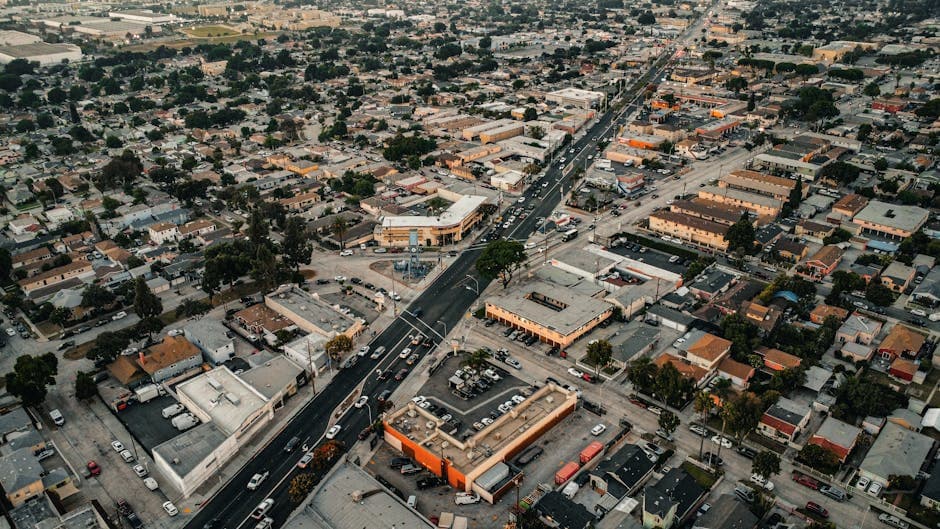
I-10 and I-605 Crossroads.
A long read on running an El Monte restaurant: the bus station that moves 22,000 daily boardings, the 65 percent Latino-majority phone economy, the Garvey Avenue spillover from Chinese and Vietnamese SGV, the Mission San Gabriel Arcangel heritage, the Aquatic Center summer season, and why bilingual direct ordering is the configuration that fits.
City
El Monte, CA
Population
approx. 106,000
Topic
Bus hub, Latino majority, Asian SGV, Aquatic Center
It is 10:46am on a Sunday in El Monte. The 10:00 Mass at Nativity Catholic Church on Workman Avenue has just ended, and a taqueria on Garvey Avenue is already four hours into its day.
The phone rings. A grandmother calling from her granddaughter's quinceanera prep wants forty tacos al pastor, twenty carne asada burritos, a tray of arroz, a tray of frijoles, and four salsas, ready by 1:00pm for pickup. The conversation is in Spanish. The total is $328.
A second call at 11:04am, this one from a small group of Foothill Transit drivers ending their morning shift at the El Monte Bus Station. They want six breakfast burritos, four cafe con leche, and two horchatas, picked up at the back counter in twenty-five minutes. They speak in a mix of Spanish and English; the owner finishes the order in Spanish to be safe. The order is $86.
A third call at 11:21am, a Chinese-American family on Garvey calling for Sunday lunch pickup. They want pollo asado family combos for eight, and they ask whether the restaurant has a Mandarin-speaker on staff. The owner does not, but the son who runs the register is a Cal State LA student who studied Mandarin for two semesters and can manage the basics. The order is $112.
Three calls in thirty-five minutes, all heading to different parts of the city, all in two languages plus the start of a third, all on the highest-volume Sunday of the year so far. The owner is taking phone orders, the kitchen has three cooks plus a tortilla maker, and the dining room will not open to walk-ins until 11:30. She is doing the work of three platforms in her own head before the doors open.
The point of this story is what we kept seeing in El Monte over a four month listening tour. A taqueria on Garvey Avenue or Peck Road or Valley Boulevard, like a pupuseria in Boyle Heights or a phở counter in Westminster, is doing fluently what a tech platform has to be designed to do. The owner is the bilingual Voice AI. The owner is the catering dispatcher. The owner is the schedule keeper, the menu translator, and the credit terms negotiator. She is, in effect, the platform. We built DirectOrders for her.
Eight numbers that fix the city in place.
Before the operator-economy analysis, the city in numbers. Restaurant count, median check, the 9.50 percent combined sales tax, the Latino and Asian shares of population, the bus-station boardings, the aquatic-center events, and the high school district enrollment. The eight figures below are the ones an El Monte operator references most.
The El Monte Bus Station is the regional knot. The freeways are the rope.
The El Monte Bus Station sits at the confluence of I-10 and I-605 and operates as the joint Foothill Transit and LA Metro hub for the San Gabriel Valley. Eight to ten major bus lines radiate from the station; Silver Line rapid service to DTLA runs every six minutes during peak. Lunch-hour pickup demand at restaurants within a mile of the hub is the steadiest weekday daypart in the city.
Visualization 1 of 3
El Monte Bus Station: the I-10 and I-605 confluence
One of the busiest US transit hubs.
The El Monte Bus Station sits at the confluence of Interstate 10 and Interstate 605, the two freeways that frame the city. Foothill Transit operates the hub jointly with LA Metro. The station moves roughly 22,000 boardings daily and produces the steadiest lunch-hour pickup wave any El Monte restaurant within a mile of Santa Anita Avenue sees.
Sources: Foothill Transit ridership reports; LA Metro El Monte Station service descriptions; Caltrans I-10 and I-605 traffic counts; City of El Monte transit element of the General Plan; operator interviews along Santa Anita Avenue and Valley Boulevard.
The bus station is the El Monte structure people across LA County have actually been inside. Foothill Transit, the regional bus authority that operates most of the lines into the station, was founded in 1988 specifically to take over and expand the service after LA County Metro consolidated. The El Monte hub is its anchor; the entire route map radiates from this confluence. Silver Line Metro Rapid runs from El Monte to El Sereno to DTLA in roughly thirty minutes during the offpeak and forty-five minutes during the peak. The 187 line runs through to Pasadena. The 488 runs east toward City of Industry. The 282 runs out toward Pomona. The 287 and the 194 cover the foothill cities including La Verne and Cal Poly Pomona.
For a restaurant near Santa Anita Avenue or Valley Boulevard the operational reality is that the bus station produces a 11:30am-to-1:30pm pickup wave on weekdays that does not exist for cities without a major transit hub. Bus drivers, commuter riders coming off a half-day, and the El Monte Civic Center workforce all hit the same window. The marketplace apps see this as ordinary lunch demand and price it as such; a direct ordering page that ranks for "lunch near El Monte Bus Station" or "Garvey lunch pickup" captures it without paying commission on a single order.
The two freeways do a related but distinct piece of work. I-10 runs east-west through the city, connecting El Monte to DTLA twelve miles west and to West Covina, Pomona, and the Inland Empire to the east. I-605 runs north-south, connecting El Monte to Whittier and Long Beach south and to the foothills north. The freeway-pickup pattern is the long-tail catering economy: drive-through-style pickup for travelers, transit workers, and the construction crews working the perpetual I-10 and I-605 widening projects. None of this fits a marketplace courier model; all of it fits a restaurant with a direct catering form and a pickup-window scheduler.
Mexican dominant. Chinese and Vietnamese spillover. Salvadoran pupuserias. Mongolian BBQ legacy.
The El Monte cuisine mix is the cleanest single-number summary of the demographic reality. Mexican-family at 38 percent of permits dominates everything else. Chinese (mostly Cantonese-leaning with Sichuan and northern Chinese counters along Garvey Avenue) and Vietnamese pho counters together pick up 23 percent through the spillover from Rosemead, Alhambra, and Monterey Park to the west. Salvadoran pupuserias are 8 percent. Mongolian BBQ remains a distinctive SGV cuisine, present at the edge.
Cuisine mix
El Monte cuisine mix: Mexican dominant, Chinese and Vietnamese spillover, Salvadoran pupuserias
Share of active food-facility permits.
The Mexican-family format dominates at 38 percent of permits, larger than any single Asian cuisine. Chinese and Vietnamese together pick up 23 percent through the Garvey Avenue corridor's spillover from Rosemead and Alhambra. Salvadoran pupuserias are an 8 percent share. The mix tells the story of a Latino-majority city sitting at the edge of the Asian SGV.
Sources: LA County Department of Public Health active food-facility permits filtered to El Monte ZIPs 91731, 91732, 91733; operator interviews on cuisine classification at the dining-room and counter level. Asian cuisines are split into Chinese, Vietnamese, and Other to reflect the corridor reality on Garvey Avenue.
Posadas in December. Diez y Seis in September. Lunar New Year in February. Aquatic Center in summer.
The El Monte operator year tracks four overlapping calendars. The Mexican-Catholic liturgical calendar drives the catering peaks. The SGV Lunar calendar shifts the Asian-cluster demand. The El Monte Aquatic Center summer competition season lifts the warm-weather baseline. The El Monte Union High School District academic year sets the weekday lunch and afternoon snack rhythm.
Seasonal calendar
El Monte operator year: Posadas in December, Diez y Seis in September, Cinco de Mayo with Mother's Day, Lunar New Year in February
Indexed demand by month.
The El Monte operator year tracks the Mexican-Catholic liturgical calendar (Posadas, Dia de los Muertos, Lent, Easter, Diez y Seis, Mother's Day) and the SGV Lunar calendar (Lunar New Year in late January or February). The El Monte Aquatic Center summer-meet season layers a June-through-August lift. The school year (EMUHSD) sets the weekday baseline.
Sources: Mexican-Catholic liturgical calendar (Posadas, Dia de los Muertos, Lent, Cinco de Mayo, Diez y Seis); USA Diving El Monte Aquatic Center calendar; EMUHSD academic-year calendar; SGV Asian-American Lunar New Year community programming. Operator interviews used to set the relative-demand index.
Dia de los Reyes Jan 6. Asian SGV begins Lunar New Year prep mid-month.
Lunar New Year drives the Asian SGV cluster. Super Bowl Sunday is the year's largest single-day pickup wave.
Lent shifts menus toward seafood mariscos. Cesar Chavez Day Mar 31 is a working California holiday for many SGV families.
Easter Sunday is a major Mexican-family pickup daypart. Spring break shifts the school-lunch baseline.
Cinco de Mayo May 5 plus Mother's Day (Dia de las Madres May 10 traditional) makes the second highest-volume week of the year.
Summer aquatic competition season opens. Graduation catering peaks. School lunch baseline drops as summer begins.
USA Diving and regional swim invitationals. Fourth of July picnic catering. Summer family lunch traffic.
School year resumes late August. Back-to-school catering for EMUHSD events. Last aquatic meets of summer.
Diez y Seis Sep 16 is the highest single-day Mexican-family demand of the year. Labor Day weekend lifts the prior week.
Pan de Muerto bakeries surge. Halloween / Dia de los Muertos transition late month.
Nov 1 and 2 Dia de los Muertos catering. Thanksgiving lifts both Mexican-family and Asian-family catering.
Las Posadas, a nine-day Mexican-Catholic procession leading to Christmas, drives the year's highest catering volume.
Las Posadas, the nine-day Mexican-Catholic procession from December 16 through Christmas Eve, is the El Monte catering peak of the year. Families and parishes coordinate nightly walks through neighborhoods, ending at a designated home with food, drink, and prayer. The catering side is enormous: tamales by the hundreds, ponche, atole, sweet pan dulce, pozole, plus the weekday Christmas Eve and Day catering for extended families. A restaurant that wakes up to Posadas demand the first week of December is already behind. A restaurant that has a catering form running by mid-November and a Spanish-language Voice AI handling the inbound calls is positioned to take the full nine-day wave.
Diez y Seis, Mexican Independence Day on September 16, is the single highest-volume Mexican-family day of the year outside Posadas. Cinco de Mayo on May 5 is the second-highest single day, lifted further by the proximity of Mother's Day (Dia de las Madres traditionally May 10 in Mexico, second Sunday of May in the US). The week of May 5 through May 12 is the second-busiest catering week of the year for an El Monte Mexican family restaurant.
Lunar New Year, observed in late January or early February depending on the lunar cycle, drives the Asian-cluster demand on Garvey Avenue and along the SGV corridor. Chinese, Vietnamese, and pan-Asian counters along Garvey see banquet bookings and pickup catering peak the week before the official date and continue through the lantern festival fifteen days later. An El Monte Asian counter that handles Mandarin and Vietnamese on its phone line, even just at the level of a few key phrases plus a bilingual confirmation script, picks up the bilingual customers the apps drop.
The El Monte Aquatic Center summer season lifts the warm-weather baseline. The facility hosts USA Diving training plus thirty-plus regional and national meets per year, with the heaviest concentration June through August. Coach families, parent groups, and visiting teams pickup-cater in the surrounding restaurants. A restaurant near the Aquatic Center (Mountain View Park area, Lambert Park area, Cogswell Road) that has a catering form ready for the team meet weekends captures the multi-thousand-dollar order tickets that swim and dive families need on Saturday and Sunday morning competition days.
Twelve restaurants. Not all of El Monte, but enough to triangulate the place.
The Mexican-family dining rooms along Garvey, the Sundays at Tlaquepaque, the Asian counter on Valley, the mercado on Garvey, the carniceria with the hot deli, the Salvadoran pupuseria, the breakfast burrito spot on Cogswell. Twelve restaurants is not the city; it is enough to triangulate the place.
Full-menu Mexican with breakfast burritos, mole, carne asada plates. Spanish-first counter, Sunday family traffic.
Mole poblano, regional Mexican specialties, weekend brunch. Higher-ticket Mexican than the taqueria tier.
Pollo asado, family combos, the Mexican-American casual format. High pickup volume on Sundays.
Pho counter, banh mi, summer roll appetizers. Lunch overflow from Rosemead and South El Monte.
Carniceria plus taco stalls plus juice bar. Sunday family destination; the mercado format the marketplace apps cannot index.
Birria, menudo on weekends, full bar. The mid-tier Sunday-family dining-room format.
Al pastor, carne asada, suadero. Late-night demand after bus-station shifts. Cash-and-counter format.
Carnitas Sundays, tortilla press at the back, hot deli takeout. Spanish-only counter, no English signage.
Breakfast through dinner. Catering for quinceaneras at the rental halls along the freeway frontage.
Tortas, tacos, carnitas, marinated meats by the pound. Lunch volume from the El Monte Bus Station.
Cantonese-influenced Chinese-American, lunch combos, banquet rooms. Overflow from Monterey Park and Alhambra.
Full menu, breakfast specialties, weekend menudo. Catering for Las Posadas processions in December.
Operators listed are public El Monte dining anchors. DirectOrders does not claim platform relationships with any restaurant unless explicitly indicated; the list is editorial and reflects the city's dining landscape, not customer endorsements.
Downtown, South El Monte, Lambert Park, Cogswell, Garvey, Peck.
El Monte's dining geography is a six-corridor structure. Downtown around the Valley Mall is the civic and commercial center. The South El Monte border at Santa Anita and Garvey is the heaviest residential pickup zone. Lambert Park to the west is residential anchored. Cogswell Road north of Valley runs through the working-class neighborhoods toward the Aquatic Center. Garvey Avenue is the SGV Asian spillover spine. Peck Road is the north-south residential corridor with the mid-tier Mexican family dining rooms.
Three El Monte operators. Three ways DirectOrders fits.
The family taqueria operator on Peck Road. The Salvadoran pupuseria on Santa Anita. The SGV Chinese restaurant on Garvey. Three different daypart shapes, three different language loads, three different catering calendars, one platform configuration that holds all three.
Sunday lunch is the El Monte daypart the apps cannot price.
Sunday lunch at a Mexican-family restaurant in El Monte runs at twice the weekday baseline between noon and 2pm. The wave is family-cover heavy (six to ten people per order), pickup-dominant (seventy percent), and Spanish-language driven. The marketplace apps price it as ordinary lunch and lose the math.
Visualization 2 of 3
Sunday family Mexican lunch: the El Monte peak that breaks marketplace math
Post-Mass through 2pm wave.
Sunday lunch is the highest single daypart of the week for a Mexican-family El Monte restaurant. The wave starts after 10am Mass at Mission San Gabriel and the local parishes, peaks between noon and 2pm, and runs hard until 3pm. The marketplace apps cannot price this volume cleanly because the pickup share runs 70 percent and the average ticket carries six to ten covers.
Sources: operator interviews with El Monte Mexican-family restaurants on Garvey, Valley, and Peck; LA County Public Health permit data for daypart classification; Mission San Gabriel Arcangel and El Monte parish Mass schedules; bus-station foot-traffic counts (Foothill Transit) for 5pm weekday rush overlay.
The Sunday wave starts at the parish steps. Nativity Catholic on Workman Avenue, Holy Family in South El Monte, San Gabriel Mission across the city line in the older San Gabriel community, and Pomona-side parishes all release Mass between 10:15 and 11:15am. The pickup demand at El Monte Mexican-family restaurants begins at 10:45am, peaks at 12:30pm, and runs hard through 2:30pm. Family orders run six to ten covers each. Average ticket sizes hit $90 to $180. Repeat-customer share is fifty to seventy percent.
The marketplace apps do not price the Sunday wave well because they treat it as ordinary lunch demand and the courier supply tightens. Their algorithms assume single-person delivery, two-bag orders, and twenty-minute delivery windows. The El Monte Sunday wave is six-person family pickups, four-bag plus drink-carrier orders, and a thirty-minute scheduled-pickup window. The restaurant does fine on its own line but pays a 25 to 30 percent commission on the marketplace-routed share of the same volume.
A direct ordering page that ranks for "El Monte Mexican Sunday lunch" or "tacos pickup Garvey" captures the family-pickup share at full margin. The Voice AI handles the Spanish-language inbound calls (forty to fifty percent of Sunday inbound is Spanish-first), schedules the pickup windows, and synchronizes the kitchen tickets. The restaurant runs Sunday at $4,000 to $8,000 daily off the family-pickup channel, with single-digit-percent platform cost rather than 25 percent marketplace commission. The annual delta on Sundays alone is $40,000 to $90,000 in recovered margin.
California 7.25% base. LA County 2.25% district. El Monte effective: 9.50%.
California restaurants collect the state base sales tax plus LA County voter-approved district taxes. El Monte's combined effective sales tax on prepared food is 9.50 percent as of 2025. Layer that on top of marketplace commissions and the math gets harsh fast.
The arithmetic for an El Monte family Mexican restaurant doing $48,000 monthly with 55 percent off-premise share is straightforward. The marketplace apps take 25 to 28 percent blended commission on the $26,400 off-premise revenue, which is $6,600 to $7,392 per month. The 9.50 percent tax stack applies to sales whether the channel is direct or marketplace; the only thing the operator controls is the commission. Direct ordering replaces the marketplace commission with a flat $249 to $349 monthly subscription plus per-delivery Uber Direct fees that run six to eight dollars per drop. The marketplace bill for an active El Monte restaurant lands $5,000 to $7,000 higher per month than the direct ordering bill on the same revenue. See pricing for full detail and compare against DoorDash and Grubhub.
California's SB 478, the Honest Pricing Law, is the regulatory context for transparent disclosure of all mandatory fees in advertised prices. SB 478 took effect July 1, 2024 and prohibits hidden fees in any restaurant or hospitality price advertised to consumers. The law applies to marketplace apps and direct ordering platforms equally; the operational distinction is that direct ordering platforms make compliance easier because the restaurant controls the price-display experience. The El Monte operator collecting 9.50 percent on the subtotal, displaying the all-in price up front, and routing the payment through her own platform is fully compliant by default.
"Hola, gracias por llamar." "Hello, thanks for calling." Mandarin and Vietnamese on request.
El Monte's bilingual reality is the design requirement, not an add-on. The Voice AI on a Garvey Avenue or Peck Road restaurant's phone line opens in Spanish because roughly sixty-five percent of the callers will be more comfortable in Spanish. It detects when the caller responds in English and switches. It detects when the caller's Spanish has a Salvadoran or Guatemalan cadence and adapts vocabulary; it stays in Mexican-Spanish for Mexican-American callers. It writes the order in English to the kitchen printer because the back-of-house operates in English with Spanish kitchen-Spanish technical terms (la plancha, salsa verde, mole, asado). See Voice AI for the full bilingual specification.
Mandarin and Vietnamese coverage is an option for the Garvey Avenue Asian-cluster operators. The SGV spillover from Rosemead and Alhambra is a real demand pattern: Mandarin-first Cantonese, Vietnamese-first pho callers, and the bilingual Mandarin-English second-generation Chinese-American families. We do not require all four languages on every line; we offer the configuration matrix and let the operator decide. A Pho 79 type counter on Garvey runs Vietnamese plus English plus a Spanish fallback for the Latino bus-station crowd. A Mexican-family taqueria on Peck Road runs Spanish plus English with no Asian-language coverage. Both are valid.
We trained our Spanish Voice AI on SGV call audio from our pilot operators (with operator consent) because the Spanish in El Monte is different from Boyle Heights Spanish or San Diego border Spanish. El Monte Spanish carries Mexican-American Chicano cadence with growing Salvadoran-influenced Central American variants. The Vietnamese training data is from Westminster and Garden Grove pilot data adapted for the SGV. The Mandarin coverage is general-purpose Standard Mandarin with regional accent tolerance. Our local-trained models hold accuracy where generic Latin American Spanish and generic Mandarin drop ten to fifteen percentage points.
The conversion lift in our four-restaurant El Monte pilot has been 22 to 31 percentage points on bilingual Spanish-English lines. The Garvey Asian operators we are piloting with show an additional 8 to 14 percentage points on top of that for Mandarin or Vietnamese coverage. Operators report that the typical English-only IVR (which most have not replaced because they do not have time to configure one) was dropping thirty-plus percent of inbound calls to voicemail. The bilingual Voice AI captures them, takes the orders, and shows up as recovered revenue within the first thirty days of deployment. For the bilingual operator pattern, the cost is included in the flat $249 monthly subscription; the Asian-language add-ons are a small per-month uplift.
On a $30 Sunday family order, the difference is $7.55.
The bar chart below shows the per-order economics on a $30 pickup ticket. The marketplace stack takes 27 percent in blended commission plus card processing. The DirectOrders stack takes roughly 1.5 percent in card processing plus a fractional-cent share of the monthly subscription. On a single $30 ticket the delta is $7.55. Multiplied by the eight-to-twelve thousand orders per year a Mexican-family El Monte restaurant runs, the annual recovered margin is $60,000 to $90,000.
Visualization 3 of 3
Cost math: 27% vs 14% on a $30 Sunday family taqueria order
CA 7.25% + LA County 2.25% = 9.50%.
A $30 Sunday family pickup order at an El Monte taqueria. Marketplace apps take roughly 27 percent in blended commission and card processing combined. Direct ordering with a flat subscription takes roughly 1.5 percent in card processing plus a fractional cent per order of the monthly subscription. The restaurant keeps the rest.
Sources: DoorDash, Uber Eats, and Grubhub published commission tiers; Stripe and Square card-processing rates; DirectOrders flat-rate pricing public schedule; CDTFA combined El Monte sales tax (9.50%) layered as a pass-through. Modeled on a $30 pickup order with no delivery fee. Delivery scenarios add Uber Direct dispatch on the DirectOrders side and platform delivery fees on the marketplace side.
The bar chart simplifies but it does not distort. The blended marketplace commission of 27 percent reflects the DoorDash Plus tier (25 percent) weighted with Uber Eats (28 to 30 percent for delivery-marketplace combined) at roughly the share most independent El Monte operators run. Card processing of 2.9 percent plus thirty cents is industry-standard for in-restaurant rates. The DirectOrders subscription share per order assumes a restaurant running ~1,200 orders per month off a $249 monthly subscription, yielding $0.21 per order. The card processing on the DirectOrders side is identical to the marketplace side because the restaurant is using its own payment processor (Stripe, Square) on direct orders.
What the chart does not show is the delivery economics. On a delivered order the marketplace adds the delivery fee, the courier tip, and the small-order surcharge to the customer's total but does not pass that to the restaurant. On a DirectOrders delivered order Uber Direct dispatch costs the restaurant $6 to $8 per drop in the El Monte radius. For pickup orders, which run sixty to seventy percent of an El Monte taqueria's volume, there is no delivery cost on either side; the math comes down to commission versus subscription share. The pickup case is where DirectOrders has the cleanest unit economics, and it is exactly the case El Monte's restaurant base operates in. See the full commission calculator to model your own numbers.
How DirectOrders fits El Monte.
The bus station economy becomes a captured-order economy when an El Monte restaurant has a direct ordering page that ranks for "lunch near El Monte Bus Station" or "Garvey lunch pickup," a Spanish-first Voice AI on the inbound line, and a pickup-window scheduler that handles the 11:30am-1:30pm wave. The 22,000 daily boardings produce the steadiest weekday daypart in the city, and the operator who owns the channel owns the margin. See ordering for the page-and-pickup configuration.
The Sunday family Mexican lunch becomes a captured-channel economy when the restaurant has a catering form, a bilingual Voice AI, and an SMS list segmented by family-event opt-in. The 11am-3pm post-Mass wave at the highest daypart of the week produces $4,000 to $8,000 in single-day pickup revenue at full margin rather than 25 percent commission. The Mexican-Catholic calendar drives the rest: Posadas in December, Cinco de Mayo and Mother's Day in May, Diez y Seis in September, Easter, Dia de los Muertos. None of these fit the marketplace apps; all of them fit a direct platform with a catering channel.
The Asian SGV spillover on Garvey Avenue becomes a manageable channel when the Mandarin and Vietnamese Voice AI options layer onto the bilingual base. The Garvey Chinese and Vietnamese counters pick up Rosemead, Alhambra, and Monterey Park overflow on weekday lunches and weekend dim-sum-style banquet bookings. The Lunar New Year week is the Asian-cluster equivalent of Posadas; a working catering form running through January and February captures it.
The Aquatic Center summer economy becomes a known revenue channel when the operators nearest the venue (Mountain View Park area, Lambert Park, Cogswell Road) have catering forms ready for the team meet weekends. USA Diving training and thirty-plus regional and national meets per year pull coach families, parent groups, and visiting teams into a multi-thousand-dollar order pattern on Saturday and Sunday competition mornings. The marketplace apps cannot price multi-thousand-dollar catering orders correctly; direct ordering with a catering channel can.
The operating cost math is the punch line. An El Monte family Mexican restaurant doing $48,000 monthly with 55 percent off-premise share is paying $6,600 to $7,392 monthly in marketplace commissions. The same restaurant on DirectOrders pays $249 monthly plus Uber Direct per-delivery fees on the delivered share. The annual delta runs $60,000 to $80,000 in recovered revenue, which in an El Monte price band buys two full-time cooks plus a dishwasher plus a renovated front counter. Compare nearby cities at Los Angeles, West Covina, and Pomona.
| DoorDash commission (55% off-prem, blended 25%) | $6,600 |
| Uber Eats commission | $792 |
| Marketing / sponsored ads | $180 |
| Lost Spanish calls (English-only IVR, ~30% drop) | $4,200 (revenue lost) |
| Monthly drag | $11,772 |
| DirectOrders subscription | $249 |
| Uber Direct (560 deliveries x ~$6.99) | $3,914 |
| Bilingual Voice AI add-on | $0 |
| Spanish calls captured (was lost) | $4,200 (revenue recovered) |
| Monthly total cost | $4,163 |
Where the numbers came from. Where to read more. Where to go next.
- City of El Monte General Plan and demographic appendix
- US Census Bureau ACS 2024, El Monte city and tract profiles
- LA County Department of Public Health restaurant permit registry
- California Department of Tax and Fee Administration (CDTFA) district tax rates
- Foothill Transit ridership and route reporting, El Monte Station
- LA Metro Silver Line and El Monte Bus Station service descriptions
- USA Diving venue calendar, El Monte Aquatic Center
- El Monte Union High School District (EMUHSD) enrollment and calendar
- Mission San Gabriel Arcangel historical records, founded 1771
- LA Times Food and Eater LA San Gabriel Valley coverage
- California Attorney General SB 478 (Honest Pricing Law) guidance
- Caltrans I-10 and I-605 traffic count data
- Los Angeles, CA12 mi west; the 5pm map of LA
- West Covina, CA8 mi east; East SGV commercial center
- Pomona, CA20 mi east; Fairplex and Cal Poly crossroads
- Pasadena, CA (region overflow)North SGV; Old Town dining
- Long Beach, CA25 mi south down the 605
- Commission calculatorPlug in your DoorDash and Uber Eats volume
- Voice AI demo (bilingual)Spanish, English, optional Mandarin and Vietnamese
- Direct online orderingRestaurant-owned page and pickup-window scheduler
- DirectOrders vs DoorDashSide-by-side commission and feature comparison
- DirectOrders vs GrubhubMarketing fee, delivery fee, processing fee stack
- PricingFlat $249 / mo. No per-order commission. Zero.
Run your El Monte restaurant on its own terms.
A 30 minute walkthrough with our El Monte implementation lead covers the corridor your restaurant sits on, the language load on your phone line, the Mexican-Catholic and Lunar holiday calendar that matters for your kitchen, and the bus-station, Aquatic Center, or Garvey Asian-cluster footprint near your door. Or browse pricing first. Both work.