How to Take Phone Orders at a Restaurant: Script and Checklist
A restaurant phone order script, a training checklist for new staff, the safe way to take card payments by phone, and how to count the calls you miss.
Updated Sep 21, 2026
Voice AI
Large pepperoni pizza
Would you like any drinks or appetizers?
Add a 2-liter Coke please
94%
Accuracy
45s
Call Time
150+
Orders/Day
Voice AI Active
Listening...
Hi, I'd like to order a large pepperoni pizza
Perfect! That's $18.99. Would you like any additions like drinks or appetizers?
Add a 2-liter Coke please
Great choice! Your total is $22.48. Pickup in 20 minutes, or would you prefer delivery?
Voice AI Performance
Never miss an order, even after hours
TLDR
Answer by the third ring, say the restaurant's name and yours, and ask pickup or delivery. Read each line back, spell the name, ask about allergies, quote the total and ready time, and confirm the number. Take payment by texted link or at pickup; never write a card number down, because PCI guidance bars storing the security code after authorization, even on paper. A June 2025 Harris Poll found 69% of Americans would likely give up on a restaurant that does not answer, so count your missed calls from the phone log each month and add a system (answering service, text-back, or AI phone ordering) once the log shows calls you cannot staff away.
TLDR
Answer by the third ring, say the restaurant's name and yours, and ask pickup or delivery. Read each line back, spell the name, ask about allergies, quote the total and ready time, and confirm the number. Take payment by texted link or at pickup; never write a card number down, because PCI guidance bars storing the security code after authorization. A June 2025 Harris Poll found 69% of Americans would likely give up on a restaurant that does not answer, so count your missed calls monthly and add a system (answering service, text-back, or AI phone ordering) once the log shows calls you cannot staff away.
Take a phone order by answering fast, naming yourself, asking pickup or delivery, reading every line back, quoting the total and ready time, confirming the number, and taking payment by link or at pickup.
This page is for the owner or manager handing the phone to a new host or counter person. Choosing a phone system is a separate question, covered in the restaurant phone ordering system buyer guide.
How do you answer the phone at a restaurant?
Answer by the third ring, say the restaurant's name and your own, and ask one routing question, "Pickup or delivery?", which takes under ten seconds, tells the caller they dialed the right place, and sets up everything that follows.
| Step | What to say | Why |
|---|---|---|
| Pick up by the third ring | Nothing yet, just pick up | Past three rings, the caller is deciding to hang up |
| Restaurant name, then yours | "Thanks for calling Main Street Pizza, this is Maria." | Confirms the number and gives a name to ask for at the counter |
| The routing question | "Pickup or delivery tonight?" | Delivery needs an address first; pickup needs a ready time |
| The name | "Can I get a name for the order?" | Ties the ticket to a person before the first item |
| If you cannot take it now | "Can I take your number and call you back in two minutes?" | A promised callback beats an open-ended hold |
How do you take a phone order without mistakes?
Write each item as the caller says it, repeat that line back before moving on, spell the name, ask about allergies once, then quote the total with tax and the ready time and read the phone number back digit by digit.
Write on the ticket the kitchen already reads. Key it into the POS as you go, or use the walk-in ticket form; a pad someone rewrites later is where mistakes are born. How a ticket travels from entry to handoff covers the rest.
Read each line back as you go. "One large pepperoni, no onions. Got it. What else?" A read-back per item catches the error while the caller still remembers; one read-back at the end catches maybe half.
Spell the name. "Is that K-A-T-E or C-A-I-T?"
Quantity, then item, then the change. "Two Caesar salads, both with dressing on the side." If the caller says "the usual", ask what it is.
Ask about allergies once, every order. "Any allergies we should know about?" Write it in the same spot on every ticket and tell the kitchen lead out loud. The nine major allergens under US law are milk, eggs, fish, crustacean shellfish, tree nuts, peanuts, wheat, soybeans, and sesame, per the FDA; what your menu must disclose is in the restaurant allergen labeling guide.
Quote the total with tax and the ready time. "That's $41.20 with tax, ready in 20 minutes." The total comes from the POS; the time comes from whoever is running the kitchen right now, and a 20 that becomes 40 is tomorrow's complaint call.
Confirm the number digit by digit, then close. "555, 010, 4477, correct? Thanks, Kate. Twenty minutes, ask for Maria at the counter."
What is the safest way to take a card payment over the phone?
The safest phone payment is one where your staff never hears the card number: text the caller a payment link, or charge the card at pickup; if you must key a card into the POS, type it straight in and write nothing down.
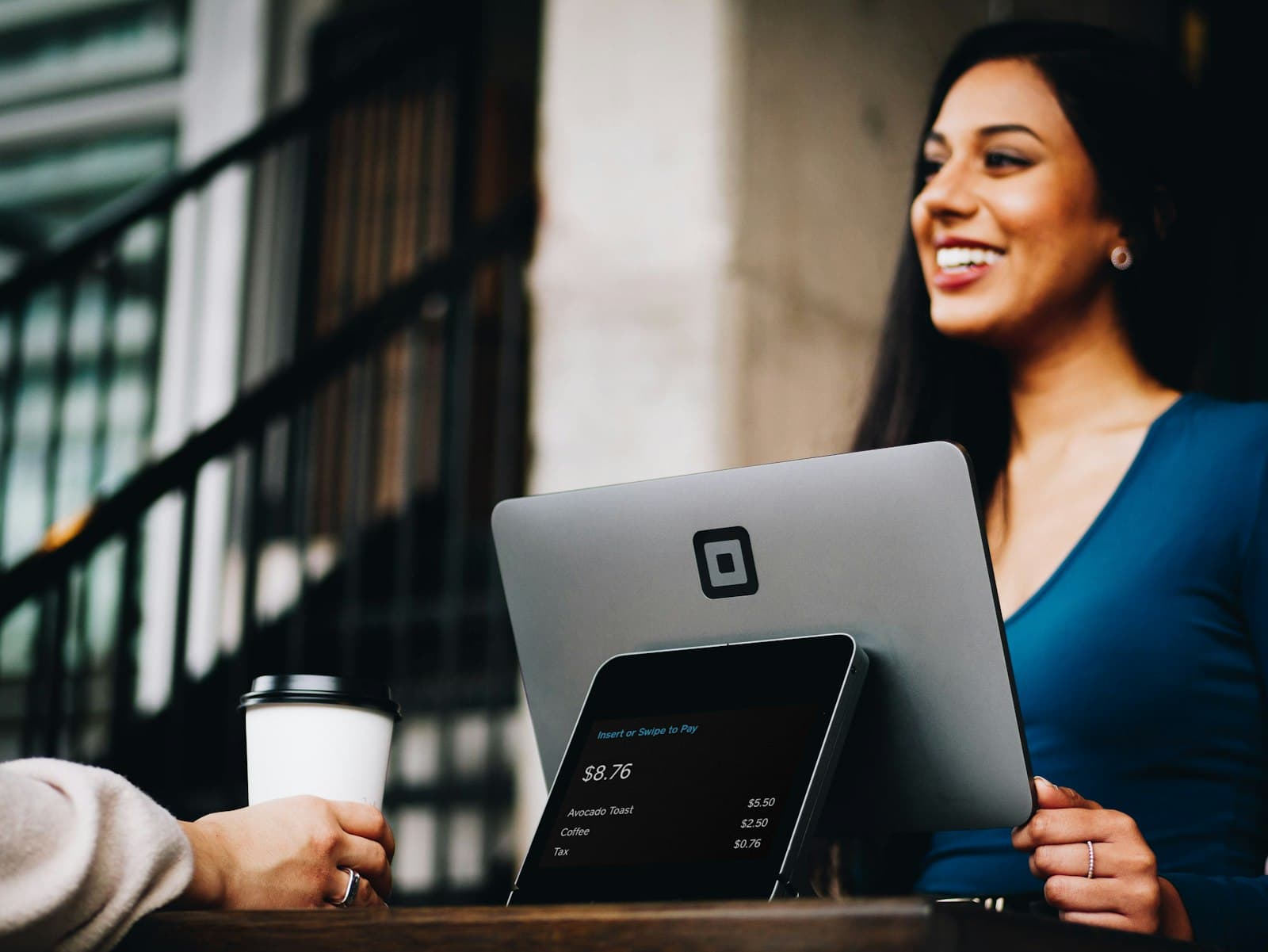
| Option | How it works | Cost example (Square US fees, September 2026; yours differ) | Risk |
|---|---|---|---|
| 1. Pay by link, sent by text | Text a link; the caller enters the card on their own phone; you see "paid" before cooking | Payment links: 3.3% plus $0.30 on Square Free, 2.9% plus $0.30 on Plus and Premium | The card never reaches your staff |
| 2. Pay at pickup | Take the order, name, and number; charge the card at the counter | In person: 2.6% plus $0.15 on Square Free | Card data never crosses the call; use a link on big orders to prevent no-shows |
| 3. Keyed entry, nothing written down | The caller reads the card; staff types it straight into the terminal | Keyed-in: 3.5% plus $0.15 on every plan (neither card nor cardholder present) | Safe only with no paper step at any point |
| Never: card number on paper, a whiteboard, or a text to a coworker | This turns a phone order into a card data breach |
Why paper is a PCI problem: the card industry's phone payment guidance, Protecting Telephone-Based Payment Card Data (PCI Security Standards Council, v3.0, November 2018), says the security code taken on a call may not be stored after authorization, even encrypted, and that if account data "is ever written or printed on paper, ensure it is securely stored, then shredded when no longer needed." It also says to keep anything that could record card data away from where cards are taken. A notepad by the phone fails all three; what PCI requires of a small restaurant is in PCI compliance for restaurants.
How do you handle the hard phone calls?
Hard calls are handled with a rule decided before the phone rings: two menu suggestions for the undecided caller, a deposit and a full read-back for large orders, a callback instead of a hold during a rush, and a manager for every complaint.
The caller who does not know what they want. Ask how many people and any favorites, then offer two options, not the menu: "For four, most tables do a large pizza and a salad, or two mediums."
Large orders. Over about ten people, or for a set time later: take name, phone, headcount, the time needed, and whether to pack it for serving. Read it all back at the end, take a payment link or deposit before it reaches the kitchen, and tell the kitchen lead in person.
Calls during a rush. Decide who owns the phone before the rush: the host, or whoever is expo. "Whoever is free" fails, because at 6:30 nobody is. If the order cannot be taken now, take a name and number and call back in two minutes, and quote honest ready times.
The caller who wants to complain. Let them finish and do not defend the kitchen. Say what happens next and by when: "The manager will call you back within 15 minutes." Take the name, number, and order time; illness or an allergic reaction goes to the manager immediately. Decide in advance what a shift lead can give away; the decision rights list for shift leaders is where to write that down.
Putting someone on hold. Ask, do not announce: "Can I put you on hold for 30 seconds?" and wait for the yes. Check back within 30 seconds, keep any hold under a minute, and take a number instead if it will run longer. Never park one caller to take a second caller's whole order.
How many calls does a restaurant miss, and what does a missed call cost?
No independent public study counts how many calls a typical restaurant misses, and vendor figures come from their own customers, so measure yours from the phone log; a June 2025 Harris Poll did find that 69% of Americans would likely give up on a restaurant that does not answer.
The Harris Poll ran it online for Hostie, an AI phone vendor, from May 29 to June 2, 2025, among 2,065 US adults; it also found 63% prefer calling to contact a restaurant and 20% say their calls are always or often ignored (release). Weigh the sponsor, but the pollster and sample are real.
Your own number comes from the phone log. A VoIP system (Ooma, RingCentral, and similar) logs missed calls by hour and exports a month. A landline handset keeps a short missed-call list, so write the count down at close. With no log, tape a tally sheet by the phone for two weeks and tick every call that rang out or went to voicemail.
Fill this table monthly; the right column is an example, not a benchmark.
| Line | Where it comes from | Example month |
|---|---|---|
| Calls received | Phone log | 1,200 |
| Calls missed (rang out or voicemail) | Phone log | 240, or 20% |
| Missed during peak (5pm to 8pm) | Phone log by hour | 180 |
| Share of calls that are orders | Listen for a week and count | 60% |
| Average phone ticket | POS, phone orders only | $32 |
| Estimated lost orders | Missed calls x order share | 144 |
| Estimated lost revenue, ceiling | Lost orders x average ticket | $4,608 |
Treat the last line as a ceiling, since some missed callers call back or order online. Even at half, $2,300 a month lands in the three hours when tickets are largest; the buyer guide's missed-call cost model shows how it compounds.
When should you hand the phone to a system?
Hand the phone to a system when the log shows missed calls you cannot staff away: calls after close, a nightly peak where the phone always loses, or more than a few missed calls a day; the options are an answering service, IVR or text-back, and AI phone ordering.
Rules of thumb: under about 20 calls a day with a host on the phone, training is the fix. Misses bunched into the same two hours nightly, or after close, call for a missed-call text with your online menu link or an AI agent. A handful or more missed at peak every night means one of the paid options below.
| Answering service (people, off-site) | IVR or missed-call text-back | AI phone ordering | |
|---|---|---|---|
| Cost model | Minute bundles. Ruby: $250 a month for 50 minutes to $1,725 for 500, 24/7 | A business phone plan feature. Ooma Office from $19.95 per user per month includes a virtual receptionist; Grasshopper's Instant Response texts missed callers | Flat monthly fee with included minutes. DirectOrders Pro + Voice: $349 a month, 500 minutes |
| What it can do | Answer every call 24/7 with a person; take messages; take an order from your script and menu | Route by keypress, play hours, text your online ordering link when you miss a call | Answer every call at once, take the order in conversation, send it to the ticket flow, text a pay link |
| What it cannot do | Know your menu like your staff, ticket into your POS without rekeying, or stay cheap on your busiest night | Take the order; some callers will not move to a screen | Handle a complaint, a kitchen-level allergy question, or a big catering call without a person to hand off to |
Prices checked September 2026. The buyer guide covers which category fits your call volume and its three-year cost. Every option still hands some calls to a person, so the script below matters.
Phone order training checklist
Print this, add a name and date, and do not let a new hire take a real call alone until every row is signed.

| Skill | How to practice | Sign off when |
|---|---|---|
| Greeting in under ten seconds | Ten mock calls, manager as the caller | Restaurant name, own name, pickup or delivery, every time |
| Read-back on every line | Manager orders six items with three modifiers | Zero misses on two orders in a row |
| Spelling names and numbers | Five unusual names, five phone numbers | All ten repeated back correctly |
| The allergy question | Manager mentions an allergy mid-order | Written in the ticket's allergy spot, kitchen lead told |
| Total and ready time | Trainee rings the mock order and asks the kitchen for a time | Total matches the POS; time matches the kitchen |
| Payment by link | Trainee texts a test link to the manager's phone | Link arrives; never asks for a card number |
| Hold and callback | Manager calls during a mock rush | Asks before holding, checks back in 30 seconds, or takes a number |
| The complaint call | Manager plays an angry caller | Listens to the end, takes details, hands to the manager |
| Shadow shift | Listens to 20 real calls, then takes 20 with the manager listening | Manager signs with the date |
The phone order script
Tape this by the phone. Swap in your restaurant's name and read it word for word until it is automatic.
Answer: "Thanks for calling Main Street Pizza, this is (your name). Pickup or delivery?"
If delivery: "What's the address? Any apartment number or gate code?"
Name: "Can I get a name for the order? Is that spelled (spell it back)?"
Order: "Go ahead." After each item: "One large pepperoni, no onions. Got it. What else?"
Allergies: "Any allergies we should know about?"
Read-back: "Let me read that back: one large pepperoni, no onions; two Caesar salads, dressing on the side. Anything else?"
Total and time: "That's $41.20 with tax. It'll be ready in 20 minutes."
Payment: "I can text you a link to pay now, or you can pay at pickup. Which works?"
Number: "What's the best number in case the kitchen has a question? Let me read that back: 555, 010, 4477."
Close: "Thanks, Kate. Twenty minutes, ask for (your name) at the counter."
If you need a hold: "Can I put you on hold for 30 seconds?" Wait for the yes.
If you are slammed: "We're right in the middle of the rush. Can I take your number and call you back in two minutes?"
If it is a complaint: "I'm sorry that happened. Tell me what went wrong." Listen. Then: "The manager will call you back within 15 minutes."
Never say: "What's your card number?" Send the link or take the card at the counter.
Where DirectOrders fits
DirectOrders is a commission-free ordering platform for independent restaurants on a flat monthly fee: Pro is $249 a month, Pro + Voice is $349 a month with 500 AI phone minutes included, and there is a 14-day free trial. Voice AI phone ordering answers the calls your host cannot get to, takes the order in conversation, and hands complaint, allergy, and catering calls to a person, the handoff rule from the table above. Every plan includes a branded website with online ordering, so the "I can text you a link" line has somewhere to point, and the restaurant keeps its customer data.
Sources
All sources checked September 2026.
- PCI Security Standards Council, Protecting Telephone-Based Payment Card Data, v3.0, November 2018: security code and paper rules.
- Square, Learn about Square fees: in-person, payment link, and keyed-in rates.
- US Food and Drug Administration, Food Allergies: the nine major food allergens.
- Hostie press release, July 27, 2025, Missed Connection? Over Two-Thirds of Americans Would Ditch Restaurants That Don't Answer the Phone: Harris Poll of 2,065 US adults, May 29 to June 2, 2025.
- Ruby, Pricing: receptionist plans and included minutes.
- Ooma, Ooma Office plans: per-user pricing and virtual receptionist.
- Grasshopper, Instant Response: automatic text to missed callers.
Bottom line
A phone order goes wrong in three places: the greeting that wastes ten seconds, the line that never got read back, and the card number that ended up on paper. The script, the read-back habit, and pay-by-link fix all three; sign off the checklist before a new hire takes a real call. Then pull the call log monthly. If it keeps showing calls nobody could have answered, the phone ordering system buyer guide is the next page to read.
Frequently Asked Questions
Say the restaurant's name, then your own, then ask the one question that decides the rest of the call: pickup or delivery. For example: Thanks for calling Main Street Pizza, this is Maria, pickup or delivery tonight? Keep it under ten seconds. The caller learns they dialed the right place, gets a name to ask for at the counter, and you learn whether you need an address before you take a single item.
Related resources
Related Articles
AI answers
Restaurant Phone Ordering System: 2026 Buyer Guide
Compare the 5 types of restaurant phone ordering systems by cost, coverage, and data ownership, then pick the right one with a missed-call cost model.
Pankaj Avhad
PCI Compliance for Restaurants: What You Actually Have to Do
Small restaurants are Level 4: one self-assessment a year, a scan in some setups. Find the SAQ for your terminal, POS and ordering page, and clear the fee.
Pankaj Avhad
How to Take Online Orders for Your Restaurant (2026 Guide)
The complete guide to restaurant online ordering: 5 methods compared, real costs, step-by-step setup, and how to keep 100% of your revenue instead of paying 15-30% to delivery apps.
Pankaj Avhad