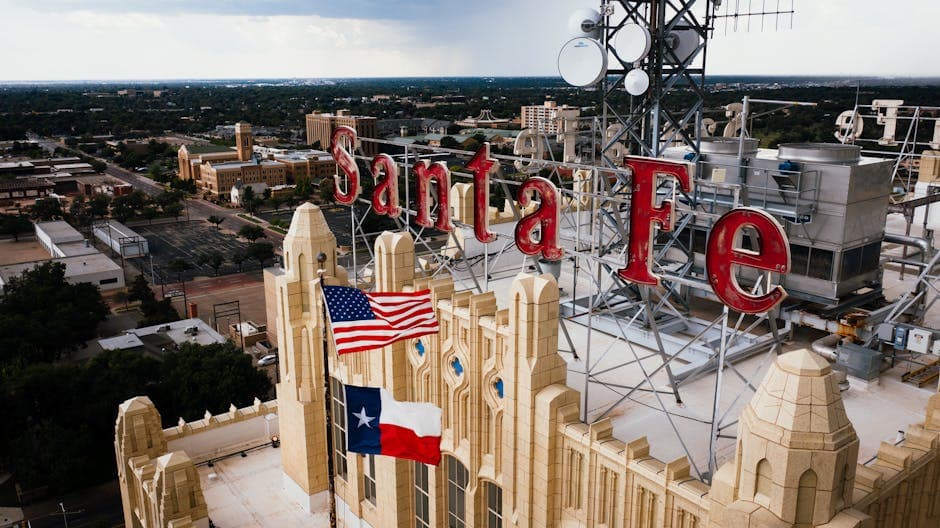
Cattle Capital and Route 66.
A long read on operating restaurants in Amarillo, the cattle feedlot capital of the United States, where I-40 runs the old Route 66 line east to west, the Big Texan dares strangers to clear a 72oz steak inside an hour, and three of the largest beef plants in North America turn the Panhandle into the country's densest meat economy.
- US fed-cattle within 150 mi
- ~25-30%
- Three-plant annual throughput
- ~7M+ head
- Pantex workforce
- ~3,500
- West Texas A&M enrollment
- ~10K
Texas Cattle Feeders Association
Tyson, JBS USA, Cargill
NNSA / Consolidated Nuclear Security
WTAMU
I. Tuesday, 7:14 P.M., I-40 East
The plate that explains the city.
It is a Tuesday in late spring. The wind has died off the High Plains and the sky west of the Big Texan Steak Ranch is the kind of orange that turns up on every postcard ever printed in Amarillo. Inside the dining room, a forty-two-year-old long-haul driver from Joplin, Missouri steps up onto the wooden stage near the front of the room. A waitress sets a plate in front of him. The plate weighs more than seven pounds. The clock on the wall starts.
The plate holds a 72-ounce top sirloin, a shrimp cocktail, a baked potato, a salad, and a dinner roll with butter. The rules, posted on the wall since 1960, are simple. If the driver finishes the full plate inside sixty minutes, the meal is comped. If he does not, he pays the $72. Every other diner in the room knows what is happening. Phones come out. The Big Texan livestreams the attempt on a camera mounted above the stage. By 7:25 he is halfway through the sirloin and slowing. By 7:42 he is staring at the last quarter of the steak and the baked potato. At 8:14 the clock hits sixty minutes. He has cleared the steak. He has not cleared the potato.
This is the scene that announces Amarillo to most of America. The Big Texan has been doing this ritual since 1960. The challenge is part menu item, part theater, part interstate tourism draw, part marketing engine that turns I-40 frontage into a moat no Texas Roadhouse can ever cross. The driver pays his $72, takes a Big Texan t-shirt as a consolation prize, walks back to his cab in the motel lot next door, and is gone by sunrise. The plate stays on the stage. The clock resets. The next attempt is at 8:30.
The economics behind the plate are not theater. Within a hundred-and-fifty-mile circle of the front door, the Texas Panhandle produces roughly one in four pounds of US fed-cattle beef. Three of the largest beef-processing plants in North America sit inside the same radius: Tyson Foods on the east edge of Amarillo, JBS USA at Cactus fifty miles north, and Cargill at Friona seventy-five miles southwest. The Amarillo Livestock Auction, just east of downtown, has been one of the busiest cattle markets in the country for half a century. The 72-ounce steak is not a gimmick. It is the city advertising its core industry on a plate.
Downtown, three miles west, the calendar is different. A wine bar on Polk Street is filling for its 7:30 dinner reservation wave. A pub on 6th Avenue is hosting trivia. On the historic Route 66 corridor, antique shops have closed and the neon signs have come on. Out on Soncy Road, the west-side dining strip, families are pulling into Texas Roadhouse and Chuy's. At Pantex, seventeen miles northeast, the day shift has ended and the night shift is loading a catering tray into a cleared-perimeter delivery slot. At Bell Helicopter, the V-22 Osprey assembly line is two hours from its shift change. A West Texas A&M Buffaloes game is three days away in Canyon.
This page exists because Amarillo is not Dallas. It is not Austin. It is not Houston or El Paso or Fort Worth. It is the cattle feedlot capital of the United States, the crossroads where Route 66 still runs east-to-west, the home of the country's only nuclear weapons assembly facility, the final-assembly home of the V-22 Osprey, the city that resettles more refugees per capita than almost anywhere in the country, and the place where a roadhouse steakhouse turned a 72-ounce sirloin into a regional identity. A platform built for downtown Atlanta misses every one of those facts.
At 8:30 the clock on the Big Texan wall resets. A college-age couple from Albuquerque steps up to the stage. The waitress sets the plate down. The room watches. The challenge is back on. The Panhandle keeps running.
II. The Feedlot Capital
Roughly a quarter of US fed-cattle inventory sits inside a hundred-and-fifty-mile circle around Amarillo.
The Texas Cattle Feeders Association, the producer organization that represents commercial cattle feeders across Texas, Oklahoma, and New Mexico, headquarters in Amarillo for a reason. On any given day, roughly five million head of fed cattle stand in feedlots across the Texas Panhandle. The same number is, depending on the season, somewhere between a quarter and a third of total US fed-cattle inventory. No other region of the country comes close on a per-mile-of-radius basis. The Lubbock-area South Plains, the only competing density, sits a hundred miles south.
Two counties carry the bulk of the density. Deaf Smith County, anchored by Hereford, is, by some industry measures, the most cattle-dense feeding county on earth. Castro County, just south, is the second. Moore County, anchored by Dumas, plus Sherman County, anchored by Cactus, carry the northern half of the cluster. A drive on US 287 north from Amarillo to Dumas in late afternoon, with the wind in the right direction, will tell anyone with a nose exactly what the Panhandle does for a living.
The Amarillo Livestock Auction, just east of downtown on Manhattan Street, is one of the largest auction houses in the country. Tuesday and Wednesday auction days draw buyers from across the Plains, the Midwest, and the Pacific Northwest. The auction calendar drives a parallel restaurant trade. Buyers and ranchers fly in for the auction, take a hotel room on Loop 335, eat dinner at a Polk Street steakhouse or the Big Texan, and fly out the next day. The auction calendar is, in operating terms, a mini-conference calendar that runs every week of the year.
The annual rhythm of the Panhandle cattle economy is steadier than the South Plains cotton calendar. Feedlots run year-round. Slaughter at the three big plants runs year-round, with the seasonal demand swings driven by grocery beef demand more than by harvest. The cattle market itself is, however, deeply cyclical: drought years pull cattle off ranches into feedlots early and drop feeder prices, wet years rebuild herds and tighten supply. Operators who serve the cattle trade learn to read the cycle.
The implication for restaurants is direct. Catering for the Amarillo Livestock Auction Tuesday lunch is a real, repeating weekly account. Catering for the Texas Cattle Feeders Association headquarters meetings, the regional feedlot conferences, and the buyer dinners on auction nights forms a steady B2B layer that no other Texas city outside Fort Worth carries in the same way. The platform that wins Amarillo is the platform that can take a catering ticket from a feedlot manager on a Tuesday morning and have it staged at the auction barn by eleven.
The cattle economy is also a household economy. Tens of thousands of Panhandle households earn a paycheck from a feedlot, a beef plant, a feed mill, a livestock-supply company, or a veterinary practice. The restaurant trade is shaped by those paychecks. A Tuesday morning breakfast counter on Amarillo Boulevard reads more like a small-town cafe than a suburban chain, because the customer base is the cattle economy clocking in for shift one.
Panhandle Cattle Ledger
| Metric | Value | Source |
|---|---|---|
| Share of US fed-cattle within ~150 mi of Amarillo | ~25-30% | Texas Cattle Feeders Association, USDA NASS |
| Texas Panhandle feedlot inventory on a typical day | ~5M+ head | Texas Cattle Feeders Association reporting |
| Cattle processed annually at the three Panhandle beef plants | ~7M+ head | Tyson Foods, JBS USA, Cargill Protein public reporting |
| Beef processing employment, Panhandle region | Tens of thousands across plants and feedlots | Texas Workforce Commission regional profile |
III. The Three-Plant Spine
Tyson, JBS USA, and Cargill run the Panhandle as one continuous beef factory.
The Tyson Foods Amarillo beef plant sits on the east edge of the city, just inside Loop 335. Daily throughput is roughly five thousand head. JBS USA Beef in Cactus, fifty miles north on US 287, runs roughly fifty-four hundred head a day, which places it among the largest single beef-processing facilities in North America. Cargill Protein in Friona, seventy-five miles southwest, runs roughly forty-five hundred head a day, fed in part by Friona Industries feedlots that surround the plant. Together the three plants put close to fifteen thousand head of cattle through stainless-steel kill floors on a typical weekday.
Combined, the three plants employ ten thousand people or more. That number is conservative; seasonal demand and contract labor push the working headcount higher through the peak grocery-demand months. The plants run multiple shifts, including overnight production crews that clock in at 2 a.m. for the sanitation and disassembly windows. The catering trade that serves the shift-change windows is structurally different from the trade that serves a normal 11:30 lunch.
The workforce reflects the long-running history of meatpacking in the United States. A significant share of plant employees are Spanish-speaking, with both first-generation immigrants and second-generation Texas residents from across the Panhandle. A separate, smaller share are refugees, resettled in Amarillo through federal and faith-based resettlement programs over the past two decades: Vietnamese, Burmese, Karen, Somali, and Latin American communities all carry working populations inside the plants.
The plants pay middle-class wages by Panhandle standards. The combined annual payroll across the three plants is enormous, and it cycles through local businesses (groceries, gas stations, used-car lots, payday-loan shops, churches, and restaurants) in ways an Austin tech-company payroll never could. A restaurant on Amarillo Boulevard East does its highest catering volume on Tyson payday weeks. A panaderia on the north side does the same. The local economy reads the plant calendar without ever needing to write it down.
The plants also drive a structural catering relationship. Tyson alone is a major regional catering customer for plant celebrations, retirement parties, safety-program lunches, and department off-sites. The platform that can take a 280-tray catering ticket from a plant administrator at 8:30 a.m. for the same day, route it through a cleared-vehicle delivery-and-drop protocol, and stage trays inside a plant breakroom by eleven is doing work a generic marketplace app cannot do.
Amarillo, east of the city near Loop 335
Tyson Foods Amarillo Beef
~5,000 head per day
One of the largest single-site beef plants in the country. Workforce of several thousand on multiple shifts. Catering trade is heavily shift-driven (lunch and the 2 a.m. shift-change window).
Cactus, ~50 mi north of Amarillo on US 287
JBS USA Beef Cactus
~5,400 head per day
Among the largest beef plants in North America. Operates the Cactus, Texas community as a company town in many practical respects. Bilingual workforce, heavy weekday breakfast and lunch catering volume.
Friona, ~75 mi southwest of Amarillo
Cargill Protein Friona
~4,500 head per day
The third Panhandle beef anchor. Friona Industries feedlots feed directly into the plant. Catering for the Friona facility runs through Hereford and the nearer Panhandle towns.
Hereford, ~50 mi southwest of Amarillo
Swift Beef (formerly Caviness Beef Packers)
Smaller, specialty operation
Hereford carries the second-largest concentration of feedlots in the country (only Lubbock-area Castro County is similar). Hereford is, by some measures, the densest cattle-feeding county in the world.
IV. Free if You Finish
The 72-ounce sirloin is the most famous menu item in West Texas, and the Big Texan has run it since 1960.
R.J. "Bob" Lee opened the Big Texan Steak Ranch on Amarillo Boulevard in 1960. The 72-ounce sirloin challenge, the public stage near the front of the dining room, the published rules, and the public list of finishers were all in place within the first decade. When the interstate highway system rerouted long-haul traffic off Route 66 onto I-40 in the 1970s, Lee moved the entire restaurant a few miles east to a new I-40 frontage site and rebuilt the place with the now-iconic painted yellow facade and the larger-than-life cowboy boots out front. The Big Texan has stayed in the same family for four generations.
The challenge rules have stayed essentially unchanged for sixty-five years. Sixty minutes. The full plate: the sirloin, the shrimp cocktail, the baked potato, the salad, the dinner roll with butter. No outside help, no splitting, no leaving the stage. A $72 entry fee. Free if the diner finishes inside the hour. Pay if they do not. The dining room watches. The Big Texan livestreams every attempt on the public web. Tens of thousands have tried since 1960; a smaller but still-large number have finished. The published finisher list includes competitive eaters who have cleared the plate in under five minutes and an oft-cited sixty-nine-year-old grandmother who cleared it on her first attempt.
Mechanically, the challenge is a tourism engine, a brand engine, and a menu economics engine all at once. The Big Texan operates an attached motel (the Big Texan Inn, with pickup-truck-shaped vans that run a free shuttle to the restaurant), a brewery, and a gift shop on the same lot. The restaurant draws Route 66 road-trippers, German and Japanese interstate tourists, Texas A&M tailgate caravans, college road-trip groups, and the occasional famous-eater attempt. The challenge is the reason every one of those customers pulled off I-40 at exit 75.
The restaurant carries a parallel menu that is, in the simple steakhouse register, very good. Hand-cut steaks, rib-eye and porterhouse and filet, plus a serviceable bar program and the in-house Big Texan Brewery beer line. Most customers who arrive intending to watch the challenge end up ordering the smaller eight-, twelve-, or sixteen-ounce sirloin. The challenge sells the restaurant and the restaurant sells the steaks.
For platform thinking, the Big Texan is the operating opposite of a chef-driven Polk Street wine bar. It is a high-volume, tourist-and-trucker, table-service restaurant with seasonal surges tied to the interstate calendar (spring break, summer road-trip months, Thanksgiving travel weeks) and a national-tourism marketing arc that depends on viral coverage of the challenge. Online ordering for the Big Texan is mostly pickup-trade catering for nearby motels and tour groups, plus tee shirts and challenge-meal gift packages shipped from the on-site gift shop.
72oz Challenge Ledger
| Component | Detail | Notes |
|---|---|---|
| The 72-ounce sirloin | 4.5 lbs of seasoned top sirloin, cooked to order | The full plate weight, before the shrimp cocktail, baked potato, salad, and dinner roll, is north of seven pounds of food. |
| The clock | 60 minutes from first bite to clean plate | If the diner finishes the full meal inside the hour, the entire $72 cost is comped. If not, they pay. |
| The raised stage | A wooden platform near the front of the dining room | Challengers eat on a stage, in view of every other table, broadcast on the Big Texan's online stream. |
| The full meal | Sirloin + shrimp cocktail + baked potato + salad + roll with butter | The challenge is not just the steak; the sides and shrimp cocktail must be cleared as well. No outside help. No splitting. No leaving the stage. |
| Public ledger of finishers | Since 1960, thousands have attempted; a published list of winners | Includes record times under ten minutes by competitive eaters and a 69-year-old grandmother. The challenge is part theater, part menu item, part tourist anchor on I-40. |
V. Ten Cadillacs Nose-Down in a Field
The most photographed art installation in the Texas Panhandle has been there since 1974.
Three miles west of central Amarillo, just south of I-40 in a flat wheat field off Hope Road, ten Cadillacs stand nose-down in the dirt at the same angle as the Great Pyramid at Giza. The cars (Cadillac sedans and coupes from the model years 1949 through 1963) were buried in 1974 by the San Francisco art collective Ant Farm at the invitation of the late Amarillo eccentric and public-art patron Stanley Marsh 3. The installation has never been a museum, has never charged admission, has never been gated, and has never been ungraffitied for longer than the time it takes a new visitor to find a spray can.
Cadillac Ranch is now one of the most photographed roadside art installations in the United States. The cars are continuously, deliberately, repainted by visitors. Every layer of spray paint covers the last. The cars have been painted Pride colors, Russian-invasion-of-Ukraine colors, election-cycle colors, and birthday colors. Tourists arrive with grocery-bag spray cans and leave the cans on the ground (the local sanitation crew clears the cans every few days). The cars themselves, beneath the paint, are deteriorating. The art is the layered paint, not the metal.
The wider Route 66 heritage that runs through Amarillo is the structural reason Cadillac Ranch exists where it does. The original 1926 alignment of US Route 66 entered Amarillo from the east on Amarillo Boulevard, ran west through downtown, jogged south onto 6th Avenue through the San Jacinto neighborhood, and exited the city westbound past where Cadillac Ranch now sits. When I-40 was completed in the 1970s, the interstate paralleled the old alignment but bypassed the downtown core. Amarillo, like most Route 66 towns, lost its through-traffic. The 6th Avenue Historic District (now on the National Register) preserved the original storefronts, the neon, and a continuous run of antique shops, small kitchens, and dive bars.
The Golden Light Cafe on 6th Avenue, open since 1946, is the oldest continuously operating restaurant on the Texas stretch of Route 66. Its sister bar, the GoldenLight Cantina, runs live music four nights a week. The strip has rebuilt slowly, restaurant by restaurant, into a walkable Route 66 corridor that competes with downtown Polk Street for evening business. The tourist trade is real. Spring through fall, foreign and domestic Route 66 travelers move through the corridor on a daily basis. Restaurants that sit on the corridor learn to read the foreign tourism calendar.
For the platform, the implication is two-channel ordering: a local-resident channel that knows the city and orders by name, and a tourist channel that finds the restaurant through Google Maps, Apple Maps, and TripAdvisor and orders by category. The Route 66 corridor restaurants depend on the second channel to make Saturday night work. A platform that ships discoverability across fifteen channels, not just the website, fits the corridor in a way a single-channel marketplace cannot.
VI. Cleared Perimeters and Final Assembly
Pantex assembles the country's nuclear weapons and Bell builds the V-22. Both are inside the radius.
The Pantex Plant sits about seventeen miles northeast of Amarillo, on a roughly sixteen-thousand-acre fenced site off US 60. It is the only US facility that assembles and disassembles nuclear weapons. The plant is operated by Consolidated Nuclear Security on behalf of the National Nuclear Security Administration, an agency inside the US Department of Energy. The site has been in continuous operation as a weapons facility since World War II. Workforce sits at roughly thirty-five hundred, including federal employees, contractor technicians, and an on-site security force.
Catering for Pantex runs through a cleared-perimeter protocol that almost no city restaurant is set up to handle on a generic marketplace stack. Vendors must be pre-approved. Drivers are subject to identity verification at the perimeter gate. No last-minute substitutions are permitted (the security protocol requires that what shows up at the gate matches what was on the pre-approved order). Catering windows are tight: the lunch window is forty-five minutes, and the overnight shift-change window (2 to 4 a.m.) is roughly an hour. A restaurant that wins a single Pantex catering account often wins it for years.
Bell Helicopter (now branded Bell Textron) operates its Amarillo Assembly Center at Rick Husband Amarillo International Airport, on the east side of the city. The facility is the final-assembly home of the V-22 Osprey tiltrotor and of the H-1 helicopter family. Workforce sits at roughly twelve hundred to fourteen hundred. Catering for Bell is structurally closer to a traditional manufacturing account than to Pantex: pre-shift breakfast catering is real (the assembly line starts at 6 a.m.), the lunch window is the standard 11:30 to 1:30, and department-level catering follows the Department of Defense contract calendar.
The third anchor in the same industrial layer is the Tyson beef plant, already described above. Together, Pantex, Bell, and Tyson carry the largest single-site workforces in Amarillo. A platform that handles cleared-perimeter ticketing, pre-approved vendor flows, and the 2-to-4 a.m. shift-change window is the platform that wins the city's biggest industrial catering accounts.
The hospital layer (Northwest Texas Healthcare and the BSA Health System) sits parallel. These two systems carry the bulk of inpatient and emergency care for the Texas Panhandle, and their catering trade runs through evening hours on shift rotation, similar to the TTUHSC catering profile in Lubbock. The catering ticket builder needs allergen flags, department-by-department presets, and fifteen-minute pickup-window granularity, not hour blocks.
Pantex + Bell + Tyson + WTAMU + Hospital Catering Map
| Account | Location | Window | Ticket | Notes |
|---|---|---|---|---|
Pantex Plant (NNSA) | ~17 mi northeast of Amarillo on US 60 | Mon to Fri, 11a to 1p plus shift-change 2 to 4a | $400 to $2,800 | The only US nuclear weapons assembly and disassembly facility. Operated by Consolidated Nuclear Security under NNSA. Workforce of roughly 3,500. Cleared-perimeter catering protocols (pre-approved vendors, identity verification at gate, no last-minute substitutions). |
Bell Helicopter Amarillo Assembly Center | Rick Husband Amarillo International Airport (eastern Amarillo) | Mon to Fri, 11:30a to 1:30p | $320 to $1,400 | Bell Textron's tiltrotor and helicopter final-assembly facility. V-22 Osprey assembly. Workforce of roughly 1,200 to 1,400. Pre-shift breakfast catering and standard lunch windows. Volume tracks Department of Defense contract cycles. |
Tyson Amarillo Beef plant catering | East Amarillo near Loop 335 | Daily multi-shift, lunch + 2 to 4a | $280 to $1,800 | Shift-driven plant catering. The 2 a.m. shift change is a real catering window for breakfast tacos, sandwich trays, and hot drinks. Few city restaurants operate the late-night production calendar to serve it. |
West Texas A&M University catering | Canyon, ~17 mi south of Amarillo | Variable across departments and athletics | $240 to $2,600 | Enrollment ~10,000. Buffaloes athletics (Lone Star Conference) drives a parallel game-day calendar. Catering across academic departments, alumni relations, and athletics. Volume tracks the academic calendar. |
Northwest Texas Healthcare + BSA Health System | Central Amarillo medical districts | Daily 11a to 2p and 5 to 8p | $220 to $1,100 | Two hospital systems carry the bulk of inpatient and emergency care for the Panhandle. Catering trade is shift-driven and runs through evening hours, similar to TTUHSC in Lubbock. |
VII. The Buffaloes, in Canyon
Canyon is seventeen miles south, and the WTAMU calendar bends the southern Panhandle restaurant year.
West Texas A&M University sits in Canyon, about seventeen miles south of Amarillo on I-27. Enrollment is roughly ten thousand students across undergraduate and graduate programs, with strong concentrations in agriculture, education, business, and nursing. Buffaloes athletics competes in the Lone Star Conference at the NCAA Division II level. Football games are played at Buffalo Stadium on campus, with home crowds in the eight-to-twelve-thousand range. Basketball, volleyball, baseball, and the rest of the athletic calendar runs across the academic year.
The WTAMU operating impact on Amarillo restaurants is real but less concentrated than the Texas Tech impact on Lubbock. Most of the campus restaurant trade is captured by Canyon operators themselves: Buff's and the family Mexican spots along 23rd Street, the breakfast counters near campus, and the road-trip cafes that line the highway to Palo Duro Canyon. Amarillo restaurants catch the Saturday game-day overflow on football weekends, the alumni-relations gatherings, and the parent-and-family-weekend traffic. The trade is steadier than tourist trade and less spiky than Texas Tech's, but it is a real annual layer.
Palo Duro Canyon, twelve miles east of Canyon, is the second-largest canyon in the country (after the Grand Canyon) and the home of the long-running outdoor musical drama TEXAS, which runs summer evenings on a natural-amphitheater stage cut into the canyon walls. The musical draws regional and tourist crowds across June, July, and August. Catering for the production, plus pre-show and post-show dining in Canyon and along Park Road 5, is a measurable summer trade for southern Panhandle operators.
For the Amarillo platform, the WTAMU layer is a calendar-aware catering opportunity. Buffaloes football home Saturdays run roughly six dates in the fall. Basketball runs from November through March. The TEXAS outdoor drama runs summer-evening dates from June through August. None of those cycles are visible on a generic marketplace stack. All of them are visible on a Panhandle-fit ordering platform that reads the WTAMU and Palo Duro calendars.
VIII. Three Restaurant Districts
Polk Street, Wolflin Village, and Soncy Road each run a different operating playbook.
Downtown Amarillo's restaurant revival has centered on Polk Street, the historic north-south spine, and on the cross streets between 6th and 16th. The Crush Wine Bar, OHMS Cafe, Six Car Pub & Brewery, Embers Steakhouse, and a cluster of newer kitchens have rebuilt the corridor over the past decade. The trade is chef-driven dinner and weekend brunch, with a measurable B2B layer that pulls from downtown banks, law firms, oil-services headquarters, and the city government complex.
Wolflin, the historic neighborhood west of downtown, carries a quieter and steadier restaurant pattern. Wolflin Village is a small mid-century commercial cluster anchored by independent retail and a handful of neighborhood kitchens. The Coyote Bluff Cafe, a beloved Amarillo burger institution, sits just north. Cask & Cork carries the wine-bar layer. The Wolflin trade is residential-village trade, repeat-customer-heavy, with smaller individual tickets than downtown but a higher repeat rate.
Soncy Road, the western dining strip that runs north-south between I-40 and Hillside, is where Amarillo's chain-and-regional-suburban dining sits. Texas Roadhouse, Saltgrass, Chuy's, Cheddar's, regional fast-casual operators, and a half-dozen large suburban Mexican restaurants line the corridor. Soncy carries the bulk of the city's suburban catering volume (rehearsal dinners, birthday parties, church-and-private-school catering, youth-sports parent-meeting orders).
The 6th Avenue Route 66 corridor, north of downtown, is a fourth district with a different operating math. Tourist trade is real, especially in the warmer months. The Golden Light Cafe's 1946 opening date makes it the oldest continuously operating restaurant on the Texas stretch of Route 66. The corridor restaurants run live music, antique-shop spillover trade, and a Friday-and-Saturday-night bar economy that runs later than the rest of the city.
The platform implication is structural: one city, four operating playbooks. Polk Street needs reservation pacing and a B2B catering builder. Wolflin needs a fast loyalty-and-repeat flow. Soncy needs suburban catering volume tools and chain-style pickup-window granularity. 6th Avenue needs Route 66 tourist discoverability across fifteen channels. A generic marketplace runs all four on one template. A Panhandle-fit platform runs four overlays on the same backend.
79101
Downtown Amarillo (Polk Street + 6th Avenue)
Historic core, civic and cultural buildings, growing restaurant row
Crush Wine Bar, OHMS Cafe, Six Car Pub & Brewery, Embers Steakhouse
79109
Wolflin (historic neighborhood west of downtown)
Established historic homes, mid-century commercial, walkable village
Wolflin Village shops, Cask & Cork, Coyote Bluff Cafe nearby
79119, 79124
Soncy Road corridor (west Amarillo)
Suburban retail spine, master-planned neighborhoods, chain plus regional
Texas Roadhouse, Saltgrass, Chuy's, regional fast-casual
79106
Route 66 / 6th Avenue Historic District
Antique row, neon, midcentury Route 66 storefronts, eclectic small operators
The Golden Light Cafe (since 1946), GoldenLight Cantina, small kitchens
79118, 79103
I-40 East / Big Texan corridor
Interstate-frontage tourism, motels, truck stops, road-trip dining
The Big Texan Steak Ranch, OST Steakhouse archetype, Cadillac Ranch nearby
79015
Canyon (West Texas A&M)
College-town residential plus campus core south of Amarillo
Buff's, family Mexican spots, Palo Duro Canyon road-trip cafes
IX. Amarillo Boulevard, in Three Languages
North Amarillo answers the phone in Spanish first. Amarillo Boulevard East answers in Vietnamese.
The Amarillo metro is roughly thirty percent Hispanic or Latino per the most recent US Census American Community Survey five-year estimates. The share is not evenly distributed. North Amarillo (79107, 79108) and parts of East Amarillo (79104) carry significantly higher Hispanic-origin concentrations and significantly higher Spanish-at-home rates than the citywide median. The corridor along Amarillo Boulevard from North Hughes to North Eastern is a Spanish-first restaurant economy: panaderias, taquerias, mariscos restaurants, and family kitchens cluster on the boulevard and on the side streets that feed it.
Layered on top is a refugee economy that has reshaped Amarillo for two decades. Driven by meatpacking workforce demand at Tyson, JBS Cactus, and Cargill Friona, Amarillo has carried one of the highest per-capita refugee resettlement rates in the United States for most of the past twenty years. Vietnamese, Burmese, Karen, Somali, and Latin American refugee communities have rebuilt blocks along Amarillo Boulevard East and around the San Jacinto neighborhood. Pho counters and Vietnamese family kitchens on Amarillo Boulevard East have been documented in Texas Monthly and in Eater national coverage.
An Amarillo Boulevard East pho counter takes incoming calls in Vietnamese, in English, and in Spanish, often within the same evening. A North Amarillo taqueria takes calls in Spanish first. The bilingual-and-trilingual phone trade is, in operating terms, the fundamental structure of the corridor. A monolingual English IVR breaks roughly half of these calls. A Voice AI that detects the language of the speaker, holds the call without forcing a press-1 decision tree, and responds in the language being spoken protects both the order and the relationship.
The implication for the platform is direct. Bilingual is the baseline. Trilingual support (Spanish + English + Vietnamese, as starting languages, with room for Burmese and Somali over time) is the right ambition for the Amarillo Boulevard East corridor. The same call running on an English-only IVR is, by structural definition, a half-served call.
Field Note: An Amarillo Boulevard East Friday
The restaurant sits on Amarillo Boulevard East, just east of North Eastern. The owner arrived from outside Hanoi in 2007 through a refugee resettlement program; her husband came two years later. The kitchen is pho and bun and a small banh mi list. The phone rings hardest from 5:30 to 8:30 on Fridays. The owner answers in Vietnamese first, switches to English when she hears the caller speak it, and switches to Spanish when she hears that, because half the customers come off shifts at Tyson where Spanish is the lingua franca.
On a recent Friday, the owner counted: of thirty-one phone orders between 5:30 and 8:30 p.m., eleven opened in Vietnamese, eight in English, and twelve in Spanish. The Spanish-speaking callers are not Vietnamese refugees; they are Tyson plant workers who have made pho a Friday-night habit. The three languages of the corridor have woven into a single restaurant economy.
A monolingual IVR breaks every Spanish and Vietnamese call. The owner has tried, for years, to handle every call herself; on busy Fridays she misses calls because the line stays open. The kitchen does not have a second phone hire to make. A Voice AI that holds the call in whatever language the caller opens with, takes the order accurately, and drops it on the printer in the kitchen's preferred language is the difference between a thirty-one-call Friday and a forty-call Friday.
The math is the rent on Amarillo Boulevard East, the relationship with a regular customer who has called this number for nine years, and a phone-trade that the marketplace app never had access to in the first place.
ZIP 79107
North Amarillo (Eastridge, San Jacinto)
Hispanic-majority residential corridor. Spanish-first phone trade. Family-restaurant ticket sizes run larger, multi-generational households. Mexican panaderias, taquerias, and mariscos cluster along Amarillo Boulevard.
ZIP 79104
East Amarillo (Eastridge edge, near Tyson plant)
Mixed Hispanic-majority and Vietnamese-refugee resettlement. Pho counters and Vietnamese family kitchens cluster on Amarillo Boulevard East. Bilingual and trilingual phone trade is the daily norm.
ZIP 79108
North Amarillo (Highway 287 corridor)
Working-class Hispanic-majority residential. Plant workers from Tyson and from the JBS Cactus commuter pool live in this corridor. Spanish-at-home rates run multiple times the citywide median.
X. The 8.25 Percent Question
Amarillo runs on the standard Texas combined sales-tax rate, and the marketplace remits.
Texas state sales tax sits at 6.25 percent on prepared food. The City of Amarillo and Potter County combine for an additional 2.00 percent local rate, bringing the combined Amarillo rate to the standard Texas 8.25 percent ceiling. Restaurant operators collect the combined rate on prepared-food tickets and remit through the Texas Comptroller of Public Accounts on a monthly cycle (or quarterly, for smaller operators). The Comptroller publishes the rate table by city, and Amarillo's number has been stable for years.
The marketplace-facilitator question (whether DoorDash, Uber Eats, and Grubhub remit sales tax on the restaurant's behalf for orders placed through their apps) was resolved by the Texas Comptroller in 2020. Marketplace apps must remit. The restaurant operator's tax-collection burden runs against the direct channels (the website, the phone, the kiosk, the QR table), not against marketplace orders. The DirectOrders platform tracks the dual streams (marketplace versus direct) and produces the Comptroller-ready report each month.
The implication is straightforward but worth saying out loud: the platform that wins Amarillo is the platform that does the sales-tax bookkeeping correctly, automatically, and in a format the city operator's accountant accepts on the first pass. The marketplace apps already remit. The direct-channel reporting is the operator's job. DirectOrders does that math.
XI. The Stack
The platform that fits Amarillo fits no other city the same way.
An Amarillo-fit ordering platform has to do six things at once. It must price predictably, because the auction-day buyer-dinner ticket and the Tyson plant catering tray are large enough that a marketplace commission rate compounds badly. It must read the Pantex cleared-perimeter and Bell Helicopter shift-change windows with enough rigor to pass a security gate at 2 a.m. It must run Spanish, English, and Vietnamese on the same phone line without a second hire. It must dispatch couriers across a low-density radius that reaches from Soncy Road to Canyon to Cactus without breaking on courier-pool sparsity. It must read the WTAMU Buffaloes calendar and the Big Texan tourist calendar at the same time. And it must move money the same day.
DirectOrders builds that stack. The pricing line is flat at $249 per month with no per-order commission and no per-channel surcharge across the fifteen-plus channels we maintain (website, Google Search and Maps, Instagram, TikTok, Apple Maps, Alexa, Siri, voice phone, QR table, kiosk, plus the rest). The Uber Direct integration handles corridor-aware courier routing across the Panhandle metro and out to Canyon. The Voice AI runs Spanish and English with mid-call language detection, and the platform roadmap extends to Vietnamese, Burmese, and Somali to fit the Amarillo Boulevard East refugee corridor.
The catering ticket builder reads the Pantex, Bell, Tyson, WTAMU, and BSA Health System accounts as named templates rather than generic suburban presets. Same-day Stripe and Adyen payouts hit the operating account on Friday. The sales-tax report runs against the Texas Comptroller monthly cycle and breaks marketplace volume out from direct-channel volume.
Put together, the stack answers the opening scene. The Big Texan tourist-trade tickets run out the back door at 2 p.m. for a spring-break tour bus. The 6th Avenue Route 66 pre-show pickup wave is staffed for at 7:15 p.m. The North Amarillo Friday phone trade is taken in Spanish, every call. The Amarillo Boulevard East pho counter takes the Vietnamese, Spanish, and English calls without switching phones. The Pantex catering tray clears the perimeter gate at 11:30. The WTAMU football catering Saturday closes out at the right moment for the Buffaloes' one o'clock kickoff. The payout hits Friday.
This is the platform-level answer to the operating problem this page describes. It is the reason the Amarillo file is its own page, not a sub-section of a regional Texas summary.
Flat $249 / month
No commission per order. No per-channel surcharge. Predictable spend at the auction-buyer-dinner and Tyson plant-catering ticket sizes where marketplace commission compounds worst.
See pricing →Bilingual Voice AI
Spanish-and-English voice answering with mid-call language detection. Roadmap extends to Vietnamese, Burmese, and Somali for the Amarillo Boulevard East refugee corridor.
How Voice AI works →Plant + cleared-perimeter catering
Pantex pre-approved vendor protocol, Bell shift-change templates, Tyson 2 a.m. window, BSA Health System department presets, WTAMU athletics catering. Named templates, not generic suburban presets.
Catering →Uber Direct dispatch
Corridor-aware courier routing across Amarillo, out to Canyon, out to Cactus and Friona. Low-density-friendly dispatch logic.
Delivery stack →Same-day payouts
Stripe and Adyen rail with same-day settlement. The Friday prep-cook is paid on Friday.
Payments →Fifteen-channel discoverability
Route 66 and Big Texan tourist trade depend on Google Maps, Apple Maps, Alexa, Siri, and the rest. One flat fee covers every channel.
Ordering features →XII. Editorial Coda
Two invitations.
If you run a chef-driven kitchen on Polk Street or a steakhouse on the I-40 frontage, book a thirty-minute walkthrough. We will map your weekly auction calendar against pickup windows, identify the Pantex and Bell catering accounts that fit your kitchen, and price your catering on a flat-fee basis.
If you run a pho counter on Amarillo Boulevard East or a taqueria on North Hughes, open the demo. The Voice AI listens in three languages. The catering ticket builder writes the order in whichever language the caller opens with. The cleared-perimeter delivery flow can pass a Pantex gate by 11:30.
XIII. Reading List and Sources
Where the numbers and the narrative come from.
Every number on this page traces to a primary source. The narrative draws on the Texas Cattle Feeders Association, USDA NASS, the Big Texan Steak Ranch, Visit Amarillo, the City of Amarillo, NNSA / Consolidated Nuclear Security, Bell Textron, Tyson Foods, JBS USA, Cargill, West Texas A&M University, the Amarillo Globe-News, Refugee Services of Texas, and US Census American Community Survey county-level data.
Texas Cattle Feeders Association
Texas Cattle Feeders Association
Industry association representing cattle feeders in Texas, Oklahoma, and New Mexico. Authoritative source on Panhandle feedlot inventory and the region's share of US fed-cattle production.
https://tcfa.org/
USDA NASS cattle and beef production
USDA National Agricultural Statistics Service
County-level cattle inventory and slaughter data for the Texas Panhandle. The Panhandle's feedlot density is the highest in the country on a per-mile basis.
https://www.nass.usda.gov/Statistics_by_State/Texas/
The Big Texan Steak Ranch
The Big Texan Steak Ranch
Operating since 1960. The 72oz steak challenge has a published rule sheet, a public list of finishers, and a livestreamed dining-room stage. Restaurant sits on I-40 frontage just east of central Amarillo.
https://www.bigtexan.com/
Cadillac Ranch
City of Amarillo / Visit Amarillo
Ten Cadillacs, buried nose-down in a field off I-40 just west of Amarillo, installed in 1974 by the Ant Farm art collective at the request of Stanley Marsh 3. Continuously repainted by visitors. Open 24 hours, no admission charge.
https://www.visitamarillo.com/
Pantex Plant
US Department of Energy / National Nuclear Security Administration
The only US facility that assembles and disassembles nuclear weapons. Operated by Consolidated Nuclear Security on behalf of NNSA. Roughly 3,500 employees. Sits on a ~16,000-acre site about 17 miles northeast of Amarillo.
https://www.pantex.energy.gov/
Bell Textron Amarillo Assembly Center
Bell Textron / Amarillo Chamber of Commerce
Final-assembly facility for Bell tiltrotor and helicopter programs, including the V-22 Osprey. Sits at Rick Husband Amarillo International Airport. Workforce of roughly 1,200 to 1,400.
https://www.bellflight.com/
Tyson Foods Amarillo Beef plant
Tyson Foods
Beef processing facility on the eastern edge of Amarillo. Among the largest single-site beef plants in the country. Several thousand employees on multiple shifts.
https://www.tysonfoods.com/
JBS USA Beef Cactus, Texas
JBS USA
JBS Beef plant in Cactus, Texas (~50 miles north of Amarillo). Among the largest beef plants in North America. Processes roughly 5,400 head per day.
https://jbsfoodsgroup.com/
Cargill Protein Friona, Texas
Cargill
Cargill beef plant in Friona, Texas (~75 miles southwest of Amarillo). One of the three Panhandle beef anchors. Pairs with Friona Industries feedlots.
https://www.cargill.com/
West Texas A&M University
West Texas A&M University
Enrollment of roughly 10,000 at the Canyon campus, about 17 miles south of Amarillo. Member of the Texas A&M University System. Buffaloes athletics in the Lone Star Conference. Catering trade across academic and athletic departments.
https://www.wtamu.edu/
Visit Amarillo
Visit Amarillo
Documents the Big Texan, Cadillac Ranch, Route 66 / 6th Avenue Historic District, downtown Polk Street, and the broader Panhandle attractions ledger. Primary source for tourist-trade calendars.
https://www.visitamarillo.com/
Route 66 / 6th Avenue Historic District
City of Amarillo Historic Preservation
The 6th Avenue corridor through the San Jacinto neighborhood is the original Route 66 alignment through Amarillo. Listed on the National Register of Historic Places. Restored midcentury storefronts, neon, and a continuous run of antique stores and small kitchens.
https://www.amarillo.gov/
Amarillo Globe-News
Amarillo Globe-News
Local-paper reporting on real estate, food and dining, beef processing, Pantex, Bell, West Texas A&M, and downtown development. Primary source for operator profiles and neighborhood reporting.
https://www.amarillo.com/
US Census ACS Potter and Randall counties
US Census American Community Survey 5-Year
Hispanic or Latino share of the Amarillo metro sits at roughly 30 percent. The North Amarillo zip codes (79107, 79108) and parts of East Amarillo (79104) carry significantly higher Spanish-at-home rates than the citywide median.
https://data.census.gov/
Refugee resettlement in Amarillo
Refugee Services of Texas, Amarillo Globe-News coverage
Amarillo has carried one of the highest per-capita refugee resettlement rates in the United States for two decades, driven by meatpacking workforce demand. Vietnamese, Burmese, Somali, and Latin American communities are concentrated near Amarillo Boulevard East.
https://www.rstx.org/
Texas Comptroller sales tax (Amarillo)
Texas Comptroller of Public Accounts
State 6.25 percent plus local 2 percent on prepared food. City of Amarillo combined rate sits at 8.25 percent. Marketplace apps remit on the restaurant's behalf.
https://comptroller.texas.gov/taxes/sales/city.php
City File / Amarillo, TX / Updated 2026-05-11 / All DirectOrders city files
Editorial note: cattle inventory and beef-plant throughput figures on this page trace to the Texas Cattle Feeders Association, USDA NASS, and the public reporting of Tyson Foods, JBS USA, and Cargill. The Big Texan 72oz challenge rules trace to The Big Texan Steak Ranch. Pantex and Bell workforce counts trace to NNSA and Bell Textron public profiles. Hispanic-share and refugee-corridor figures trace to the most recent US Census American Community Survey five-year estimates and to Refugee Services of Texas annual reporting.