The Texas Riviera.
The Queen of Tejano.
One ordering stack.
An editorial feature on Corpus Christi restaurant economics. The gateway to Padre Island and the Texas Riviera, the Port of Corpus Christi as the 5th-largest US port by tonnage, NAS Corpus Christi as the Navy's largest flight training base, the Selena Quintanilla heritage that draws pilgrims to the bayfront, the Whataburger founding on Ayers Street in 1950, the 61 percent Hispanic Spanish-first reality, and the Bayfront plus SPID plus Flour Bluff atlas.
The bayfront wind, the Spanish phone, the English ticket.
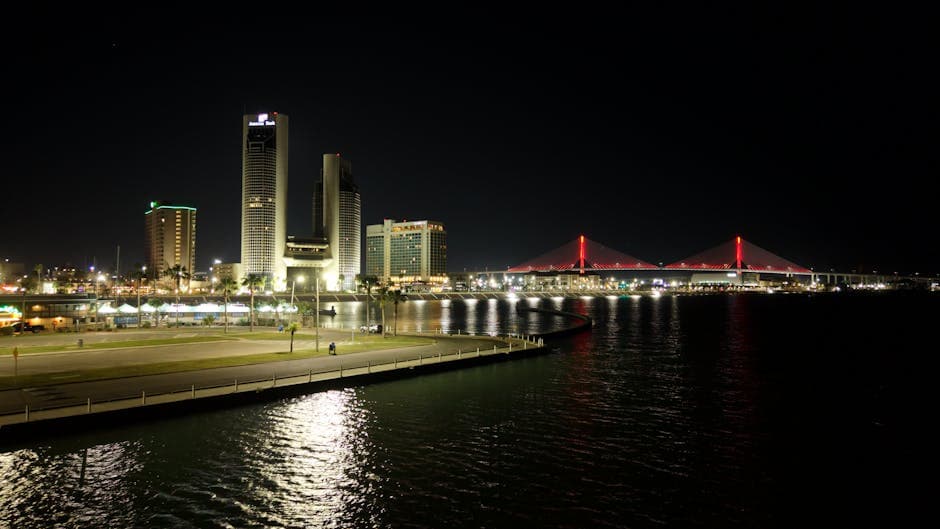
At 6:48 on a Friday evening, the dining room of a Shoreline Boulevard restaurant has every patio table claimed. The Gulf breeze comes in off Corpus Christi Bay, lifting the corners of paper napkins. Across the water, the lights of the USS Lexington Museum begin to flicker on against the dark hull. A few hundred yards north, the Selena Quintanilla statue at Mirador de la Flor glows softly under bayfront lamps, a steady stream of visitors walking by even at dinner hour. The hostess greets a family in Spanish, then pivots into English for a tourist couple in line behind them. The phone rings on the second tone.
The first call is in Spanish, from a multigenerational family in Flour Bluff placing a pickup order on the way home from a beach day on North Padre Island. The second is in English, from a Navy flight instructor at NAS Corpus Christi booking catering for a Saturday change-of-command ceremony at the squadron. The third is bilingual start to finish, from a Six Points neighborhood resident who switches between languages mid-sentence without thinking. The fourth is in English from a convention attendee staying at the bayfront hotel, asking whether the kitchen can hold a seven thirty pickup for ten people. The phone has been working like this for years.
On the counter computer, the marketplace app shows a forty-eight minute courier ETA for delivery to a North Padre condo across the JFK Causeway. The marketplace flattens the menu into a generic Tex-Mex listing, charges a 28 percent commission on a $16 enchilada plate, renders only in English, and routes the order without any sense of the seven-mile drive across the Laguna Madre to the barrier island. The customers who call the restaurant directly are doing the operator a favor. The Spanish-first households across Flour Bluff and the SPID corridor who tried the marketplace once and hit an English-only checkout never came back.
The direct site for this restaurant takes the order in Spanish, defaults to the local Spanish keyboard input on mobile, surfaces a Bayfront pickup window and a separate Padre Island delivery window, and ships the kitchen ticket to the line printer in English. The Voice AI on the inbound phone answers in Spanish first, hears the caller, and routes the order through the same ticket printer. The translation cost is paid once, at the surface. The kitchen runs in the language the line cooks already run in.
At seven fifteen, the Flour Bluff family pickup arrives. The matriarch pays in Spanish. The teenage daughter leaves a tip on the screen in English. Two minutes later a Navy spouse from NAS Corpus picks up the Saturday catering deposit slip in English. Behind her, a couple from Houston staying at the convention hotel ask about pickup for a dinner at sunset. Every order has run through one phone line, one ticket printer, and one card reader. But the customer base has crossed two languages, three neighborhoods, one barrier-island causeway, and one military installation in the span of thirty minutes. The ordering stack does not see any of it. It just prints the ticket.
What follows is a feature on the Texas Riviera and Padre Island tourism layer, the Port of Corpus Christi as the 5th-largest US port by tonnage, the NAS Corpus Christi flight training economy, the Selena Quintanilla heritage, the Whataburger 1950 origin story, the 61 percent Hispanic Spanish-first reality, the Bayfront and SPID and Flour Bluff atlas, Texas's 8.25 percent sales tax close-read, the hurricane operational continuity playbook every Gulf Coast operator runs, and the case for an ordering stack built for the way the city actually runs.
Padre Island is the longest barrier island in the world at 113 miles.
Padre Island runs roughly 113 miles down the South Texas coast from Corpus Christi Bay nearly to the Mexican border at the Rio Grande mouth. It is the longest barrier island in the world. Per the US National Park Service, Padre Island National Seashore protects the largest stretch of undeveloped barrier island remaining anywhere on the planet, roughly seventy unbroken miles of dune, beach, and shorebird habitat south of the developed North Padre footprint. Corpus Christi is the northern gateway. The JFK Causeway from Flour Bluff is the bridge.
North Padre Island, the section inside Corpus Christi city limits, runs from the JFK Causeway down to the entrance of Padre Island National Seashore. The North Padre condo and beach-house cluster sits inside the Corpus utility grid and the city delivery footprint. This is the volume zone for tourism-driven ordering. Bob Hall Pier at the south end is the visual landmark before the National Seashore boundary. A meaningful share of summer Padre Island demand is for pickup orders staged from Flour Bluff and SPID corridor restaurants and carried across the causeway by the renter or the day-tripper.
North of Padre Island, Mustang Island runs another roughly eighteen miles up to Port Aransas. Port Aransas sits at the northern tip with a free state-run ferry connection to the mainland at Aransas Pass. Mustang Island carries a separate vacation economy, with condo blocks at the southern end joining North Padre via the JFK Causeway and an Aransas Pass ferry at the top. The whole barrier system, North Padre plus Mustang Island plus the National Seashore, is what Texas tourism marketing has called the Texas Riviera for decades. The phrase predates the Mexican coast comparison.
South of the National Seashore boundary, the island becomes inaccessible to standard vehicles. Four-wheel-drive is required beyond roughly the five-mile marker. The seventy uninterrupted miles below are pure barrier island, with no commercial infrastructure and no restaurant economy. The southern tip of the island, South Padre Island in Cameron County, is a separate metropolitan economy entirely, in the Brownsville-Harlingen footprint, not the Corpus delivery zone. Mention of the Texas Riviera in Corpus marketing always means North Padre, Mustang Island, and the seventy-mile National Seashore, not the South Padre resort towns down by the border.
For Corpus restaurants, the tourism layer compresses summer demand into a tight calendar window: Memorial Day weekend, the Fourth of July, the entire month of July through mid-August, and the Labor Day weekend close. Spring break in March generates a second smaller surge. The rest of the calendar runs on local demand and the Navy plus port industrial economy. A direct ordering site that surfaces a "Padre pickup window" tied to the JFK Causeway drive, a "beach delivery" window for North Padre condos in the city utility footprint, and a tourism-side menu (group orders, pre-bookable platters) captures volume the marketplace flattens away.
The marketplace apps do not model any of this. A DoorDash listing for a Flour Bluff restaurant defaults the same forty-five minute courier dispatch radius whether the customer is two miles up Waldron Road or sitting in a beach-house rental on North Padre fourteen miles across the JFK Causeway. The operator absorbs the routing failure. The direct ordering surface closes it.
Texas State Parks at Mustang Island add a year-round camping and day-use volume on the north end of the barrier. The Texas Riviera tourism layer is structurally counter-cyclical to most of the country: the peak season runs March through Labor Day rather than the winter cool-season tourism that drives Florida and Arizona. Corpus operators index their staffing and inventory to the summer surge, and the direct ordering stack indexes the pickup windows to the same calendar.
The 5th-largest US port by tonnage runs on crude, refined product, and LNG.
Per the Port of Corpus Christi Authority and the US Army Corps of Engineers Waterborne Commerce Statistics, the Port of Corpus Christi consistently ranks as the 5th-largest US port by total tonnage and as the largest US crude oil export gateway. The Eagle Ford shale and the Permian Basin pipeline networks terminate at the port's Inner Harbor and the La Quinta Channel. Crude oil, refined petroleum products, and LNG dominate the tonnage. Bulk grain, petrochemicals, and project cargo round out the cargo mix.
The port's industrial footprint is the structural backbone of the regional economy that does not show up in the Texas Riviera tourism brochure. Citgo, Flint Hills Resources, and Valero refineries run continuous twenty-four-hour operations on the Inner Harbor. Corpus Christi LNG (Cheniere) at Portland on the north side of the harbor exports liquefied natural gas to global buyers. A growing petrochemical cluster on the La Quinta Channel produces ethylene, propylene, and polymer feedstock for export.
For restaurants, the port and refinery cluster generate a distinct catering and shift-line ordering economy. Refinery workforce on rotating twelve-hour shifts orders pickup and delivery against tight windows. Plant turnarounds (the scheduled maintenance shutdowns that bring in hundreds of contractor workers for two to six weeks) generate concentrated lunch-and-dinner volume in the industrial corridors. Port pilots, harbor tug operators, longshore workforce, and the broader maritime services workforce sit on independent shift schedules and order around them.
The marketplace apps do not model shift-line catering or plant turnarounds. A DoorDash listing has no concept of a six-week sustained contractor surge in an industrial corridor. The operator who books the turnaround catering does it through a direct relationship, on a net-30 invoice, with dietary screening and on-site delivery scheduling. The platform that handles this is not a marketplace. It is a direct ordering surface with an invoicing layer and a recurring-order configuration.
DirectOrders ships with a recurring-order and net-30 invoicing surface that maps to the industrial catering pattern. The port and refinery cluster is the second-largest restaurant demand driver in Corpus Christi after NAS Corpus and the Navy plus Coast Guard footprint, and it operates on a workflow the marketplace apps cannot transact in.
The largest US Navy flight training base, plus the Army's helicopter depot.
Per Commander, Navy Installations Command, NAS Corpus Christi is the host installation for primary naval flight training in the United States. The base anchors the southern end of Corpus Christi at Flour Bluff, with the main gate on Ocean Drive and a footprint that includes Cabaniss Field and Truax Field for outlying training operations. Total installation population sits at roughly 7,000 personnel plus families and contractors, when you sum active duty, student aviators, civilian workforce, and tenant commands.
The Chief of Naval Air Training (CNATRA), headquartered at NAS Corpus, is the command authority for all Navy and Marine Corps flight training across five installations: NAS Corpus, NAS Kingsville (forty miles south), NAS Whiting Field, NAS Meridian, and NAS Pensacola. Training Air Wing FOUR (TW-4) at NAS Corpus runs primary flight training for roughly 2,500 student naval aviators plus instructors annually. Wings-pinning Friday graduations are the weekly catering anchor of the Navy economy in Corpus.
The Corpus Christi Army Depot (CCAD), a tenant on the NAS footprint, is the largest helicopter repair facility in the world per US Army Aviation and Missile Command. CCAD overhauls every Army rotary-wing platform: Apache, Black Hawk, Chinook, Kiowa. The depot runs a workforce of roughly 3,500 Army civilians and contractors on a multi-shift schedule. The Coast Guard Air Station Corpus Christi, also a tenant, runs search-and-rescue and law enforcement air operations across the Texas Gulf Coast with roughly 300 active duty plus reservists.
The marketplace apps cannot transact in this market. A Department of Defense Government Purchase Card cannot route through a DoorDash service-fee structure, the wings-pinning Friday graduation catering cannot be booked on a 28 percent commission, and the base access logistics at the Ocean Drive main gate do not map to marketplace dispatch defaults. The catering volume runs through direct relationships: a Spanish-and-English booking interface, an invoice template that accepts a GPC, a base-access window, and a dietary screening surface that the marketplace flat does not offer.
Operators inside the Flour Bluff radius and along Ocean Drive routinely book TW-4 wings-pinning, CCAD project milestones, and Coast Guard family functions as the recurring revenue base. DirectOrders ships a catering portal that handles GPC, net-30, dietary screening, and bilingual confirmation in a single ordering surface, mapped to the Navy and Army installation that anchors the south side of the city.
Selena Quintanilla, the bayfront statue, and the heritage trail.
Selena Quintanilla Perez was born in Lake Jackson, Texas, in 1971 and grew up performing across South Texas with her family's band. By the late 1980s and early 1990s she had become the dominant figure in Tejano music, a cross-border genre that fuses Mexican-American conjunto, ranchera, cumbia, and contemporary pop. By 1994 she was widely called the Queen of Tejano. Her family settled in Corpus Christi early in her life. The recording studio, the boutique, and the family base were all in the city. Per Q-Productions and the Selena Museum, the entire family business and creative footprint anchored on Corpus throughout her career.
On March 31, 1995, Selena was murdered at the Days Inn on Navigation Boulevard in Corpus Christi by the former president of her fan club. She was twenty-three years old. The news broke first across South Texas and within hours spread nationally and then internationally. The Spanish-language press across the Americas treated her death as the loss of a generational icon. The English-language press, slower to recognize what had been happening in Tejano music, caught up over the days that followed. Mexico, where she had been on the verge of full pop superstardom, mourned a daughter of the diaspora.
Corpus Christi made the heritage visible. The Mirador de la Flor memorial on the Bayfront, a bronze statue of Selena overlooking the bay, was dedicated in 1997. The Selena Museum at Q-Productions on Leopard Street holds her stage costumes, her cars, her Grammy, her studio gear, and the boutique she opened in Corpus. The family home is in Molina, a working-class neighborhood on the west side of the city. The Days Inn building, controversially preserved for years as a site of pilgrimage and grief, was eventually rebranded. Every March 31, on the anniversary, the bayfront fills with mourners who travel from across the United States and Mexico to lay flowers at the statue.
For Corpus restaurants, the Selena heritage is a year-round visitor draw concentrated on the Bayfront and the Molina neighborhood. The pilgrimage volume runs higher during the annual Fiesta de la Flor festival, which Visit Corpus Christi hosts in late March or April depending on the year. Hispanic-heritage tourism builds across the spring, and the Selena route (statue, museum, boutique, birthplace, the Days Inn site, the bayfront concert venues) anchors a meaningful share of restaurant demand on the Shoreline corridor and at Six Points. The marketplace apps do not index any of this. A direct site can.
The Spanish-first ordering surface is not an accessibility feature for a Corpus restaurant tied into the Selena tourism economy. It is the operating language of the visitor base. The pilgrims to the bayfront statue come from Houston, Dallas, San Antonio, Monterrey, Reynosa, McAllen, Brownsville, and from every Mexican-American community along the Gulf Coast and across the Southwest. They expect to order in Spanish, hear confirmations in Spanish, and read a menu that does not flatten the Tejano cultural register into a generic Tex-Mex listing. The direct ordering stack respects that. The marketplace does not.
Whataburger was founded on Ayers Street in Corpus Christi in 1950.
Per Whataburger corporate history, the first Whataburger stand opened on Ayers Street in Corpus Christi in 1950. Harmon Dobson built the brand around a five-inch bun (then unusual in fast food), a 100 percent beef patty, and the simple promise that a customer biting into the burger would call out "What a burger." The orange-and-white striped A-frame became the brand's identity across South Texas as the chain spread up the Coastal Bend and into the Rio Grande Valley.
By the 1960s, the orange-and-white roofline had spread across South Texas highway stops. By the 1970s, Whataburger was the dominant Texas-born QSR chain to scale outside the state's metropolitan cores. The corporate offices stayed in Corpus Christi for the next several decades. The Dobson family controlled the company. Whataburger became Texas cultural shorthand: a road trip wasn't a road trip without an orange-and-white stop, and a 2:00 AM closing-hour pickup was a Texas rite of passage that the chain encoded into its brand.
In 2019, BDT Capital Partners, the Chicago-based merchant bank tied to Byron Trott, acquired a majority stake. The Dobson family retained involvement. Shortly after the transaction, Whataburger's corporate office relocated from Corpus Christi to San Antonio. The relocation was not popular in Corpus. The brand had been Corpus Christi cultural identity for nearly seventy years. The HQ relocation closed an era but did not change the origin story. Whataburger remains a Corpus Christi-born chain. The Ayers Street stand is the foundational address.
For independent Corpus restaurants, the Whataburger heritage is a useful reference point in how to think about the QSR landscape. Whataburger built brand identity in Corpus before fast food was a national category. The independent operator running a Tex-Mex room on Six Points or a seafood spot on the bayfront is operating inside the same regional identity. The marketplace apps flatten that. The direct ordering stack lets a Corpus operator surface the regional character that the chain Whataburger commodified into national Texas identity.
The mechanical implication for the ordering surface is the same as everywhere else in the city. Render the menu in the dialect customers actually use. Surface the regional heritage without flattening it. Run pickup windows that map to how Corpus customers actually move through the city. Charge a flat $249 a month instead of a percentage commission, because the percentage commission was a structure designed for the marketplace economics, not for an independent restaurant operating inside a regional brand identity built across seventy-five years.
Bayfront downtown, SPID corridor, Flour Bluff, North Padre.
Corpus Christi runs as four overlapping zones. The Bayfront downtown along Shoreline Boulevard holds the hotels, the convention center, the USS Lexington Museum across the Harbor Bridge on Corpus Christi Beach, the Texas State Aquarium, and the Selena Mirador de la Flor. The pedestrian seawall and the marina anchor the visitor experience. Restaurants along Shoreline and at Water Street Market take cross-language calls all day, with the tourist English layer mixing into the Spanish-first local base.
South of downtown, the SPID (South Padre Island Drive) corridor cuts west across the city as the suburban retail spine. La Palmera Mall at SPID and Everhart is the anchor. Family casual chains, regional independents, and fast-casual density run along the spine and the surrounding streets (Staples, Airline, Weber). The call mix is heavily bilingual, with Spanish-first family ordering as the steady base and the English-side professional and college layer mixing in at lunch.
Flour Bluff, on the southeast side of the city near the NAS Corpus main gate, is the gateway neighborhood to North Padre Island. Waldron Road is the main commercial spine. Multigenerational Tex-Mex restaurants sit alongside Navy-adjacent family casual and tourism-side restaurants serving the beach traffic crossing the JFK Causeway. The call mix is the most Spanish-first in the city outside of Molina, layered with a Navy English call pattern around the base gates.
Calallen and the northwest Corpus footprint run as the suburban outer ring along US-77 toward Robstown. The chain-and-local mix is dense, the call language is more English-leaning than the inner ring, and the suburban household ordering pattern resembles other Texas suburban suburbs of the same size. North Padre Island across the JFK Causeway runs as a separate tourism zone in the summer with year-round residential density in the condo blocks and beach-house corridors.
Each corridor has its own call language mix, its own dominant ordering pattern, and its own delivery and pickup logistics. A single ordering stack that handles Spanish-first Flour Bluff, bilingual SPID, tourist-English Bayfront, and summer-surge North Padre is the Corpus operating playbook. The marketplace cannot route differently across these four zones. The direct ordering surface can.
Texas restaurants run an 8.25 percent combined sales tax.
Per the Texas Comptroller of Public Accounts, the combined sales tax in Corpus Christi is 8.25 percent: 6.25 percent state, 1.0 percent City of Corpus Christi, 0.50 percent Nueces County (with the local total capped at 2.0 percent under state law). Texas restaurants charge 8.25 percent on prepared food and most non-alcoholic beverage sales. Mixed beverage sales (alcohol) carry a separate state mixed beverage gross receipts tax of 6.7 percent paid by the operator and an 8.25 percent mixed beverage sales tax paid by the customer, structured around the state's alcohol tax regime.
For an ordering surface, the 8.25 percent is mechanical math: the line item total drives the tax line, the tax line drives the total, the total drives the customer payment and the operator's tax remittance to the state. A direct ordering site renders the tax line transparently on every cart. The marketplace surfaces the 8.25 percent inside a stack of additional service fees that obscure the actual tax-on-food calculation. The customer sees one number; the operator absorbs the math.
The mixed-beverage layer matters for any operator selling alcohol. The 6.7 percent state mixed beverage gross receipts tax is a separate filing the operator pays monthly to the state. The 8.25 percent mixed beverage sales tax appears on the customer's receipt the same as food tax. A direct ordering platform with an alcohol-capable cart needs to handle the two-track tax structure cleanly. The marketplace apps generally do not. They route alcohol through restricted partner flows and collect tax in ways that complicate the operator's monthly reconciliation.
Texas does not have an additional restaurant-specific tax at the state level. The 8.25 percent combined rate is the headline number for every Corpus operator. The simplicity is part of why Texas restaurant operators index their pricing and their reconciliation against the flat 8.25 percent and do not have to track a separate Chicago-style meal tax or a New York-style additional restaurant surcharge. The DirectOrders platform ships with Texas tax handling configured for the 8.25 percent combined rate and the mixed-beverage two-track structure out of the box.
Operators sometimes ask whether DirectOrders charges a service fee on top of the tax. The answer is no. The platform charges $249 a month flat. The transaction processing flows through Stripe at standard card-processing rates (currently approximately 2.9 percent plus thirty cents per transaction at standard pricing, which the operator can negotiate with Stripe directly for higher volumes). There is no commission per order, no marketing fee, no service fee, and no hidden tax-line obfuscation. The 8.25 percent the customer pays is the 8.25 percent the operator remits to the state.
61 percent Hispanic is not a demographic. It is the working language of the city.
Per US Census Bureau ACS 2024, the Hispanic or Latino share of the City of Corpus Christi is approximately 61 percent. Corpus is one of the most Hispanic-majority mid-sized US cities. The figure is below El Paso (82 percent) but above San Antonio (64 percent) and well above the Texas state average. The Spanish-language environment is not an accent on top of an English-speaking city. Spanish is the operating language of large swaths of the Corpus restaurant economy.
The mechanical implication for restaurant ordering is that an English-only ordering surface excludes the majority of the addressable customer base on the inbound channel in zip codes 78404, 78411, and 78418. A Flour Bluff multigenerational Tex-Mex room takes most of its phone orders in Spanish. A Six Points neighborhood cafe takes orders from a Spanish-first inner-ring household base. An SPID corridor family casual restaurant takes a balanced bilingual mix. A Bayfront downtown hotel-adjacent restaurant takes a tourist English layer mixed into a Spanish-first local base. The marketplace flattens all of this.
The drop-off from an English-only checkout flow is silent. The operator has no analytics to confirm that the failed call was a Spanish-language attempt. The cart abandonment happens at a transaction-completion screen the operator never sees. A Spanish Voice AI on the inbound phone line changes the economics. The line opens with a Spanish greeting that an English-first caller can pivot off. The menu renders in Spanish with English alternates. The pickup confirmation comes in the customer's chosen language. The kitchen ticket prints in English so the line cook does not have to context-switch.
DirectOrders Voice AI ships with English and Spanish from launch day, with the Spanish layer tuned for the South Texas coastal dialect. The vocabulary that a Corpus customer uses for elote, raspas, machacado, fajita, and fideo is not the vocabulary that a Madrid-trained speech model defaults to. The Corpus dialect overlaps strongly with the broader Tex-Mex Spanish that spans South Texas down through the Rio Grande Valley and across the border. The tuning is the difference between an ordering interface that works and one that fails on the first menu read.
The Selena Quintanilla bayfront tourism layer adds a Spanish-first visitor base on top of the local Spanish-first resident base. The Mexican-American pilgrims who travel to the Selena statue expect Spanish to be the working language of every place they eat in Corpus. The direct site can deliver that. The marketplace surfaces a single English interface and quietly drops the volume.
Hurricane operational continuity is a Gulf Coast restaurant discipline.
Per the National Hurricane Center, the Atlantic hurricane season runs from June 1 through November 30, with peak activity in August and September. Corpus Christi sits squarely in the climatological strike zone for tropical systems moving into the western Gulf of Mexico. The barrier-island geography that anchors the Texas Riviera tourism economy also exposes the city to storm surge from any system making landfall along the South Texas coast. Hurricane Harvey in 2017 made landfall fifty miles up the coast at Rockport and reshaped the entire Coastal Bend restaurant economy for the better part of a year.
For Corpus restaurants, hurricane operational continuity is a discipline that every operator runs. Pre-landfall, the playbook is the same: communicate operating-hour changes to customers, freeze inventory exposure, secure perishable supply, post evacuation notices clearly, and shut down ordering channels in advance of the storm. Post-landfall, the playbook is reopening communications: announce operating hours, surface menu changes if supply is disrupted, manage customer expectations on delivery while courier networks rebuild, and coordinate with local relief efforts where applicable.
The marketplace apps are blunt instruments during hurricane season. A DoorDash listing has no concept of a pre-landfall ordering freeze, no surface to communicate evacuation timing to customers, and no mechanism for an operator to push out a "we are open" or "we are closed" notification with any meaningful reach. The platform default is to keep the listing live whether or not the operator can fulfill the order. The result, every hurricane season, is a wave of orders to closed restaurants and a wave of frustrated customers blaming the operator for failures the marketplace caused.
A direct ordering surface gives the Corpus operator the controls they need. The DirectOrders platform supports a one-button storm mode that freezes incoming orders, posts a clear status banner across the branded site, sends a Spanish-and-English notification to the customer subscriber list, and reopens cleanly on the operator's timeline. Catering orders booked weeks in advance can be deferred without penalty. The Voice AI line answers in storm mode with an evacuation message in Spanish and English. The kitchen and ordering surface stay synchronized through the storm window in a way the marketplace cannot replicate.
Hurricane preparedness is not a marketing differentiator for Corpus restaurants. It is operational table-stakes that every customer in the Coastal Bend expects from every restaurant they trust. The direct ordering stack is the surface where that operational discipline shows. The marketplace surface is the one that pushes orders at closed restaurants every September.
Why a flat $249 a month is the only stack that fits Corpus Christi.
Step back from the Texas Riviera, the Port, NAS Corpus, Selena, Whataburger, and the corridor atlas. The argument is mechanical. Corpus is a 61 percent Hispanic-majority Gulf Coast city, the northern gateway to a 113-mile barrier island, anchored by the 5th-largest US port by tonnage, the largest US Navy flight training base, the world's largest helicopter overhaul depot, the Selena heritage trail, and the 1950 origin story of Whataburger. The marketplace percentage model was not designed for this profile.
Tuned for the South Texas coastal dialect, not generic Spanish. Elote, raspas, machacado, fideo, fajita rendered correctly on the menu, the call, and the confirmation.
Hear the Voice AIGovernment Purchase Card payment, net-30 invoicing, dietary screening, base gate access logistics. The TW-4 wings-pinning, CCAD, and Coast Guard catering economy maps to this surface.
See catering channelsPickup windows tied to the JFK Causeway drive, beach-delivery routes for North Padre condos in the city utility footprint, Uber Direct dispatch across Bayfront, SPID, and Flour Bluff.
See delivery optionsOne-button freeze on incoming orders, Spanish-and-English customer notification, Voice AI line in evacuation mode, clean reopening on the operator's timeline. Marketplace defaults do not have this.
Read $249 pricingThe simple math.
A Corpus Christi restaurant doing $45,000 a month in marketplace volume at a blended 25 percent commission pays roughly $11,250 a month, or $135,000 a year, to the marketplace. A flat $249 a month DirectOrders subscription, with Uber Direct flat dispatch averaging $4 per order, costs roughly $8,500 to $10,500 a year on the same volume. The annual savings sits between $124,000 and $126,000.
The argument is not that DirectOrders is cheaper. The argument is that the percentage commission model was designed for a market without 61 percent Hispanic call volume, without NAS Corpus's GPC catering economy, without a 113-mile barrier-island tourism layer, without a Whataburger-anchored regional brand identity, without a Selena pilgrimage tourism overlay, and without the recurring six-month hurricane operational window that defines every Gulf Coast operator's calendar. Corpus is a city where the percentage model breaks the operator on multiple sides simultaneously.
Corpus Christi does not need a smarter algorithm.
It needs a stack that understands the Texas Riviera.
The Bayfront seawall and the Selena statue. The SPID corridor and the La Palmera mall. The Flour Bluff family Tex-Mex room and the NAS Corpus main gate. The Port of Corpus Christi crude tanker and the CCAD helicopter line. The Padre Island summer pickup and the JFK Causeway sunset drive. Each runs a different ordering pattern. All of them run a different ordering pattern from the marketplace app's default model.
A flat $249 a month, with Spanish-first Voice AI tuned for the South Texas coastal dialect, an NAS Corpus catering portal that accepts Government Purchase Cards, Uber Direct dispatch across Bayfront and SPID and Flour Bluff and North Padre, a Padre Island summer surge playbook, a Selena heritage layer, a hurricane storm mode, and same-day Stripe payouts, is the minimum architecture that maps to Corpus as it actually runs. Every operator already knows the city. The only question is whether the ordering system they pay for is built for it.
Other Texas and Gulf Coast markets
Where the data comes from
Every claim above is grounded in primary or trade-press reporting. Specific figures come from the named source. Operator descriptions are drawn from public reporting and not from confidential operator interviews.