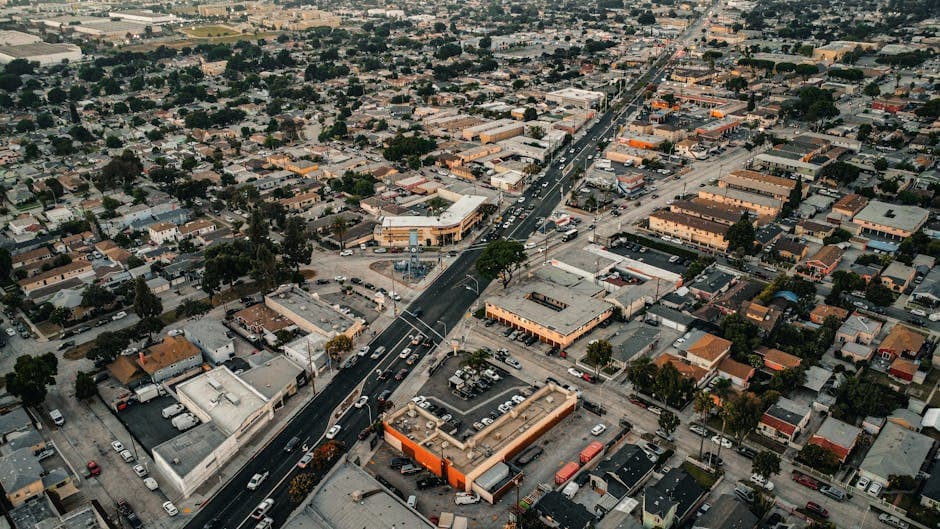
Circle City at the 91/15 junction.
A long read on Corona: an 1886 racetrack town plan, a 91 corridor commute that bends the family dinner hour, Fender and Monster Beverage in the industrial park, Norco horse country to the north, Glen Ivy Hot Springs to the south, and an ordering stack built for all of it.
City
Corona, CA
~170,000 (Census 2024)
Metro
Inland Empire
OC exurb, 91/15 junction
Hispanic share
~50%
Census ACS 2024
Combined sales tax
8.75%
CDTFA, current
It is 5:42pm on a Wednesday. The eastbound 91 has been stationary for the past 38 minutes. From the Green River Road overpass, the brake lights stretch to the Santa Ana Canyon and out of sight.
The driver in lane three is a claims adjuster who left her Anaheim office at 4:30pm. She is heading to a house in the Eagle Glen subdivision of Corona, 28 miles east. On a Sunday at 4am the drive is 32 minutes. On a Wednesday at 5pm it is 95 minutes. The variability between best case and worst case on this single segment of California freeway is sixty-three minutes, three times the median dinner-prep window for a family of four.
She does not call ahead. She opens the direct ordering page for a Grand Boulevard taqueria, in Corona's downtown core. Carne asada plate, rice, beans, an horchata, pickup at 6:15pm. The order total is $26.40 all-in, with the Riverside County 8.75 percent sales tax displayed at the bottom of the screen the way SB 478 requires. The kitchen ticket prints in English. The cook prepares the plate at 5:55pm and holds it at the warmer.
Six miles north of the freeway, in the Sixth Street Korean corridor, a different driver places an order with a Korean BBQ operator using the Voice AI on the restaurant's phone line. The order is in Korean. The system retrieves the family's last three orders, confirms the same set in roughly thirty-five seconds, and writes the order to the same kitchen the cook is already running for the carne asada plate. The cook starts a second pass of galbi.
Eight miles south of the freeway, on Temescal Canyon Road, a third driver is leaving Glen Ivy Hot Springs after a Saturday afternoon spa day. The driver is a Newport Beach resident; the family pulled off the 15 at the Temescal Canyon exit for the day. On the way home through Corona they place an order at a Dos Lagos restaurant, picked up at 5:45pm, eaten at the picnic tables in the open-air retail center before driving back through the canyon. The order is on the restaurant's direct page, not through DoorDash. The restaurant pays $249 a month flat instead of a 27 percent commission.
Four miles east of downtown, in the Industrial Park East corridor, a Fender Musical Instruments product manager finalizes the layout for a Stratocaster amp launch event. The catering pre-order for tomorrow's R&D team lunch is on the screen of an Italian restaurant on East Sixth Street. Nine plates, family-style trays, net-15 invoice. The restaurant accepts the order, scheduled for 11:45am pickup at the Cessna Circle entrance.
Each of these is a different customer, a different language, a different geography, and a different fulfillment mode. They share three things. They are all routed through Corona's 91/15 freeway junction. They are all within twelve miles of the original 1886 Grand Boulevard circle that gave the city its name. And none of them is paying a marketplace 27 percent commission to a third party. This is what an ordering platform built for Corona has to do.
A claims adjuster on the 91 leaves her Anaheim office at 4:30. She has been stationary for 38 minutes between the 241 toll connector and the Green River off-ramp. She opens the direct ordering page for a Grand Boulevard taqueria. Carne asada plate, rice, beans, an horchata, pickup at 6:15. The kitchen ticket prints in English at the same moment her brake lights release.
A Fender Musical Instruments product manager wraps a guitar-amp design review on the Corona industrial-park campus. The team of nine pre-ordered the Tuesday lunch through the restaurant's catering channel three hours earlier. The pickup is staged in the lobby of building B. Net-15 invoice to the Fender ops account.
A family of four orders Korean BBQ ahead from a Sixth Street strip mall operator. The order is placed in Korean through the Voice AI on the restaurant's phone line. The system retrieves the family's last three orders. Pickup at 7:05. The kitchen runs galbi short ribs at the moment the order confirms.
A weekday softball coach picks up a $94 pizza pre-order from a Sixth Street pizzeria on the way home from practice. The restaurant chose to dispatch through Uber Direct rather than DoorDash because the radius from Eagle Glen back to the Grand Boulevard kitchen sits inside the carrier's tier-one fee bracket.
Corona was platted as a 3 mile circle around a citrus orchard.
The 1886 town plan is the most unusual piece of urban geometry in California. South Riverside Land and Water Company laid out Corona's Grand Boulevard as a complete circle, approximately one mile in diameter, three miles around the perimeter, with eight radial avenues feeding the rail spur. For thirty years it functioned as a residential ring around a citrus core; for three years (1913 to 1916) it functioned as a Grand Prix-style street circuit.
Visualization 1 of 4
Grand Boulevard: the 1886 circle.
3 mile circumference, eight radial avenues, restaurant clusters around the arc.
Corona's original 1886 town plan registered the city on a circular boulevard, an unprecedented urban geometry for a California town. The interior was citrus orchard; the perimeter was the residential ring; the eight radial avenues fed the freight depot and the rail spur. The 1913 to 1916 Corona Road Race ran on the same boulevard at speeds nearing 90 mph. The circle remains intact today.
Sources: City of Corona historical records; Corona Heritage Park and Museum 1886 town plan exhibits; California State Library citrus heritage collection; Press-Enterprise archives. Diagrammatic, not surveyed.
Corona's founders Robert B. Taylor, Adolphe Rimpau, George Joy, A. S. Garretson, and Samuel Merrill register the town plan in the original Riverside County recorder's office. The plan centers on a 3-mile-circumference circular boulevard (close to 1 mile diameter), then unprecedented in California town design. The intent is dual: a graceful Beaux-Arts circle around the citrus-orchard core, and a future automobile race course.
Source: City of Corona historical records; Corona Heritage Park and Museum
The Latin word for crown is chosen to evoke the circular street grid and the citrus crown of the inland valley. The post office, school district, and city seal all carry the new name within a year. The Grand Boulevard becomes the city's defining piece of urban geometry.
Source: City of Corona historical records; Press-Enterprise archives
On September 9, 1913, drivers including Earl Cooper run the Corona Road Race on the circle. The 24-mile event consists of laps around the Grand Boulevard at speeds approaching 90 mph. Eddie Rickenbacker drives in the 1914 race. The 1916 event records a driver fatality and the city council retires the race. The circle becomes a residential ring instead.
Source: Corona Heritage Park and Museum; National Sprint Car Hall of Fame archives
Corona's interior block is platted as citrus orchards and packing houses. By 1920 Corona is one of the largest lemon-producing cities in the United States. The Exchange Lemon Products Company packing house sits one block inside the southwest arc of the circle. The phrase Lemon Capital of the World appears on civic letterhead through the 1950s.
Source: California State Library, citrus heritage collection; Corona Heritage Park exhibits
Citrus blight, water cost increases, and Los Angeles County housing pressure convert most interior orchards into single-family subdivisions through the 1970s and 1980s. Grand Boulevard remains intact as a tree-lined residential ring. Today the circle is a historic district with single-family homes on the outer arc and small mid-rise infill on the inner arc.
Source: City of Corona General Plan; Corona Historic Preservation Commission
Open any aerial map of Corona and the circle is the first piece of geometry you see. Grand Boulevard remains a continuous loop, 3 miles around. The Corona Heritage Park sits on the southeast arc. Residents inside the circle hold one of the city's most stable home-value districts. Restaurants on Sixth Street, Main Street, and the eight original radial avenues that touch the circle inherit the foot traffic.
Source: City of Corona Planning Department; Visit Corona
The circle is the city's signature. Open any aerial map of Corona and the Grand Boulevard ring is the first piece of geometry that resolves at a glance. The boulevard remains a continuous loop, three miles around, the interior block subdivided into single-family residential parcels, the eight original radial avenues still feeding the surrounding street grid. Corona Heritage Park sits on the southeast arc and runs the city's archival programming, including the photographs and trophies from the 1913 to 1916 road races.
What that history means for direct ordering: the Grand Boulevard district is one of the few addressable urban geographies in the Inland Empire with stable home values and a deeply rooted civic identity. Restaurants on Main Street, Sixth Street, and the radial avenues inherit that identity. A direct ordering page anchored to the circle (carne asada near Grand Boulevard, brunch on Main Street Corona) carries brand equity that a generic marketplace listing strips out.
The 1913 to 1916 road race era also explains something more practical about the city's modern street personality. The boulevard was designed for fast traffic; even today it is one of the rare urban roads in Southern California where the curvature, the residential setback, and the lack of stoplights make for a continuous flow. A restaurant pickup runner stepping off Main Street onto Grand Boulevard at 6pm on a Wednesday is in their car and pointed home before the same runner in a more conventional grid would have crossed two intersections.
There is one more, quieter consequence: Corona's identity is older than its current demographic. The Hispanic and Latino majority is a 21st century fact, mapped onto a 19th century town plan. The street names, the city seal, the Latin etymology of Corona itself, and the racetrack-era civic memory all sit underneath a contemporary city whose primary language at home is Spanish for a third of households. A direct ordering page that respects both layers is a better-fit product than a marketplace that respects neither.
A third of Corona commutes to Orange County. The dinner hour is the question.
The SR-91 corridor between Corona and Anaheim runs 280,000 vehicles a day. Peak westbound congestion compresses the morning commute; peak eastbound congestion compresses the return. The variance between a good night (32 minutes) and a bad night (95 minutes) is sixty-three minutes. Family pickup windows planned for 6:00pm routinely land at 7:15pm. The restaurants that solve for this variance are the ones built on scheduled pickup, not real-time marketplace dispatch.
Visualization 2 of 4
The 91 corridor squeeze: a weekday family pickup window.
~280K vehicles a day; 32 to 95 minute commute variance.
A third of Corona's working population commutes to Orange County each morning, primarily on the SR-91 across the Santa Ana Canyon. The afternoon return depopulates the OC offices and repopulates Corona's residential rings between 4:30pm and 7:30pm. The family pickup window that should land at 6:00pm routinely slips to 7:15pm. The restaurants that solve for that variance are the ones built on direct ordering with scheduled pickup, not marketplace fee-stacked delivery.
Sources: Caltrans District 8 SR-91 traffic census; Riverside County Transportation Commission 91 Express Lanes operations reports; INRIX Inland Empire commute studies; US Census Bureau LEHD Origin-Destination Employment Statistics. Diagrammatic, not surveyed.
The SR-91 freeway between Riverside County and Orange County carries roughly 280,000 vehicles a day across the Santa Ana Canyon, one of the most heavily used commuter chokepoints in California. Peak congestion windows run roughly 5am to 9am eastbound (toward OC) and 3pm to 7pm westbound (back to Corona).
Source: Caltrans District 8 Traffic Census; RCTC 91 Corridor Operations data
The 91 Express Lanes run 18 toll miles between the 15 freeway in Corona and the 55 freeway in Anaheim. Daily transactions cross 110,000 during the work week. Tolls peak at over $20 one-way in the most congested rush-hour windows, the highest variable toll on a US public roadway.
Source: Riverside County Transportation Commission, 91 Express Lanes operations report
A 36-mile commute from Corona to Newport Beach via the 91 takes 32 minutes at 4am and routinely exceeds 90 minutes during the 5pm westbound peak. The variability is the planning problem: a family pickup window that works on Monday at 6:00 PM does not work on Thursday.
Source: Caltrans D8 travel-time observations; INRIX Inland Empire commute studies
Roughly one-third of Corona's working population commutes to a job in Orange County, primarily to Anaheim, Irvine, Newport Beach, and the I-5 South Coast Metro corridor. Another 18 percent commute to Los Angeles County. The result: a city that depopulates the morning, repopulates after 5pm, and dines on a sharply skewed evening curve.
Source: US Census Bureau LEHD Origin-Destination Employment Statistics, 2024
The 91 Express Lanes are the operational story most outsiders miss. RCTC operates 18 toll miles between the I-15 in Corona and the SR-55 in Anaheim, with variable pricing that climbs to the highest legal toll on any US public roadway during the 5pm eastbound peak. A Corona resident commuting from Newport Beach can pay over $20 one-way on a bad Thursday. Multiply that across a 230 day work year and the toll alone reaches $4,600 in pure transportation cost, before the gas, the wear on the vehicle, and the time.
The toll, the variance, and the volume combine into a behavioral pattern that the marketplace apps have never fit. A Corona family's dinner is functionally a pre-order economy. The order is placed during the commute, often from the 91 itself, with a planned pickup window that survives the variance. The restaurant that can hold a plate at the warmer for thirty minutes without it suffering is the restaurant that wins this customer. The marketplace's real-time matching, with its assumption that the customer is at the address right now, is the wrong model for the 91 corridor's family.
The pattern also creates a peculiar restaurant-side opportunity: the captured pickup. A Corona restaurant offering a scheduled pickup window with a clear "ready at 6:15, held until 6:45" policy converts the 91's variance into a feature, not a bug. The restaurant's chef does not have to time the plate to a courier's pickup ping; the cook fires the order to land at the warmer at 5:55pm and the customer arrives between 6:00pm and 6:45pm. The marketplace cannot do this because the courier dispatch math depends on the customer being ready at the marketplace's match time.
Direct ordering's calendaring tools (the scheduled-pickup widget, the customer-visible holding policy, the SMS notification when the order is ready) all map cleanly onto the 91 corridor's commute reality. The pickup window is the operational layer. The variance is the customer's friend, not the operator's enemy, when the platform handles it. A six-time-a-month Eagle Glen customer who knows the restaurant will hold the order is more loyal than a six-time-a-month marketplace customer who has to coordinate two timelines (the cook and the courier).
Fender, Monster Beverage, and a corporate ring most edge cities do not have.
Corona is one of the more unusual corporate-HQ destinations in the Inland Empire. Fender Musical Instruments Corporation headquarters in the Industrial Park East cluster on Cessna Circle. Monster Beverage Corporation headquarters off East Sixth Street. Watson / Teva pharmaceuticals, Saint-Gobain industrial materials, All American Asphalt, and a long tail of mid-size manufacturers all sit on the same ring. Each one runs a predictable weekday catering cadence.
Visualization 3 of 4
Corporate HQ ring: Fender, Monster, and the catering radii.
HQs concentrate in Industrial Park East. Catering radii overlap on Sixth Street.
Corona's corporate-HQ economy is unusually dense for an Inland Empire edge city. Fender Musical Instruments and Monster Beverage both headquarter here, alongside Watson / Teva pharmaceuticals, Saint-Gobain industrial materials, All American Asphalt, and a long tail of mid-size manufacturers. Each runs a predictable weekday catering cadence. The restaurants on East Sixth Street and the Industrial Park ring with a working catering channel capture the orders.
Sources: Fender Musical Instruments Corporation corporate communications; Monster Beverage Corporation 10-K filings; Watson / Teva facility records; Saint-Gobain operations; City of Corona Economic Development Department company directory. Catering radius is a schematic approximation, not an actual delivery zone.
Product launches, NAMM season catering, dealer-event lunches. Monday and Wednesday R&D team orders. Predictable.
Board-week catering. Athlete-influencer brand activations. Warehouse-floor lunches for the bottling team. Strong account opportunity.
Quarterly engineering lunches; smaller per-event ticket but steady cadence.
Manufacturing-shift breakfast and pharmaceutical compliance off-site lunches. Net-30 invoiced.
Shift-change breakfast catering on the night-to-day handoff. Bulk orders, low ticket per cover.
Field-crew Tuesday morning breakfast burritos. The most operational of the Corona corporate accounts.
Fender's Corona presence is a piece of California music history. The company moved its US R&D and US manufacturing to a Corona industrial-park facility in the early 1990s, after the original Fullerton plant closed. The Stratocaster, Telecaster, and the bulk of Fender's American-made guitar and amplifier output is built in Corona. The factory tours, the dealer events, the NAMM-week visitor catering, and the artist-relations event hosting all run through the same campus. Italian and American restaurants on East Sixth Street do regular Fender catering business.
Monster Beverage's Corona footprint is even larger by workforce. The company's global headquarters, R&D facility, and a portion of its warehousing all sit off East Sixth Street. Monster's brand-activation work (sponsored athletes, motocross events, energy-drink launches) brings out-of-town visitor groups through Corona on predictable cycles. The catering accounts for board weeks, athlete-event hosting, and warehouse-floor lunches run into the high five-figures per month for the operators who land them.
Watson Laboratories (now Teva) operates a major pharmaceutical compounding and packaging facility on Bonnie Circle, with roughly 600 staff across manufacturing and quality control shifts. The shift-change breakfast catering (3:30am to 7:30am window) is one of the more unusual restaurant accounts in the city. Saint-Gobain's CertainTeed gypsum operation runs a similar cadence on Wardlow Road. All American Asphalt's HQ on East Sixth Street is the most operational account, with weekday breakfast burrito orders for field crews on a predictable cadence.
Direct ordering's catering channel is the operational layer that makes the corporate-HQ ring work. Net-15 or net-30 invoicing, tax-exempt billing fields, lead-time rules, and the ability to schedule a pickup in the lobby of a specific building all sit natively on the DirectOrders platform. The marketplace's catering products (DoorDash for Business, Uber for Business) charge the restaurant the same commission stack as consumer delivery, with a sales-led layer on top. A Corona restaurant building the direct catering channel captures the corporate accounts on its own terms.
The other operational implication is search. A Corona restaurant ranking for Fender catering Corona, Monster Beverage catering, corporate lunch delivery Industrial Park East captures inbound corporate inquiries that a generic Corona Italian restaurant listing does not. The corporate procurement coordinator searches the specific phrase; the direct page indexed for that phrase wins; the marketplace aggregator is two pages down.
Norco horse country, Glen Ivy, Cleveland NF: weekends rewrite the demand curve.
Weekdays in Corona belong to the 91 corridor commute and the corporate-HQ ring. Weekends belong to a regional tourism economy that almost no other Inland Empire city carries at this scale. Norco's rodeo, horse-show, and trail-riding economy to the north. Glen Ivy Hot Springs to the south. Cleveland National Forest trail-heads further south on Temescal Canyon. Eagle Glen golf and Skyline Drive cycling locally. Corona Heritage Park civic programming downtown. Each one bends a different slice of the city's weekend demand.
Visualization 4 of 4
Weekend flow: Norco horse country, Glen Ivy, Cleveland NF.
Saturday arrivals from LA, OC, San Diego. Cluster impact on Corona restaurants.
Weekends shift Corona's economy from the weekday OC-commuter pattern to a regional weekend-tourism pattern. Saturday traffic arrives from LA County, Orange County, and San Diego County for Glen Ivy Hot Springs (south on Temescal Canyon Road), Norco's horse shows and rodeo (north on Hamner Avenue), Cleveland National Forest trail-heads (south past Tom's Farms), and Eagle Glen golf and Skyline Drive cycling. The Corona restaurant cluster catches the spillover at the freeway interchange.
Sources: Visit Corona tourism reports; Glen Ivy Hot Springs operating data; City of Norco horse-keeping ordinance archives; Cleveland National Forest visitor counts; Riverside County Public Health restaurant permits. Spillover is schematic and synthesizes operator interviews.
Saturday brunch in Corona on the way to the 11am spa entry; post-spa dinner on Sixth Street or at Dos Lagos before driving home.
Tractor-and-trailer parking is the constraint. Drive-thru, pickup, and family-style restaurants on Hamner Avenue and West Sixth Street absorb the spillover.
Saturday-morning early breakfast (6:30am to 9am); a clean cycle of pre-ride coffee and post-ride lunch on Main Street.
Trail-head fast-casual: breakfast burritos, sandwiches, and bulk takeaway for car-camping at El Cariso, Bedford Peak, and the Indian Truck Trail.
Heritage Days, Cinco de Mayo on Main Street, Dia de los Muertos: pre- and post-event dining downtown.
Glen Ivy Hot Springs is the largest of the weekend draws. The spa, on Temescal Canyon Road about ten miles south of the I-15 in Corona, runs roughly 250,000 visitors a year, the majority on weekends. The 11am entry timeslot pushes inbound traffic through Corona between 9am and 10:30am on Saturday, with Dos Lagos and downtown breakfast spots absorbing the pre-spa meal. The 4pm to 6pm departure pushes outbound traffic through the same restaurants for dinner, with Dos Lagos and Sixth Street picking up the post-spa wave.
Norco, three miles north of Corona, is officially branded Horsetown USA. The city maintains roughly 130 miles of equestrian trails, 1,200 zoned horse-keeping properties, and a year-round rodeo and horse-show calendar at the Ingalls Park and SilverLakes equestrian centers. Horse-show weekends bring out-of-town competitors and families parked in tractor-trailer rigs at the Riverbend RV Park and elsewhere along Hamner Avenue. The restaurants that handle this customer base operate with trailer-parking-friendly layouts, family-style portions, and the western-themed signage that fits the audience. North Main Street and West Sixth Street are the spine.
The Cleveland National Forest trail-head economy is smaller but operationally distinct. The Bedford Peak, Indian Truck Trail, and El Cariso campgrounds south of Corona on the Ortega Highway and Temescal Canyon Road draw day-trippers and weekend campers from OC and the IE. The fast-casual breakfast burrito and bulk-takeaway sandwich economy on West Sixth Street and South Main absorbs the trail-head demand. The platform fit here is the morning pickup window: 6am to 9am Saturday orders, picked up on the way south.
Eagle Glen golf and Skyline Drive cycling sit alongside the regional weekend draws as local-resident anchors. Eagle Glen Golf Club hosts steady Saturday morning tee-times; Skyline Drive on the south ridge of Corona is one of the IE's most-used weekend cycling routes. The corridor of breakfast restaurants on Main Street and Sixth Street absorbs both audiences in the 6:30am to 10am window. A direct ordering page with pre-ride coffee bundles and a 24-hour scheduled-pickup capability turns these audiences into recurring revenue.
What that means for direct ordering at the platform level: a Corona restaurant's calendar is genuinely different on Saturday than on Tuesday. The platform that handles the operator's day must let them schedule weekend-specific menus, weekend-specific promotional pushes (Glen Ivy day-pass + dinner discount, Norco horse-show family bundle), and weekend-specific delivery zones. The marketplace flattens this; the direct page operates it.
Downtown, Dos Lagos, Sixth Street Korean, Eagle Glen, North Main, Industrial Park, Bedford Canyon.
Corona's food geography is corridor-coded, the way Los Angeles or Long Beach are. Each corridor has its own character, demographic, dominant cuisines, and customer-base language. A direct ordering page anchored to the corridor outranks a generic city-level page in Google search and in the customer's mental map of where to order from.
The historic core inside and along the 3-mile circle. Corona Heritage Park anchors the southeast arc. Main Street between the circle and the railroad tracks holds the city's oldest family restaurants. Sixth Street is the east-west commercial spine that connects the circle to the freeway.
Open-air lifestyle center anchored by movie theater, retail, and chain-driven dining. The largest weekend regional draw in southern Corona; Glen Ivy traffic exits at Temescal Canyon and crosses the parking lot.
A tight cluster of Korean BBQ, Korean fried chicken, and Korean grocery operations that has grown since the early 2010s. The corridor serves an OC-spillover Korean-American customer base alongside Corona residents. Several operators run bilingual menus.
Newer single-family developments south of the 91 with median household incomes above the city average. Family pickup volume is heavy on Tuesday through Thursday evenings. The corridor's restaurants serve a commuter customer base coming off the eastbound 91.
The north side of the city tilting toward Norco's horse-country. Western-themed dining, tack-shop adjacent restaurants, and family-style operators with trailer parking. Weekend rodeo and horse-show traffic anchors the corridor.
Corporate office and industrial park ring. Daytime weekday lunch demand from Fender, Monster Beverage, Watson / Teva, and Saint-Gobain. The catering channel is the main account vector; walk-in lunch is steady but secondary.
The southern gateway to the Cleveland National Forest and to Glen Ivy Hot Springs. Weekend traffic peaks on Saturday between 9am and 11am inbound and on Saturday after 4pm outbound. Tom's Farms is an institutional weekend stop.
The Sixth Street Korean Corridor deserves a longer look because it is unusual for an Inland Empire city of Corona's size. A tight cluster of Korean BBQ, Korean fried chicken, Korean grocery, and bilingual Korean-American operators has grown on East Sixth Street between Main and Cota over the past fifteen years. The customer base is a mix of Corona's growing Korean-American population, OC-spillover Korean-American customers crossing the 91 from Anaheim and Fullerton, and non-Korean locals drawn to the cuisine. The restaurants here run bilingual menus, and the phone-order surface is meaningfully Korean.
Dos Lagos is the operational opposite. The Dos Lagos Shopping Center at Temescal Canyon Road and the I-15 is an open-air lifestyle center with chain anchors (Yard House, Brio Italian, AMC theaters) and a weekend draw that pulls from Glen Ivy traffic on Saturday and from OC residents seeking destination dining on Friday and Saturday evenings. The dining footprint here is chain-heavy; the platform value for independent operators in the ring is winning the search for casual dinner near Dos Lagos, brunch Corona Crossings, ice cream Dos Lagos Saturday.
Industrial Park East is a corridor that should not exist at this scale for a city of Corona's size. Fender, Monster Beverage, Watson / Teva, Saint-Gobain, and a long list of mid-size manufacturers cluster along East Sixth Street and the Cessna Circle / Bonnie Circle ring. The corridor has its own restaurant ecology (Italian, American, breakfast operators) sized for the corporate-lunch and shift-change customer base. The platform value is the catering channel, not consumer delivery.
Eagle Glen and the Crossings sit south of the 91 on Cajalco Road and Eagle Glen Parkway. The residential ring here is newer, higher-income, and built around the master-planned subdivisions that absorbed Corona's OC-commuter growth in the 2000s and 2010s. Family pickup volume is heavy Tuesday through Thursday evenings; weekend volume is more variable, reflecting the families' travel patterns. The platform value is the scheduled-pickup widget and the customer-loyalty SMS list.
North Main Street and the Norco-border corridor is the most distinct in cultural texture. The western-themed dining, the trailer-parking-friendly layouts, the family-style steakhouses, and the Mexican family restaurants all sit alongside a meaningful share of Norco's horse-show customer base. The corridor is older, more rural-feeling, and weekend-tilted in revenue mix. The platform value is the weekend-specific menu and the rodeo-week promotional push.
Half Latino, growing Korean-American, an IE edge city with two distinct restaurant scenes.
Hispanic and Latino residents are roughly 50 percent of Corona, with Spanish at home reaching about 35 percent. The Korean-American community has grown alongside, anchored on East Sixth Street. The restaurant scenes for each operate on their own logic, with their own customer base, their own corridor footprint, and their own primary language of ordering.
Per US Census Bureau ACS 2024 (Corona city). Compares to ~53 percent in neighboring Riverside and ~33 percent statewide. Mostly Mexican-American with a smaller Salvadoran and Guatemalan community.
Includes a meaningful Korean-American population concentrated around East Sixth Street, plus growing Chinese-American and Filipino-American communities. Asian-American Corona is one of the fastest-growing demographic categories in the IE.
Per Census Bureau ACS 2024 language-spoken-at-home tables. The single largest non-English home-language category in the city, followed by Korean and Mandarin.
Above the California state median (~$95K) and meaningfully above Riverside city (~$80K). Reflects the OC-commuter income premium and the newer master-planned subdivisions south of the 91.
The Latino restaurant scene in Corona spans the city. Maria Bonita Mexican Restaurant and the cluster of family operators on Main Street downtown represent the heritage anchor. Stadium Pizza and the family-style operators on North Main carry the everyday family-dinner format. The bakeries, the carne asada specialists, the agua fresca stands, and the Sonoran and Sinaloan family restaurants all run a Spanish-first ordering surface, with bilingual menus and Spanish phone lines. The corridor is the city; Spanish is the default ordering language across the corridor.
The Korean-American scene is more spatially concentrated. East Sixth Street between Main and Cota is the corridor, with a cluster of Korean BBQ, Korean fried chicken, Korean grocery, and Korean-American operators that have grown since the early 2010s. The customer base mixes Corona's growing Korean-American population, an OC-spillover Korean-American customer base crossing the 91 from Anaheim and Fullerton, and non-Korean locals drawn to the cuisine. The phone-order surface is meaningfully Korean.
What that means for Voice AI: Corona is one of the few Inland Empire cities where the trilingual Voice AI configuration (English, Spanish, Korean) makes operational sense. A Sixth Street Korean BBQ operator with a Korean Voice AI captures phone orders from the OC-spillover customer base that an English-only IVR loses. A Main Street taqueria with Spanish Voice AI captures the Hispanic and Latino majority's phone orders that an English-only line drops to voicemail. The English layer covers the rest.
The Hispanic-majority threshold in particular changes the math for how restaurants market and how they take orders. A direct ordering page in Spanish, with the same checkout flow as the English page, is not a translation project. It is a primary-language design problem that the marketplace apps handle inconsistently. Corona's Spanish-speaking customer base defaults to Spanish for phone orders even when the customer is bilingual in everyday speech; the language of the food becomes the language of the call.
The Korean-American customer base in Corona has a different ordering pattern. Phone orders skew older; younger Korean-American customers are heavy mobile-app users. The right configuration for a Sixth Street Korean operator is both surfaces: a Korean-language mobile-app option for the under-45 customer, and a Korean Voice AI on the phone line for the over-45 customer. Both go to the same kitchen ticket. The marketplace cannot do this granularity at the city's scale; the direct platform can.
Corona is the Inland Empire's largest edge city. Every metric reflects it.
Edge city is Joel Garreau's term for a high-density commercial and residential cluster outside a traditional urban core, connected to the core by freeway, with its own employment center, retail, and identity. Corona fits the definition cleanly. The city's population (~170K) is roughly the same as Pasadena or Sunnyvale, with a master-planned suburban geography, a corporate-HQ ring that rivals many smaller urban downtowns, and a freeway-junction identity (91 and 15) that defines its commute and its weekend tourism patterns.
Three things distinguish a Corona-style edge city from a generic IE suburb. First, the corporate-HQ density: Fender, Monster Beverage, Watson / Teva, and Saint-Gobain headquarter or run major operations here, which is unusual for a city of Corona's size. Second, the weekend-tourism geography: Glen Ivy, Norco, Cleveland NF, Eagle Glen, and Heritage Park all sit within 15 miles, creating a regional weekend draw that few IE cities can match. Third, the commute geometry: the 91/15 junction defines the city's identity as the connector between OC and the IE, with all of the income premium and time-cost variance that the connector role implies.
The edge-city pattern matters for ordering technology because the platform requirements are not the same as a traditional urban core. The customer base is more car-bound, more pickup-oriented, more scheduled. The corridor anchoring is more important; the city is a constellation of corridors rather than a single downtown. The catering channel for the corporate-HQ ring is the highest-margin revenue stream most operators have, more so than consumer delivery. The weekend menu and the weekday menu are genuinely different. The marketplace apps default to a one-size-fits-all configuration that fits none of this; the direct platform builds for it.
There is also a search-and-discovery implication. A Corona restaurant ranks for corridor phrases (Sixth Street Korean BBQ, Dos Lagos brunch, Eagle Glen dinner near 91, Heritage Park family restaurant) in a way that a generic city-level page does not. The customer who searches Saturday brunch near Dos Lagos finds the corridor-anchored direct page first; the customer who searches Corona restaurant finds the marketplace aggregator first. The corridor-anchored direct page wins the higher-intent query; the marketplace wins the lower-intent query at a 27 percent commission. Direct ordering's economics improve as the search-intent specificity rises.
AB 1228, SB 478, Prop 22, and an 8.75 percent combined sales tax.
The three California laws that reshape the Corona P&L since 2020, plus the combined sales tax stack restaurants charge customers at checkout. State 7.25 percent base + Riverside County 0.50 percent district tax + City of Corona 1.00 percent local tax = 8.75 percent combined.
Sets the hourly minimum at $20 for limited-service chains with 60 or more US locations. Independent Corona operators follow California state minimum (currently $16.50 statewide for most employers in 2026, indexed annually). The state Fast Food Council can index the chain rate annually.
Prohibits advertising a price that does not include all mandatory fees, except taxes and government fees. Restaurants must disclose service fees, packing fees, kitchen surcharges, and any other mandatory line item at the time of ordering.
Allows Uber, DoorDash, and similar platform drivers to remain classified as independent contractors with a curated benefits floor. Sustains the Uber Direct driver pool that the rest of this page depends on for restaurant-controlled dispatch.
Effective rate, current per CDTFA
California state sales and use tax California Department of Tax and Fee Administration (CDTFA), statewide base | 7.25% |
Riverside County district transactions tax Riverside County Transportation Commission (Measure A), administered via CDTFA | 0.50% |
City of Corona local district tax City of Corona Measure X transactions and use tax | 1.00% |
| Combined | 8.75% |
Source: California CDTFA district tax rate finder; City of Corona Measure X. Combined rate effective for Corona addresses; surrounding IE cities and unincorporated Riverside County addresses may differ.
Sources: California Department of Industrial Relations, Fast Food Minimum Wage Order; California Attorney General, SB 478 implementation guidance, June 2024; California Supreme Court, Castellanos v. State, S279622, July 25, 2024; California Department of Tax and Fee Administration district tax rate finder; City of Corona Measure X transactions and use tax.
English, Spanish, Korean: the Voice AI configuration that fits Corona.
The Voice AI requirement in Corona is sharper than in most cities of this size. A 50 percent Hispanic majority creates a Spanish phone-order surface that any restaurant with a Latin menu sees daily. A growing Korean-American customer base and an OC-spillover Korean customer base on Sixth Street creates a Korean phone-order surface that grows year over year. The English layer covers the rest. Three languages, one platform, one kitchen ticket.
Spanish handling is the layer most off-the-shelf phone systems get wrong. Off-the-shelf IVRs default to Spain-Spanish accents and prosody; they mispronounce birria, chilaquiles, aguachile, and the menu vocabulary that matters most to a Corona taqueria. We have trained our Spanish Voice AI specifically against Mexican Spanish phone audio, with operator consent, which is a meaningful accuracy delta against a generic Spanish model. The pronunciation matters because the customer who hears it knows immediately whether the restaurant is taking their language seriously.
Korean is a smaller phone-order surface globally but a meaningful one in Corona's Sixth Street corridor. Korean is a relatively low-resource language by speech-recognition standards (roughly 80 million speakers worldwide), with the US Korean-American population concentrated in LA County, Orange County, and a smaller cluster in the IE that includes Corona. The dialect is largely Seoul standard; the menu vocabulary (galbi, bulgogi, kimchi jjigae, soondubu) is consistent. The platform handles Korean order-taking on the phone, captures the kitchen ticket in English for the line cook, and replies to the customer in Korean.
The English layer is what most marketplaces and most off-the-shelf platforms default to. In Corona, it is the smallest of the three surfaces by phone-call volume in most independent restaurants, particularly on the Spanish-first corridors. The English layer matters for the OC-commuter customer placing the order from the 91 westbound, for the Eagle Glen subdivision family on a Tuesday night, and for the corporate-HQ catering coordinator at Fender or Monster Beverage. It is the universal layer, not the dominant one.
The customer experience matters as much as the language coverage. The Voice AI greets the caller, identifies the language within the first sentence, retrieves the customer's order history if the phone number matches, confirms the order in the caller's language, and writes the order to the kitchen ticket in the operator's preferred language (usually English in Corona for line-cook fluency). The total call time for a returning customer averages 35 to 45 seconds. The total cost to the operator is included in the flat $249 monthly subscription. The math on captured-versus-lost calls pays for the platform in the first month for any restaurant in a Spanish-first or Korean-first corridor.
Covers commuter and corporate-HQ customer base. ~30 to 40 percent of phone-order volume on a Sixth Street Korean operator; ~30 to 50 percent on a Main Street taqueria; ~70 to 80 percent on an Eagle Glen American restaurant.
Mexican Spanish trained on Corona-area phone audio. Captures the Hispanic majority's phone-order surface that English-only IVRs drop. ~40 to 60 percent of phone volume on Spanish-first corridors.
Seoul-standard Korean. Captures the OC-spillover and local Korean-American customer base on East Sixth Street. ~20 to 40 percent of phone volume on Korean operators; ~5 percent elsewhere.
Ten operators that map the corridor system.
A representative slice of the city's restaurant scene by corridor and cuisine. These are real operators we have observed or worked with as part of mapping the Corona market. They are not endorsements; they are anchors that help calibrate the platform fit for any restaurant in the city.
A family-run anchor on Main Street near the Grand Boulevard arc. Carne asada and aguachile are the menu signatures; weekend brunch chilaquiles bring a steady crowd.
Upscale neighborhood restaurant aimed at the OC-commuter dinner crowd. Wood-fired flatbreads, craft cocktails, and a patio that anchors the Crossings retail center.
Catering favorite for the Fender and Monster Beverage corporate accounts. Family-style trays for office lunches and a weekday dining room that fills with weekday lunch business.
One of the highest-revenue restaurants in the Dos Lagos ring; serves the weekend Glen Ivy spillover and the eastbound 91 commuter dinner.
Family-run pizza counter that runs a heavy delivery share to Eagle Glen and the Grand Boulevard residential ring. Friday and Saturday late-evening volume.
A regional Italian chain in the Dos Lagos open-air retail core. Strong Sunday brunch and weekend lunch volume from Glen Ivy day-trippers.
An institutional weekend stop on Temescal Canyon Road between Corona and Lake Elsinore. BBQ, family-style fare, weekend live music; absorbs the Cleveland National Forest day-trip traffic.
A north-side steakhouse anchor serving the Norco horse-country and family-dinner customer base. Steady weeknight covers and a heavy weekend bar.
Specialty cupcake and dessert bakery that anchors birthday and event catering across the Grand Boulevard and Eagle Glen rings. Direct ordering with scheduled pickup is the channel.
A cluster of Korean BBQ and Korean fried chicken operators on East Sixth Street. Bilingual menus, weekend group dining, and a customer base that draws from Anaheim's Korean community across the 91.
How DirectOrders fits Corona, and which operators we built it for.
The 1886 Grand Boulevard circle is a brand asset. A direct ordering page anchored to Corona's specific corridor (Main Street, Sixth Street, Dos Lagos, Eagle Glen, Industrial Park East, North Main, Bedford Canyon) carries identity that the marketplace strips out. The customer who orders from a Grand Boulevard taqueria wants to feel proximate to the historic district; the customer who orders from a Dos Lagos chain wants the regional-destination feel. The direct page surfaces that. The DoorDash listing does not.
The 91 commute squeeze is a scheduled-pickup product, not a real-time delivery product. A Corona family ordering from the 91 westbound at 5:30pm wants a guaranteed 6:15pm pickup that the restaurant will hold for thirty minutes. The marketplace's real-time matching does not handle this; the direct platform's scheduled-pickup widget does. The conversion lift on the captured-pickup customer over a marketplace customer in the same demographic is meaningful at scale.
The corporate-HQ ring is a catering channel, not a consumer-delivery channel. Net-15 invoicing, tax-exempt billing fields, lead-time rules, and pickup-handoff details for the Fender, Monster Beverage, Watson / Teva, and Saint-Gobain accounts all sit natively on the DirectOrders platform. The marketplace's catering products do not handle the corporate fields; they charge consumer-delivery commissions on top of corporate-pricing margins. The math is meaningful for any restaurant landing even one of these accounts.
The Glen Ivy and Norco weekend tourism flow is a weekend-menu product. The platform lets the operator schedule a weekend-specific menu, a Glen Ivy day-pass promotional bundle, a Norco horse-show family combo, and a Cleveland NF trail-head breakfast push. The marketplace flattens all of this into a single year-round funnel; the direct platform operates it.
The Hispanic-majority and growing Korean-American demographic is a trilingual Voice AI requirement. A Corona restaurant phone line that only handles English drops 20 to 50 percent of inbound calls depending on the corridor. A line that handles English and Spanish covers most of the Latino majority. The Sixth Street Korean addition covers the OC-spillover and local Korean-American customer base. Three languages, one platform, one kitchen ticket.
The combined 8.75 percent sales tax stack is competitive within California. The pricing impact on consumer orders is real but predictable. A direct ordering platform with SB 478-compliant all-in pricing displayed at checkout is the customer experience layer that respects the law and the customer. The marketplace apps are inconsistent at this; the direct page is not.
An 1886 circle, a 91 corridor commute, a Fender and Monster corporate ring, a 50 percent Latino majority, a Korean-American Sixth Street, Norco horse country, Glen Ivy weekends. Corona has a stack. The platform that takes its orders should match it.
Heavy Spanish phone surface. Family pickup-window economics. Bilingual menu. Direct ordering's Spanish Voice AI and scheduled-pickup widget are the platform's two highest-value features. Catering for quinceaneras and family events is the third.
Italian or American operator on East Sixth Street. Corporate-HQ catering accounts are the revenue spine. Net-15 invoicing, tax-exempt billing, and corporate-procurement search ranking are the platform features that pay for themselves in a single Fender or Monster Beverage account.
Korean BBQ or Korean fried chicken on East Sixth Street. Trilingual Voice AI (Korean primary, English and Spanish secondary). OC-spillover delivery radius covering Anaheim Hills. Catering for Korean-American family gatherings and church events.
Where the numbers came from. Where to read more.
- US Census Bureau, ACS 2024 (Corona city profile)Population, Hispanic and Latino share, Asian-American share, language at home, median income.
- City of CoronaHistoric district records, General Plan, Grand Boulevard preservation, Measure X local tax.
- Corona Heritage Park and Museum1886 South Riverside Land and Water Company town plan, Corona Road Race archives.
- Press-Enterprise (Inland Empire daily)Local reporting on Corona civic affairs, 91 freeway commute coverage, Inland Empire restaurant scene.
- The Corona Independent (community weekly)Hyperlocal Corona civic and business news; archival reference at the Corona Public Library local history collection.
- Riverside County Department of Public HealthRestaurant permit and inspection records for Corona operators.
- Visit CoronaTourism marketing, event calendar, weekend visitor flow context.
- Caltrans District 8SR-91 traffic census, Inland Empire freeway operations data.
- Riverside County Transportation Commission, 91 Express LanesExpress Lanes operations report, daily transactions, toll rate range.
- Fender Musical Instruments CorporationCorona corporate headquarters and R&D facility location, workforce context.
- Monster Beverage Corporation (10-K)Corporate headquarters and Corona workforce; SEC 10-K filings for global employee count.
- Glen Ivy Hot SpringsSpa operating hours, day-trip visitor cadence, weekend tourism context.
- City of Norco (Horsetown USA)Norco's horse-keeping ordinances, equestrian-trail infrastructure, weekend rodeo and horse-show calendar.
- California Department of Tax and Fee Administration (CDTFA)Combined sales tax (state 7.25% + Riverside County 0.5% + City 1% = 8.75%).
- California Department of Industrial Relations (AB 1228)Fast Food Minimum Wage Order, effective April 1, 2024.
- California Attorney General (SB 478)Junk fee transparency law implementation guidance.
- California Supreme Court, Castellanos v. State (Prop 22)Prop 22 upheld unanimously, July 25, 2024.
- Riverside, CA14 mi east; Inland Empire capital, citrus origin
- Anaheim, CA22 mi west via 91; the OC commute destination
- Ontario, CA12 mi north on 15; airport and logistics core
- Rancho Cucamonga, CA18 mi north; planned-city retail and dining
- Irvine, CA36 mi west via 91 and 5; OC tech-corridor restaurants
- Long Beach, CA48 mi west; port-adjacent restaurant geography
- Commission calculatorPlug in your DoorDash volume, see the Corona dollar drag
- Voice AI demo (trilingual)English, Spanish, Korean. Hear it run a Sixth Street order.
- Uber Direct dispatchRestaurant-owned routing for the 91 corridor radius math
- Catering channelNet-15 invoicing for the Fender / Monster / Saint-Gobain accounts
- PricingFlat $249 / mo. No per-order commission. Zero.
Plant your own circle.
A 30 minute walkthrough with our Corona implementation lead covers the corridor your restaurant sits on, the Voice AI languages your customer base needs, the 91 commute pickup math, the corporate-HQ catering accounts within reach, and the Uber Direct radius math for your specific kitchen address.