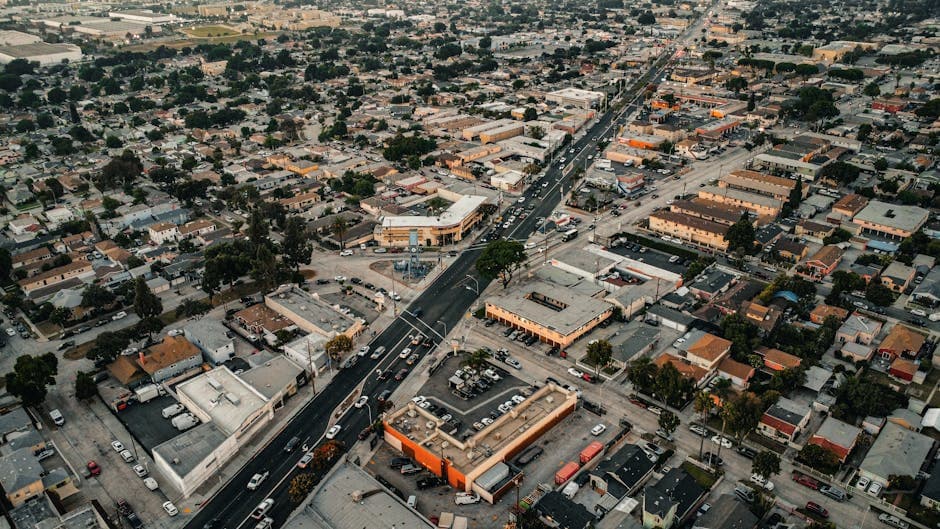
The Inland Empire's logistics core, with a 70 percent Latino kitchen.
A long read on Fontana: a Kaiser Steel town, the Auto Club Speedway city, the Amazon and Costco and Target and Walmart warehouse cluster, and a downtown Sierra Avenue taqueria spine, and an ordering stack built for all of it.
City
Fontana, CA
~215,000 (Census 2024)
Metro
Inland Empire
~4.7M residents
Latino share
~70%
Census ACS 2024
Combined sales tax
8.5%
CDTFA, current
It is 12:04 on a Tuesday in May. The line at a family taqueria two blocks south of the Lewis Library is out the door. Spanish on the counter, English on the kitchen ticket.
Downtown Sierra Avenue runs roughly from the Lewis Library and Technology Center at Sierra and Arrow Boulevard south through Fontana City Hall, the Center Stage Theater, and a tightly-spaced strip of family taquerias, panaderias, raspados, and the city's longest-tenured sit-down restaurants. On a Tuesday at noon, the lunch rush is bilingual by default and Spanish first in many of the kitchens that work this strip.
Two miles north, on Cherry Avenue, an Amazon fulfillment building runs a thirty minute lunch break. Forklift operators, sortation workers, and last-mile loadout staff cycle out in two waves. Many open a phone, hit the direct ordering page of a Sierra Avenue taqueria, and place three burritos and an horchata for a 12:35 pickup. The transaction is all-in, no marketplace markup, no driver tip stacked on a tip. The restaurant prints the kitchen ticket in English and the customer-facing receipt in Spanish.
South of the I-10 freeway, in the Jurupa Hills foothills, a construction crew breaks for lunch in the parking lot of a tilt-up warehouse under construction. The crew's foreman dispatches a Voice AI catering call in Spanish for thirty plates of birria with consomme to be picked up the next day at 11:45. The Voice AI takes the order, retrieves the foreman's prior history, applies a net-15 corporate invoice tag, confirms in roughly seventy seconds.
And southwest of all of that, on the perimeter of Auto Club Speedway, a track operations crew pre-orders pickup lunches for the next four days of a private test session. Twenty-five burrito bowls, twelve aguas frescas, scheduled across four 45 minute pickup windows. The Speedway has not hosted a NASCAR Cup race since the Pala Casino 400 in February 2023, but the track remains active for testing, club racing, and private corporate events; the catering demand is still there.
These are four different orders, four different addresses, four different ways of paying. They share two things. They are all in Fontana, the city built first on steel and then on warehouses, the city of Sierra Avenue and Cherry Avenue and Foothill Boulevard. And none of them is paying a 30 percent marketplace commission to a third party. That is what an ordering platform built for Fontana actually has to do.
A line forms at the counter of a family taqueria two blocks south of the Lewis Library and Technology Center. Carnitas, asada, lengua, three rotating salsas. Spanish on the customer side, English on the kitchen ticket.
A forklift operator on a 30 minute lunch break at an Amazon fulfillment building opens the restaurant's direct ordering page. Three carne asada burritos, an horchata, pickup at 12:35. Pay $26.70 all-in. No marketplace markup.
A construction crew at a tilt-up warehouse site dispatches a Voice AI catering order in Spanish for thirty plates of birria with consomme. Net-15 invoice. Pickup tomorrow 11:45.
A track operations crew pre-orders pickup lunches for the next four days during a private test session. Twenty-five burrito bowls, twelve aguas frescas. The kitchen ticket schedules each pickup to a different 45 minute window.
The largest US warehouse cluster outside Joliet. Fontana is in the middle of it.
The Inland Empire holds roughly 700 million square feet of industrial inventory and over a quarter-million logistics jobs. Fontana, on the I-10 / I-15 / SR 210 grid, sits at the geographic center of that cluster. Amazon, Costco, Target, Walmart, and FedEx all run regional buildings here, surrounded by dozens of third-party logistics tenants. The diagram below sketches the corridor.
Visualization 1 of 5
The Fontana warehouse cluster, by tenant.
Amazon, Costco, Target, Walmart, FedEx, plus dozens of 3PLs.
The Inland Empire is the largest US warehouse footprint outside the Joliet-Chicago corridor, with roughly 700 million square feet of industrial inventory and over a quarter-million logistics jobs. Fontana sits in the middle of the cluster, along the I-10 / I-15 / SR 210 freeway grid, a single-day truck haul from the Ports of Los Angeles and Long Beach. The grid below sketches the tenant tiles and freeway frame.
Sources: CBRE Inland Empire Industrial MarketView; JLL Inland Empire industrial reports; Amazon, Costco, Target, Walmart, FedEx corporate filings and facility directories; San Bernardino County Economic Development Agency. Diagrammatic, tenant tiles approximate, not to scale.
Amazon operates a cluster of fulfillment, sortation, and last-mile delivery stations across Fontana and the immediately adjacent unincorporated San Bernardino County. The Cherry Avenue Amazon facility footprint runs into the multi-million square-foot range when combined with related Ontario, Rialto, and Eastvale buildings. Fontana's geographic position on the I-10 / I-15 / SR 210 freeway grid puts it within a single-day truck haul of the Ports of Los Angeles and Long Beach.
Source: Amazon press releases; CBRE Inland Empire Industrial MarketView reports
Costco runs a regional distribution depot serving Costco warehouse stores across Southern California, southern Nevada, and Arizona from a footprint inside the Fontana-Rialto-Mira Loma corridor. The depot inbound flow is direct from ocean terminals at Long Beach. Outbound is overnight truck drayage to retail locations.
Source: Costco corporate filings; San Bernardino County Economic Development reports
Target's Southern California regional import warehouse network includes very large tilt-up buildings in the Fontana-Mira Loma node. These facilities handle ocean-container deconsolidation, sortation by retail-store destination, and pallet-level outbound truck loads to Target stores across the western US.
Source: Target corporate filings; JLL Inland Empire industrial market reports
Walmart's Southern California regional distribution network includes Fontana-adjacent buildings supporting both Walmart and Sam's Club retail store networks across the western states. The IE concentration of Walmart's footprint exceeds any other US metro outside Bentonville and Joliet.
Source: Walmart corporate sustainability and supply chain reports; CBRE IE industrial reports
FedEx operates a network of Ground and Express facilities across the Fontana-Ontario-Rialto cluster, with Fontana proper hosting one of the larger overnight package sortation footprints in Southern California. The cluster anchors next-day delivery flows across the Pacific timezone.
Source: FedEx corporate facilities directory; SBC EDA reports
Dozens of 3PL operators, freight forwarders, and import logistics firms operate buildings ranging from 200,000 to 1.2 million square feet across the Fontana industrial corridor. The cluster supports the import flow for major retailers, direct-to-consumer brands, and Amazon FBA inventory pools.
Source: JLL and CBRE Inland Empire industrial market reports, quarterly
Bureau of Labor Statistics, Riverside-San Bernardino-Ontario MSA, Transportation and Warehousing supersector. The largest single concentration of warehouse and logistics employment in the western US.
CBRE Inland Empire Industrial MarketView, recent quarters. Continues to expand each year despite vacancy-rate softness. The largest US warehouse footprint outside the Joliet-Chicago corridor.
Bureau of Labor Statistics OEWS, Material Movers and Stockers, Riverside-San Bernardino-Ontario MSA. Up substantially from the pre-2020 baseline.
California Air Resources Board, Truck and Bus Regulation registry. The IE drayage and over-the-road truck fleet is among the largest single-metro fleets in the country.
Fontana's logistics geography is the operational backbone of the city. The I-10 freeway runs east to west through the middle of the city, connecting the Ports of Los Angeles and Long Beach (about 60 miles west via the I-10 / I-110 chain) to the Mojave-side ramp at the Cajon Pass and onward to the rest of the western United States. The I-15 freeway, on the city's western edge, takes Las Vegas-bound truck traffic and southern Nevada drayage flows. SR 210 runs east-west across the northern corridor. Cherry Avenue, Sierra Avenue, Citrus Avenue, Etiwanda Avenue, and Slover Avenue serve as the local arteries that connect freeway exits to the building footprints.
Amazon's footprint inside Fontana and the immediately adjacent unincorporated San Bernardino County runs into the multi-million square-foot range when you add up the fulfillment centers, sortation buildings, and last-mile delivery stations. The Cherry Avenue and Catawba Avenue clusters in particular concentrate Amazon labor. CBRE's quarterly Inland Empire Industrial MarketView consistently identifies Fontana as one of the top three IE submarkets by total inventory.
Costco runs a regional warehouse depot in the Fontana-Rialto-Mira Loma logistics ring, inbound directly from ocean terminals at Long Beach and outbound overnight on the truck drayage cycle to retail locations across Southern California, southern Nevada, and Arizona. Target operates Southern California regional import warehouses in the same corridor. Walmart operates Southern California regional distribution buildings supporting both Walmart and Sam's Club retail networks. FedEx runs Ground and Express overnight package sortation across the Fontana-Ontario-Rialto cluster.
What all of that means for direct ordering: Fontana restaurants serving the warehouse customer base are looking at a very particular ordering pattern. Breakfast peaks at the 6 to 7 AM shift change. Lunch peaks at 11:30 AM to 12:30 PM (the typical 30 minute lunch break window inside a fulfillment building). Dinner peaks at the 6 to 7 PM shift handoff. Each peak is sharp, repeated, and predictable. A direct ordering page with scheduled pickup windows, a catering channel for crew-level orders, and a bilingual Voice AI on the phone line captures the volume the marketplace apps do not handle well.
The freight side has its own ordering pattern. Class 8 truck drivers on overnight runs, dispatchers calling from a yard office, dock supervisors ordering crew lunches for a forty-person turn: these are all phone-first customer segments. A Voice AI on the restaurant's phone line that takes a Spanish or English catering order, applies a corporate invoice tag, and books a pickup window is the channel that captures that demand. The customer is not opening a marketplace app at 3 AM in a yard truck cab.
The other consequence is air quality and labor politics, which both shape the customer base. The IE has some of the highest particulate matter levels in California (the South Coast Air Quality Management District attributes a substantial share to diesel truck traffic), and the IE warehouse workforce has organized aggressively through Warehouse Worker Resource Center and Teamsters affiliates around wages, heat protection, and bathroom access. Restaurants that operate alongside that workforce, particularly the lonchera operators on Cherry Avenue, are deeply integrated into the warehouse worker community.
Direct ordering, in this geography, is not a luxury. The marketplace apps charge a 25 to 30 percent commission on every order. For a Cherry Avenue taqueria running 1,500 monthly delivery orders at a $14 average ticket, that is roughly $5,500 a month in marketplace cut. The DirectOrders subscription at $249 a month plus Uber Direct's per-delivery fee captures the same revenue at roughly 80 percent less in platform cost.
A 2-mile NASCAR tri-oval, built on Kaiser Steel land, retired from the Cup Series in 2023.
Roger Penske's Penske Motorsports group built the California Speedway between 1995 and 1997 on 522 acres of former Kaiser Steel mill property. The track hosted NASCAR Cup Series weekends from June 1997 (the inaugural California 500, won by Jeff Gordon) through February 2023 (the Pala Casino 400, won by Kyle Busch). Auto Club Insurance acquired naming rights in 2008. Reconfiguration plans are in motion.
Visualization 2 of 5
Auto Club Speedway: a 2-mile tri-oval, 1997-2023.
Built on former Kaiser Steel land. Final Cup race February 2023.
Roger Penske's Penske Motorsports group built the 2-mile D-shaped tri-oval on 522 acres of former Kaiser Steel mill property between 1995 and 1997. The inaugural California 500 in June 1997 was won by Jeff Gordon. For over two decades the track hosted NASCAR Cup Series weekends, Xfinity, Trucks, IndyCar (through 2005), and NHRA drag racing. The final Cup race in the 2-mile configuration was the Pala Casino 400 on February 26, 2023, won by Kyle Busch.
Sources: NASCAR press archive; Auto Club Speedway press releases and historical timeline; Press-Enterprise February 2023 race reporting; San Bernardino Sun construction-era reporting. Track geometry diagrammatic, not to engineering scale.
Roger Penske's Penske Motorsports group builds a 2-mile D-shaped tri-oval superspeedway on a 522-acre site that was formerly part of the Kaiser Steel works. Construction completes in 1997. The track is initially named California Speedway.
Source: NASCAR press archive; San Bernardino Sun construction reporting
The inaugural NASCAR Cup-level race at California Speedway is the California 500, won by Jeff Gordon driving for Hendrick Motorsports. The track joins the Cup Series schedule as one of the two NASCAR weekends California hosts each year (the other being Sonoma).
Source: NASCAR press archive; ESPN race results database
The track hosts an annual NASCAR Cup Series weekend (and for several years, two Cup weekends per season) along with NASCAR Xfinity, Camping World Truck, IndyCar (through 2005), and NHRA drag racing events. Auto Club Insurance acquires naming rights in 2008.
Source: NASCAR.com race archive; Auto Club Speedway press releases
The Pala Casino 400, won by Kyle Busch on February 26, 2023, becomes the final NASCAR Cup Series race run on the 2-mile California Speedway oval. NASCAR and Speedway Motorsports / International Speedway Corporation announce plans to reconfigure the property to a short track and redevelop the remaining acreage for logistics use.
Source: NASCAR press release February 26, 2023; Press-Enterprise reporting
The property is in long-running planning for a short-track reconfiguration with substantial acreage carved off for industrial logistics buildings. The Auto Club Speedway brand persists as a venue for testing, club racing, and private track-day operations during the redevelopment cycle.
Source: Auto Club Speedway press releases; San Bernardino County planning records
The Auto Club Speedway is the cleanest physical artifact connecting Fontana's industrial past to its industrial present. The 522 acres were Kaiser Steel land. Penske bought the parcel in the mid-1990s when the post-Kaiser remediation cycle was at its midpoint. The Cup Series races, between 1997 and 2023, drew six-figure crowds to a place that twenty years earlier had been an open-hearth steel mill. The transition is the city's signature.
Operationally, the track is still active. Even with the Cup Series gone, the property hosts testing, NASCAR-sanctioned regional racing, club racing days, private corporate test sessions for OEM development teams, and a continuous calendar of track-day operations for individual entrants. Each event brings out-of-town visitors who fill hotels in Fontana, Rancho Cucamonga, Ontario, and Riverside; the dinner and breakfast economy spills into the Sierra Avenue and Foothill Boulevard restaurants on every active weekend.
Catering is the operational layer where the Speedway matters most for restaurant operators. Track operations crews, OEM test teams, hospitality coordinators, and event organizers all place catering orders against a per-day or per-event budget. A Fontana restaurant with a catering channel on its direct ordering platform (lead-time rules, group-meal menus, net-15 invoicing, a per-person headcount entry, and a pickup-window selector) captures those orders in a way the marketplace apps do not.
What the Cup Series retirement does change is the calendar predictability. Before 2023, the Auto Club 400 weekend was a fixed two-day surge each February or March. After 2023, the calendar is smoother and lower-amplitude. That favors restaurants with steady year-round catering channels (corporate test team weekday lunches, club racing weekend pickup, private event Friday dinners) over restaurants whose business model required the one big weekend per year. The direct ordering platform handles the smoother calendar; the marketplace apps need the surge.
The Speedway is also a brand asset for the city in a way restaurants can lean on. A Fontana restaurant's About page that nods to the NASCAR heritage and the Penske-era construction history is doing the same neighborhood-anchoring work that a downtown taqueria does when it references Sierra Avenue. The customer who lives in Fontana, or works at one of the Cherry Avenue warehouses, or comes through for a club racing weekend, all of them recognize the Speedway as a city anchor. The direct ordering page can surface that.
Once the largest integrated steel mill west of the Mississippi. The city it built is the city Fontana still is.
Henry J. Kaiser opened the mill in 1942 to feed his Richmond Liberty Ship yards. At peak the works employed over 9,000 workers across blast-furnace, hot-strip, cold-strip, and finishing lines on a single integrated site. Steelmaking ended in 1983. The blast furnaces are gone. The administration building is preserved. The warehouse corridor that defines today's Fontana sits where the mill once did.
Visualization 3 of 5
Elevation: Kaiser Steel works, 1942-1983.
Once the largest integrated steel mill west of the Mississippi.
Henry J. Kaiser opened the Fontana mill in 1942 to supply plate steel for the Liberty Ships built at Kaiser's Richmond shipyards during World War II. It was the first fully integrated steel mill west of the Mississippi, with blast furnaces, open-hearth furnaces, hot-strip and cold-strip rolling, and finishing on a single site. At peak the works employed over 9,000 workers. Steelmaking ended in 1983.
Sources: San Bernardino County Museum Kaiser Steel archives; California State Archives; Mike Davis, City of Quartz (1990); Los Angeles Times historical reporting on the 1983 plant closure. Diagrammatic elevation, not to engineering scale.
Henry J. Kaiser opens the Kaiser Steel mill on the south side of Fontana in 1942 to supply steel plate for Liberty Ships built at Kaiser's Richmond shipyards. The plant is the first fully integrated steel mill west of the Mississippi River, with blast furnaces, open-hearth furnaces, rolling mills, and finishing lines on a single site.
Source: San Bernardino County Museum archives; California State Archives
Through the postwar boom, Kaiser Steel becomes the largest integrated steel plant in the western United States. At peak the works employ over 9,000 workers across blast-furnace, hot-strip, cold-strip, and finishing operations. Fontana's population doubles and then triples on the back of the mill payroll. The city becomes a steel town in the literal sense.
Source: Mike Davis, City of Quartz; Kaiser Steel Resources historical archive
Through the 1970s the plant struggles against Japanese and Korean imported steel, rising energy costs after the 1973 oil shock, and Clean Air Act compliance costs. Capacity reductions begin in the late 1970s; layoffs accelerate.
Source: Los Angeles Times historical reporting; California Air Resources Board
In 1983 Kaiser Steel closes its Fontana steelmaking operations. The plant's blast furnaces are cold; the open-hearth and basic oxygen furnaces are demolished or scrapped. Roughly 8,000 direct jobs and an estimated 15,000 to 20,000 supplier jobs across the IE disappear within five years.
Source: Los Angeles Times reporting, 1983-1986; UCLA Labor Center IE economic history
Portions of the former Kaiser site are sold to Penske Motorsports for the California Speedway in the mid-1990s. The remaining acreage is redeveloped, decade by decade, into the tilt-up warehouse cluster that defines Fontana's current industrial identity. The blast furnaces are demolished. The Kaiser Steel administration building is preserved. The city's industrial center of gravity migrates from steelmaking to logistics.
Source: City of Fontana General Plan; San Bernardino County Museum
Kaiser Steel is the deep grammar of Fontana. The mill was built in 1942 because the Liberty Ship yards Henry J. Kaiser had set up at Richmond, on San Francisco Bay, were the dominant US shipbuilding operation of World War II and required plate steel at a scale the existing Pacific-coast steel supply could not deliver. The choice of Fontana, well inland, was driven by a combination of land cost, freshwater availability from the Lytle Creek wash, distance from the coast for wartime safety, and rail access via the AT&SF and Union Pacific networks.
The mill itself was a fully integrated operation. Iron ore came in from Eagle Mountain in eastern Riverside County. Coal came from Utah. Limestone came from local quarries. Blast furnaces produced pig iron. Open-hearth furnaces (and later basic oxygen furnaces) made steel. Hot-strip and cold-strip rolling mills turned the steel into coil and sheet. Finishing lines made plate, structural shapes, and the long products the postwar US economy was eating. At peak, the works ran 24 hours a day, with three shifts of workers cycling through a payroll that supported a Fontana population that doubled and then tripled between 1942 and 1970.
The decline through the 1970s is the standard US steel story. Japanese and Korean imported steel undercut domestic mill prices. The 1973 oil shock made the energy-intensive integrated steel cycle uneconomic. Clean Air Act compliance costs were nontrivial. The 1981 to 1983 recession finished the plant off; steelmaking ceased in 1983. Roughly 8,000 direct jobs disappeared, and an estimated 15,000 to 20,000 supplier jobs across the IE followed within five years. The city's economic center of gravity collapsed.
What replaced the mill is the warehouse corridor. Through the 1990s and 2000s, the Kaiser site was redeveloped piece by piece: 522 acres sold to Penske for the California Speedway in the mid-1990s, more acreage carved off for tilt-up warehouse construction, the Kaiser administration building preserved as a heritage marker, the blast furnaces themselves demolished and the scrap shipped out for recycling. By 2010 the transition was visible. By 2020 it was complete. Today's Fontana is a warehouse city because the steel city left an industrial land bank that fit warehouse construction perfectly.
The heritage matters for restaurants because it shapes the customer's relationship to the city. A Fontana restaurant that names a menu item after a steel-era reference (the Kaiser Burger, the Open Hearth, the Foundry Lunch) is plugging into a civic memory that is roughly half the city's age range. The customer in their forties or fifties may have a parent who worked the mill. The customer in their thirties grew up around the redevelopment. The customer in their twenties only knows the warehouses. A direct ordering page that gives a restaurant the editorial space to surface that heritage (an About page, a story tile, a menu copy) outperforms a marketplace listing that strips all of that out.
Roughly 70 percent of Fontana is Latino. Roughly half of households speak Spanish at home.
Hispanic and Latino residents are about 70 percent of Fontana, with Spanish at home reaching roughly 50 percent (US Census ACS 2024). One of the highest Latino shares of any IE city over 200,000 in population. A bilingual ordering surface, a Spanish-first Voice AI, and a checkout experience that does not assume English are operational requirements, not soft preferences.
Visualization 4 of 5
Fontana is roughly 70 percent Latino.
100 residents, by race and ethnicity.
Per US Census Bureau ACS 2024, Hispanic and Latino residents make up roughly 70 percent of Fontana, with Spanish at home reaching roughly 50 percent. The tricolor band below (green-white-red) is the Mexican flag motif; the dot grid is the underlying demographic distribution. The Filipino-American cluster sits primarily in north Fontana and Sierra Lakes.
Sources: US Census Bureau ACS 2024, Fontana city profile and language-spoken-at-home tables. Filipino-American residents are counted within the Asian American bar; their share alone is roughly 2.5 percent of the city. Spanish at home reaches roughly 50 percent across all households.
Per US Census Bureau ACS 2024 (Fontana city). One of the highest Latino-majority shares of any IE city with population above 200,000. Compares to ~53 percent in Riverside, ~67 percent in San Bernardino, and ~33 percent statewide.
Per US Census Bureau ACS 2024 language-spoken-at-home tables. Roughly half of Fontana households use Spanish as a primary or co-primary home language. The single largest non-English home-language population in the city by a wide margin.
Per US Census ACS 2024 nativity tables. Foreign-born share roughly doubles the national average. Largest source countries are Mexico, Guatemala, El Salvador, and the Philippines.
Per US Census ACS 2024. Fontana's median age sits several years below the California state median and is among the youngest of any IE city of comparable size. A young Latino-majority population with active family ordering patterns.
Fontana is more Latino than Riverside, more Latino than Ontario, more Latino than the IE as a whole, and substantially more Latino than the state. The 70 percent share concentrates particularly in downtown Sierra Avenue, Jurupa Hills, and the Cherry Avenue residential ring south of I-10. North Fontana and Sierra Lakes are more demographically mixed, with a growing Filipino-American community concentrated around the Sierra Lakes Marketplace ring.
The bilingual ordering surface is the operational consequence. A direct ordering page in Spanish, with the same checkout flow as the English page, is not a translation project. It is a primary-language design problem. The customer is not switching languages mid-order; they are placing the entire order in Spanish or in English or, often, in a code-switching mix the marketplace apps handle inconsistently. The direct ordering platform that bakes the language toggle into the customer surface (with menu names, modifier options, customizations, and receipt all in the chosen language) captures the order without friction.
The phone-order surface is even more critical. A taqueria on Sierra Avenue or a birrieria in Jurupa Hills takes a high share of its non-pickup orders via the phone. A Voice AI that understands Mexican Spanish (the predominant Spanish in the IE, with regional intonation patterns from Jalisco, Michoacan, Sinaloa, and the central plateau), pronounces birria and aguachile and chilaquiles and asada correctly, and routes the order into the kitchen without dropping to voicemail recovers a meaningful share of phone calls that English-only IVRs lose entirely.
The catering channel for the warehouse and construction crews is dispatched almost exclusively in Spanish. A foreman placing a thirty-plate carne asada order for a Tuesday lunch crew is not opening the marketplace app. They are calling the restaurant. The Voice AI that takes that call in Spanish, asks the date and the pickup window, applies a net-15 invoice tag, and confirms the order in roughly seventy seconds is the channel that captures the work. Without it, the call drops to voicemail and the next restaurant on the list gets the order.
There is no IE city for whom the bilingual ordering surface matters more than Fontana. There is no marketplace app that handles the Spanish-first ordering pattern at the granularity the city's neighborhoods actually require. The direct ordering platform's Voice AI is the answer to a problem the marketplace cannot solve and will not solve, because the city by itself is not large enough to merit a dedicated language model. Fontana operators have to bring the answer themselves.
Downtown Sierra, Route 66, Sierra Lakes, Jurupa Hills, Cherry warehouse, Speedway.
Fontana's food geography is corridor-coded. Each one has a distinct character, demographic mix, dominant cuisines, and customer-base language. A direct ordering page that anchors to the corridor outranks a generic city-level page in Google search and in the customer's mental map.
Visualization 5 of 5
Six corridors of Fontana.
Downtown, Route 66, Sierra Lakes, Jurupa Hills, Cherry warehouse, Speedway.
Fontana's food atlas is corridor-coded. Downtown Sierra Avenue carries the traditional Latino taqueria and panaderia spine. Foothill Boulevard is the Route 66 stretch. Sierra Lakes is the master-planned northern ring. Jurupa Hills and the Cherry Avenue warehouse corridor anchor the south. The Auto Club Speedway perimeter sits in the far southwest. The compass is approximate.
Sources: City of Fontana General Plan; US Census Bureau ACS 2024 (by zip code); San Bernardino County Economic Development Agency; Caltrans roadway network. Diagrammatic, not to scale.
The historic downtown spine. Lewis Library, Center Stage Theater, Fontana City Hall. Family taquerias, panaderias, raspados, and the city's longest-tenured sit-down restaurants. The corridor where the city's Latino food culture is most concentrated.
Route 66 runs through Fontana as Foothill Boulevard. Mid-century motels, drive-in restaurants, the Bono's Italian Restaurant Orange (a Route 66 roadside icon), and a tightly-spaced strip of Mexican panaderias, drive-thru taquerias, and pollo asado stands.
The northern master-planned ring. Sierra Lakes Marketplace and the Falcon Ridge Town Center anchor a higher-income family residential pattern. Fast-casual chains, sushi, and a small but durable Filipino-American cluster.
South of I-10. Heritage Latino neighborhoods, warehouse-worker housing, and the southern half of the industrial corridor. Taquerias, birrierias, and a thick concentration of breakfast burrito and lonchera vendors targeting warehouse shift changes.
The IE warehouse cluster proper. Amazon, Target, Costco, Walmart, FedEx, and dozens of 3PL buildings. Restaurants here serve warehouse workers, truck drivers, dock supervisors, and the construction crews building the next round of tilt-up. Breakfast and lunch peaks are sharp and shift-driven.
The southwest corner. The Speedway property itself, surrounding industrial parks, and the small but reliable hospitality and racing-services F&B that operates around track activity. Catering and group pickup spike around race weekends, test sessions, and private corporate events.
The corridor anchoring is real. A taqueria on downtown Sierra Avenue ranks for tacos sierra avenue fontana, taqueria downtown fontana, and a long tail of Spanish-language searches that map to a tight neighborhood base. It does not rank for fontana mexican food, a generic surface that aggregator listings dominate. The way to win is corridor-anchored direct ordering pages, indexed independently, optimized for the queries the customer actually types and the language they type them in.
Sierra Lakes is the cleanest example of why corridor anchoring works for Fontana. Sierra Lakes Marketplace and the Falcon Ridge Town Center anchor a higher-income, master-planned residential pattern in the north. The dining mix here is fast-casual chains, sushi, Hawaiian, sit-down family dining, and a small but durable Filipino-American restaurant cluster. A Sierra Lakes restaurant with a direct ordering page anchored to its corridor and zip captures the local pickup query in a way a marketplace listing cannot.
The Foothill Boulevard / Route 66 corridor is the city's Americana stretch. Bono's Italian Restaurant, the orange-shaped roadside stand at Bono's, mid-century motels, drive-in eateries, and the tightly-spaced strip of Mexican panaderias and drive-thru taquerias all sit on Foothill. Route 66 nostalgia is a legitimate marketing surface; a direct ordering page that surfaces it captures both the local customer and the road-trip tourism wave that still moves through the Mojave-to-Pacific corridor on weekends.
Operationally, corridor anchoring also drives delivery economics. Uber Direct dispatch is most efficient when the restaurant's typical delivery radius is well defined. A downtown Sierra Avenue taqueria's effective delivery radius is roughly 3 miles, covering most of the central and southern residential ring. A Sierra Lakes restaurant's radius is roughly 2.5 miles to cover the master-planned residential ring. A Cherry Avenue warehouse-corridor restaurant's lunch radius is roughly 4 miles, sized to reach the cluster of fulfillment buildings during a 30 minute lunch window. The marketplace flat-rate dispatch fee does not differentiate; the direct ordering platform with Uber Direct does.
A quarter-million IE logistics workers. The Cherry Avenue lunch rush is their lunch rush.
The IE warehouse and logistics workforce is one of the largest single-metro labor concentrations in the country. Bureau of Labor Statistics OEWS data for the Riverside-San Bernardino-Ontario MSA puts Transportation and Warehousing supersector employment at over a quarter-million workers. The median wage in the OEWS Material Movers and Stockers categories has climbed substantially since 2020, partly due to organizing pressure from the Warehouse Worker Resource Center, the Teamsters, and the California labor coalition that pushed AB 701 (the warehouse quota transparency law) through Sacramento in 2021.
What this workforce orders, and how, shapes Fontana's restaurant economy. Breakfast peaks are sharp: 6 to 7 AM, on the shift change. Lunch peaks are sharp: 11:30 AM to 12:30 PM, the typical 30 minute lunch break inside an Amazon, FedEx, Costco, Target, or Walmart fulfillment building. Dinner peaks are sharp: 6 to 7 PM, the day-shift handoff. Each peak is repeated five or six days a week and is deeply predictable. The restaurants that fit this customer base are the ones that build a direct ordering pickup channel with scheduled windows, a catering channel for crew-level orders, and a Spanish-first Voice AI for the orders that come in by phone.
The loncheras (mobile food trucks) on Cherry Avenue and Slover Avenue are the most embedded restaurant operators in the warehouse worker community. They run on tight 4 to 5 hour windows around shift changes, the truck parked at a permitted curb or in a designated lot. Direct ordering, in this format, is pre-order pickup: the worker places a 6:15 AM order on the way in to the fulfillment center, the lonchera has the breakfast burrito wrapped and bagged when the worker pulls up at 6:18, the transaction takes thirty seconds. The marketplace apps cannot handle the lonchera format. The direct ordering page can.
The longer-term layer is wages and tips. As IE warehouse wages have climbed (the OEWS median for Material Movers is in the $23 to $28 hourly range in recent reports), the disposable spend on prepared food has climbed with it. A Fontana taqueria's average ticket for a warehouse-worker lunch has moved from roughly $8 to $9 in the late 2010s to roughly $12 to $14 today. The volume is steady. The check size has grown. The marketplace commission, applied to a higher check, takes a larger absolute dollar bite. The direct ordering platform's flat subscription does not.
AB 1228, SB 478, Prop 22, and an 8.5 percent combined sales tax.
The three California laws that reshape the Fontana P&L since 2020, plus the combined sales tax stack restaurants charge customers at checkout. State 7.25 percent base + San Bernardino County 0.25 percent district tax + City of Fontana 1.00 percent local tax = 8.5 percent combined.
Sets the hourly minimum at $20 for limited-service chains with 60 or more US locations. Independent Fontana operators follow the California state minimum (currently $16.50 statewide for most employers in 2026, indexed annually). The state Fast Food Council can index the chain rate annually. The chain-independent wage gap reshapes labor costs along the Foothill Boulevard fast-food strip and around the Cherry Avenue warehouse corridor.
Prohibits advertising a price that does not include all mandatory fees, except taxes and government fees. Restaurants must disclose service fees, packing fees, kitchen surcharges, and any other mandatory line item in the price shown at the time of ordering. The marketplace apps have been inconsistent at this; a SB 478-compliant direct ordering page is the clean customer experience.
Allows Uber, DoorDash, and similar platform drivers to remain classified as independent contractors with a curated benefits floor. Sustains the Uber Direct driver pool that the Fontana direct ordering page depends on for dispatch.
Effective rate, current per CDTFA
California state sales and use tax California Department of Tax and Fee Administration (CDTFA), statewide base | 7.25% |
San Bernardino County district transactions tax San Bernardino County Measure I transportation tax, administered via CDTFA | 0.25% |
City of Fontana local district tax City of Fontana Measure FS / local transactions and use tax | 1.00% |
| Combined | 8.5% |
Source: California CDTFA district tax rate finder; San Bernardino County Measure I; City of Fontana local district tax. Surrounding IE cities and unincorporated San Bernardino County addresses may differ.
US Census Bureau ACS 2024, Fontana city
US Census Bureau ACS 2024, Riverside-San Bernardino-Ontario MSA
California Department of Finance E-1 estimates; rotates with San Bernardino city
US Census Bureau ACS 2024, Fontana city
Sources: California Department of Industrial Relations, Fast Food Minimum Wage Order; California Attorney General, SB 478 implementation guidance, June 2024; California Supreme Court, Castellanos v. State, S279622, July 25, 2024; California Department of Tax and Fee Administration district tax rate finder; San Bernardino County Measure I transportation tax; City of Fontana local transactions and use tax.
How DirectOrders fits Fontana.
The logistics geography is a customer base. A direct ordering page anchored to Fontana's specific corridor (downtown Sierra Avenue, Foothill Boulevard, Sierra Lakes, Jurupa Hills, Cherry warehouse, Speedway perimeter) captures the warehouse worker, the truck driver, the dispatcher, the construction crew foreman, the OEM test team coordinator, and the local family at the Saturday raspado stop. The marketplace listing strips all of that out into a generic Fontana surface that the customer does not search for.
The Latino-majority demographic is a Voice AI requirement, not a feature. A Spanish-first Voice AI that handles Mexican Spanish (with central plateau, Jalisco, Michoacan, and Sinaloa intonations), pronounces birria and asada and aguachile correctly, and routes the order into the kitchen without dropping to voicemail captures phone-order volume that English-only IVRs lose to voicemail. Roughly half of Fontana households use Spanish as a primary or co-primary home language. The phone-order surface is where that matters most.
The Cherry Avenue warehouse customer base has sharp shift-driven peaks. A direct ordering page with scheduled pickup windows, group catering forms, lead-time rules for next-day crew lunches, and net-15 corporate invoicing for the construction crews and test teams captures the volume that the marketplace flat consumer app does not handle well. The lonchera operator on Cherry Avenue pre-orders breakfast burritos at 6:15 AM for a 6:18 pickup; that is a direct ordering pattern.
The Auto Club Speedway perimeter, post-Cup-Series, has migrated from one big surge weekend per year to a smoother calendar of testing, club racing, and private corporate events. The direct ordering platform's catering channel (group menus, per-person pricing, pickup windows, net-15 invoicing, multiple-day order scheduling) is the operational layer that handles that smoother calendar. The marketplace's catering products charge restaurant-side commission on top of consumer-side delivery fees.
The Kaiser Steel heritage is a brand asset and a customer story. A Fontana restaurant's About page that surfaces the steel-era reference is doing real brand work. The direct ordering page is the editorial surface that lets the operator tell that story. The marketplace listing does not. The customer in their forties or fifties may have a parent or grandparent who worked the mill; the direct ordering page can speak to that.
The combined 8.5 percent sales tax stack is competitive within California (lower than Los Angeles, lower than Anaheim, lower than Riverside, comparable to most of San Bernardino County). The consumer impact is real but predictable. A direct ordering page with SB 478-compliant all-in pricing at checkout is the customer experience layer that respects the law. The marketplace apps have been inconsistent at this; the direct page is not.
A 1942 steel mill, a 1997 superspeedway, a 700-million-square-foot warehouse cluster, a 70 percent Latino majority, and a Sierra Avenue taqueria spine. Fontana has a stack. The platform that takes its orders should match it.
Where the numbers came from. Where to read more.
- US Census Bureau, ACS 2024 (Fontana city and IE MSA)Population, Hispanic and Latino share, language at home, median income, nativity.
- California Department of Tax and Fee Administration (CDTFA)Combined sales tax (state 7.25% + San Bernardino County 0.25% + City 1% = 8.5%).
- California Department of Industrial Relations (AB 1228)Fast Food Minimum Wage Order, effective April 1, 2024.
- California Attorney General (SB 478)Junk fee transparency law implementation guidance.
- California Supreme Court, Castellanos v. State (Prop 22)Prop 22 upheld unanimously, July 25, 2024.
- US Bureau of Labor Statistics, OEWS IE MSARiverside-San Bernardino-Ontario MSA wages, transportation and warehousing employment.
- California Air Resources BoardTruck and Bus Regulation registry; IE diesel emissions context.
- NASCAR official site, race archiveAuto Club Speedway / California Speedway race results, 1997 to 2023.
- Auto Club SpeedwayTrack history, ownership, reconfiguration announcements.
- San Bernardino County MuseumKaiser Steel mill historical archives, Fontana mid-century history.
- City of Fontana General PlanLand-use planning, corridor identification, downtown specific plan.
- Fontana Herald NewsLocal daily reporting; Kaiser, Speedway, and warehouse-corridor coverage.
- San Bernardino SunRegional daily; IE logistics, labor, and land-use reporting.
- CBRE Inland Empire Industrial MarketViewInland Empire industrial inventory, vacancy, rent, absorption data, quarterly.
- JLL Inland Empire industrial market reportsInland Empire industrial supply, demand, and tenant footprint reporting.
- Press-Enterprise (Inland Empire daily)Regional daily; Auto Club Speedway final race reporting February 2023.
- Riverside, CA12 mi south; IE capital, citrus origin
- Los Angeles, CA55 mi west; the 5pm drive-time tax
- Anaheim, CA40 mi southwest; Orange County resort corridor
- Long Beach, CA60 mi southwest; port-adjacent restaurant geography
- Santa Ana, CA45 mi southwest; OC Latino restaurant capital
- Joliet, ILThe other US warehouse cluster
- Commission calculatorPlug in your DoorDash volume, see the Fontana dollar drag
- Voice AI demo (bilingual)Hear a Spanish-first catering call routed to the kitchen
- Uber Direct dispatchHow restaurant-owned dispatch sizes the Cherry Avenue lunch radius
- Catering channelNet-15 / net-30 invoicing for warehouse and Speedway crews
- PricingFlat $249 / mo. No per-order commission. Zero.
Build it where the steel mill used to be.
A 30 minute walkthrough with our Fontana implementation lead covers the corridor your restaurant sits on, the Spanish-first Voice AI tuning for your customer base, the warehouse-corridor pickup window math for your specific kitchen address, and the catering channel setup for Cherry Avenue crews and Speedway test teams.